3 Reasons recruiters need to build AI skills now

Most recruiters already know AI is changing the role. The question that still trips people up isn't whether to learn it. It's whether the gap between adopters and non-adopters is already wide enough to matter.
It is. The 380-recruiter survey we ran in late 2024 measured the gap, and it's lopsided. AI-enabled recruiters speak to a quarter more candidates a week and spend almost half as much time on admin.
Here are the three reasons.
The efficiency gap is already wide
Most recruiters can relate to the pain of spending hours on tedious work. Poring over resumes. Writing up candidate notes. Playing schedule tetris.
AI takes most of that off your plate. The recruiters who've delegated it are already pulling ahead on every measurable metric.
From the 380-recruiter survey: top-performing AI-enabled recruiters speak to 25% more candidates per week. They spend 41% less time on candidate documentation. And on teams where AI is implemented across the hiring process, recruiters complete 66% more candidate screens weekly than colleagues using AI only individually.
The gap isn't theoretical. It's already showing up in offer-acceptance rates, time-to-fill, and the number of reqs each recruiter can run at once.
AI is your career insurance, not your career risk
The clichéd concern is that AI will replace recruiters. The data says the opposite.
Roughly 27% of the recruiting industry was using AI as of LinkedIn's 2024 Future of Recruiting Report. That number has kept climbing. The 73% who weren't using AI when the survey ran are the ones at risk, not from AI itself, but from being outpaced by the colleague three desks over who is.
The Metaview survey is unambiguous on this. 93% of recruiters and recruiting leaders say AI skills are now necessary for the job. Not nice-to-have. Necessary. And 74% say AI has already had, or will have, a positive impact on their career.
The recruiters reading those numbers as a threat are reading them backward. They're a hiring signal. The teams hiring fastest in 2026 are screening for AI fluency the way teams screened for ATS proficiency a decade ago.
The hours go back into work AI can't do
AI is good at the parts of recruiting that scale. It's not good at the parts that don't. The split looks like this.
- Notetaking during interviews and screens
- Summarizing candidate experience across multiple touchpoints
- Recalling specific details on demand (comp expectations, skills, motivations)
- Scheduling logistics and follow-up coordination
- Judging fit beyond what's on the resume
- Selling the company to a wavering candidate
- Coaching a hiring manager who's slow-rolling the loop
- Building the relationship that decides whether the top candidate accepts
Those are the parts of the job that make recruiters valuable. Delegating admin to AI is what makes time for them.
Metaview has transformed the way I work. The versatility in feedback templates, the ease of developing scorecards, and the constant product advances. It's my all-round favorite product of the year."
For context on what that looks like in numbers, the hiring-efficiency deep-dive walks through the survey breakdown and the customer outcomes (Quora cut their feedback loop from days to 10-20 minutes).
Where to start: a 3-step playbook
The hardest part of building AI fluency is starting. Three concrete moves to make this quarter.
| Step | What to do | What you'll see |
|---|---|---|
| 1. Educate yourself | Pick two trusted sources for recruiting-specific AI news (not generic tech news). Follow them, skim weekly. Talk to peers at other companies about what they're actually using. | A working sense of which AI tools matter for recruiting and which are noise. Most AI value lives in workflows, not headlines. |
| 2. Build intuition with the tools | Pick one AI tool that maps to your biggest admin pain. Notetaking is the most common starting point. Run it on every interview for a month. | Hours back per week and a real feel for what AI does well versus poorly. Intuition only develops with repetition. |
| 3. Share your wins | Once your workflow saves real hours, write it up for the broader team. Push for centralized adoption across the recruiting function. | The 66% team-wide productivity lift from the survey. Solo gains don't compound; team-wide adoption does. |
How Metaview captures and coaches this
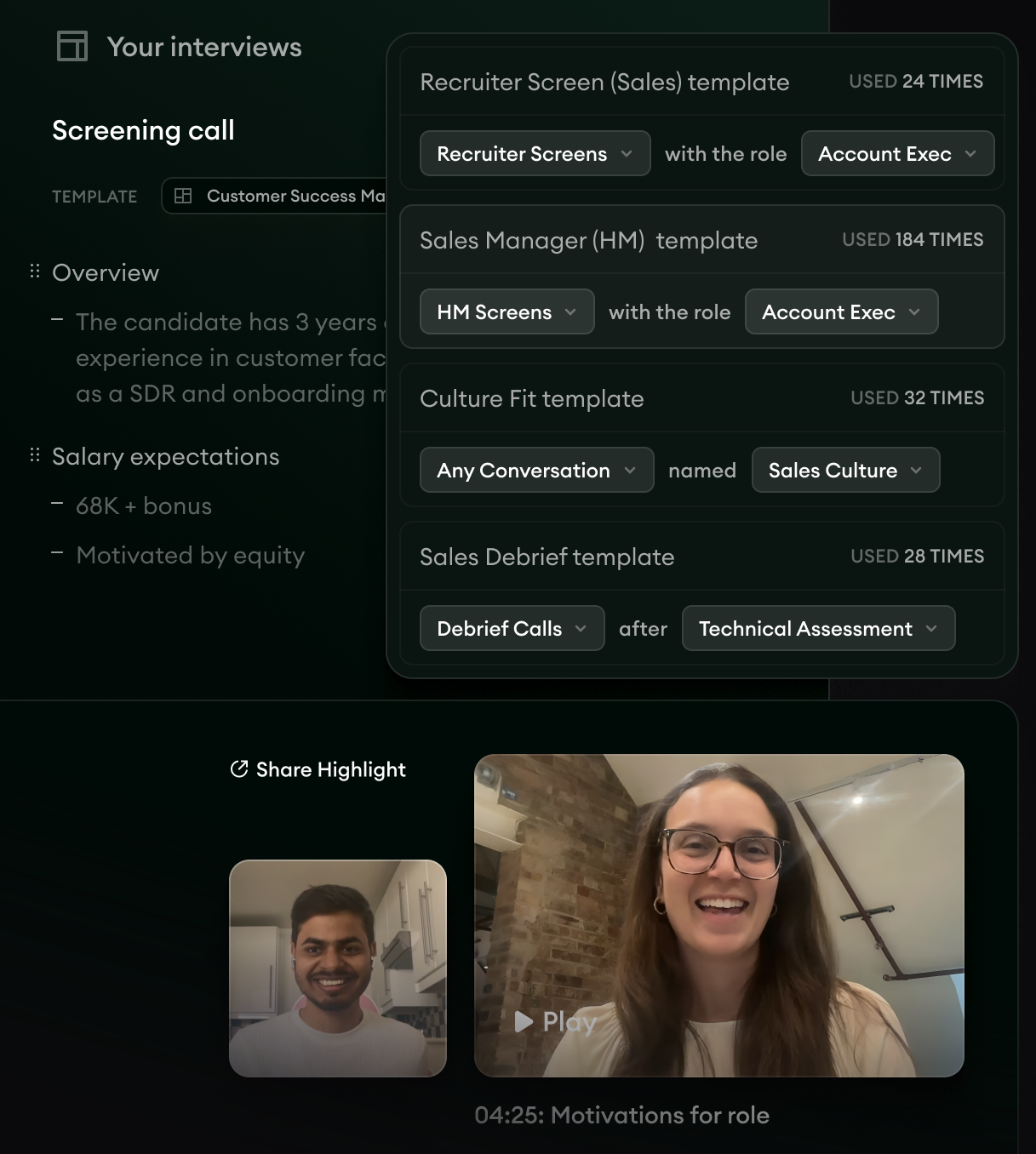
Metaview's Notetaker records and transcribes every interview automatically. AI Notes generates the summary in the format your team uses. AI Filters lets you query the whole interview corpus in plain language.
The point isn't the individual feature. It's that the workflow compounds. Capture every interview, surface the patterns across them, and the team has a coaching loop instead of a list of one-off opinions about who's a good interviewer.
For the team-wide picture, the 2026 AI & Hiring Alignment Report found that 85% of companies exceeding their hiring goals use AI in hiring. The recruiters running the AI workflows on those teams are the ones whose careers are accelerating.
Frequently asked
Why should recruiters learn AI?
Because the recruiters who already have are speaking to 25% more candidates a week and spending 41% less time on admin. 93% of recruiters and recruiting leaders surveyed say AI skills are now necessary for the job. The gap between adopters and non-adopters is already showing up in performance reviews, promotion paths, and which recruiters get poached.
What AI tools do recruiters use?
The most common entry point is an AI notetaker that captures and structures interview conversations automatically. From there, recruiters add AI-powered candidate summarization, scorecard generation, ATS sync, and natural-language search across their interview corpus. Practical starting point: get fluent with one note-taker, one summarization workflow, and one search-by-question tool. That covers most day-to-day use cases.
Will AI replace recruiters?
No. 74% of recruiters and recruiting leaders surveyed believe AI has had or will have a positive impact on their career. AI takes over the parts of the job that scale (notes, summaries, scorecards, recall) and gives recruiters more time for the parts that don't (judging fit, building candidate relationships, partnering with hiring managers). The recruiters at risk are the ones not using AI, who get outpaced by colleagues who do.
How do I learn AI as a recruiter?
Start with one tool that solves one specific pain in your week. Note-taking is the most common starting point because it gives back the most time fastest. Run it on every interview for a month. Then expand: AI-powered candidate summarization, natural-language search of your interview corpus, scorecard auto-fill. Once you've built a workflow that saves you real hours, push for team-wide adoption. The 66% productivity lift in our survey came from team-wide implementation, not individual use.
Bring Metaview into your hiring stack.
Live notes, structured scorecards, and ATS sync - set up in under 10 minutes.