
The "perfect candidate" who turns out not to exist is no longer a hypothetical. AI-generated applicants are flooding ATS pipelines, and AI avatars are showing up in live interviews. Gartner's projection is that one in four candidates worldwide could be fake by 2028. The recruiting industry is not ready.
Siadhal Magos, CEO of Metaview, joined Nolan Church on 10x Recruiting to unpack what's actually happening across the hiring world. Two problems in one. The first is mass-application volume: real and synthetic candidates using AI to spray thousands of applications per role. The second is more chilling: AI avatars conducting interviews on behalf of people who never get hired (or worse, people who do).
This recap walks through both flavors of the fake-candidate problem, why it is rising faster than most teams realize, what to do about it right now, and where the long-term solution will land. The throughline: trust is the new recruiting bottleneck, and recruiters are the team uniquely positioned to defend it.
The polluted ATS.
The first version of the problem is volume. Job seekers are using AI to mass-produce optimized resumes and templated responses, then firing them at every open role in the market. Some of those applicants are real people with AI assistance. Some are entirely synthetic. The recruiter cannot tell the difference at scan-speed, and the ATS becomes a pile in which the real candidates are increasingly hard to find.
Nolan called it the "polluted ATS." The inbound feels healthier than ever (more applications per role than the team has seen in years) but the conversion to real interviews keeps dropping. The pipeline metrics that used to be reliable proxies for pipeline quality (volume, response rate, completion rate) are all degraded by the synthetic noise.
The compounding problem is what it does to recruiters' attention. When 70% of inbound is AI-generated, the team drifts toward surface signals (LinkedIn polish, resume formatting, brand-name companies) because nothing else scales. That filter then biases against real candidates who happen to have less polished profiles. "There are literally real applicants using AI to make thousands of applications as well," Siadhal said. "That's hard to discern."
- Recruiter scans LinkedIn manually for thin profiles. The real fakes have already been polished to look legit.
- Pattern-matching against gut feel. The bias falls on real candidates with unconventional backgrounds.
- Fakes consume recruiter hours that should have gone to real candidates. Pipeline metrics look healthy; conversion collapses.
- Six offers already extended to fakes before the security team notices. The breach landed.
- Digital-footprint + metadata + behavioral signals scored on every applicant automatically.
- Fraud and AI-generated patterns flagged on the row so the recruiter sees the risk alongside the candidate.
- Real candidates with thin LinkedIn presence still surface; the filter is signal-based, not appearance-based.
- The fake gets stopped at the application layer, not at month four after the breach.
The avatar in the interview.
The second flavor is more sophisticated and more dangerous: AI avatars showing up to live interviews. These are not enhanced resumes. They are deepfake video impersonators who can hold a conversation, answer behavioral questions, and pass a 30-minute recruiter screen.
We're hearing it more from our larger customers. Someone turns up for the interview who isn't the same person that ends up on the job.”

The episode highlighted a real case from Pindrop. A recruiter noticed that the candidate's mouth movements didn't match the audio. It turned out to be an AI avatar impersonating a real applicant. Pindrop is now building internal tooling specifically to detect deepfake candidates before they reach sensitive roles. They are not alone. The frequency of these incidents is highest at large, well-resourced organizations because the upside for the attacker (insider access, IP, customer data) is largest there. For more on this pattern, see the standalone analysis of deepfake interviews.
Nolan shared a more extreme story: a company that unknowingly extended six offers to fake candidates and hired a couple of them. The fraud was part of a broader scheme that included impersonating the company itself to harvest bank details and SSNs from real job seekers. The harm runs both ways, employers get defrauded, candidates get exploited.
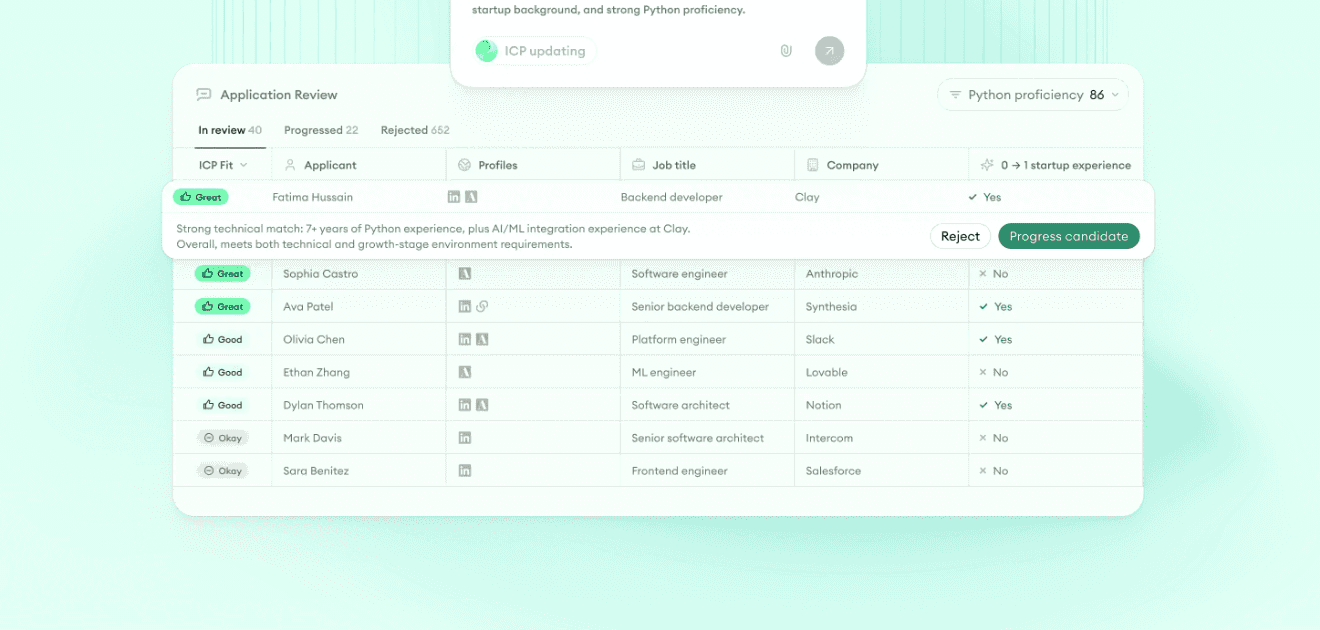
- 1Every applicant gets a Great / Good / Okay verdict against the role's ICP. Mass-applied AI resumes cluster at the Okay tier, where the recruiter can audit them in bulk instead of one-by-one.
- 2The one-sentence rationale exposes the pattern. "Generic responses across multiple criteria" reads differently from "deep specific match on three of five." Fakes don't survive this column.
- 3Progress or Reject is a single click. The recruiter still owns the call; the AI just compressed the time-to-decision from days to seconds and surfaced the suspicious rows first.
Why this is rising fast.
Several forces are converging at the same time. AI tools are cheap and accessible (generative video and voice models that cost $50K to produce two years ago now cost $50 a month). Remote-first culture means most interviews happen over Zoom, which is the right medium for an avatar to hide in. High-value companies are especially attractive targets for state-sponsored actors looking for sensitive systems access.
We thought this was just a pipeline problem, but now we're seeing it all the way through the funnel.”
The geopolitical layer is real. The CNBC reporting Nolan referenced ties some deepfake recruiting activity to state actors in North Korea and elsewhere. The goal in those cases is not a paycheck. It is access. The fake-candidate problem is now a security problem, not just a recruiting problem.
What teams can do right now.
There is no universal solution yet, but Siadhal and Nolan walked through four tactics that work today. None are perfect; together they shrink the attack surface.
Add friction early, but explain why. A short asynchronous video ask (record a 90-second answer to a specific question) surfaces fakes quickly. The key is to frame it for the candidate: "We get thousands of applications and want to move fast, but only with serious people." Done well, this actually improves the candidate experience because the people who get through feel selected.
Train recruiters on red flags. Current-generation AI avatars struggle with three things: gesturing with their hands, looking left or right on command, and responding authentically to unexpected questions. "It might be a bit weird," Siadhal acknowledged, "but if you asked the candidate to look to their left and look to their right, the AI avatar would not do a good job of this." Not a panacea (the next generation will solve this), but a useful screen today.
Use in-person or hybrid for high-sensitivity roles. For any role with access to sensitive systems or data, the final round should be something AI cannot replicate yet. An in-person meeting. A working session in your office. A trip out to meet the team. Not feasible for fully remote orgs, but for companies with physical presence it is the cleanest verification layer.
Screen LinkedIn metadata. Fake profiles tend to have no posting history, few connections, and recently created accounts. The patterns are visible to a recruiter who knows to look. The volume problem then becomes: do this 10 times manually, then automate it. Most recruiters who run this check land on building a small application-review automation within a week.
The arms race ahead.
Both hosts agreed: this gets worse before it gets better. The infrastructure that will eventually solve the problem (identity verification at the job-board layer, ATS-level fraud scoring, candidate digital-footprint validation) does not exist at scale yet. The recruiting industry is going to spend the next 18 months in a manual-detection arms race.
The right team posture: normalize the conversation. Carve out 30 minutes every six to eight weeks for the recruiting team to compare notes. What red flags people are seeing. Which tactics are working. How the tech is evolving. Loop in IT and security early. They have detection patterns from other domains (account takeover, fraud monitoring) that map cleanly onto this problem.
The middle ground worth thinking about now: legitimate uses of AI by real candidates. "We're probably not that far away from a world where a smart candidate literally thinks, for the recruiter screen, I'm just going to send my AI agent to that. I think it can probably handle it." If the avatar is a verified likeness trained on the candidate's real experience, is that fraud or is that smart time management? The industry has to decide.
Where AI gives recruiting teams use.
The defense against AI-driven fakes is, partly, more AI in the recruiter's stack. The volume problem (mass-applied AI-generated resumes) is exactly what intelligent application review handles at scale. The depth problem (avatars in live interviews) is harder, but every conversation captured cleanly is a conversation that can be analyzed later for inconsistencies. The teams that fall behind are the ones still doing this triage by hand.
Metaview Notetaker captures every interview verbatim so the team has the artifact to go back to if something feels off. Application Review handles the inbound volume so fake profiles get filtered before they consume senior recruiter hours, and so the real candidates surface faster. The longitudinal pattern detection (which screening signals correlate with which post-hire outcomes) sits in Reports. For the AI-augmented-recruiter perspective on this whole shift, see the Claude for recruiters writeup.
Numbers from the 2026 AI & Hiring Alignment Report, surveying 505 recruiting leaders and hiring managers across North America and EMEA. The 50% vs 80% split is the one that maps cleanest to the fake-candidate thesis: when AI handles the volume layer and the trust layer, the real candidates surface before they leak to competitors and the fakes drop out before they hit recruiter hours.
The operating shift.
Three concrete moves any recruiting team can make this quarter to harden the funnel against fakes:
One: add an asynchronous video ask to every initial application. 60-90 seconds, one specific question that requires gesturing or showing context. Frame it for the candidate as "we move fast for serious people." Real candidates get respected with a quick process; fake ones drop out.
Two: install a 30-minute fake-candidate retro on the recruiting team's calendar every 6-8 weeks. What red flags have you seen. What worked. What didn't. Compare notes with IT and security. The pattern recognition compounds across the team.
Three: define which roles get an in-person final round. Any role with access to sensitive systems, customer data, or IP gets a physical verification step before offer. The cost is one travel day; the protection is real.
The recruiters who treat trust as a first-class part of the pipeline will outperform the ones still optimizing only for speed. That is the operating shift.
Bring Metaview into your hiring stack.
Live notes, structured scorecards, and ATS sync - set up in under 10 minutes.
Frequently asked questions.
What counts as a "fake candidate"?
Anyone misrepresenting their identity, experience, or capabilities during the hiring process. That spans AI-generated resumes, mass-applied templated responses, exaggerated work histories, third-party impersonators, and fully synthetic AI avatars conducting interviews. The common thread: the hiring team receives distorted signal and spends time evaluating candidates who were never qualified or authentic.
How bad is the problem right now?
Gartner projects that one in four candidates worldwide could be fake by 2028. Anecdotally, Metaview is hearing avatar incidents most frequently from larger, well-resourced customers because the upside for attackers (insider access, IP, customer data) is largest there. The problem is concentrated at the top end of the market and getting more common across the board.
What's the simplest defense a small team can deploy this week?
A 60-90 second asynchronous video ask at the application stage. The candidate records a short answer to one question that requires natural gesturing. Real candidates get through quickly; fakes drop out at the friction point. Frame it for the candidate as "we move fast for serious people" so the friction reads as respect, not gatekeeping.
Are there reliable in-call tests for AI avatars?
Current-generation avatars struggle with three things: gesturing with their hands, looking left or right on command, and responding authentically to unexpected questions. Asking the candidate to look to their left and then their right (or to wave their hand across their face) reveals limitations in most current avatar tech. The next generation will close this gap; the test is a short-term tool, not a long-term solution.
What's the long-term solution?
Bank-grade KYC infrastructure for hiring. Identity verification at the job-board layer (similar to how banks verify account-holders), ATS-level fraud scoring based on candidate digital footprint and metadata, and standards for what counts as an authenticated AI avatar (if the candidate has a verified likeness trained on their real experience, is that fraud or smart time management?). The industry will sort this out over the next 18-24 months. Until then, recruiters are on the front line.

