
A head of engineering hires externally for a senior platform engineer role. Six weeks later, on the new hire's first day, she shadows Lina on the data-platform team to learn the architecture. Lina has been running adjacent scope for six months.
Nobody had ever asked her if she wanted the role.
Sourcing externally is expensive and slow. The harder cost is the internal candidate the recruiter never scanned.
The strongest match for the next role is often already on payroll, performing the work in plain sight, just not visible to whoever opened the req.
This post lays out the 5-move playbook for hiring from within: when to scan internal first, how to make roles visible, how to evaluate with parity, how to align the manager incentive, and how to land the transition so the internal hire isn't sink-or-swim.
Why internal recruiting is the scan you run first
Most recruiting time goes to chasing people the team doesn't know. The strongest match for the next role is usually a few desks away, already shipping work on the team next door. They don't get scanned because nobody set the policy that scans them first.
Internal mobility is a discipline, not a default. Without an explicit internal-first trigger, the recruiter opens the LinkedIn tab, the manager runs a back-channel ping, and the person who'd raise their hand never gets asked.
A discipline, not a default means the scan happens in writing, on a cadence, by tier.
The payoff stacks across dimensions external hiring can't match in the same window. Internal hires ramp faster because they already know the systems, the people, and the operating cadence.
Cost per hire drops because sourcing, agency spend, and onboarding shrink. Retention compounds because employees who see visible mobility paths stay longer than those who don't.
The trade-off matters more than the budget line. An external hire is an 18-month bet on culture-fit, ramp speed, and performance ceiling you can only confirm in hindsight. An internal hire is a known performer being asked to do adjacent work.
If I can give someone a learning opportunity, I'm more likely to retain top performers and I may not even have to go external. Otherwise I spend a ton of money and hope that, in a year, the quality of that hire plays out.”
Rhys Hughes' frame is the right one. Internal mobility isn't soft on the budget. It's the harder bet on the people you already trust.
The 5-move playbook for hiring from within
The playbook makes the discipline operational. Five moves, sequenced, with the Metaview surfaces named at the steps they accelerate. The point isn't to add ceremony. It's to make the internal scan something a recruiter at her desk can run, every time a req opens.
1. Set the internal-first trigger by role tier
Not every role suits internal mobility, and a blanket "always check internal first" rule collapses into noise.
Tier the trigger. Leadership, specialist-with-institutional-knowledge, and adjacent-scope lateral moves default to an internal scan first. Entry-level high-volume and net-new skill domains default to external.
The written policy is the move. Without it, every req turns into a per-recruiter judgment call, and the asymmetry between "we'd consider internal" and "we forgot to ask" widens. Tier-by-tier, not blanket, is what keeps the scan from becoming theater.
2. Make open roles visible internally on the same surface as external
Internal recruiting only works when employees know roles exist. Post open positions on an internal job board, share them in company channels, and ask managers to surface specific opportunities to specific people.
The asymmetry between how external candidates discover roles (everywhere) and how internal candidates discover roles (informal nomination) is the bug.
Equal visibility cuts both ways. It makes the process fair for employees who don't have a manager champion, and it makes hiring managers accountable to a public roster rather than a private shortlist.
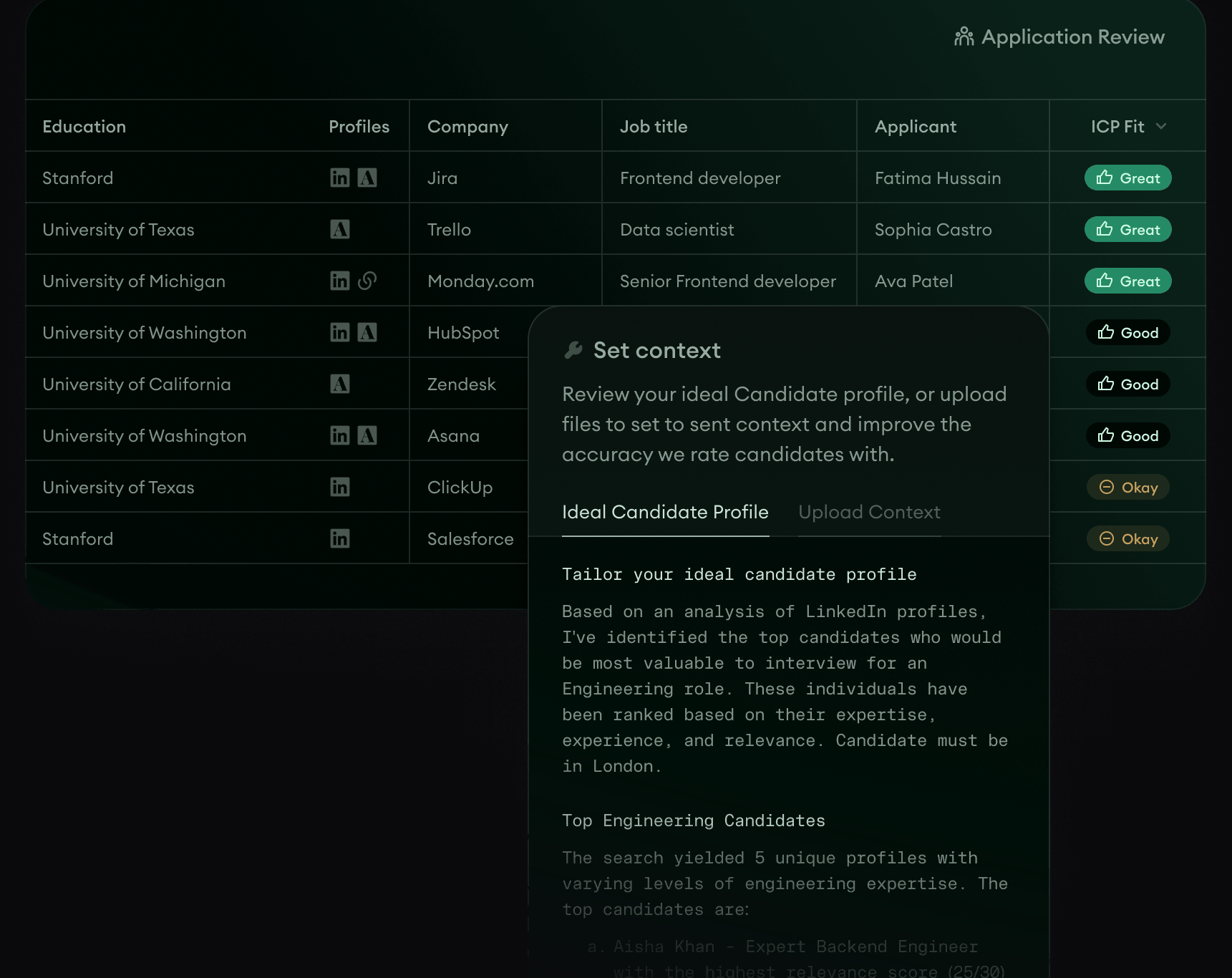
- 1The role context panel anchors evaluation on the role, not the applicant's source.
- 2Internal and external candidates land in the same table, scored against the same rubric.
- 3The reasoning trail surfaces why a match was flagged, drawn from prior interview signal.
3. Evaluate against the same rubric you use externally
Internal candidates should be evaluated with the same rigor as external ones. The same rubric, every time, against the role-specific criteria. Define what "ready now" and "ready soon" look like in terms of skills, behaviors, and evidence, not tenure or familiarity.
The substrate makes this practical. The interview signal captured during the employee's original hire, plus the structured notes from any internal interviews since, gives recruiters and hiring managers a richer picture than a résumé or a current title.
AI Notes preserves that signal. Reports surfaces patterns across the corpus that anchor the rubric in evidence, not memory.
Do they have the right mindset to be a culture add within the organization? That means mental agility and a growth mindset. If they don't have the knowledge yet, let's not hold that against them.”

4. Move the manager incentive from hoarding to development
The hardest part of internal recruiting isn't finding the candidate. It's the manager who loses a strong performer and resists the move. Most policies stay silent on this, and the result is a quiet veto layer that kills internal mobility before it starts.
Make the incentive explicit. Managers who develop talent that moves elsewhere should be recognized for it, not penalized.
Build backfill commitments and knowledge-transfer windows into the move plan upfront so the source team has runway. The contract is talent-development, not talent-retention-at-all-costs.
This is where leadership has to back the policy with visible follow-through. A single high-profile blocked move sends the signal that internal mobility is rhetoric, and recruiters start back-channeling around it within a quarter.
5. Treat the transition like an onboarding
Internal hires fail at the handoff, not at selection. The promoted engineer who was excellent in the previous role drifts in the new one because nobody framed the ramp expectations, the success metrics, or the first-month calibration window.
Sink-or-swim is the failure mode internal mobility quietly hands its strongest moves.
Treat the internal move with the same care you'd treat an external hire. Define ramp goals for the first 30, 60, and 90 days. Document what success looks like in the new role, not the old one.
Plan the transition so the source team has knowledge-transfer time and the receiving team has a structured ramp instead of an assumed one.
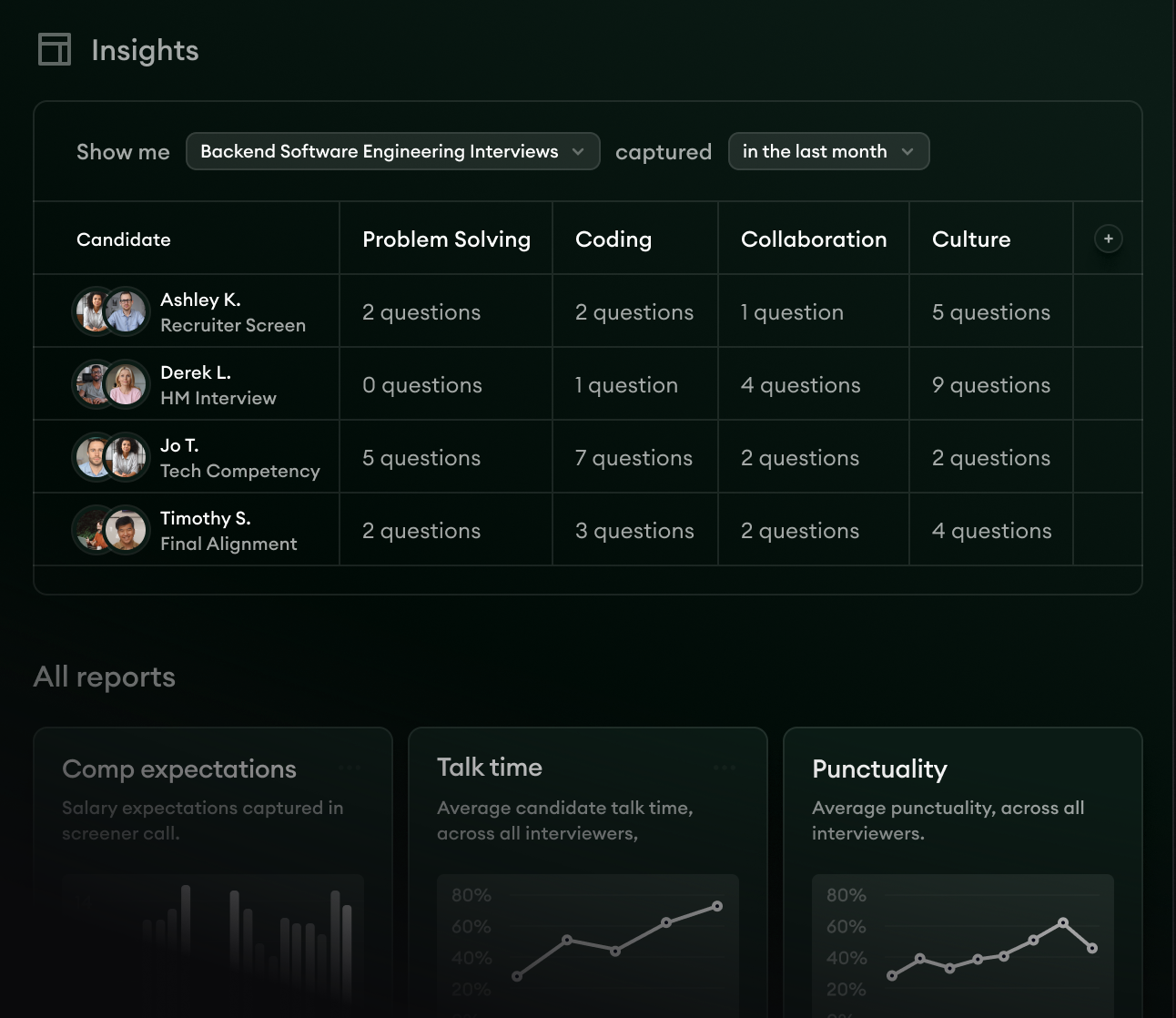
- 1Per-competency reads across every interview the team has run with this employee.
- 2Patterns surface across roles and rubrics, not just per-interview snapshots.
- 3Readiness signal is anchored in evidence, not the manager's memory of the last 1:1.
The five moves run sequentially on every req that qualifies for the internal-first scan. None of them require a separate tool. They require the team to treat internal candidates as the default lens, not the leftover.
Why this beats external recruiting on speed and trust
The playbook holds because the broader hiring data backs the structural case. Teams that align across recruiting and hiring management hit goals at much higher rates than teams that don't, and AI is the lever closing the gap.
According to Metaview's 2026 AI Hiring Alignment Report, surveying 505 recruiting leaders and hiring managers across North America and EMEA, the pattern is hard to argue with.
Internal recruiting sits inside that alignment-as-advantage story by structure. The recruiter and the hiring manager are looking at the same employee, with the same captured signal, against the same rubric.
The trust gap the Alignment Report measures externally is smaller internally by definition, and faster to close when AI surfaces the signal.
Speed is the other side. The 67% figure isn't theoretical. Teams running external-only sourcing watch strong candidates take other offers while the search drags.
Internal mobility eliminates the recruitment lag entirely on the moves it covers, and shifts time into evaluation rigor and transition planning, where the marginal hour produces better outcomes.
The searchability of the internal pool is what makes the speed compound.
AI Sourcing queries past interview signal in natural language, so the recruiter can ask for a senior engineer who showed strong reliability instincts in their original screen and get a ranked list of current employees who match.
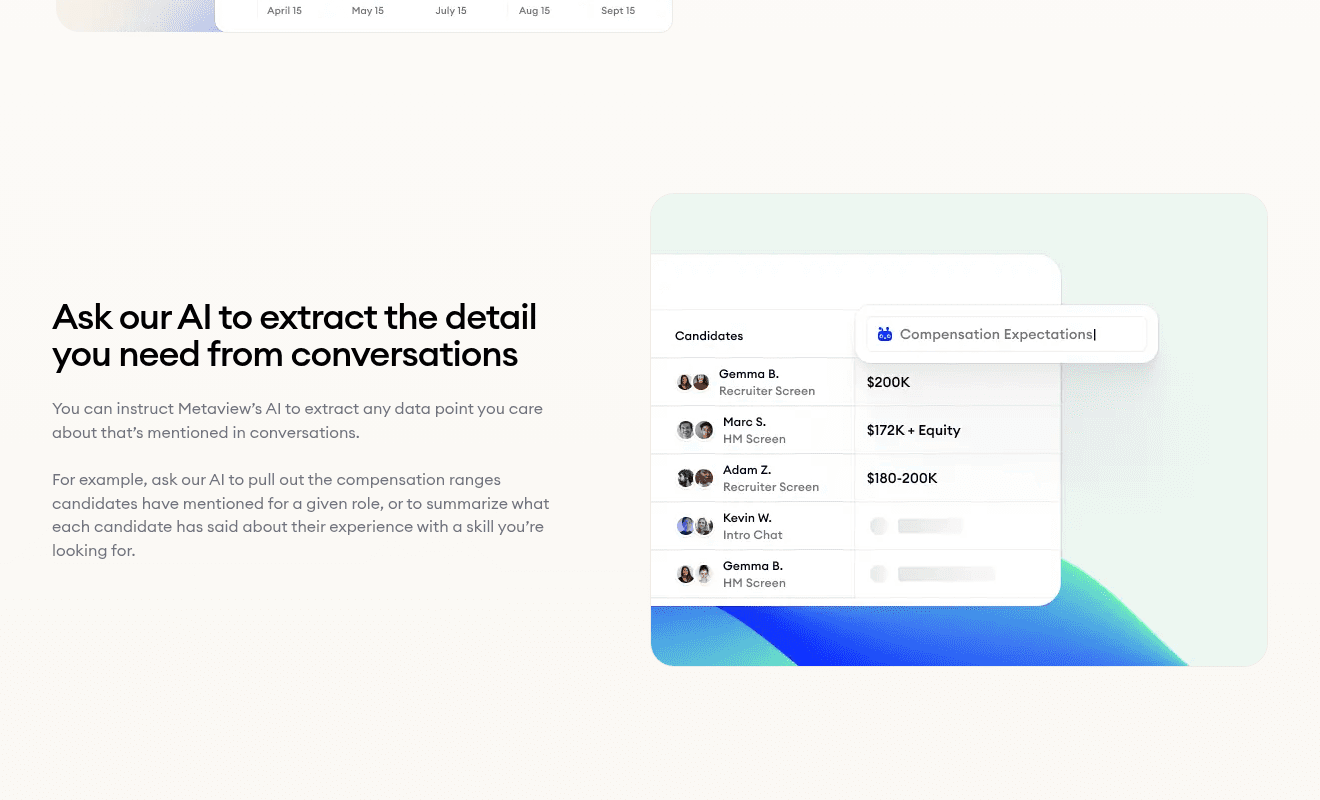
- 1Type the role criteria as the hiring manager would describe them, no Boolean required.
- 2The query runs against the corpus of captured interview signal across current employees.
- 3Internal candidates surface ranked by how their original interview matched the new role's requirements.
Make hiring from within the default scan, not the backup
External recruiting will always matter. Net-new skill domains, high-volume entry-level pipelines, and the roles where institutional knowledge is a liability all default to external.
The question this post answers isn't internal vs external. It's which roles get the internal scan first, and what does that scan have to look like to produce real candidates instead of a paperwork exercise.
The 5-move playbook makes the scan repeatable. The substrate of captured interview signal, structured notes, and evidence-led rubric makes the internal pool searchable instead of remembered.
The manager who watched the candidate grow doesn't get cut out of the move, but they're not the only person evaluating either. The decision runs on the same rigor every external candidate gets.
Try this on your next leadership or specialist req. Run the 5-day internal-first window. Triage on the same surface, with the same rubric. Document the transition.
Then see whether the move you'd have made externally was the move you'd make at all once you saw the internal candidate the team already knew was strong.
Bring Metaview into your hiring stack.
Live notes, structured scorecards, and ATS sync - set up in under 10 minutes.
Frequently asked
How do you encourage employees to apply for internal roles without penalizing them for the conversation?
The mechanic is a written no-penalty rule paired with manager training on how to handle the conversation. Employees stop applying when "I'm exploring this role" feels like an exit signal to their current manager. A short policy that says exploration is supported, plus a quarterly 1:1 prompt managers run on career interest, is enough to shift behavior. Psychological safety is the precondition; mobility paths are the proof.
Which role types are best suited for internal recruiting first?
Leadership, specialist roles with institutional knowledge, and adjacent-scope laterals get the strongest internal-first signal. Entry-level high-volume pipelines and net-new skill domains usually go external first because the internal pool either doesn't exist or isn't cost-competitive at scale. The typology matters more than the rule: tier the trigger, document it, and revisit it once a quarter.
How do you prevent the internal hire from hurting the source team's performance during transition?
Plan the backfill before the move closes. The receiving and source manager agree on a 30-day overlap window, a knowledge-transfer document the employee owns, and an interim-coverage assignment if the source role has critical-path responsibilities. The structured handover is what turns the move from a productivity tax into a measured handoff.
How does internal recruiting work in remote or hybrid teams where the manager doesn't see the candidate daily?
Remote-shaped work often makes internal candidates more visible, not less. Their output is more documented, their cross-functional collaboration shows up in shared tooling, and the readiness signal lives in artifacts rather than office presence. The bottleneck isn't proximity, it's the manager who hasn't read what's already written down. A structured readiness check, anchored in Reports patterns and captured interview signal, closes the gap.
How do you handle a strong internal candidate who's not "ready now" but will be in six months?
Score them on the same rubric, name the specific gap, and scaffold the role to bridge it. An interim assignment in the new scope, a shared-responsibility window with the eventual full owner, or a stretch project tied to the gap competency are all cleaner than either promoting before they're ready or passing on them entirely. Document the development arc and check in at 90 days. Most "ready soon" gaps close faster when they're named than when they're hoped to close.


