10 common hiring mistakes (and how to dodge them)
Recruiting is strategically critical—and still painfully inconsistent.
As companies grow, hiring pressure increases. Speed matters. Volume matters. But alignment, rigor, and candidate experience often slip. The result? The same hiring mistakes show up again and again, quietly damaging quality, morale, and retention.
This article breaks down the most common hiring mistakes companies make, why they’re costly, and how to avoid or fix them before they compound at scale.
Three key takeaways
- Most hiring mistakes are process failures, not people problems.
- Speed without alignment kills quality—and alignment without speed kills candidates.
- The right systems (and AI) prevent repeat mistakes at scale.
10 common hiring mistakes too many companies make
Most growing companies fall into the same familiar recruiting traps. These mistakes don’t come from bad intentions. They come from weak systems under pressure.
Left unchecked, they compound quickly as hiring scales. Here’s what to watch out for, and what to do if you spot any of these issues.
1. Failing to calibrate
The problem
Teams begin hiring without a shared definition of what success looks like in the role. Each interviewer evaluates different skills, levels, or behaviors based on personal preference. Calibration either never happens—or happens too late.
Strong recruiter-hiring manager alignment is crucial.
The impact
Feedback becomes contradictory and hard to reconcile. Hiring managers lose confidence in the process, and strong candidates get rejected for unclear or inconsistent reasons. Decisions either slow down, or the loudest voices dominate.
How to fix it
Calibrate before interviews begin. Align on success criteria, must-have signals, and evaluation priorities, and document them clearly. Revisit calibration if feedback starts drifting mid-process.
- Chris Adams sourcer #1 at Uber, former Talent Partner at Atomic
2. Using boilerplate job descriptions
The problem
Job descriptions are copied from past roles or generic templates. They list everything someone could possibly do, instead of what will actually make them successful in this job and company. The roles themselves sound lofty and impressive, but also vague and ill-defined.
The impact
You attract unqualified candidates and miss strong ones who don’t see themselves reflected. Candidates enter the process with misaligned expectations, leading to drop-off and declined offers.
How to fix it
Write job descriptions around outcomes, not buzzwords. Be explicit about what success looks like in the first 6-12 months. Clarity is far better than hype.
Write top-quality job descriptions in seconds with our free Hiring Studio tool
3. Typing instead of engaging
The problem
Hiring teams rely too heavily on async comments, long email threads, and real-time notetaking in interviews. Context gets flattened into bullet points. Nuance disappears. And you end up relying on recruiters’ memories
The impact
Misalignment grows silently. Decisions take longer because people are reacting to partial information. Recruiters spend more time clarifying than progressing candidates.
And you lose the chance to really engage and connect with candidates if you’re always looking down at your keyboard.
How to fix it
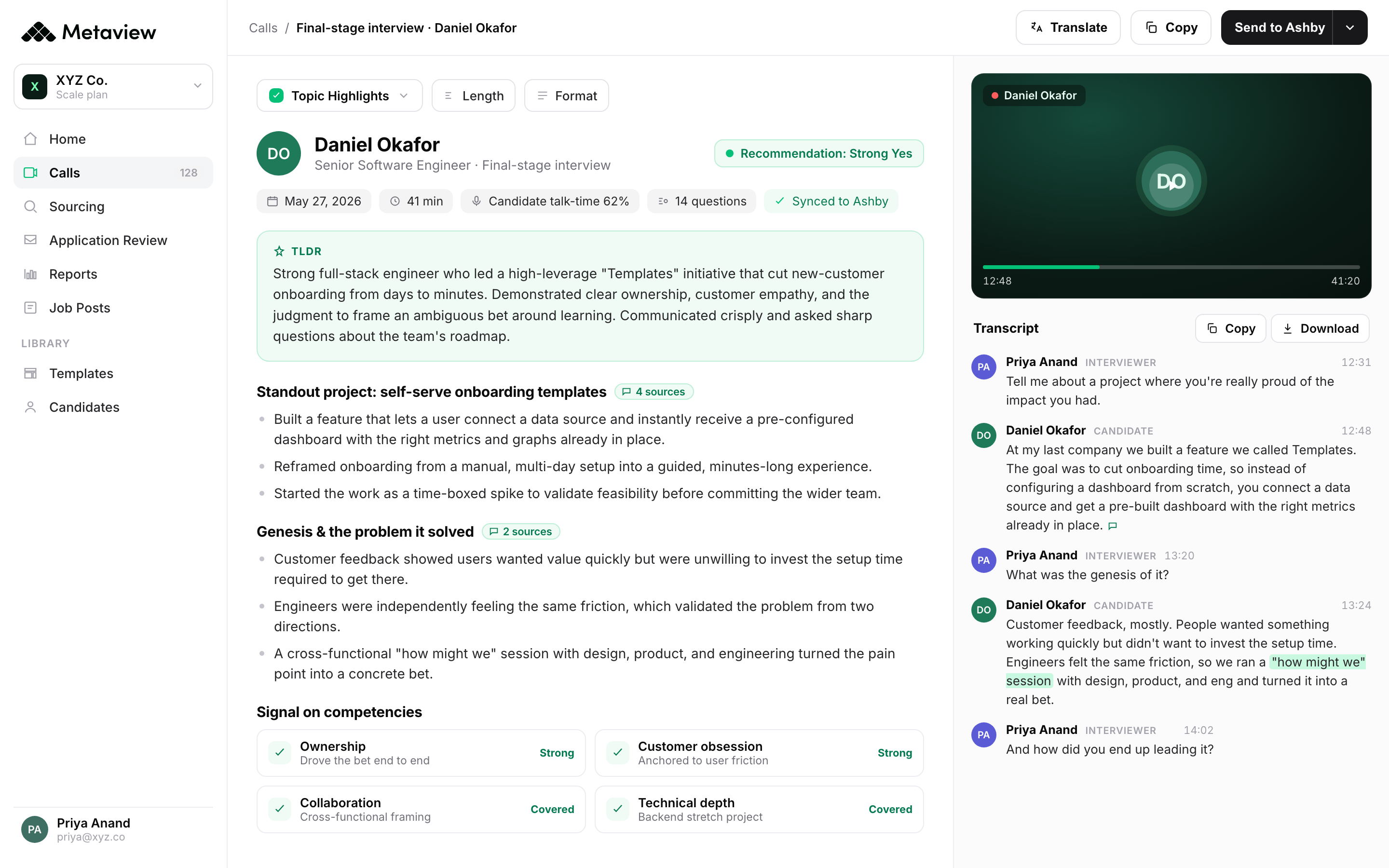
Get an AI interview notetaker, and stop taking notes altogether. Instead, use live conversations to get to know candidates and really judge their chances of success.
You can equally use AI notetakers for internal meetings, to align on key decisions. You leave each conversation with a clear picture of next steps, automatically documented and shared with all stakeholders.
4. Going on gut feel
The problem
With a lack of evidence (and missing notes), interviewers rely on intuition instead of what was actually said. Feedback sounds confident but vague, often rooted in likability or familiarity. And decision criteria shift depending on the candidate or the final decision maker.
The impact
Bias creeps in and consistency disappears. Confident interviewers outweigh accurate ones. Hiring quality becomes unpredictable, and you’re entirely dependent on people’s instincts being right.
How to fix it
Use structured rubrics and interview scorecards. Require interviewers to tie opinions to observable evidence (captured automatically by your AI notetaker app). Gut feel may still be the tiebreaker on very rare occasions, but enough interview evidence all but eliminates this issue.
5. Rushing people through
The problem
When you’re scaling and under pressure, hiring gets sped up. Interviews are shortened, prep is skipped, and feedback is rushed. Time to hire becomes your primary metric, and “bums in seats” trumps quality.
The impact
Key signals are missed, and mis-hires go way up. Teams pay the price months later in performance issues or churn.
And candidate experiences suffer too. Those who aren’t hired feel like they’ve been shorted, and even those who do accept offers quickly realize they haven’t been set up to succeed.
How to fix it
Automate processes to speed up admin, not evaluation. Use better coordination, clearer criteria, and fewer unnecessary steps, but protect decision quality at all costs.
6. Moving too slowly
The problem
Delaying or prolonging processes can be just as bad as racing through them. Feedback drags, decisions wait for perfect information, and approvals stack up.
The impact
Top candidates disengage or accept competing offers. Pipelines decay while teams debate. Recruiters lose momentum and credibility. And fundamentally, you have to wait even longer to fill that crucial role.
How to fix it
Again, automate as much as possible. Then set clear SLAs for feedback and decisions. Empower recruiters to push for closure, and encourage hiring managers to make decisions.
In recruiting, momentum is a competitive advantage.
7. Obsessing over experience and pedigree
The problem
Teams overweight logos and brand-name employers. Candidates from Google, Tesla, or Meta get default credibility. And the same goes for top schools. Suddenly, you’re only interested in the most competitive (and likely most expensive) new hires.
- Andy Pittman, VP of Global Talent, ShipBob
The impact
High-potential candidates are filtered out early, and diversity suffers. Teams hire familiarity instead of capability.
You’ll likely have to bend over backwards to sign them. Which means compromising on your own culture and standards, just to land people who may have got lucky in a previous position.
How to fix it
Focus on skills, judgment, and learning ability. Do they bring the right attitude and desire to win?
Evaluate what candidates can do, not where they’ve been. Pedigree is a weak proxy for performance.
8. Relying on manual sourcing
The problem
Recruiters spend hours manually searching the same platforms for the same profiles. Sourcing becomes repetitive and exhausting. Coverage stays narrow.
The impact
Recruiters have less time for candidate engagement and evaluation. Burnout increases. And pipelines lack diversity and depth.
How to fix it
Automate sourcing where possible. Let machines handle repetition so humans can focus on conversations, judgment, and closing.
9. Sticking with outdated tools
The problem
Legacy ATSs and disconnected tools dominate the stack. Notes are scattered. Feedback is inconsistent. And context gets lost.
The impact
Recruiters drown in admin, and hiring managers disengage. Data becomes unreliable and underused. And your entire process is less efficient and valuable.
How to fix it
Adopt hiring tools that capture context automatically, structure feedback, and support better decisions. Modern, scalable hiring requires modern, scalable infrastructure.
10. Neglecting long-term retention
The problem
Hiring optimizes for signed offers, and ignores what comes after. Teams celebrate offer acceptance rates, but stop tracking long-term outcomes. And quality of hire is an afterthought.
The impact
New hires churn, and the same roles reopen. This hurts team morale, frustrates hiring managers, and reflects poorly on recruiters. Hiring costs compound quietly over time.
How to fix it
Track performance, engagement, and tenure post-hire. Feed those insights back into how you define and evaluable roles. What makes your best hires so successful? And how can you find more people like them next time around?
Hire for durability, not just speed.
Five keys to smarter hiring at scale
Avoiding mistakes is table stakes. Hiring at scale demands systems that hold up under pressure. When volume increases, stakeholders multiply and decisions need to stay fast and accurate.
These five principles separate teams that merely survive growth from teams that hire well through it.
Clarity and calibration are critical
Hiring speed collapses when teams aren’t aligned on what they’re hiring for. Clear success criteria, skill definitions, and evaluation priorities give interviewers a shared frame of reference.
Calibration isn’t a one-off. It’s an ongoing practice that keeps feedback grounded as roles evolve.
When clarity is high, decisions move faster and disagreements are easier to resolve.
Less admin unlocks better judgment
Great recruiters are paid to think, not to transcribe notes or chase calendars. When admin work consumes attention, judgment suffers and subtle signals get missed. Reducing manual work frees recruiters to focus on candidate quality, stakeholder alignment, and risk assessment.
Less noise leads to better decisions.
Standard rubrics and scorecards ensure consistency
Consistency is what allows quality to scale. Structured rubrics help interviewers evaluate candidates against the same criteria, reducing bias and opinion drift. Scorecards also make feedback easier to synthesize, compare, and defend.
Without structure, hiring quality depends on who happens to be in the room.
AI agents are your secret weapon
Humans are good at judgment, but terrible at repetition and memory at scale. AI recruiting agents handle the repetitive work, capturing context, organizing feedback, and spotting patterns across interviews and roles.
This lets teams scale without losing rigor or insight. AI doesn’t replace decision-makers; it gives them better inputs.
Feedback loops turn hiring into a learning system
Most teams hire in isolation, never revisiting outcomes. Strong teams review performance, retention, and decision quality after hires land. These insights feed back into role definitions, interview design, and calibration.
Hiring improves when every cycle informs the next.
How Metaview helps teams avoid common hiring mistakes
Most hiring mistakes don’t come from bad judgment. They come from missing context, fragmented feedback, and misalignment that compounds as teams scale.
Metaview fixes these issues by capturing what matters, structuring data clearly, and making it visible when teams need it most.
- Capture hiring intent and interview insights automatically. Metaview transcribes intake and interview discussions automatically, preserving your intent, success criteria, and nuanced candidate signals that are usually lost or summarized poorly. So recruiters never have to rely on memory or manual notetaking.
- Structure feedback so decisions are evidence-based. Metaview turns raw interview input into structured insights tied to defined criteria. This makes it easier to compare candidates, identify real strengths and risks, and challenge vague opinions.
- Spot alignment issues early. Misalignment rarely announces itself. It shows up as conflicting feedback, shifting criteria, or slow decisions. Metaview surfaces these signals early, allowing recruiters to intervene while the process is still recoverable.
- Preserves institutional hiring knowledge over time. Metaview preserves historical hiring context—what worked, what didn’t, and why decisions were made. This institutional memory improves future role scoping, interview design, and calibration.
By reducing admin, preserving context, and structuring insight, Metaview helps teams avoid the most common hiring mistakes at scale. Recruiters spend less time firefighting and more time making thoughtful decisions.
Hiring becomes faster, calmer, and more consistent—without sacrificing quality.

Get a hiring advantage by removing basic errors
Most hiring failures aren’t mysterious. They’re highly predictable and entirely preventable.
Companies that win at hiring don’t rely on hero recruiters or lucky breaks. They remove friction, enforce clarity, and use systems that scale good judgment.
Fix the basics and you unlock a real hiring advantage.
Try Metaview for free and stop repeating the same hiring mistakes.
FAQ
Why do hiring mistakes increase as companies scale?
More stakeholders, more roles, and more pressure amplify weak processes.
Can AI really improve hiring quality?
Yes, when it reduces admin, preserves context, and supports better decisions.
How do you measure hiring success long term?
Track quality of hire, performance, and retention. Not just time to hire.
How do you get hiring managers to follow a structured hiring process?
Involve hiring managers early in defining criteria, show how structure leads to faster decisions, and reduce the admin burden on them. When structure saves time instead of adding friction, they’ll be glad to follow the process.
What’s the biggest signal that your hiring process isn’t scaling well?
Inconsistent decisions across similar roles. If different teams hire for the same role using different standards, it’s a sign that alignment and systems aren’t keeping up with growth.
How often should hiring processes be reviewed and updated?
Reviews should incorporate outcome data like performance, retention, and candidate feedback. Processes that don’t evolve tend to break quietly before anyone notices.