
Most teams treat offer acceptance as an offer-letter problem. They tighten the comp ladder, sweeten the signing bonus, send the letter four hours faster. The candidate still declines. The decline was decided two weeks earlier, in a 45-minute conversation where three different interviewers heard the same compensation concern, in three different ways, and nobody connected the dots into the offer-prep brief.
Interviews are signal-rich. Candidates talk about competing offers because they want you to bid against them. They ask about flexibility because they are benchmarking the day to day. They talk about motivation because they are testing whether you can describe the role in language that maps to their why. All of that is captured if your panel runs structured interviews. Almost none of it makes it into the offer-prep conversation.
This guide is for TA leaders who already know their offer acceptance rate is the wrong metric to optimize directly. It walks through the four signals every panel already captures, the pre-offer diagnostic that reads the signal stack before the letter goes out, and a 7-day audit you can run against last quarter declines to find which roles you were closing on price when you should have been closing on something else entirely.
What are offer acceptance rates?
An offer acceptance rate measures how many job offers are accepted by candidates compared to the total number of offers extended. It’s a simple but powerful indicator of how appealing your roles, compensation, contracts, and your company are to prospective employees.
This metric also gives a clear snapshot of how effective your end-to-end recruiting process is. A high rate means your offer aligns well with candidate expectations and you’re providing a great candidate experience. A low rate, on the other hand, can highlight gaps in communication, compensation, or employer branding.
It’s one of the few KPIs that directly connects your talent strategy to business outcomes. Because an offer that goes unaccepted means a critical role remains unfilled.
Why does your offer acceptance rate matter?
Your offer acceptance rate tells a story far beyond the numbers. It reflects the trust and enthusiasm you’ve built with candidates throughout the hiring process, and whether your final offer meets their needs and aspirations.
A strong acceptance rate means your recruiting engine is in sync: your messaging resonates, your compensation is competitive, and your candidate experience builds confidence. It’s also an indicator of efficiency, because every declined offer adds time, cost, and extra workload for recruiters who must restart the search.
Low acceptance rates, meanwhile, can signal missteps at any stage of the funnel. Perhaps expectations weren’t clearly set, feedback loops were too slow, or candidates weren’t engaged enough to stay committed. Each rejection is a data point that can help you diagnose and improve.
Ultimately, tracking this metric gives recruiting leaders a pulse check on the overall health of their process. When candidates consistently choose you, you’re not just filling roles. You’re confirming that your hiring experience and company promise truly stand out in a competitive market.
How to calculate your offer acceptance rate
Calculating your offer acceptance rate is simple. But interpreting it correctly requires context.
Here’s the standard formula used by most recruiting teams:
Offer acceptance rate = (Number of accepted offers ÷ Total number of offers extended) × 100
If you make 60 offers in a quarter, and 51 are accepted, your offer acceptance rate is:
(51 ÷ 60) × 100 = 85%
In other words, 85% of the candidates you wanted to hire said “yes.”
Many high-performing talent teams aim for an 85–90% acceptance rate, though the ideal target varies by industry, role type, and seniority. For example:
- Tech and engineering roles often see more competitive markets and slightly lower rates (70–80%).
- Sales and operations positions might achieve higher averages due to more standardized compensation structures.
The real goal is to understand why offers are accepted or declined. When paired with qualitative data from interviews or candidate feedback, your acceptance rate becomes a diagnostic tool, revealing where improvements can have the biggest impact.
Offer acceptance is a signal problem, not an offer-letter problem.
The standard playbook for raising offer acceptance is to optimize the offer letter itself. Format it better. Get hiring committee approval faster. Add an equity refresh slide. Move comp band up half a level. Every one of those moves is fine, and none of them changes the rate by more than a point or two. The reason is mechanical: by the time the letter is being drafted, the candidate has already decided. The offer-letter quality affects the negotiation surface; it does not move the underlying answer.
The candidate decided during the interview process. Specifically, they decided when one of the four signals (compensation, flexibility, motivation, decision-timeline) came up and either was followed up on or was not. If it was followed up on, you are now competing on a known set of variables. If it was not, you are sending a letter into a black box and hoping the comp band lands within the candidate accept zone.
According to Metaview 2026 AI & Hiring Alignment Report, surveying 505 recruiting leaders and hiring managers across North America and EMEA, 90% of teams rate their cross-functional relationship as good or excellent. That surface number masks an underlying gap. Only 15% say bypassing their counterpart never crosses their mind. And even teams with excellent partnerships still lose 50% of qualified candidates to competitors who move faster, while teams with poor partnerships are 3x more likely to miss overall business goals. The relationship is the thing. Offer acceptance is what falls out of it.
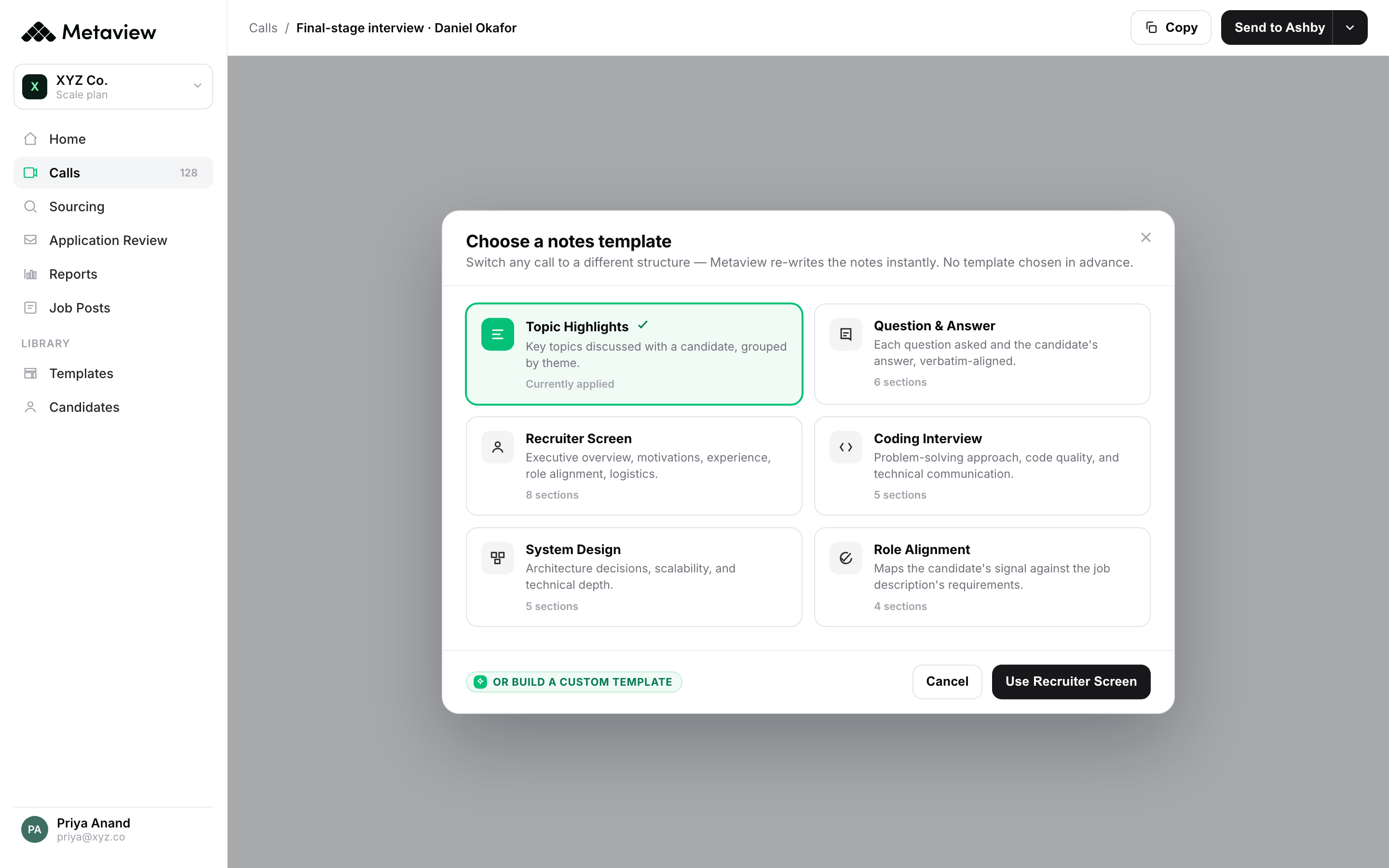
The capture layer matters here. If the panel uses one notetaker on Monday and a Google Doc on Tuesday and a different AI tool on Wednesday, the signals scatter across three formats and three places, and nobody finds them on Friday at offer-prep. Step one is making sure every interview lands in the same template, with the same prompts, automatically.
The four candidate signals every panel already captures.
Across the panels we have audited at Metaview, four candidate signals show up reliably enough that you can build a diagnostic around them. None of these are exotic. They are the things candidates have always said in interviews; what is new is the ability to recover them across the panel in a structured way.
1. Compensation language.
Candidates rarely lead with a number. They leak the topic. I want to make sure the comp ladder is competitive with senior IC roles at Series C. What is the equity refresh structure like? I am currently at X. I have two other processes running. Each of those is a compensation signal. Captured. Searchable. But almost never surfaced into the offer-prep brief, because the interviewer who heard it is not the recruiter who writes the brief.
2. Flexibility asks.
Remote and hybrid days, start-date flexibility, schedule expectations, parental leave, four-day workweek interest. These come up in the recruiter screen for about 60% of candidates we audit, and in the hiring manager round for about 30%. Whatever the candidate raises here is a leading indicator of what the offer letter will need to address. If the panel never followed up, the offer letter is going to land into an objection nobody saw coming.
3. Motivation language.
The candidate why. Not the canned answer to why are you interested in this role. The real motivation comes out in side-questions: how they describe their last manager, what they say about their current ICP, the kind of problems they describe as the most fun. If the role does not map to that motivation, the offer is competing on price. If it does, you have a closing wedge that no signing bonus can replicate.
4. Decision-timeline cues.
When they will decide, who else they are talking to, what their current situation forces them to do (lease ending, vesting cliff, partner relocation). The candidate who says I am trying to land somewhere by end of the month is on a different track than the candidate who says I am looking for the right role, not the next role. Same role, same panel, totally different close strategy. The recruiter should know which track the candidate is on before drafting the letter.
Why these are leading indicators, not lagging.
Once the offer letter goes out, you are in negotiation mode. You are reading the candidate from their response to your move. That is too late to gather signal; the candidate is in evaluation-of-offer mode, not evaluation-of-role mode. The four signals above are gathered while the panel is still happening and the candidate is in evaluation-of-role mode. That is where the leverage is.
What changes when you read them BEFORE sending the offer.
The offer-prep conversation between recruiter and hiring manager goes from what is the comp band to based on what came up across rounds one, two, and three, here is what this letter needs to address and which closing call we run first. Different conversation. Different outcome.
Closing top candidates is specific to every candidate. What was their why? Why did they take my call? Do we have a relationship? Sign-ons are coming back but money isn't everything. It's: is it a culture they want, a career path, a step-up, something attached to their purpose.”

The pre-offer diagnostic: reading the signal stack before the letter goes out.
The diagnostic is a four-step read across the panel, run after the final round and before the recruiter and hiring manager align on the letter.
Pull the multi-source summary for the candidate. Metaview generates one synthesis across every interview transcript for that role and that candidate, which means the recruiter does not have to read four separate scorecards to reconstruct what happened. The synthesis is already in the format the diagnostic needs.
Search the synthesis for the four signal categories: compensation, flexibility, motivation, decision-timeline. For each signal found, note (a) which interviewer heard it, (b) whether they followed up in the interview itself, and (c) whether the recruiter caught it in the offer-prep notes. For each unaddressed signal, schedule a 15-minute closing call with the candidate BEFORE the offer letter goes out. Just recruiter and candidate, no hiring manager, agenda is straightforward: we want to make sure the offer is tailored to what matters to you.
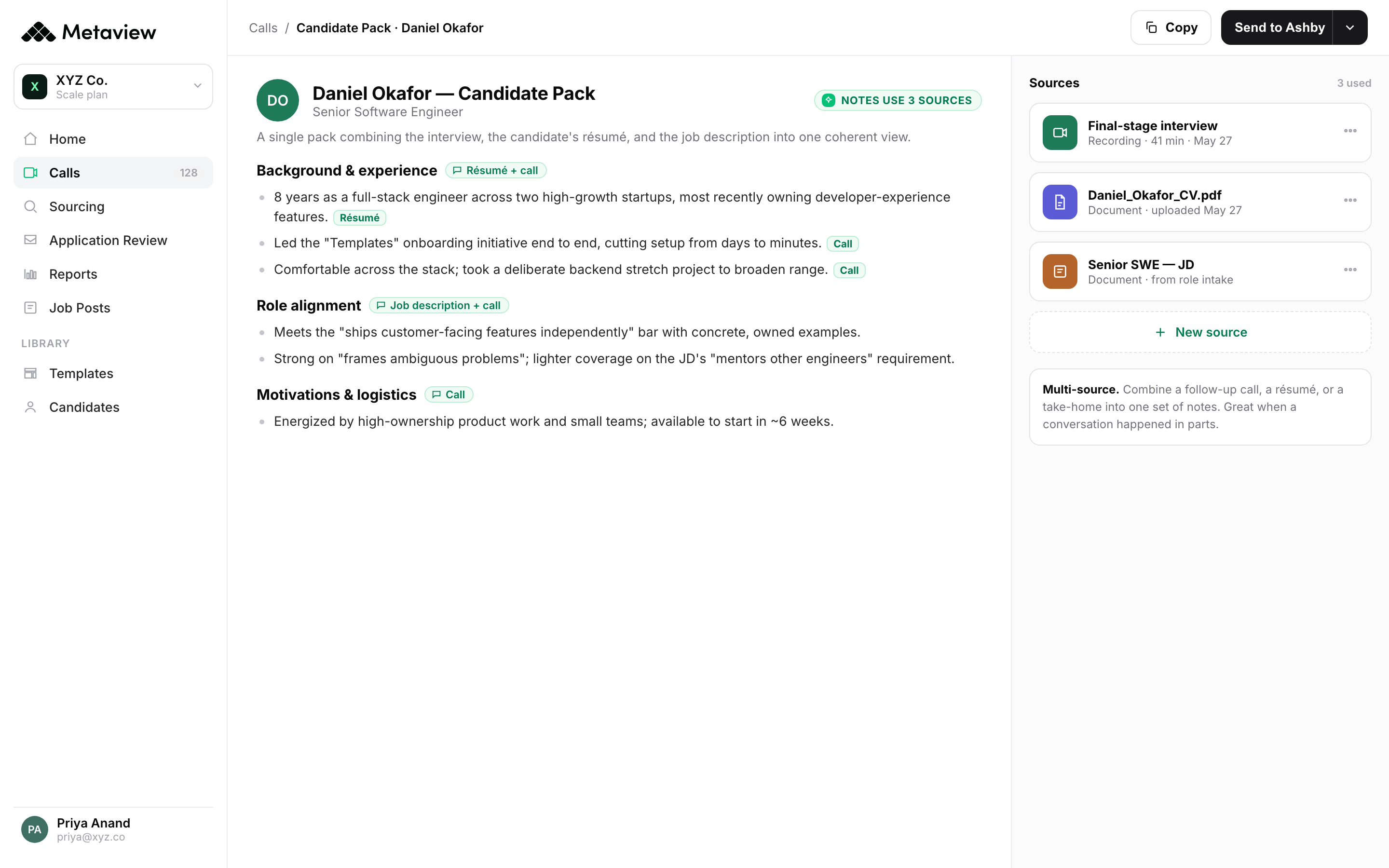
Most decline-risk surfaces from un-addressed signals, not from comp misses you could not have known about. The candidate already told you. The audit is whether you read what they said.
Manual vs. generic AI vs. coordinated capture.
One way to describe the signal-recovery problem is to look at how it changes by capture mode. Below is the operating reality at three points on the spectrum: pure manual capture (interviewer types notes during the call), a generic AI assistant (interviewer uses any general notetaker), and Metaview as the coordinated capture layer.
| Dimension | Manual | Generic AI | Metaview |
|---|---|---|---|
| Capture quality | Depends on the notetaker that day | Per-tool, hit or miss | Standardized template per role, every panel |
| Signal recovery | Only what survives in the scorecard | Whatever the LLM remembered | Searchable transcripts across the whole panel |
| Cross-panel synthesis | One scorecard at a time in a doc | Manual prompt per interview | Multi-Source AI Notes synthesises across every interview for the role |
| Decline-risk pattern detection | After the fact, during quarterly review | Not built for it | AI Filters: natural-language query across every panel you have run |
| ATS handoff | Manual scorecard fill | Copy and paste from the AI tool | Scorecard autofill into Greenhouse, Ashby, Lever, SmartRecruiters, Workable, Teamtailor, and Gem |
Querying the signals: who said what about comp, flexibility, and motivation.
Once your capture layer is consistent, the signals become queryable. Not via dashboards or SQL: via natural language, against the corpus of every interview your team has run.
Three workflows are worth setting up in week one.
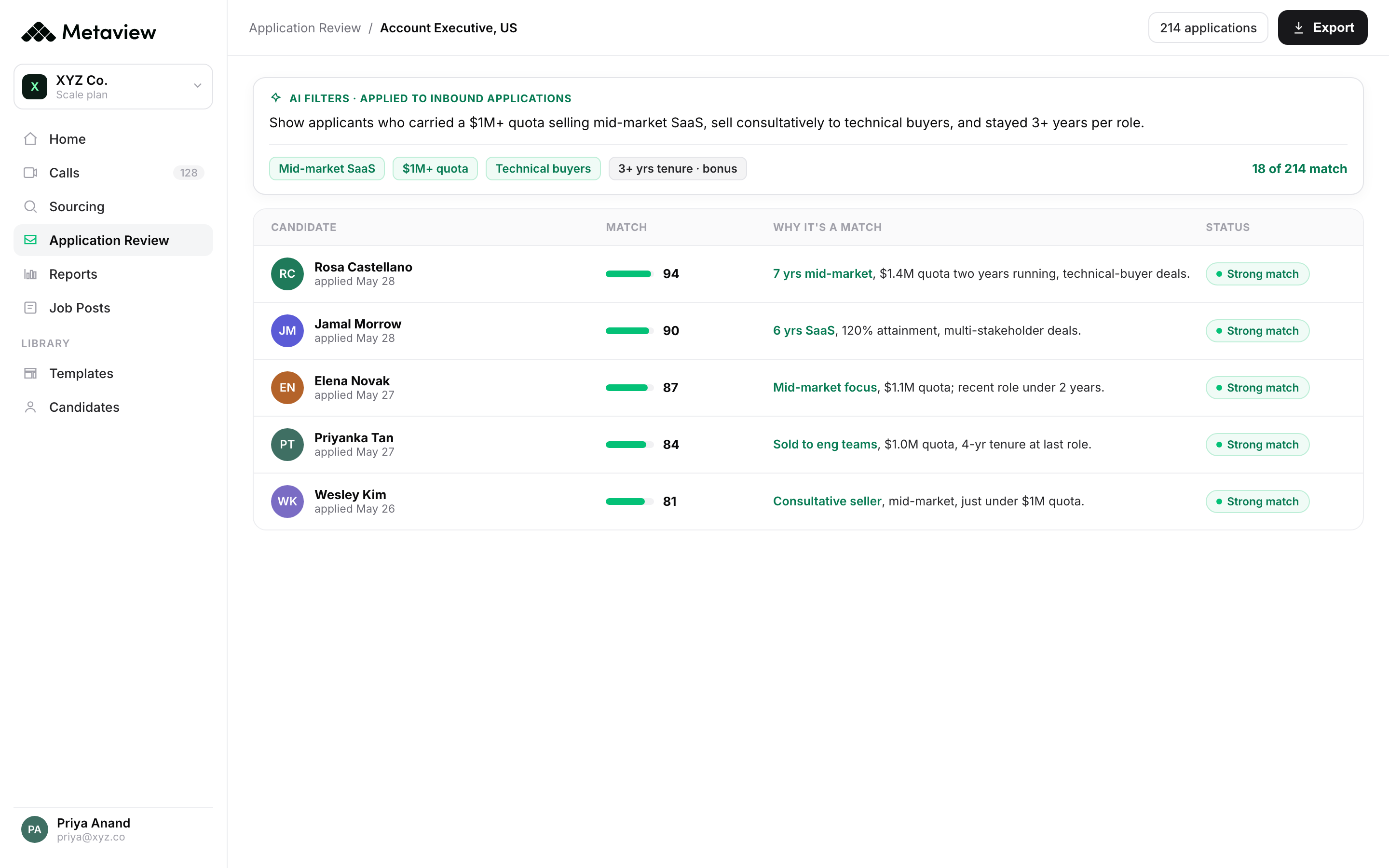
Trending. Show me every candidate in the last 90 days who mentioned competing offers in round two. Output: a list, by recruiter, by role. Now you know which roles have a comp-pressure problem versus a closing-conversation problem. They have different fixes.
Forensic. Show me declines from the last quarter where flexibility came up in round one. Output: the post-mortem on your worst-converting bucket. Most of these will be roles where the panel never followed up on the flexibility signal.
Coaching. Show me which interviewers most often capture compensation signal that the recruiter was not briefed on. Output: which panel members need a 15-minute conversation about what to do when this comes up. The fix here is process, not personality.
 Dom Blossom
Worth reading alongside the four-signal diagnostic in section three, the offer stage rewards deliberate work, not just faster delivery.
We had some ideas about what we should be offering, but actually talking to candidates and running reports really helped. If we spoke to 20 backend engineers, we could just ask the AI assistant to build a report based on the average salary expectations discussed in those calls.”
The 7-day offer-acceptance audit.
The audit is designed to be run once, then folded into the live process. It is not a rolling exercise; it is a one-week sprint that finds the gap, then a permanent change to how offer-prep happens.
- Day 1. Pull the last 90 days of declined offers. Order them by role and recruiter.
- Day 2. For each decline, pull the Metaview transcripts for round two and round three (or the last two interview stages). Skim for any of the four signals: compensation, flexibility, motivation, decision-timeline.
- Day 3. Tag each signal you find. Note whether the interviewer followed up, and whether the recruiter knew about it at offer-prep.
- Day 4. Tally. Which signal was raised most often? Which panel members surfaced signals that the recruiter did not catch?
- Day 5. Look at the SLA gap. How long between when the signal was raised and when the recruiter knew about it? Most teams find this gap is measured in weeks, not days.
- Day 6. Build the four-signal diagnostic into the live offer-prep step. The recruiter and hiring manager run through it together before the letter is approved.
- Day 7. Re-run the audit on the next 30 days of offers. Look for early movement on the signals-caught rate first, not the offer-acceptance rate yet, that lags by 60 to 90 days.
If you have a smaller volume (under 30 declines a quarter), expand the lookback window to 180 days. The diagnostic is the same.
Bring Metaview into your hiring stack.
Live notes, structured scorecards, and ATS sync - set up in under 10 minutes.
Frequently asked questions.
What is a good offer acceptance rate?
There is not a single benchmark, it varies by role and company stage. Most analytics blogs cite 85% to 95% for healthy operations, but the number that matters is the trend, not the absolute. If your rate is dropping quarter over quarter, the signal-layer diagnostic in this guide will tell you why. If it is stable, watch for declines from your top sources first; those usually move before the headline rate does.
What are the most common reasons candidates decline offers?
Compensation misalignment, flexibility gaps (remote, start date, schedule), and competing offers, in roughly that order. The underlying issue, though, is usually that the recruiter found out about the concern at the offer stage when the candidate had already told the panel about it in round two. The signal was captured. The follow-up was not.
How fast does hiring-manager feedback need to move after the final round?
Most operating teams target 24 hours between the final-round interview and the panel debrief. The bigger lever is what happens inside that 24 hours, whether the panel actually surfaces the four signals (comp, flexibility, motivation, decision timeline) into the recruiter offer-prep brief. Speed without signal is a vanity metric.
Can you predict an offer decline before sending the letter?
Yes, to a useful degree. Across the panels you have already run, count how often a candidate raised compensation as a concern in round two and then declined an offer in week four. The base rate is high enough that surfacing the signal triggers a comp conversation before the letter goes out, which closes most of those candidates. Metaview AI Filters let you query that across every panel you have run.
How does Metaview surface decline-risk signals from interviews?
Three product surfaces. AI Notes captures the interview into a structured template with the signal categories pre-tagged. Multi-Source AI Notes synthesises across every panel for the role, so a compensation comment in round two ends up in the offer-prep summary even if a different interviewer heard it. AI Filters let you query natural language over your transcript corpus (for example, show me candidates who mentioned competing offers). Scorecard autofill carries the same signal into Greenhouse, Ashby, Lever, SmartRecruiters, Workable, Teamtailor, and Gem.


