
The personality call is the part of a hiring decision panels write down least. The hiring manager says the candidate is a great fit, nobody asks what fit means, and the candidate moves to offer on a sentence no one could put in writing the next morning. That is what the phrase “personality hire” usually describes: a decision made on a feeling nobody anchored in the interview.
Personality is one of the highest-stakes signals in any interview process. It's also the one most teams assess privately.
Hiring for personality works when the traits are tied to the role, defined as behaviors an interviewer can observe, scored on a shared rubric, and written down before the panel meets. The five moves below cover how to do that, from picking the traits to reviewing each quarter which ones held up.
Metaview's job in that playbook is the evidence. The Notetaker records and transcribes each interview and drafts the scorecard from the conversation, so every interviewer works from the same transcript and the personality call becomes something the team can defend in writing.
Why personality matters when it's structured.
Most teams already assess personality. They just do it informally, often without realizing it.
The hiring manager who finds the candidate “engaging.” The recruiter who notes the candidate is “easy to work with.” The interviewer who flags that the candidate “has a great presence.”
Every one of those notes is a personality call, made in private, with no shared rubric behind it.
The fix isn't removing personality from the conversation. Empathy, communication style, decision-making under pressure, response to feedback. All of these are role-relevant signals.
They predict whether the new hire grows in the job or burns out. Removing them leaves an evaluation that scores skill and ignores how the person shows up at work.
What changes when personality becomes a shared signal is the line between private preference and observable evidence. The trait is named. The behavior is observable. The score is written down before the panel meets.
The pattern is reviewed across hires instead of relitigated case by case.
The eight traits worth assessing alongside skills.
Personality only earns its place alongside skills and experience when each trait is role-relevant and tied to outcomes.
Generic labels like “great attitude” don't survive a debrief because nobody can describe what they saw. The eight below are the ones that recur across the roles teams genuinely struggle to assess.
| Trait | What it looks like in practice |
|---|---|
| Learning ability and adaptability | Adjusts fast when the role, team, or workflow shifts. |
| Values alignment | Shares core principles like ownership, customer focus, or integrity. |
| Collaboration and communication | Moves the work, not just sounds confident or articulate. |
| Decision-making under uncertainty | Sound judgment when the data is incomplete; not bravado. |
| Resilience and response to feedback | Reflects on setbacks instead of explaining them away. |
| Motivation and drivers | Drivers match the role, not just interview enthusiasm. |
| Ownership and accountability | Talks in outcomes and learning, not activities. |
| Ethical judgment | Handles gray areas; ignoring this compounds risk over time. |
Why personality hiring fails (and what to fix).
Most teams recognize that personality matters. The breakdown happens when they try to assess it without shared definitions or a system that holds each interviewer to the same standard.
Four failure modes show up across teams of every size:
- Following personal impressions. Decisions land on whether the candidate “feels right” or mirrors the interviewer's own style. That favors familiarity over job relevance and stacks interviewer bias on top of the call.
- Each manager's own criteria. Without a shared framework, every manager defines personality differently. Decisions stop being comparable across teams, and outcomes get harder to predict or defend.
- Trait assessment disconnected from outcomes. Personality is scored in isolation, with no link back to business goals or role-specific success. The result is feedback nobody can learn from after the hire lands.
- Vague feedback in the scorecard. “Great culture fit” or “strong presence” tells the next interviewer nothing. Without specific behavioral evidence, the panel cannot compare candidates or calibrate over time.
The fix for all four is the same. A defined rubric, scored against observable behaviors, submitted before the debrief, and tied to outcomes over time.
How to assess personality, step by step.
The five-move playbook below is what the fix looks like in practice.
Each move sits where most teams break down today, and each one builds on the next. The substrate is evidence-based capture. The surface is a personality call the team can defend in writing.
1. Pin the traits to the role and define them as behaviors.
Pick four to six personality traits that genuinely predict success in this specific role. Resilience for customer support. Cross-functional stakeholder management for product leaders. Decision-making under uncertainty for senior engineering.
Tie each trait back to an outcome the role has to hit.
Then translate the trait into observable behavior. Not “collaboration” on its own, but “actively asks for input before deciding, names the trade-offs, resolves conflict directly.”
The substitution test is what protects the rubric from becoming a proxy for style, charisma, or similarity to the interviewer.
2. Build the rubric and run behavioral questions.
Build an interview rubric for each trait with clear scoring definitions. What a 1, a 3, and a 5 look like, with both positive and negative indicators so the interviewers know what counts as strong evidence and what counts as a red flag.
Then run behavioral questions that force real examples. “Tell me about a time you had to change a decision after getting new information.”
Follow with targeted probes: “What did you do next?” “What feedback did you get?” “What would you change?”
The candidate's answers produce comparable evidence the panel can score, instead of confident storytelling the panel rewards on instinct.
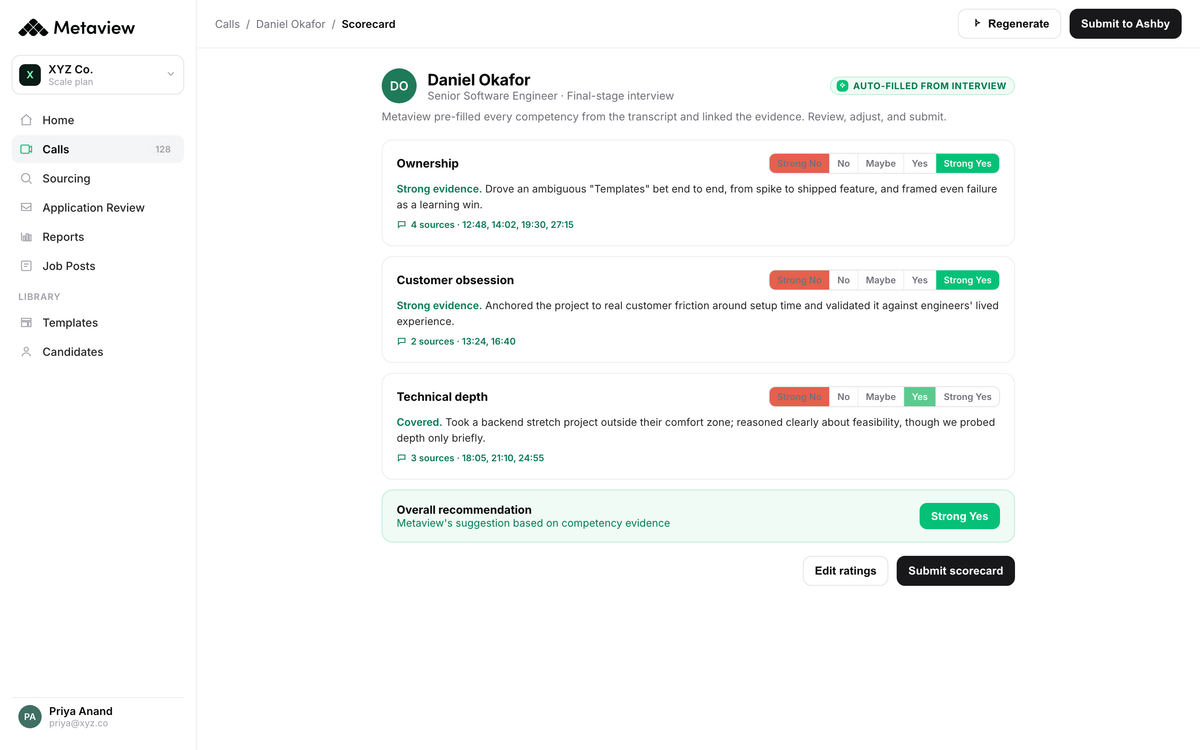
3. Split traits across the panel and score before opinion.
Assign different traits to different interviewers so each person is focused and accountable. One interviewer assesses resilience and learning. Another assesses collaboration and communication. A third assesses values alignment and ownership.
Coverage replaces redundancy, and no single interviewer's preference dominates the outcome.
Then lock the scoring sequence. Every interviewer submits their scorecard with written evidence before the panel meets. The debrief opens with the scorecards already in.
Groupthink loses its lever, and the panel debates the evidence rather than the loudest voice in the room.
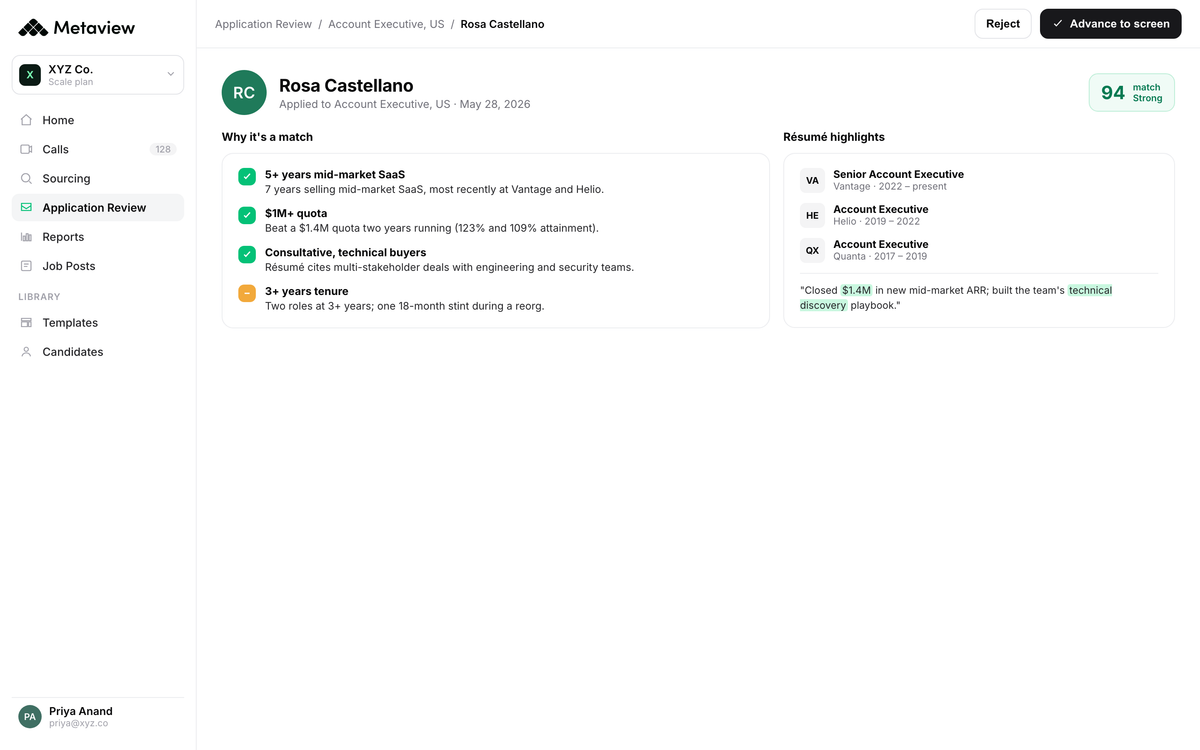
4. Separate signal from style in the debrief.
In the debrief itself, focus on the evidence in the scorecards. Which traits were strongly supported by behavioral examples? Which were ambiguous? What risk remains?
Anchor every comment to a behavior the candidate showed, not a feeling the interviewer carried out of the room.
The most useful filter to run is the style filter. “Not my style” isn't the same as “won't succeed in this environment.” When an interviewer flags a candidate as “off,” the recruiter's job is to push for the specific behavior.
If the behavior isn't on the rubric and isn't tied to the role, the comment doesn't earn weight in the call.
5. Validate traits against outcomes and refine.
Personality assessment is a living system, not a one-off setup. Once a quarter, review which traits predicted retention and performance, and which produced false positives or hires who flamed out.
Update the rubric and the question set so the next cohort gets evaluated against what genuinely worked, not against the team's prior reference points.
Capture the loop. Which traits the panel scored. Which candidates moved to offer. Which hires were still in seat at six months. Which ones outperformed expectations.
The data closes the gap between “we hire for these traits” and “these traits predict success here.”
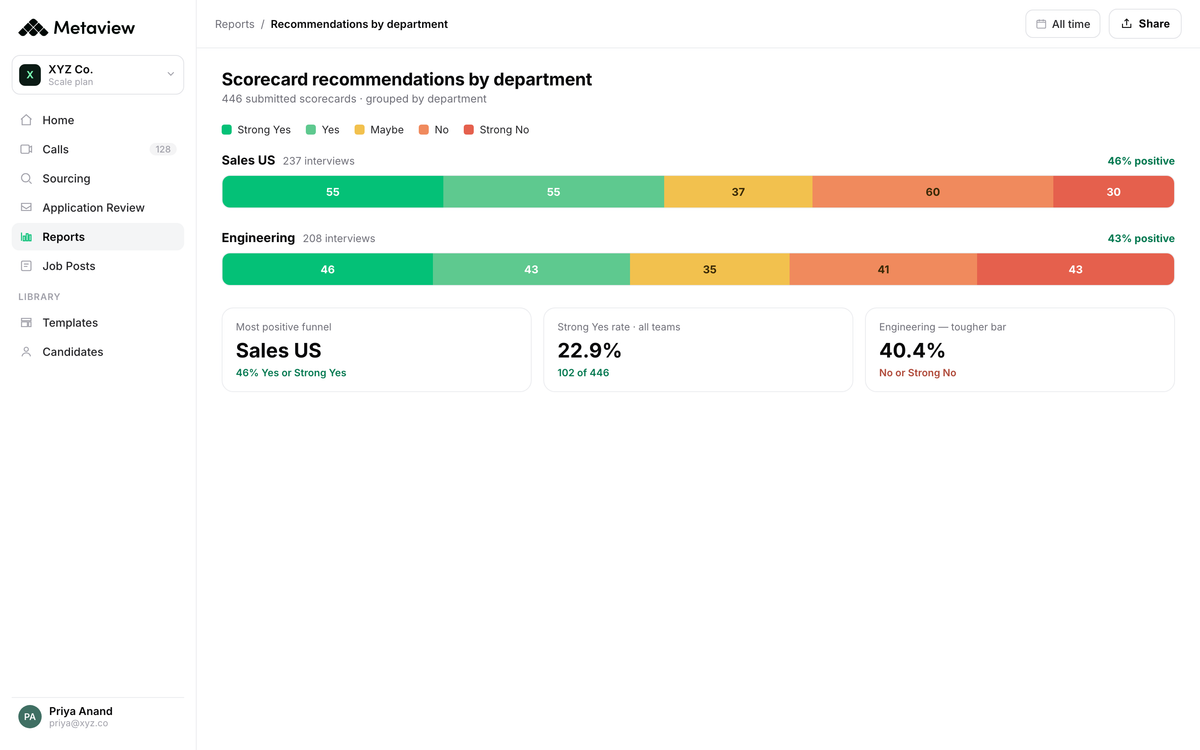
What the evidence supports, and where it stops.
The personality call is where private judgment shows up most often, but it's not the only place. Where the team lacks shared signal, the workaround instinct kicks in.
No controlled study sits behind this playbook. The closest evidence is Metaview's 2026 AI & Hiring Alignment Report, a survey of 505 recruiting leaders and hiring managers at companies with 200 or more employees across North America and EMEA. It measured how the two sides of the hiring partnership work together and how AI use relates to that. It did not test personality rubrics, so the figures below make the case for shared, written evidence in general rather than for this playbook in particular.
In the report, teams where AI is core to hiring rate the partnership as excellent more often and start more of their searches aligned, and fewer teams with excellent partnerships report losing candidates to faster competitors. The survey cannot say which came first; teams with strong partnerships may also be the ones that adopt AI. The figures do support the mechanism this playbook relies on: written, shared evidence that every interviewer can see and a recruiter can trace back to something the candidate said or did.
Personality assessment is the slice of that picture where private judgment runs the highest risk. Structured capture closes the gap most directly.
When senior leadership adopts the same evaluation standards as the broader hiring team, it creates consistency from top to bottom. Even our Chief Revenue Officer now uses the same structured approach for his own interviews.”
How Metaview accelerates personality assessment.
Metaview turns the playbook into a system that runs in the background of every interview. AI Notes capture the candidate's exact words against the rubric the panel agreed on, so “what they said” stops being a memory exercise.
The Notetaker's multi-source notes combine several conversations and documents (earlier interviews, the resume, the job description) into one notes document. The next interviewer reads what the prior round already covered instead of starting cold and asking the same question again.
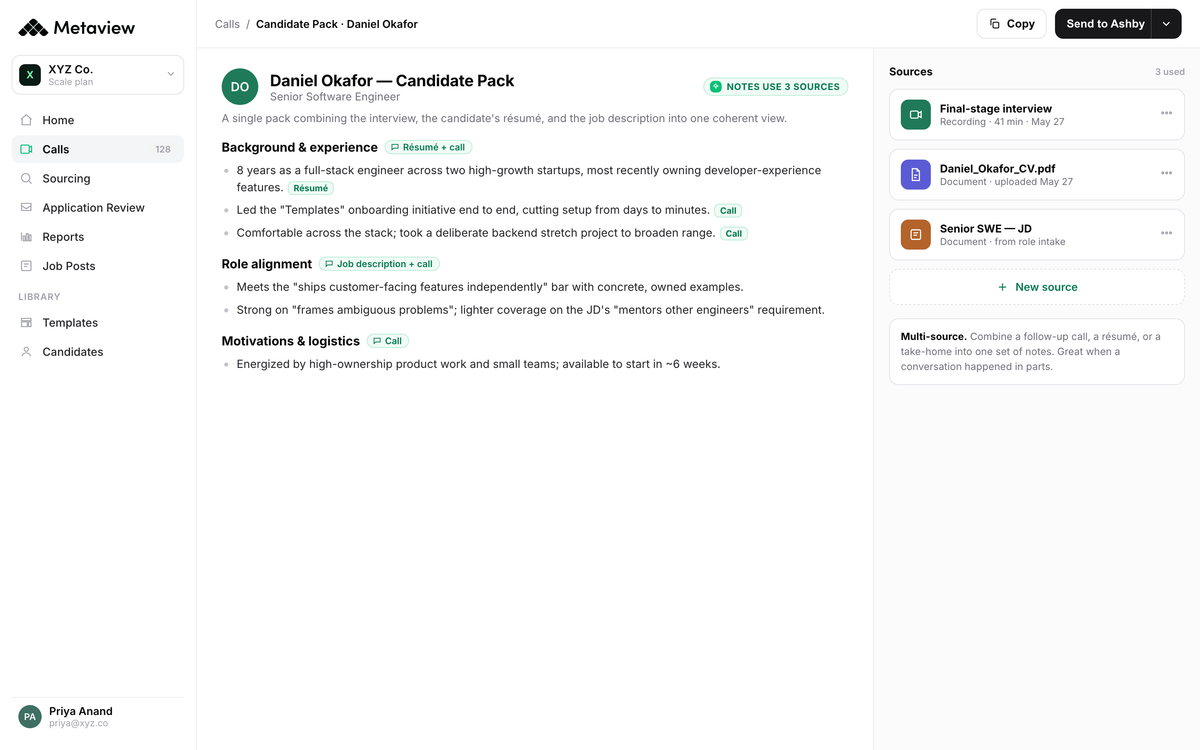
Reports runs over the team's own interview data, queryable in the product or through MCP, so the quarterly review in step five starts from a record of which traits the panel scored and how the scorecard recommendations split by department. Metaview covers what happens up to the hiring decision; retention and performance live in the HRIS or the performance system, and the team joins those to the scorecards itself. Metaview Assistant answers plain-language questions about the captured interviews and recalls specific details, which helps when a debrief turns on the exact words a candidate used.
The cumulative effect is the part that matters. Each interview adds shared signal to the next. The team gets faster at calibrating, more confident in close calls, and more able to defend the personality call in writing when the panel disagrees.
Personality hiring stops being a label people use to dismiss a call, and starts being a signal the team can defend, calibrate, and improve. That's when structure beats gut feel, and the next debrief lands cleaner than the last one.
Bring Metaview into your hiring stack.
Live notes, structured scorecards, and ATS sync - set up in under 10 minutes.
Frequently asked.
Is hiring for personality the same as hiring for culture fit?
No. Personality describes the candidate's traits and behaviors. Culture fit describes how those behaviors map to your company's values and operating context. The same trait that lands well at one company can be a mismatch at another, and culture fit lives in that mapping.
Can a structured personality assessment make bias worse?
Only if the rubric itself encodes bias, for example by scoring “executive presence” without saying what that looks like. A rubric built on observable behaviors and role outcomes, scored independently before the debrief, makes bias visible and auditable instead of invisible and habitual. The interviewer bias post covers the mechanics in more depth.
How many personality traits should we assess per role?
Four to six is the working range. Under four, one weak trait can swing the call. Over six, the rubric dilutes and the interview loop runs too long to cover every trait properly. The trait-to-question mapping is covered in the interview rubric guide.
What role does AI play in personality assessment without amplifying bias?
By making the evidence shared and written. The Notetaker records and transcribes the interview and drafts the scorecard from what was said, so interviewers argue from one record. Metaview Reports shows how scorecard recommendations split by department, which is where the quarterly rubric review starts. The scoring and the hiring decision stay with the interviewers and the hiring manager.
Should we drop the term “personality hire” entirely?
Keep it. Once the playbook is running, “personality hire” describes a candidate the team selected on written behavioral evidence, in the same family as “skills hire” or “potential hire.” The label only reads as a dismissal when the assessment happened in private and nobody can say what changed their mind.


