
Ninety percent of recruiters and hiring managers say they have a good or excellent working relationship with their counterpart. Fifty-eight percent say, when asked privately, that they wish they could work around their counterpart entirely. The numbers are from Metaview's 2026 AI & Hiring Alignment Report, surveying 505 recruiting leaders and hiring managers across North America and EMEA, and the gap between them is where recruiter burnout actually lives.
Burnout doesn't show up the day you take on too much. It shows up 18 months later, when you've spent every Friday afternoon copy-pasting interview feedback into a scorecard, every Monday cleaning up a debrief that drifted because nobody captured what was actually said, and every quarter explaining to a hiring manager why the candidate they wanted disappeared into a competitor's pipeline. It's not a personality problem. It's a workflow problem dressed up as one.
This piece names the three workflow layers that quietly compound into burnout for recruiters, walks through which parts of them are actually load-bearing and which parts are admin debt you've been paying interest on for years, and lays out the operating-model shift that the recruiters who don't burn out tend to make first. The data anchors come from the 2026 Alignment Report and from named customer outcomes in the Metaview case-study library; the tactics come from patterns across hundreds of TA teams running AI inside their interview workflow.
The burnout signal nobody names.
Recruiter burnout has a paragraph-long clinical definition, sustained physical and emotional exhaustion, cynicism toward the work, and a reduced sense of accomplishment, that almost nobody finds useful when they're sitting in front of their fourth interview of the day at 5:47pm. The clinical version doesn't tell you anything you can act on. It tells you what burnout is. It doesn't tell you what produced it.
What produced it, almost every time, is a workflow that asks recruiters to do three different kinds of work in the same hour: be present in a candidate conversation, capture everything that was said in a form a hiring manager can act on, and stitch the conversation into a debrief that has to align with three other interviewers who also did all three of those things badly. The conversation is the part that matters. The other two are admin. The admin is the part that compounds.
The signal you're actually feeling, tired in a way that doesn't go away over the weekend, dreading the inbox more than the interviews, is the workflow telling you the admin layer is now larger than the conversation layer.
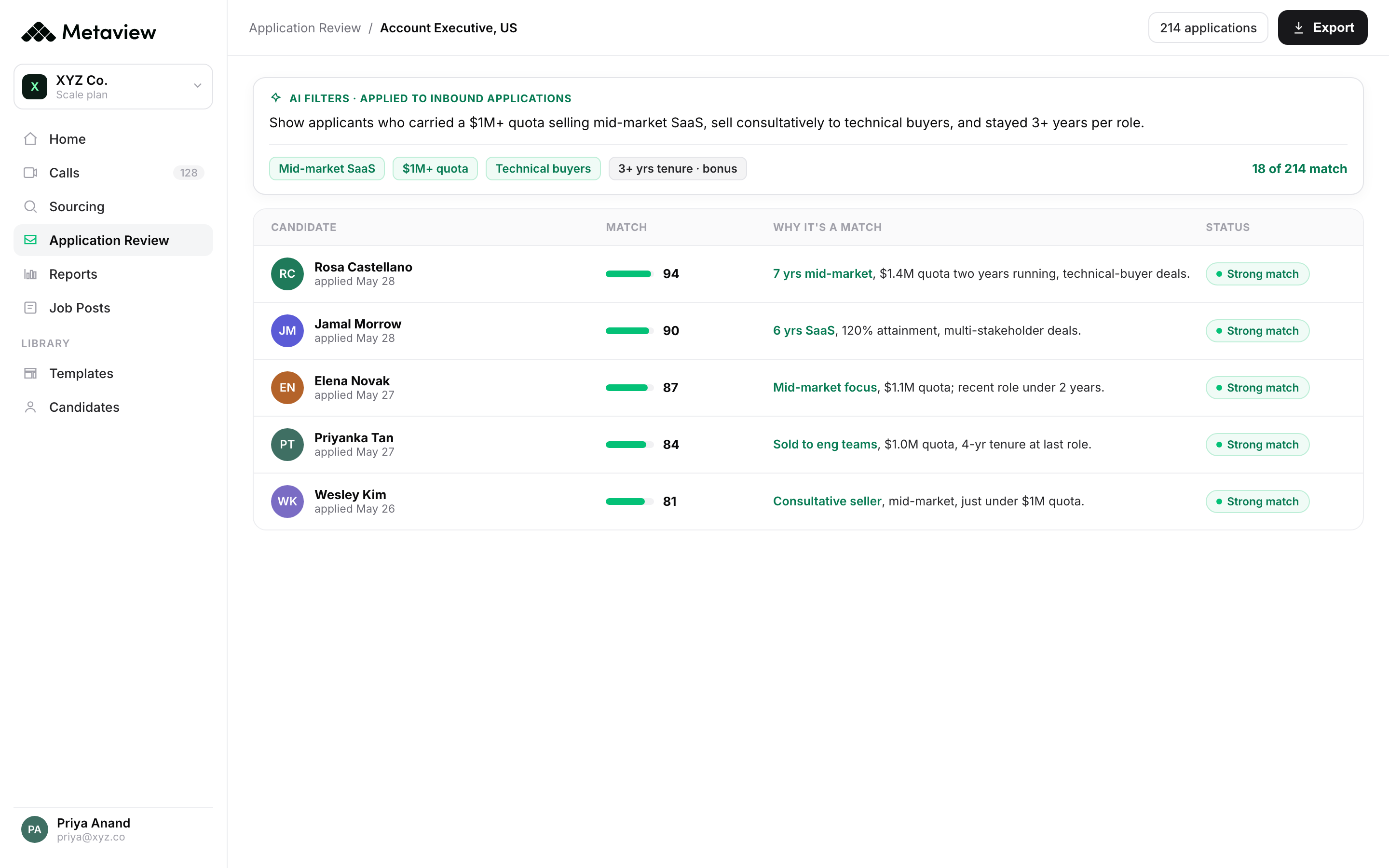
This is consistent with the 2026 Alignment Report data, which found that 58% of recruiting leaders and hiring managers wish they could work around their counterpart even though 90% of them rate the working relationship as 'good or excellent' on a survey. That gap, between the professional answer and the private one, is the same gap recruiters feel between the conversation they signed up for and the admin they ended up running. According to Metaview's 2026 AI & Hiring Alignment Report, surveying 505 recruiting leaders and hiring managers across North America and EMEA, the relationship-quality gap, the candidate-loss rate, and the AI-adoption gap all track to the same underlying problem: workflows that don't preserve signal between the people who need it.
The 3 admin layers compounding into burnout.
Below are the three layers, in the order they compound. Layer 1 is the one most recruiters can name. Layer 3 is the one that actually drives the exit interview.
Layer 1: post-interview admin (write-up + scorecards + recap emails).
This is the layer recruiters point at when asked what burns them out: the 30-to-45-minute hole after every interview where you turn shorthand into a write-up, copy fragments into a scorecard, and send a candidate recap email that exists mostly to make the next interviewer not start from scratch. If you do four interviews in a day, you have between two and three hours of after-the-fact admin that you're now stacking on top of evening time.
Layer 1: what good capture actually replaces.
The fix at this layer is structural, not personal. AI notetakers that capture interviews against a structured scorecard reduce the admin hole from 30 to 45 minutes per interview down to 2 to 5 minutes of validation. That's where customer outcomes like SoSafe's 'half an hour to two minutes' or Airalo's 77 workdays saved across 1,900 calls come from. The time savings are real because the admin layer was real.
Layer 2: coordination drag.
The second layer is the one nobody includes in their workload estimate but which actually pulls the most psychic energy: keeping four interviewers, two hiring managers, and one finance partner aligned on what 'good' looks like for a role you all kicked off three weeks ago. Every misalignment turns into a debrief that runs over, a candidate who's surprised by a question on the third call, or a hiring manager who wants to re-discuss the role spec after a candidate underwhelms.
Layer 2: how structured feedback breaks the loop.
The fix at this layer is also structural: structured scorecards that auto-populate from the interview itself rather than getting filled in after the fact, plus a shared multi-source brief that every subsequent interviewer reads before they enter the room. Multi-source briefs are the difference between an interviewer going into round three knowing what rounds one and two found versus walking in cold and re-asking three questions you already have answers to.
Layer 3: decision-fog (the layer that drives exit interviews).
The third layer is the one recruiters don't talk about until they're already on the way out the door. It's the slow erosion that happens when you've done 200 interviews this quarter but the team still can't reliably tell you which two interviewers are calibrated and which two aren't, which questions actually predict 90-day performance, or which hiring-manager debriefs have been disagreement-driven versus consensus rubber-stamp. The signal exists (you created it) but it doesn't surface anywhere you can act on it.
Layer 3: when AI surfaces the signal the team already created.
The fix here is the one most recruiters haven't seen yet: AI that doesn't just take notes but turns the interview library into a queryable system. Natural-language filters that let you ask 'show me every interviewer who asked the system-design question and how their candidates performed' against your own data. Reports that surface which interviewers are consistently scoring tighter or looser than the panel mean. The admin layer disappears AND the signal layer becomes visible. That's the operating-model shift the rest of the article is about.
Half an hour or more after each interview turning handwritten notes into something usable. Now, reviewing and validating notes takes two minutes.”
The 67% number nobody talks about.
Here's the part of the Alignment Report that doesn't make the LinkedIn carousels: 67% of teams lose qualified candidates to faster-moving competitors every single month. Not 'in tight markets.' Every month. Sixty-seven percent.
For a recruiter, that number doesn't show up as a stat. It shows up as a Slack message at 4pm on a Thursday saying the candidate you've been working for three weeks just accepted somewhere else, and a thirty-second conversation with the hiring manager asking what happened. The conversation is short. The cumulative effect of having that conversation 12 times a quarter, for 18 months, is not.
Two cuts from the same dataset matter for burnout specifically. First, the candidate loss rate is not the same across teams. Teams with excellent partnerships still lose half their qualified candidates to faster competitors; teams with good-or-below partnerships lose 80%. The 60-percentage-point gap between those numbers lives in coordination drag (the second admin layer above). Second, the AI-adoption gap. Teams where AI is core to hiring rate their working relationship as 'excellent' 55% of the time. Teams that don't use AI rate it 'excellent' 14% of the time. The 3.8x multiplier isn't about AI being faster. It's about AI giving the workflow a shared substrate to coordinate on. The recruiter and the hiring manager are reading the same auto-populated scorecard, not two divergent recaps written 36 hours apart.
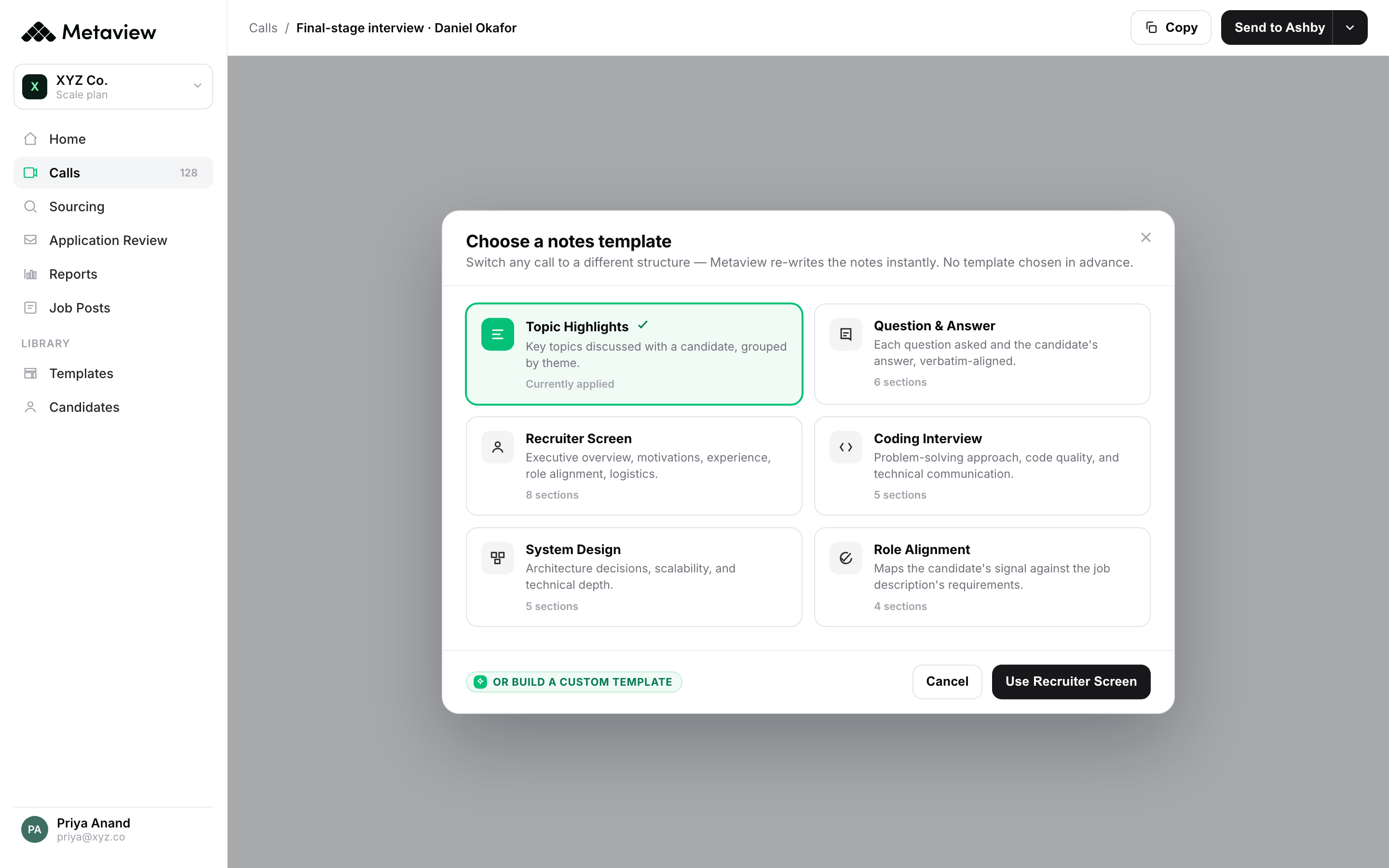
Where AI actually reduces load (and where it just adds another tab).
Not every AI tool reduces burnout. Some of them add a new admin layer on top of the three above. The distinction matters more than the brand on the box.
| Daily burnout driver | Manual | Generic AI | Metaview |
|---|---|---|---|
| Post-interview write-up | 30 to 45 min per interview | "Summarize this transcript" + manual cleanup | Auto-capture against your scorecard, 2 to 5 min validation |
| Scorecard sync to ATS | Copy-paste between 3 tabs | Copy-paste between 4 tabs (now including the AI) | Native ATS sync, structured fields write back |
| Cross-panel coordination | Calendar invites + Slack threads | Calendar invites + Slack threads + AI summary nobody reads | Multi-source briefs auto-shared before next round |
| Hiring-manager debrief | Email recap from memory | Generic transcript summary | Side-by-side scorecard with calibration variance flagged |
| Decision-stage rework | "Can we hop on a call?" | "Can we hop on a call about the summary?" | Searchable interview library, queryable by competency |
Dan McCarthy (Talent Partner, Paradigm) on the two real jobs of a recruiter, and which everything-else can be deleted.
Stop owning the admin, start owning the signal.
The operating-model shift that customer teams who don't burn out have made first, before any of the specific tactics: they stopped treating the admin layer as their primary work product.
What 'primary work product' means in practice: the artifacts a recruiter is held accountable for. For most teams, those are the write-up, the scorecard, the debrief recap, and the ATS update. All four are downstream of the actual signal-creating activity, which is the candidate conversation. When those four artifacts become the work, the conversation becomes the rushed input that has to be transcribed afterward. When the workflow auto-generates those four artifacts from the conversation itself, the conversation becomes the work and the artifacts become the residue.
This is the shift Airalo's TA team made. They've captured over 1,900 calls on Metaview (77 full workdays saved across the recruiting team) and the metric they actually talk about is not the time saved. It's the multi-source feature: every interviewer in round three has read what rounds one and two found, with structured prep, before they walk in. The 77 workdays isn't the value. The 77 workdays is what frees the team to do the work that produces the value.
The implication for hiring managers: the recruiter you're partnered with is now bringing you signal you couldn't have gotten from the recap email. Cross-panel agreement scores, competency-level coverage maps, which interviewer hit the depth of competency vs. which one stayed shallow. The relationship gap that the Alignment Report names (90% surface satisfaction, 58% wishing to work around the counterpart) collapses when both sides are reading the same underlying signal at the same time.
I can be engaged with candidates and clients more fully when on calls and then my notes are much more thorough as well.”

 Sarah Allum
Your 10-minute end-of-day reset (and the weekly rhythm to keep it).
None of the above replaces the recovery layer. The customers above didn't just install Metaview and stop burning out. They installed Metaview AND adopted a recovery practice that the workflow no longer fights. Two pieces.
Then, once a week, a 20-minute audit on Friday.
- Check every requisition's age in days. Anything over 60 days is now a coordination conversation, not a sourcing problem.
- Open the interviewer-level scoring report. Anyone scoring 0.5+ standard deviations off the panel mean is a calibration conversation. Schedule one before the next round of debriefs runs.
- Read the top three queries to the interview library this week. Which competencies did the team ask about most? Are any of them showing up in candidate failure modes downstream?
- Pull the candidate-loss list. Who dropped, where in the funnel, with what stated reason. If 'process speed' shows up twice, that's not a sourcing issue, it's a coordination-drag tell.
- Block 30 minutes of unstructured time on next week's calendar before anyone else can claim it. This is the structural recovery slot.
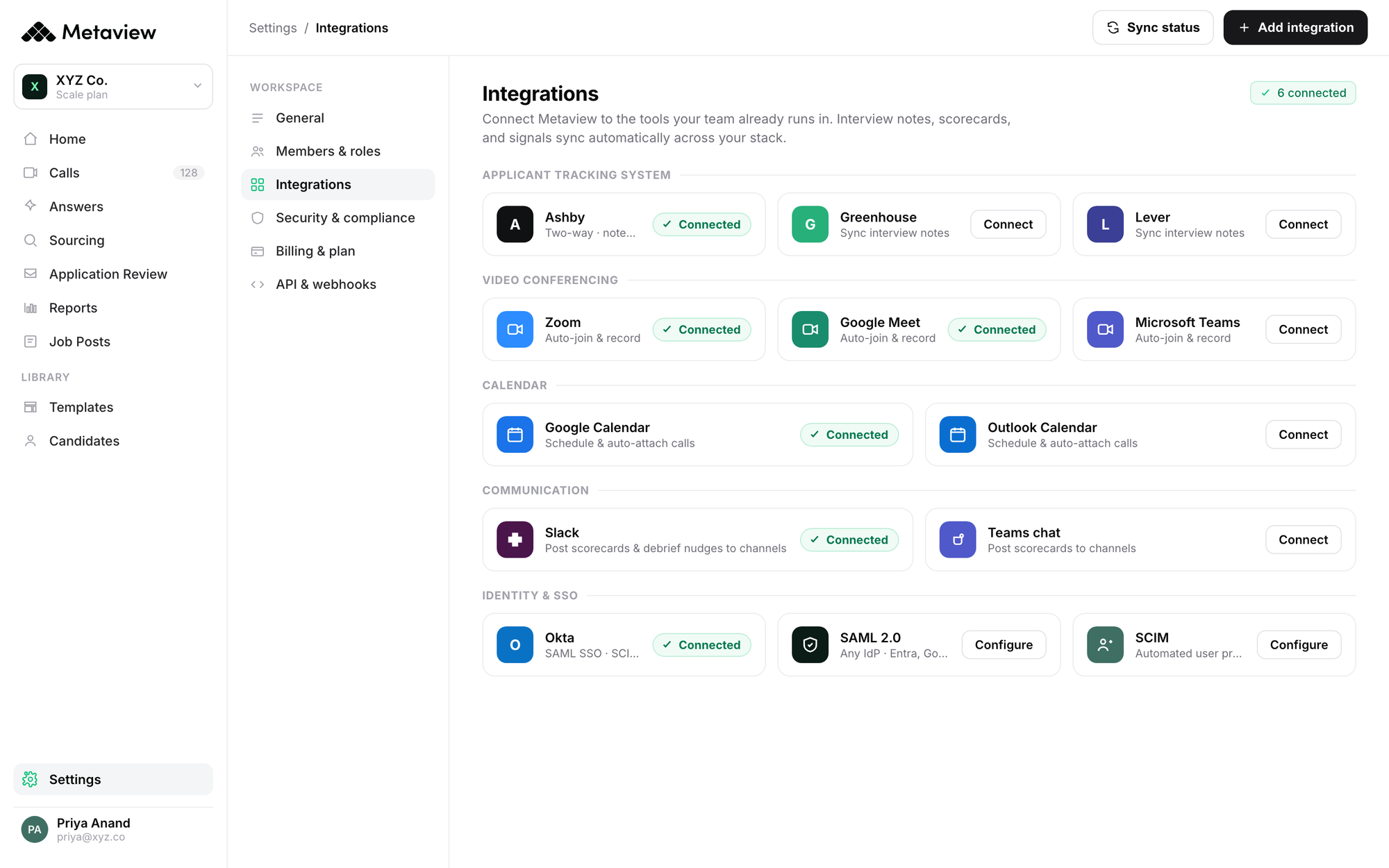
Bring Metaview into your hiring stack.
Live notes, structured scorecards, and ATS sync, set up in under 10 minutes.
Frequently asked questions.
How common is recruiter burnout?
There isn't a single industry-wide percentage, but the 2026 Alignment Report's adjacent data points (58% wishing to work around their counterpart, 67% losing qualified candidates to faster competitors monthly) track to the workflow conditions that produce burnout. If your team is at or above those numbers, you're operating in a high-burnout-risk pattern.
Can technology really help reduce recruiter burnout?
It can reduce the workflow conditions that produce burnout, specifically the post-interview admin layer, the cross-panel coordination layer, and the decision-fog layer. Customer outcomes in the Metaview case-study library (Airalo, Cockroach Labs, SoSafe) show capacity recovery measured in tens of workdays. Technology can't address the supportive-management or career-progression layers that also contribute. Those remain a human leadership job.
What's the difference between burnout and regular stress?
Regular stress responds to a weekend off or a slower week. Burnout is the form stress takes when the workflow that produces it is still in place after the recovery period. Clinical recovery from burnout requires 2+ weeks of changed conditions, not just changed time off. Operationally, you can't rest your way out of it. You have to redesign the workflow.
How can leaders support recruiters to prevent burnout?
Three operational moves. First, audit the post-interview admin layer and delete the parts that an AI notetaker can replace. This is the biggest single lever. Second, build a coordination layer that doesn't depend on Slack threads and calendar invites: multi-source briefs, auto-shared scorecards, decision-stage handoffs that don't require synchronous calls. Third, surface the signal the team already created so recruiters don't have to keep recreating it: searchable interview libraries, panel calibration reports, hiring-manager debrief variance flags. These three together address the three admin layers above.
What's the first thing a recruiter can do this week to feel less burned out?
Block the 10-minute end-of-day reset on your calendar, starting Monday. Then audit which of the three admin layers eats the most time in your week and which one feels the heaviest. Those are often different layers. Fix the heaviest one first, not the largest one: the heaviest is what burns you out, the largest is what eats your hours. They compound differently.


