
You're a senior engineer with three live offers. You spend the morning re-running the loops in your head: who'd actually be a great place to work, who said something thoughtful in the panel, who's been quiet for nine days. You don't compare salaries first. You compare how each company made you feel.
That's the candidate market right now. Headcount plans are aggressive, recruiters juggle 80 active candidates, and every shortlist is fighting two other shortlists. The teams winning that fight share one trait: a hiring process that feels organized, fair, and human by design, not by accident.
The instinct is to pick between speed and personalization. The reality is that the best candidate experience is both, built as a system rather than a hack.
Below: the five pillars that hold it up, the 10 moves that operationalize them, the three product surfaces that make the whole thing scale, and the patterns that quietly undo it in high-growth teams.
Why candidate experience is now the competitive edge.
Candidate experience used to read as a soft metric, a survey score the talent team chased to round out the year-end deck. It's now the visible operating signal candidates use to model what working at your company will be like.
If the process is chaotic, slow, or impersonal, they assume the work is too. And the data on what's actually happening behind closed doors is uncomfortable.
According to Metaview's 2026 AI Hiring Alignment Report, surveying 505 recruiting leaders and hiring managers across North America and EMEA, the surface looks fine and the reality doesn't. Nine out of ten teams rate their internal hiring relationship as good or excellent. The same teams, asked honestly, want to work around each other.
The trust gap inside the hiring team is the trust gap the candidate sees from the outside. A debrief four days late, a hiring manager who reopens the rubric mid-loop, an interviewer who hasn't read the resume: none of those are candidate-experience failures in isolation.
Together they're the same failure. The system isn't built to hold the candidate.
That's why the competitive edge lives in the process itself, not in a careers-site redesign or a perks page. A process the candidate experiences as clear, fast, fair, respectful, and personal, every time, even when the calendar is full.
The five pillars hiring teams design around.
The strongest hiring teams treat candidate experience as a system with five distinct attributes the process must exhibit. Skip one and the others can't hold the weight. The inventory, in the order they tend to break:
| Pillar | What it looks like in your process | How candidates feel it |
|---|---|---|
| Clarity | Every stage, evaluator, and timeline communicated up front and in writing. | "I know exactly where I stand." |
| Speed | Short gaps between rounds, debriefs scheduled before the loop opens. | "They respect my time." |
| Fairness | Structured questions, aligned scorecards, written feedback before debrief. | "The process feels legitimate." |
| Respect | Interviewers prepped, on time, asking role-tied questions, not trick ones. | "They actually saw me." |
| Personalization | Specific signals referenced, follow-ups tailored, strengths named back to the candidate. | "They listened." |
Skip clarity and ambiguity becomes anxiety. Skip speed and the offer arrives after the candidate has accepted somewhere else. Skip fairness and the strongest candidates self-select out.
Skip respect and the panel ends up debriefing a candidate who's already pulled out. Skip personalization and the close reads like a marketing email.
The 10-move playbook for operationalizing the pillars.
The pillars name what a great candidate experience exhibits. The moves below name what your team does to make each pillar real, every time, even when the calendar is full. Each move maps to at least one pillar and earns its place by being concrete enough that a recruiter can run it next week.
1. Set clear expectations from the first touchpoint.
On the recruiter screen, walk the full process: stages, who the candidate will meet, what each round assesses, and the decision timeline. Follow up with a written summary so candidates can re-read it later. If the timeline shifts, tell them before they ask.
This is the foundational candidate outreach move. Done well, it removes most of the inbound "any update?" messages.
2. Design a structured interview process.
Define the four to six competencies that predict success in the role and assign each one to a specific interviewer. Coverage is complete and duplication is zero.
Tie questions directly to those competencies and standardize scoring through a shared rubric. The deeper walkthrough lives in our interview rubrics guide and the panel design playbook.
Calibrate the panel on what each score level should look like in evidence, and require written feedback before the debrief to prevent groupthink.
3. Prepare interviewers every time.
Before every panel, send each interviewer a short brief: candidate resume, notes from prior rounds, the competencies they're responsible for, and the areas to probe so they build on the conversation instead of repeating it.
With a structured capture layer like Metaview's Notetaker, those briefs assemble themselves from the prior round's evidence. Ten minutes of prep is the difference between a panel that compounds and a panel that resets.
4. Move fast, without cutting corners.
Audit your current time-to-decision and identify the delays. Schedule debriefs before the first interview, not after. Set internal SLAs for feedback submission. 24 hours is the right target for most roles.
If a stage doesn't materially change the hiring decision, cut it. Speed earned through structure is what proves respect to the candidate. Speed without rigor is sloppy.
Brex is definitely an advocate for candidate experience. Everyone really cares about how we're running candidates through and building relationships.”
5. Personalize communication at scale.
Build flexible templates with prompts to reference specific signals from interviews: a project the candidate mentioned, a strength the panel noted, a question they asked that landed.
In the closing conversation, name one or two specific strengths the panel observed and connect them to what the candidate cares about. The deeper how-to lives in our personalized outreach playbook.
Templates carry the structure. The recruiter carries the signal.
6. Make interviews feel like conversations, not interrogations.
Train interviewers to balance structured assessment with real dialogue. Explain briefly why you're asking each question. Context turns interrogation into conversation.
Build space for the candidate to ask meaningful questions throughout, not just in the last five minutes. Interviews are a two-way evaluation, and candidates who feel heard tell their friends about your company whether they got the offer or not.
7. Provide thoughtful, specific feedback.
For final-round candidates especially, write feedback that reflects real evaluation. Highlight strengths the panel saw, name the gaps relative to the role, and align with HR guidance without letting risk-aversion empty the substance.
The deeper guide to specific candidate feedback covers the templates. A few specific sentences turn a rejection into a constructive moment, and that moment compounds across years.
8. Eliminate redundant steps.
Review your funnel and ask which stages actually influence the hire. Pull your last 20 hires and check whether each stage meaningfully changed the outcome.
If a stage didn't change the call on a single recent hire, consolidate it or cut it. Long, repetitive processes drain candidate enthusiasm and lift your drop-off rate without lifting your hire quality.
9. Align interviewers on the company story.
Run a short alignment session with the hiring manager and the interview panel before the role opens. Clarify what success looks like in the first six to twelve months, what the team is facing, and how the company is evolving.
Provide talking points on mission and growth so interviewers stay honest about challenges while staying consistent on the framing. Mixed signals on the company story are one of the fastest ways to lose a finalist.
10. Close the loop with humanity.
Never leave candidates guessing. If decisions are delayed, say so before they ask. When delivering rejections, reference specific elements of their candidacy and thank them for the time.
For strong-but-unsuccessful candidates, keep the relationship warm via talent communities and occasional future-role check-ins. The finalist you reject this quarter is the referral source you need next quarter, or the offer you close eighteen months from now.
How Metaview makes the system scale.
Most of the 10 moves above are workflow discipline owned by the team, not the tool. Three are workflow problems where the tool earns its place: capturing real interview evidence at scale, triaging the inbound cleanly, and turning the post-interview write-up into specific feedback that holds up under scrutiny.
Three surfaces, one job each. The customer outcomes back the pattern.
Notetaker handles capture and prep. Every interview is recorded against the role's competencies, so the next interviewer's brief assembles itself from the prior round's evidence. Move 3 stops depending on the recruiter manually stitching the panel together.
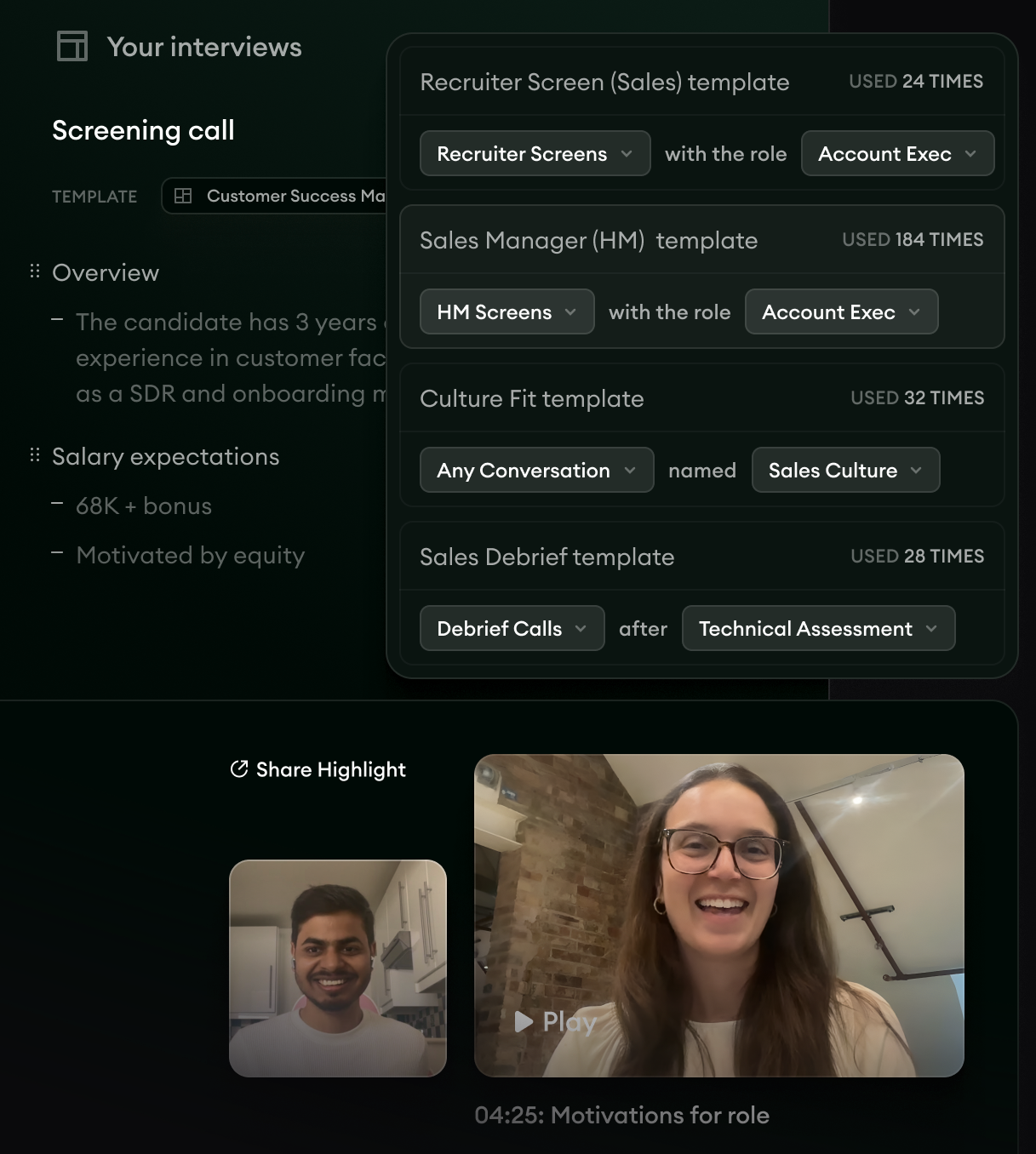
- 1The live transcript captures every exchange against the role's competencies in real time.
- 2Auto-tagged signal lifts the moments that matter for the scorecard, so the recruiter is present in the conversation instead of typing.
- 3The structured post-call summary is shareable before the candidate hangs up.
Application Review handles the inbound. Every application is scored against your ICP with the reasoning trail attached, so the recruiter spends the saved hours on candidates worth a conversation. Moves 1 and 8 both lean on this surface.
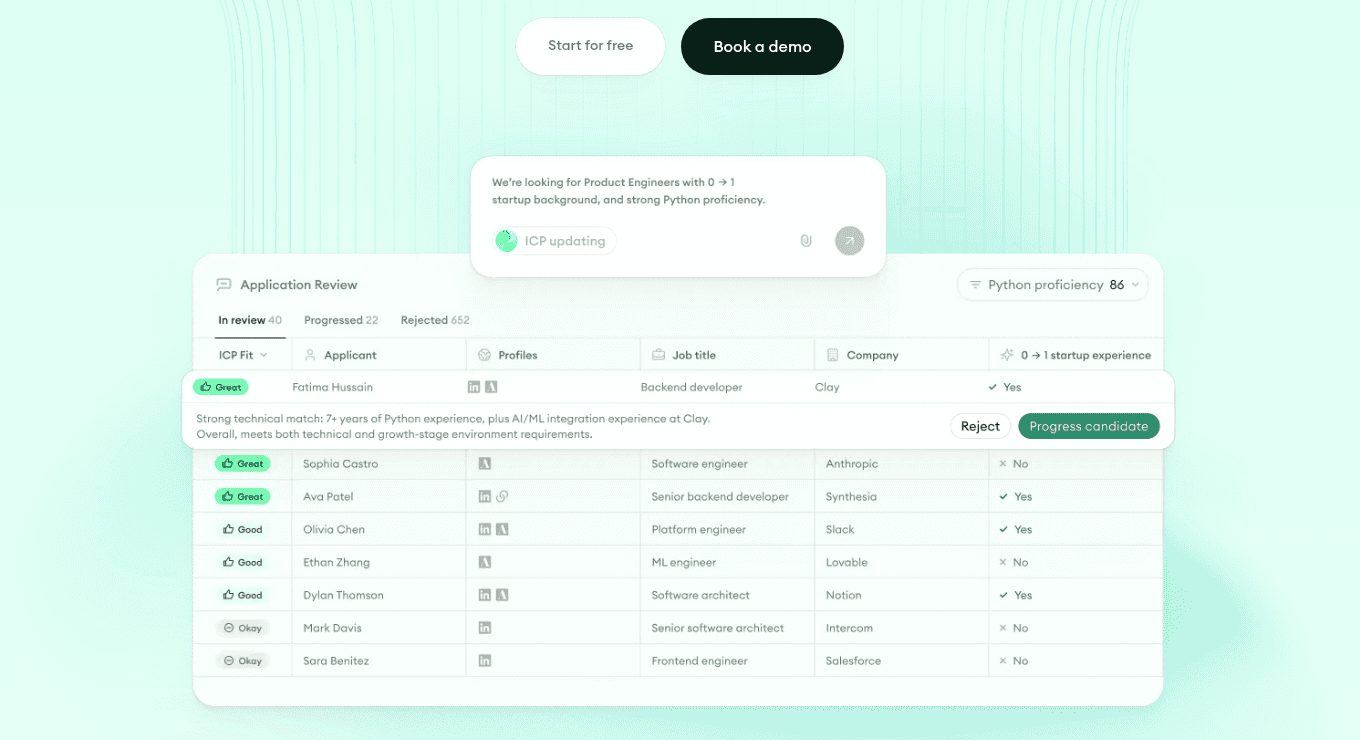
- 1Every inbound profile scored against your ICP with the reasoning trail attached.
- 2Progress or reject actions feed the next pass, sharpening the bar with every decision.
- 3Fraud and AI-generated patterns flagged before they reach the recruiter's queue.
Reports closes the feedback loop. Per-competency evidence across the panel means the post-final-round summary is grounded in specific moments. Exactly what move 7 asks for.
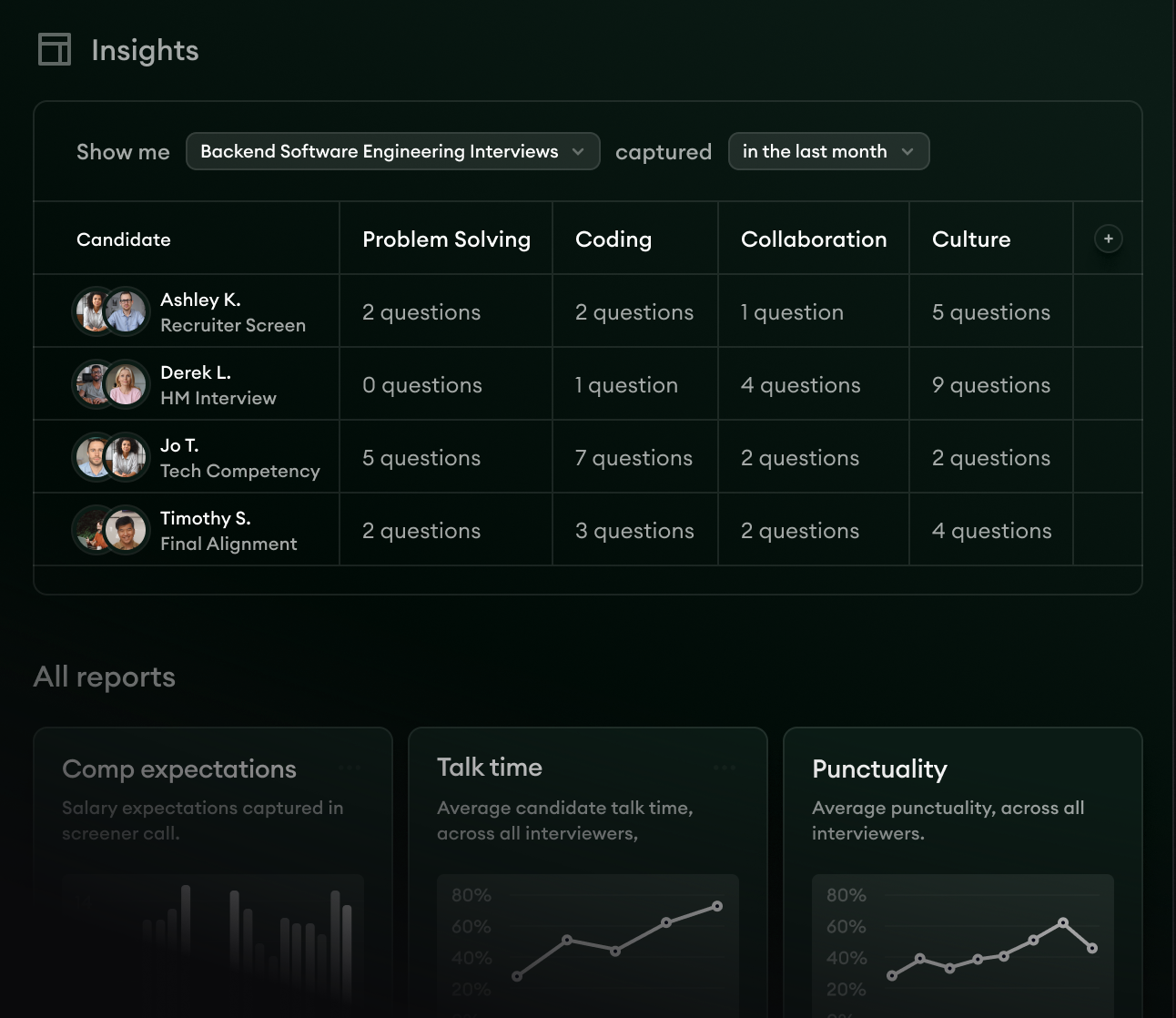
- 1Per-competency capture across every interview, so the panel sees what was actually said.
- 2Patterns across candidates surface what "qualified" looks like inside your team, not against an industry benchmark.
- 3Cross-interview Reports make the feedback to candidates evidence-based, not memory-based.
Customers running this end-to-end describe the same shift: stronger signal on the inside, a more consistent experience on the outside.
We're using Metaview to create stronger hiring signals, better calibration across interviewers, and a really high-quality experience for candidates as well, regardless of the interviewer.”

The patterns that quietly break candidate experience.
No recruiting team sets out to build a poor candidate experience. It happens as a side effect of growth, urgency, or leaning on tools to substitute for process design. The patterns below are the ones that quietly recur in high-growth teams. Each has a specific reset.
Three to watch for, in the order they tend to compound:
The pattern across all three is the same: the team substitutes velocity or volume for process design, and the candidate pays the cost. Fixing them is rarely a tooling decision; it's an operating discipline the recruiter and the hiring manager hold each other to.
Frequently asked.
How do you measure candidate experience effectively?
Combine cNPS with operational metrics: time-to-feedback, time-to-decision, interview-to-offer conversion, and offer acceptance rate. The strongest signal comes from cross-referencing experience data with operational data. If slower feedback correlates with lower acceptance, that's where to fix first.
What role do hiring managers play in candidate experience?
Outsized. Hiring managers own timelines, evaluation criteria, and final calls. When a hiring manager delays feedback, reopens the rubric mid-loop, or runs unstructured interviews, candidate experience drops immediately. Align them early on competencies, scoring, and the SLA for feedback turnaround so the partnership runs tight.
How does candidate experience impact long-term talent strategy?
Far beyond a single hire. Candidates who feel respected re-engage later, refer others, and become customers in industries where that matters. Over two or three years, consistent experience compounds into a pipeline that's cheaper and warmer than cold sourcing, plus an employer brand that doesn't need a perks page to do the work.
When should you audit your candidate experience?
Trigger-based and cadence-based. Triggers: new leadership, declining offer acceptance, region expansion, new ATS. Cadence: a light quarterly review of timelines, feedback quality, and candidate-survey data. Either kind of audit is cheaper than the cost of the issues they surface.
Can AI improve candidate experience without making it impersonal?
Yes, when it removes the admin work that was making personalization impossible. Notetaker handles capture so the recruiter is present in the conversation. Application Review handles inbound triage so the recruiter spends time on candidates worth a conversation. Reports surface the evidence so feedback is grounded in what was said, not what was remembered. The AI runs the substrate; the recruiter runs the relationship.
The competitive edge lives inside the hiring process. The pillars set the bar, the 10 moves operationalize it, and the interview-intelligence layer makes the system scale past 50 candidates a week without losing the human signal.
The recruiter and the hiring manager hold this together. With the right systems in place, the choice between efficiency and human connection collapses, and you get both, on purpose. Pick the one move your team will run this week, and start there.
Bring Metaview into your hiring stack.
Live notes, structured scorecards, and ATS sync - set up in under 10 minutes.


