
Recruiting teams are dealing with a completely different hiring market than they were even two years ago.
For starters, application volume has exploded. We’re dealing with a 412% increase in applications per recruiter, and a 111% increase in applications per role.
At the same time, candidates are increasingly using AI tools to generate résumés, cover letters, assessments, and application responses. Case in point: 39% of candidates now use AI during the application process in some form. And while much of that is to help with proofreading or formatting, some candidates use AI to exaggerate qualifications, generate fake work samples, and even fake interviews entirely.
The combo of radically rising applications and dramatically easier content generation is reshaping the hiring funnel.
The result is a growing signal-to-noise problem:
- Recruiters spend more time sorting through irrelevant or low-quality applications.
- ATS systems become flooded with noisy data.
- Hiring teams lose confidence in early-stage screening signals.
- The cost of identifying strong candidates rises significantly.
The recruiting process is becoming adversarial. Not always, but just enough to make us all a little paranoid and untrusting.
This article uses 10 key statistics to present the scale of candidate fraud, and the real-world impact it’s having on hiring teams.
Stop candidate fraud in its tracks.
Metaview reviews every application in seconds. Smart, contextual AI that beats basic filters every time.
1. Applications per recruiter have increased by 412%.
You’re not imagining things: inbound pipelines have exploded in recent years. Which might have been exciting for a minute, until you actually dug in.
Benchmarks from Greenhouse show that applications per role are up 111%. But more challenging for TA pros: applications per recruiter have increased by 412%. That level of growth completely changes the economics of recruiting.
Recruiters are asked to review dramatically more inbound candidates using workflows and systems that were designed for a much lower-volume environment. Your hiring team hasn’t quadrupled in size to keep up. As a result, the amount of time available to evaluate each individual application keeps shrinking.
And when scrutiny decreases, noise increases.
Why is this happening?
First, it’s a tough market out there for job seekers. Fewer open roles and more competition mean candidates can’t be choosy. Applying to dozens or hundreds of jobs is the new normal.
And large language models have dramatically reduced the effort required to produce a polished application. Candidates can tailor résumés to job descriptions, generate customized cover letters instantly, and mass-apply to roles with minimal friction.
And because many of these applications are highly optimized, traditional filtering mechanisms struggle to separate genuine fit from AI-generated noise.
2. 39% of candidates now use AI in the application process.
AI use in hiring is no longer experimental. It’s mainstream.
Gartner found that 39% of candidates now use AI during the application process:
- 54% use AI to generate résumé text
- 50% use it for cover letters
- 36% use it for writing samples
- 29% use it to help answer assessment questions
Most of this usage is relatively harmless, and doesn’t equate to real fraud (more on that in a moment). But for recruiters, AI compresses the distinction between strong applications and truly compelling candidates.
Recruiters could typically infer communication ability, effort, attention to detail, and domain expertise from the quality of a résumé or written response. AI weakens those signals.
As more candidates adopt the same tools, applications become increasingly homogenized. Recruiters end up reviewing dozens of candidates who all sound similarly polished, similarly keyword-optimized, and similarly aligned to the role.
AI-generated applications require more contextual evaluation of consistency, depth, communication patterns, and authenticity across the entire hiring process.
But ironically, AI is also the solution. The same advances that make applications easier to generate are making it possible to evaluate them with far more nuance than legacy ATS workflows ever could.
3. 83% of AI-using job seekers admit to exaggerating or lying about skills.
Here’s where we go from understandable optimization to actual fraud. According to Capterra, 83% of AI-using job seekers said they’d used AI to exaggerate or lie about skills on a résumé, cover letter, job application, or skills assessment.
That’s a huge proportion, and a massive problem. It used to at least take a little effort to lie or embellish, but not anymore. Candidates can now:
- Instantly tailor résumés to match job descriptions.
- Generate convincing explanations for skills they don’t actually possess.
- Produce polished writing samples with little expertise.
- Create technically accurate responses to assessments.
- Reframe unrelated experience into highly targeted qualifications.
Large language models are exceptionally (and increasingly) adept at producing plausible professional text. So these applications often seem credible to the naked eye.
But then you encounter candidates who interview poorly, lack the depth implied by their résumé, or struggle to demonstrate practical competency once deeper evaluation begins.
The challenge is especially acute in high-volume recruiting, where you only have a few seconds to review each application.
Recruiters have to flip into zombie mode and look for certain things in the profile, without looking at them in detail. People literally tell us they spent three to five seconds looking at these applications.”

In effect, AI is flattening the presentation layer of hiring.
That has major implications for how companies evaluate talent. Surface-level signals like formatting, keyword alignment, and polished written communication are becoming less predictive of actual capability.
4. 22% of job seekers use bots to apply automatically.
Separate Greenhouse research found that 22% of job seekers use bots to apply to jobs automatically, rising to 31% among Gen Z candidates. And the same dataset found that 28% of job seekers admit to using AI to generate fake work samples.
This is one of the biggest reasons application volume is exploding.
Candidates no longer need to manually search for roles, customize applications, and submit them one at a time. Increasingly, AI tools can:
- Identify relevant jobs
- Tailor résumés
- Generate responses
- Submit applications in bulk
- Create portfolios or work examples on demand
The traditional assumption was that applying required enough effort to act as a natural filter. But that friction is disappearing. Candidates can apply to hundreds of jobs in a single day with minimal effort.
Which inevitably leads to more poor-fit candidates with low intent, hidden behind AI-crafted cover letters and CVs.
“They’ve figured out how to make the profile attractive enough or to get on a call with the candidate. But when you get on the call, something feels off. The person's mouth, is it actually lined up with the words coming out? “Recruiters are saying that it’s polluting the applicant tracking system.” ”

Large volumes of low-quality or automated applications contaminate ATS data, distort conversion metrics, and make it harder for recruiting teams to identify which sourcing channels are actually producing qualified talent.
Even portfolios and written assignments are no longer a reliable trust signal. These can also be generated partially or entirely by AI systems in minutes. That forces hiring teams to rethink how they validate candidate capability.
Hiring infrastructure was designed for human-scale application behavior. But recruiting teams are increasingly operating in a world of machine-scale candidate activity.
5. 1 in 4 candidate profiles will be fake by 2028.
Candidate fraud is no longer a fringe concern. According to Gartner, by 2028, one in four candidate profiles globally will be fake.
That prediction would have sounded extreme only a few years ago. But the underlying conditions are already in place:
- Application volume is surging
- Interviews are overwhelmingly remote
- AI tools can generate convincing professional identities instantly
- Verification processes remain largely manual
- Recruiters are operating under intense time pressure
Candidates themselves are becoming more comfortable with deceptive behavior in the hiring process. Gartner also found that 6% of candidates admit to participating in interview fraud, either posing as someone else or having another person pose as them during interviews.
Importantly, fake candidates don’t always mean entirely fictional people.
The spectrum of fraud is widening:
- Candidates exaggerating qualifications with AI assistance.
- Applicants using generated work samples.
- Proxy interviews conducted by more technically skilled individuals.
- Identity substitution during remote interviews.
- Fully synthetic candidate profiles built to bypass screening systems.
Remote hiring workflows make many of these tactics surprisingly difficult to detect. But even in-person interviewing isn’t always a guarantee, as we’ll see in a moment.
More broadly, trust is quietly eroding across the hiring funnel. Recruiters increasingly have to ask:
- Is this candidate real?
- Is this the same person who completed the assessment?
- Does this person actually possess the skills represented in the application?
- Was this work genuinely produced by the candidate?
Increasingly, companies are recognizing that screening is no longer just about finding qualified candidates. It’s also about filtering out fraudulent or misleading ones before they consume recruiter time, enter interview loops, or create downstream business risk.
6. 35% of hiring managers say someone else participated in a candidate’s interview.
Fraud isn’t stopping at the application stage. Checkr found that 35% of hiring managers say they’ve experienced situations where someone other than the listed applicant participated in a virtual interview.
Meanwhile, 31% say they interviewed a candidate who was later revealed to be using a fake identity.
"We’re hearing it more from our larger customers: Someone turns up for the interview who isn’t the same person that ends up on the job."”
Separate research from Resume Genius and Pollfish found that 17% of hiring managers have encountered candidates using deepfake technology to alter video interviews.
These statistics highlight how rapidly candidate fraud is evolving.
A few years ago, most hiring deception happened on paper: embellished résumés, inflated job titles, or inaccurate dates of employment. But AI and remote hiring have dramatically expanded what’s possible.
Candidates can now:
- Use another person to complete technical interviews
- Receive real-time AI assistance during screening calls
- Modify audio or video feeds
- Generate convincing fake identities and professional histories
- Use deepfake technology to manipulate appearance during interviews
And because recruiters are already overwhelmed by application volume, these issues often go unnoticed until much later in the process.
That creates significant operational risk.
A fraudulent candidate doesn’t just waste recruiter time. They can:
- Consume interview bandwidth across multiple stakeholders
- Corrupt hiring data and funnel metrics
- Delay legitimate hires
- Introduce compliance and security risks
- Create expensive replacement hiring cycles if discovered after onboarding
The deeper issue is that traditional interview processes were built around an assumption of authenticity. And that assumption is weakening.
7. 62% of managers believe candidates are better at faking identities than recruiters are at detecting them.
Perhaps most concerning is that hiring teams themselves know they’re losing this battle. According to Checkr, 62% of managers say that job seekers are now better at faking identities with AI than hiring teams are at detecting them.
The tactics are evolving faster than traditional hiring systems can adapt.
Only 19% of managers say they’re extremely confident their current hiring process would catch a fraudulent applicant. Similarly, Equifax found that only 20% of HR professionals feel “very confident” in their ability to detect fabricated or misleading candidate information.
That means the overwhelming majority of hiring organizations are operating with moderate or low confidence in their ability to validate candidate authenticity. A dangerous dynamic.
Teams either:
- Become overly skeptical and risk filtering out strong candidates, or
- Move candidates forward despite uncertainty because they lack the time or tooling to investigate further.
Neither outcome scales well.
In many ways, hiring is entering the same transition other industries already experienced: when fraud becomes machine-scale, detection has to become machine-scale too. The next generation of AI hiring tools must tackle this issue head on.
8. 71% of HR professionals have encountered fabricated or misleading candidate information.
For most hiring teams, candidate deception is becoming routine. Equifax found that 71% of HR professionals have encountered fabricated or misleading candidate information during the hiring process.
Checkr’s data tells a similar story: 60% of managers say they’ve uncovered candidates misrepresenting their experience or qualifications, while another 13% suspected deception but couldn’t prove it.
That last statistic is particularly important. The uncertainty is taking hold in talent teams.
Recruiters increasingly encounter candidates who seem overly polished, perform inconsistently across interview stages, or submit suspiciously generic or optimized materials.
But proving deception is often difficult. And hiring is an inherently human game - you want to be able to trust and connect with candidates. As a result, recruiters spend growing amounts of energy validating basic authenticity instead of evaluating fit.
Every suspicious application consumes recruiter attention:
- Reviewing application materials
- Cross-checking experience
- Re-running assessments
- Conducting additional screening
- Escalating concerns internally
Multiply that across hundreds or thousands of applications, and candidate fraud becomes a significant productivity drain on recruiting teams.
The hidden cost is often larger than organizations realize.
9. Remote roles are 10X more likely to receive fraudulent applications.
Cybersecurity firm Huntress built its own system (Endorsed) to flag fraudulent job applications and CVs. And per Huntress’ growing data set, remote roles are vastly more likely to be flooded with fake or suspicious responses:
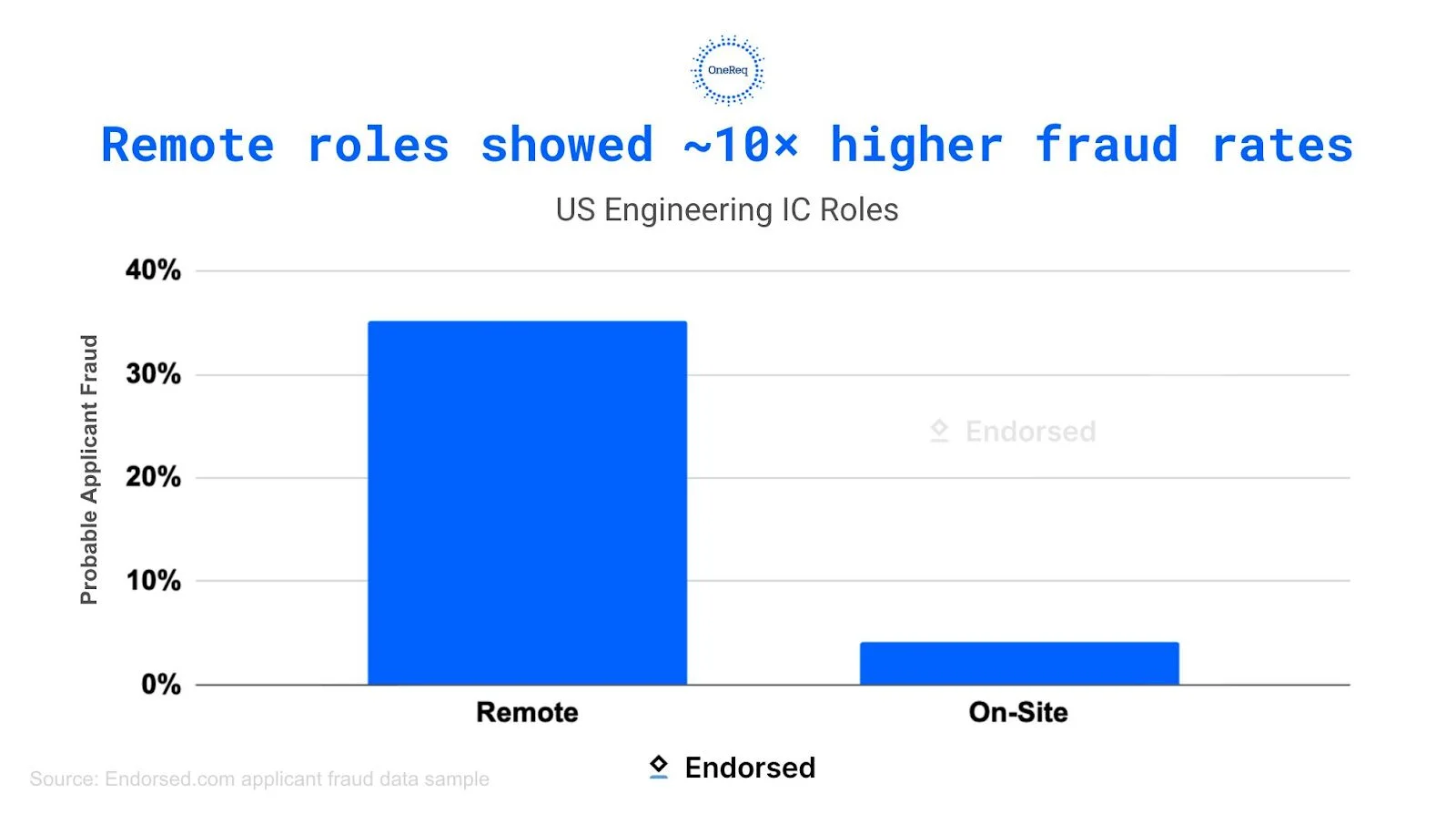
Even if remote work opportunities are declining compared with pandemic-era peaks, it’s an alarming statistic. We shouldn’t have to factor in a heavy screening burden as yet another factor when deciding whether in-person, hybrid, or at-distance is best for a given role.
And these aren’t even particularly elaborate scams. “Fraud risk signals within Endorsed include: email address, phone number, LinkedIn & social media, Identity Trace, and Fraud Network.”
A fake email address, phone number, or LinkedIn profile is fairly easy to identify. But doing so manually, and at scale, is a real problem.
Huntress built Endorsed to automate screening in house. And according to the firm, “without the assistance of a resume review tool, our recruiters would spend 4 weeks, 1 day, 1 hour, and 40 minutes more on pure applicant review time.”
That’s valuable time that can be redistributed towards interviews with real, human candidates, outbound outreach and headhunting, and improving internal processes.
10. 23% of companies lost more than $50,000 to hiring fraud last year.
Candidate fraud is expensive, and not just in recruiter time. According to Checkr, 23% of hiring managers report losses of more than $50,000 in the past year due to hiring or identity fraud. Even more striking, 10% say losses exceeded $100,000.
Hiring fraud is often framed as an inconvenience: wasted interviews, bad applications, or frustrating recruiter workflows. But the downstream consequences can be far more serious.
A fraudulent hire can create costs across:
- Recruiter and hiring manager time
- Onboarding and training expenses
- Delayed productivity
- Replacement hiring cycles
- Security and compliance exposure
- Damage to customer relationships or internal systems
In technical or regulated industries, the risks become even greater.
Candidates with fabricated credentials may gain access to sensitive customer information, financial systems, proprietary company data and internal infrastructure.
At that point, hiring fraud stops being a recruiting problem and becomes a major business risk. Screening is no longer just about saving recruiter time. It’s about reducing operational, financial, and security exposure before fraudulent candidates enter the organization.
And in an environment where application volume continues to rise and AI lowers the cost of deception, that capability is becoming increasingly critical.
How to respond and prevent candidate fraud.
To reduce candidate fraud, you need to catch it early. The further they make it through the funnel, the greater the costs and risks. That’s why automated detection is your single best defense.
AI-powered fraud detection surfaces patterns that are easy to miss manually, especially at scale. Common signals include:
- Repeated similarities across resumes, applications, or assessment answers
- Mismatches between a candidate’s written communication and live interview performance
- Signs of AI-generated or heavily coached responses during screening stages
- Suspicious application patterns, such as unusually high submission volume or velocity
It doesn’t just auto-reject candidates. It identifies high-risk applications early, so you can apply additional verification only where needed.
And good news: Metaview has everything you need.
How Metaview automatically reduce candidate fraud.
Fraud detection now in Application Review
Application Review checks every inbound application to make sure it matches your role and ideal candidate profile. The agent also specifically looks for fake or suspicious applications using signals like:
- Identity inconsistencies: does the application align with the person showing up in interviews and assessments?
- Automated application behavior: are there patterns associated with bots, mass-apply tools, or synthetic submissions?
As always with Application Review, the system surfaces the signals and you make the final call. High-risk candidates are flagged automatically, and you can choose to look closer or reject immediately.
Fraud detection gives your team the information it needs to make a confident decision quickly, not to make that decision for you.
From there, Metaview turns interviews into structured, searchable data that teams can review consistently across stages. This lets you:
- Compare candidate responses across interviews and stages
- Surface contradictions or low-depth answers more quickly
- Create alignment between recruiters and hiring managers
- Base hiring decisions on evidence instead of isolated impressions
- Improve sourcing quality using richer signals than keyword matching alone
The result is a hiring process that is both more resilient to fraud and fairer to genuine candidates.
Keep reading:
- Fake job applications: How recruiters can spot & stop resume scams
- Candidate fraud detection: What hiring teams need to know for 2026
AI is both the cause and solution to the candidate fraud problem.
The hiring funnel is entering a new era in which application is volume exploding and AI-generated applications are normal. Fraudulent candidates are moving deeper into the hiring process, and recruiters are being asked to make increasingly high-stakes decisions using signals that are becoming harder to trust.
The old hiring stack wasn’t built for this environment.
Traditional ATS systems organize applicants and automate workflows. But they’re not cut out to evaluate authenticity, detect deception, or spot suspicious work samples.
Pure automation is no longer enough. And because AI has lowered the cost of producing convincing applications, the amount of noise entering recruiting systems will likely continue to grow.
But the same technology driving that shift also offers the clearest path forward.
AI-native screening systems can evaluate applications with far more nuance than traditional workflows:
- Identifying inconsistencies across candidate materials
- Detecting suspicious communication patterns
- Surfacing strong-fit candidates earlier
- Helping recruiters focus on genuine signals instead of keyword matches
- Reducing recruiter workload without sacrificing quality
Most importantly, AI can help restore trust to the hiring process. Not by replacing recruiters, but by helping them operate in a world where candidate behavior is increasingly machine-assisted.
A core part of our mission at Metaview is to generate consistent, reliable signal from the first application to the final offer. Our AI agents deeply understand your business, your roles, and your hiring priorities far better than any automated filtering system.
Application Review instantly evaluates inbound applications and flags those you need to respond to. Based on your own criteria and conversations, not keywords.
Stop candidate fraud in its tracks. Try Metaview now.
Cut out candidate fraud with Metaview.
Review all inbound applications automatically, as part of a complete AI hiring process.


