
Two hundred applications hit the inbox by Tuesday morning. Forty are obviously off. A hundred and twenty are plausible. Forty look strong on paper. Five days later, the recruiter still has not picked finalists, the hiring manager has stopped opening the slack channel, and the candidate the team actually wanted has signed an offer somewhere else. The problem on the surface is volume. The problem underneath is signal.
Candidate screening, the way most teams run it in 2026, is doing the resume read and the recruiter-screen call the same way it was done in 2018. The volume changed. The applicant mix changed. The benchmarks changed. The workflow did not. Sixty-seven percent of teams now lose qualified candidates to faster-moving competitors every month, according to Metaview's 2026 AI & Hiring Alignment Report, surveying 505 recruiting leaders and hiring managers across North America and EMEA. The fix is not more reviewers. The fix is treating the screen as a structured signal layer, not a filter.
At Workleap, the senior recruiter team cut screening time by fifty percent after pointing the Application Review agent at the same inbound funnel they had been hand-reviewing. The candidates who came out the other side were not different people. They were the same people, sorted against the same ICP, in a fraction of the time, with the rationale attached.
That's the move this post is about: how to go from two hundred resumes to five well-prepared finalists in a day, and the Metaview surfaces that make it repeatable.
Why "screening" is the wrong word for what good recruiters actually do.
The word "screen" was inherited from a paper era. You had a stack of resumes, you filtered out the ones that did not pass minimum bar, you forwarded the rest. The verb is subtractive: remove the noise, keep the signal. That framing made sense when applications were rare, when most candidates had a single resume that took them weeks to write, and when the recruiter was the bottleneck on intake.
None of that is true now. Applications are cheap. A single inbound posting can pull a thousand resumes in a week, half of them AI-assisted, a quarter of them template-spam, the rest a real mix of strong and weak. Subtracting noise is not the work. The work is building a structured read of the funnel that the hiring manager can interrogate, the panel can act on, and the recruiter can defend in a debrief two weeks later. That is a signal-layer problem, not a filter problem.
The shift matters because the operating model is different. A filter pipeline is fragile: it depends on one set of keyword rules, one recruiter's judgment, and the panel inheriting whatever survived. A signal layer is durable: every applicant gets a structured read against a written ICP, the rationale is attached to the candidate record, and the hiring manager can challenge the read with one click. The recruiter still decides who advances. The decision is just supported by a structured artifact instead of a memory of a fifteen-minute resume scan.
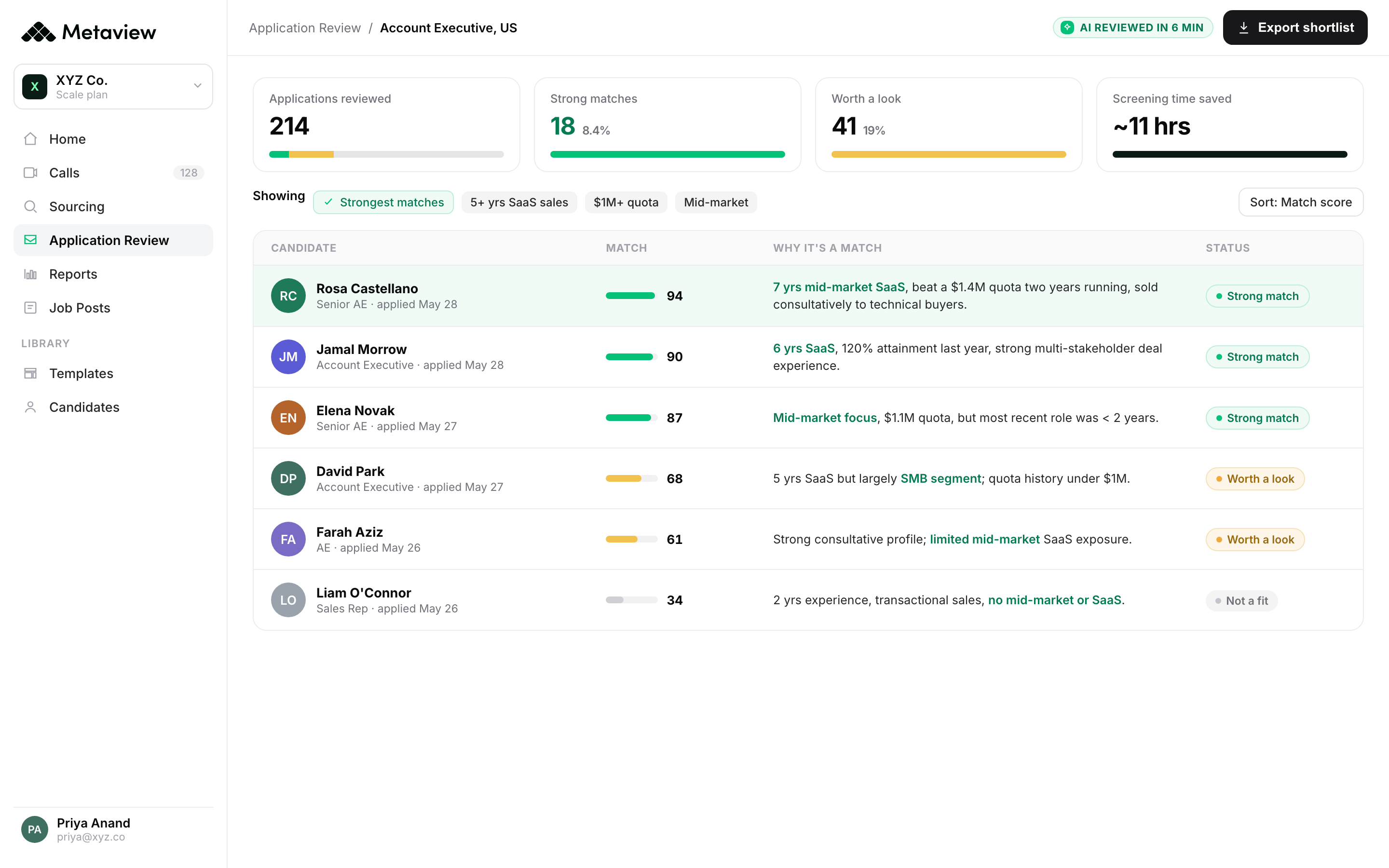
- 1ICP Fit column carries the verdict (Great, Good, Okay) for every applicant against the role profile. Sortable and filterable like any column.
- 2The reasoning sits next to the rating. Each row carries the one-sentence rationale, so the recruiter can sanity-check or override without a click into a profile.
- 3Progress or Reject is a single action. The decision posts back to the ATS as feedback. The recruiter is still the human in the loop.
The signal-layer reframe is also what makes the team stats from the 2026 Alignment Report cohere. Teams that put AI at the core of hiring are 3.8x more likely to rate their cross-functional relationship as excellent. Eighty-five percent of companies exceeding their hiring goals are using AI in hiring. Those numbers are not about replacing the recruiter or replacing the panel. They are about replacing the verbal hand-off with a captured artifact, so the recruiter and the hiring manager argue with the same data instead of arguing with their memories.
It's reduced my screening time by up to 50%. Both strong and weak profiles are reviewed within a couple of seconds.”

The two screens nobody draws on the org chart.
When a recruiting team talks about "screening," they usually mean two completely different events compressed into a single word. One is the resume screen: someone reads the application, decides yes or no, moves it along. The other is the recruiter-screen call: a thirty-minute conversation that decides whether the person becomes a real candidate or a polite rejection. They are wildly different workflows. The first one is volume-heavy and pattern-heavy. The second one is judgment-heavy and signal-heavy. Most teams run them with no clean hand-off between them, which is why the panel keeps re-litigating the same questions the recruiter already answered.
Alan Price, VP of People at Deel, made this point bluntly on the 10x Recruiting podcast: if your recruiter-screen process rate is around eight percent, then at five hundred applications your best candidate is almost certainly inside the first one hundred to one hundred fifty resumes. The volume past that point is mostly noise to wade through to find the next one. That means the marginal value of a faster, more structured resume read is enormous, and the marginal value of a deeper, captured recruiter-screen call is even bigger.
Screen one: the resume read.
What the resume read needs to produce is a ranked, rationale-attached pass at the funnel, against a written ICP. Not a keyword filter. Not a yes-or-no. A read with reasoning, sortable like a spreadsheet column, that the hiring manager can scan in under five minutes and challenge in two more. The recruiter still owns the final call on who moves to the screen call, but the work is supported, not redone, every Monday morning.
Screen two: the recruiter-screen call.
The thirty-minute recruiter screen is the single highest-leverage signal event in the entire pipeline. It is the only place where the recruiter gets to ask all of the open questions: motivation, compensation expectations, the timeline, the deal-breakers, the actual reasons the candidate is open, the calibration against the role's must-haves. If that conversation is captured and structured, it becomes a brief the hiring manager can read in two minutes before the next round. If it is not captured, every panelist re-asks the same questions, the candidate experience degrades, and the recruiter ends up retyping the same notes for the fifth time.
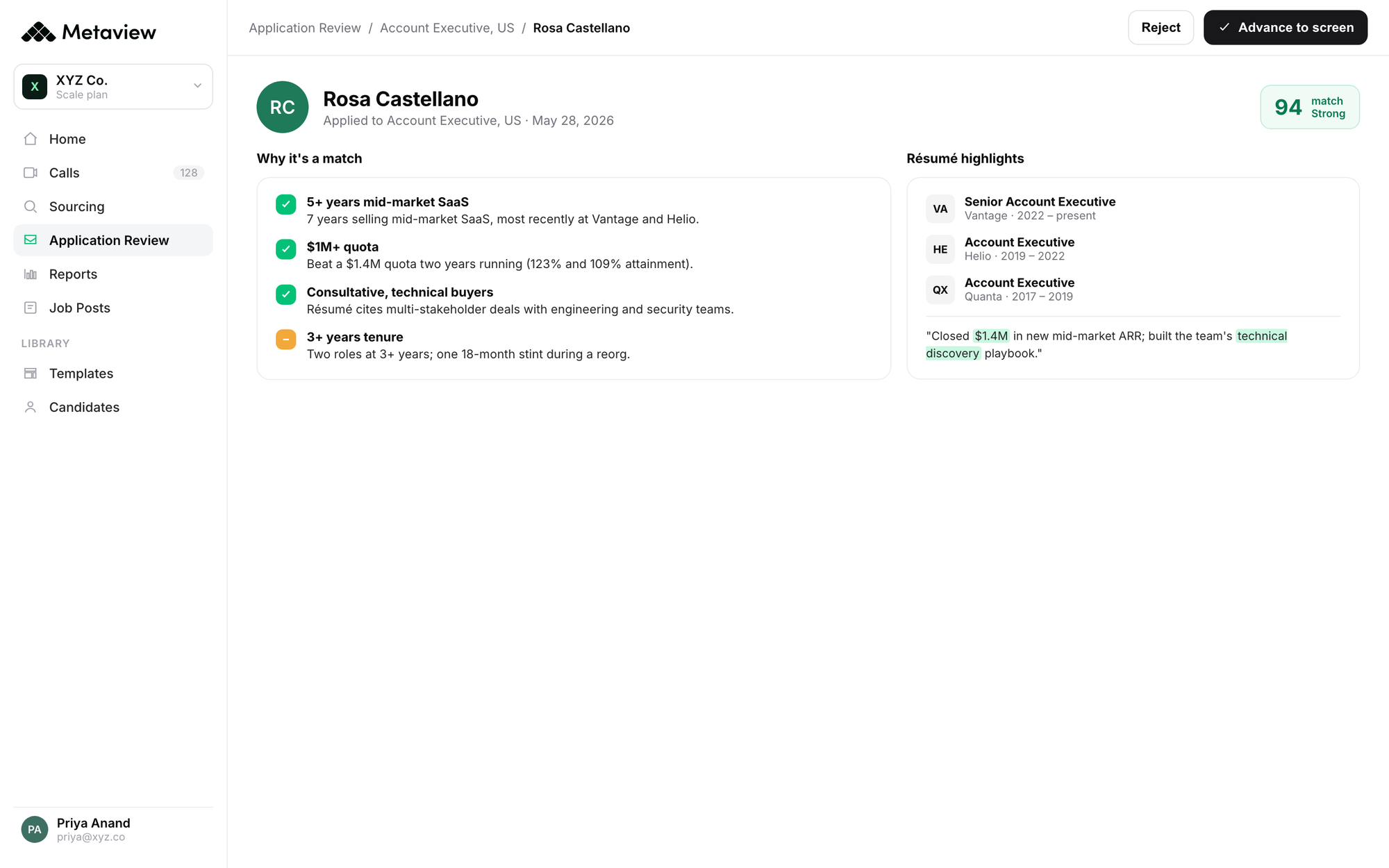
- 1The Ideal Candidate Profile is the artifact the recruiter and hiring manager align on once, in plain language. It is the source the AI works from.
- 2Every applicant gets evaluated against that same ICP, with the rationale and ICP Fit verdict attached to the row.
- 3The human decision sits at the end, by design. Progress or Reject is a recruiter call, posted back to the ATS for the panel.
- Recruiter eyeballs 200 resumes in a morning, makes a yes/no call from memory, no rationale captured.
- Hiring manager re-asks the resume questions in round one because the recruiter's read is in a private slack DM.
- The fifth panelist hears a different version of the candidate story than the first one heard. Calibration drifts every round.
- Two weeks in, the recruiter cannot remember why candidate #43 was rejected and the candidate cannot get a useful answer.
- Every applicant gets a structured read against a written ICP, with a one-sentence rationale on the row.
- The hiring manager reviews the ranked list in five minutes, posts feedback that re-trains the ICP for the next batch.
- The recruiter-screen call is captured and summarized. Every panelist reads the same brief before round one.
- The reject reason sits on the candidate record, posted back to the ATS, defensible at the candidate experience layer.
Inside the Application Review agent.
Metaview's Application Review agent went generally available on March 17, 2026, and the design choice that matters most is the one that is easy to miss in a marketing page: it is built to be a signal layer, not a decision-maker. The agent reads every inbound application against the role's Ideal Candidate Profile, produces an ICP Fit rating (Great, Good, Okay), and attaches the rationale to the row. The Progress and Reject buttons stay in the recruiter's hands. There is no auto-reject path.
The two-minute walkthrough below from Metaview's own channel is the best way to see the loop end-to-end. The pieces to watch for are: the ICP brief on the left, the ranked applicant table in the middle, the inline rationale on each row, and the human decision card on the right.
Four pieces of the agent are worth being explicit about. First, the ICP is the work product, not a hidden prompt. You write it in plain English, you upload context, you iterate on it as feedback comes in. Second, every applicant gets a read, not just the ones who match a keyword regex, so the recruiter does not have to worry about a strong candidate dying in a filter. Third, the decision posts back to the ATS as feedback, so Greenhouse and Ashby (the two integrations at launch) both stay the source of truth. Fourth, the agent's calibration sharpens as the recruiter feeds it accept and reject signals on each batch.
The recruiter-screen call as a signal layer.
The thirty-minute recruiter screen is the most under-leveraged surface in modern recruiting. It is where the candidate says, in their own words, what they actually want, what they will turn down, what they are worried about, and what they would have to be paid to leave their current role. It is also, on most teams, the worst-captured signal in the funnel, because the recruiter is typing into a Greenhouse note while the candidate is talking, and ends up with a half-page of bullet points that the hiring manager skims before round one and then forgets.
The fix is not to type faster. The fix is to capture the call as a structured artifact: a TLDR paragraph, a Q-and-A summary against a chosen template, the verbatim quotes that mattered, and a transcript that anyone on the panel can grep. Metaview's Interview Notes agent runs this loop for the recruiter automatically. The point is not that the AI takes notes. The point is that the recruiter, the hiring manager, and the third-round panelist all read the same brief two weeks after the call happened.
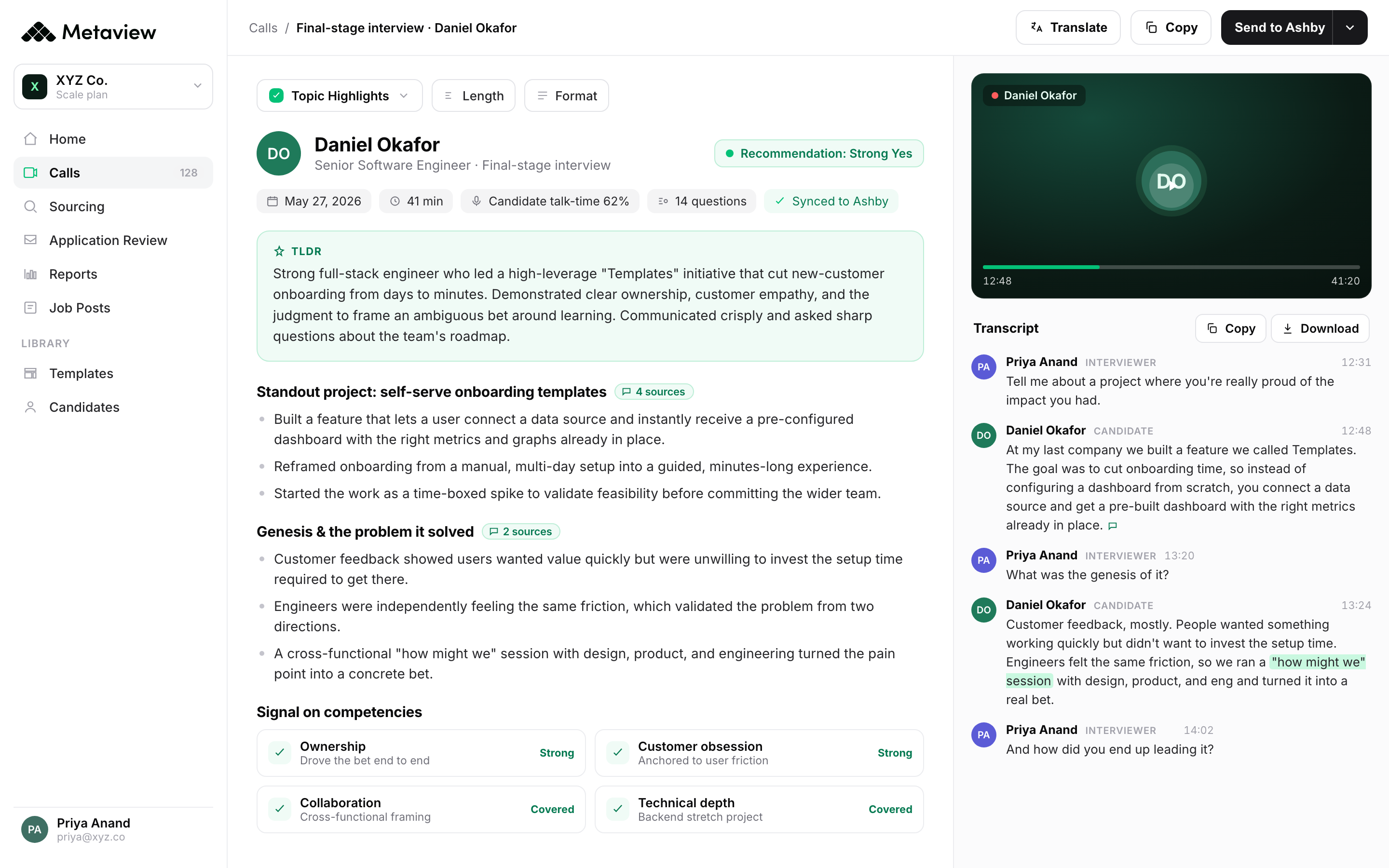
- 1Every recruiter-screen call lands here with the candidate, the role, and the round (Recruiter Screen) on the header.
- 2The Q-and-A template is the structured artifact. The panel reads the same template before round one, two, and three, so the questions do not repeat.
- 3A one-paragraph TLDR sits at the top for the hiring manager who has thirty seconds before joining the next call.
The Application Review agent that pairs with this Notes loop launched on LinkedIn on the same day it went generally available. The post is a good single-page primer on the calibration model, and the comment thread is full of recruiter-to-recruiter reaction worth reading.
 linkedin.com
Customer proof: what changes after 90 days.
Workleap turned Metaview's screening loop on across its inbound funnel and tracked the delta for ninety days. The senior recruiter team had been hand-reviewing applications against a written rubric for years, so the comparison was honest: same role, same volume, same recruiter, different workflow. The numbers below are the ones the team reported in the published case study, not modeled, not projected.
The number that matters more than fifty percent is the one Johnny Drexhage called out about the bottom of the pile: weak profiles get the same two seconds as strong ones. Before, the bottom hundred resumes either got a rushed reject (no rationale) or got skipped entirely because the recruiter ran out of time. After, every applicant got a structured read with rationale attached, which is the part the candidate experience team had been asking for since the volume doubled. The win is not just time. The win is consistency.
The second-order effect is the part that compounds. Once the ICP is the work product, and once the recruiter-screen call is captured as a brief, the hiring manager stops re-asking the resume questions in round one. The panel stops re-litigating the same calibration debate in round three. The recruiter stops retyping the same notes for the fifth round. The whole panel runs on a single read of the same evidence, and the time savings stack across every step.
How to roll this out in the next two weeks.
The four-step rollout is deliberately small. The reason most teams stall on "AI screening" is that they treat it as a stack migration when it is actually a workflow change. The technology side takes a morning. The workflow side takes two weeks, and only because the team needs to see two batches of calibration before they trust the ICP.
- Day 1: write the ICP in plain language. Two paragraphs. The role, the must-haves, the disqualifiers, the bar for Great vs Good vs Okay. The recruiter and the hiring manager sign off on the same draft. This is the work product.
- Day 2: connect the ATS. Application Review supports Greenhouse and Ashby at GA, with the rest of the ATS surface area on the roadmap. Connection takes under ten minutes. The agent inherits the same role permissions as the ATS.
- Days 3 to 10: run the first two batches with the recruiter on every Progress and Reject. No auto-anything. The recruiter clicks through every row, flags the misses, and the ICP sharpens against the feedback. Treat this as the calibration step, not the production step.
- Days 11 to 14: layer the recruiter-screen call capture on top. Notes runs on every recruiter-screen call against the chosen template. Two weeks in, the hiring manager is reading the brief before round one, not asking the same questions in round one.
This ICP, the ideal candidate profile, is your primary work product as a recruiter now. Engineer the context such that the AI understands what you're looking for just as well as you do, and then use that context in any part of the workflow where it makes sense.”

Bring Metaview into your hiring stack.
Live notes, structured scorecards, and ATS sync - set up in under 10 minutes.
Frequently asked.
What's the difference between candidate screening and candidate shortlisting?
Screening is the structured read across the full inbound funnel. Shortlisting is the recruiter's call on who moves to a recruiter-screen conversation. In a signal-layer workflow, screening produces the ranked artifact, and shortlisting is the human decision on top of it. Most teams collapse the two and lose the rationale; keeping them distinct is what makes the downstream panel review fast.
How long should the candidate-screening process take in 2026?
For a single batch of around 200 inbound applications, a ranked, rationale-attached read should land in under an hour, and the recruiter's go-forward calls should land inside a working day. The benchmark to beat is not headcount; it is the gap between when an application arrives and when the candidate gets a useful response. Anything over five business days is where teams start losing the strongest people to faster-moving competitors.
How does AI screening reduce bias instead of amplifying it?
The honest answer is: only if the ICP is written explicitly, the rationale is attached to every row, and the recruiter is the one clicking Progress or Reject. Bias-aware screening is a workflow shape, not a feature toggle. Anonymising specific fields, surfacing the reasoning behind every rating, and keeping the recruiter on the decision button are the three moves that matter.
What's the right ratio of resumes to recruiter-screens to hiring-manager screens?
A useful rule of thumb in mid-funnel hiring is a three-to-one ratio at each step: three at the recruiter screen for one to the hiring manager screen, three at the hiring manager screen for one to onsite. If you are below that, you are moving people forward who should not be moving forward; if you are well above it, your screen quality is bleeding strong candidates.
Can Metaview's Application Review replace the recruiter screen call?
No, and it is not designed to. Application Review compresses the resume read; the recruiter screen call is where motivation, compensation, timeline, and deal-breakers actually surface. The two surfaces compound: a structured resume read makes the screen call shorter and sharper, and a captured screen call feeds the next round with a brief the panel can actually use.
How does Metaview's screening loop differ from an ATS keyword filter?
An ATS keyword filter is a subtractive rule: match the regex, advance the row. Metaview's loop is additive: read the application against a written ICP, attach a rationale, post the verdict back to the ATS as feedback. The ATS stays the system of record. The screening loop adds the signal layer the ATS keyword rules cannot produce on their own.


