
The energy industry's response to specialized-roles scarcity has been to chase time-to-hire numbers. Faster offers. Fewer interview rounds. Deeper agency relationships. Looser certification verification. Twelve months later, the same companies post higher turnover, more on-site incidents, and re-hires that cost twice what the original hire cost. The "go faster" frame solves the wrong problem.
The slow part of energy hiring is not sourcing. It is the handoffs. Every specialized hire travels through six conversations: technical interview, safety and compliance check, operations debrief, hiring-manager calibration, ATS sync, onboarding handoff. Each conversation produces signal the next one mostly cannot see. By the time the candidate is in the offer pipeline, the original technical question about whether they actually understood arc-flash protection is a footnote in someone's Slack DM.
This guide rebuilds energy sector recruitment around what compresses the cycle: structured capture of certification, scenario, and competency signal at the interview itself, surfaced through every downstream conversation so nothing gets lost in the handoff. According to Metaview's 2026 AI & Hiring Alignment Report - surveying 505 recruiting leaders and hiring managers across North America and EMEA, only 27% of recruiting leaders and hiring managers say the thought of bypassing their counterpart never crosses their mind. Add specialized roles, compliance gates, and project-spike deadlines on top of that gap, and the cycle stretches further than any sourcing optimization can recover.
Why "hire energy talent faster" is the wrong frame.
Most energy TA leaders inherit a metric stack that rewards speed. Time-to-fill on the dashboard. Cost-per-hire next to it. Offer-acceptance rate as the only quality proxy. The metrics are not wrong, they are just the wrong load-bearing column. A linemen role filled in 18 days with a poor competency match costs more in month four (when the crew lead reassigns them off the high-voltage work) than the same role filled in 35 days with a clean signal trail.
The cost of a bad specialized hire in energy is not the recruiter's fee. It is a six-month retraining cycle, the on-site safety culture tax that everyone else pays around them, and the offer the company now has to make on the next backfill against a tighter market. Reframe the question and the scoreboard changes. Instead of "how fast did we fill it," the load-bearing metric becomes "how much signal did we capture about whether this hire actually understood the work, and is that signal still visible to the next conversation after the interview ends."
Most energy hiring stacks fail at signal preservation, not at speed. The 90-minute technical interview produces a single PDF summary that lands in the ATS. The safety lead, who joins the panel three days later, reads the summary, asks four follow-up questions, takes notes on a printed scorecard, and emails the recruiter a thumbs-up. The operations debrief happens on a call where nobody takes minutes. The offer team sees an ATS row with "strong technical, safety-cleared, ops-approved." The original signal, where the candidate actually described a near-miss they witnessed and how they intervened, is gone. So is the moment to catch a hire who fudged the answer.
The 4 capture inputs that actually compress the cycle.
If "go faster" is the wrong frame, what is the right one? Four capture inputs that travel through every handoff intact. Each one individually compresses one of the bottlenecks above. Together they are what most teams mean when they say "interview intelligence" without quite naming it. Below is each input, the failure mode it fixes, and what it looks like operationally.
Input 1. Certification capture.
Energy hiring runs on a verifiable certification stack: OSHA 30, NFPA 70E, IECEx, NERC, AWS welding codes, lock-out/tag-out competency, confined-space entry, and dozens of role-specific credentials. Most teams capture credential names in the ATS and stop there. The failure mode shows up later, when the credential is current but the candidate has not actually applied it in 18 months. The capture has to include the most recent specific scenario in which the candidate used the credential. Certificate number plus a story, not a checkbox.
Input 2. Scenario and safety signal.
The interview question that actually predicts on-site safety is not "have you been trained on fall protection." It is "walk me through the last time you watched a peer skip a fall-protection step. What did you say, and what happened next." The answer is scenario signal. It either exists in the candidate's history or it does not. The capture problem is that most teams ask the question, get an answer, and lose the verbatim response inside a summary. The scenario has to land in the record as a quotable moment, not a paraphrase. That is what survives the handoff to the safety lead three days later.
Input 3. Cross-panel synthesis.
Specialized energy roles are interviewed by a panel that almost never meets in the same room. The technical lead works one shift. The safety lead is regional. The operations manager is on the rig or at the substation. By the time anyone synthesizes their input, two of the three have already moved on to other work. The synthesis layer needs to produce a single artifact every panelist can pressure-test before the offer, with their own assessment preserved verbatim alongside the others. Not a vote tally. A side-by-side that lets disagreement surface.
Input 4. ATS sync and audit trail.
Whatever you capture has to land in the system of record before it is useful. Energy hiring also carries a compliance overlay almost no other industry shares: in a regulated incident investigation, you may need to produce evidence of every competency-related question asked during a hire's interview cycle. That cannot live in a Notion doc. It has to be in the ATS or in a tool the ATS can ingest without manual export. The audit trail is a feature you only realize you needed after the OSHA letter arrives.
I get more signal off of work trials than I do just about anything else. You give them a situation, they have to solve it, and they come back and present it to the team. The team jams on it with them. In that exercise alone I see problem solving, writing skills, presentation skills, how they collaborate with the team.”

What gets lost between the technical interview and the safety debrief.
Most energy hiring funnels have the right interview stages on paper. Technical screen with the discipline lead. Safety review with a field-experienced manager. Operations debrief with the people the candidate will actually work alongside. The structure is sound. The loss happens between those stages, in the seams the recruiter is supposed to bridge but rarely has the working memory to bridge well.
The technical interviewer asks about a specific high-voltage scenario and the candidate answers in detail. The recruiter writes "strong technical depth on substation work." The safety lead reads that line three days later and asks the candidate to walk through the same scenario again, because the summary did not preserve the details that matter for the safety perspective. The candidate, tired by the third interview, gives a shorter version. The safety lead approves the hire on a less rigorous version of the answer than the technical lead heard. Nobody noticed.
Compounding the loss: each interview also produces signal about what the candidate did not say, which is often more diagnostic than what they did say. A field-experienced safety lead notices when a candidate describes a hot-work scenario without mentioning the permit chain. A summary cannot notice that. The mechanism for preserving the absence is the verbatim capture itself, scoped to the question that was actually asked, available to the next interviewer before they ask their own version.
- Technical interview produces a one-paragraph PDF summary. Verbatim scenario answer is gone by day 3.
- Safety lead re-asks the same scenario; candidate gives a shorter version; nobody compares.
- Operations debrief happens on a call with no minutes. Concerns surface privately to the recruiter.
- ATS holds three thumbs-ups and no underlying evidence. An incident investigation has nothing to pull.
- Technical interview is captured verbatim. Scenario answer is searchable, quotable, and visible to every later panelist.
- Safety lead sees the technical version before asking their own follow-up. Discrepancies surface inside the interview, not 4 weeks later.
- Operations debrief is structured against the same competency template. Concerns are visible to the panel, not buried in DMs.
- Every competency-related question and answer is in the system of record. An audit pull is one ATS export, not a 6-week reconstruction.
Certifications, scenarios, and the audit trail you need anyway.
Even teams that fully embrace the signal-not-speed reframe still underweight one part of it: the audit trail. Energy hiring is regulated work in a way that most TA leaders only feel after an incident triggers a discovery request. At that moment, the question is not "did your hiring process look reasonable" but "can you produce evidence of every competency-related question asked during this hire's interview cycle, and can you do it within the response window the agency is giving you."
Most teams cannot. The interview happened on Zoom or Google Meet. The recording is gone, deleted on the platform's default retention. The interviewer's notes are in a private Notion page nobody can find now that the interviewer has changed teams. The recruiter's ATS comments are a five-line paraphrase. The pulled record satisfies almost nobody. The legal and operations cost of that gap is uncapped, and it gets paid in the worst possible moment.
The argument for capture-as-default is not that every interview needs to defend itself in a deposition. It is that the same infrastructure that makes the everyday handoffs less lossy also produces an audit trail you can hand over inside an hour. The TA team gets faster cycles in the happy path and a working defense in the bad path. The cost is one configuration change to use a capture-by-default tool for every panel.
Where Metaview fits in an energy hiring stack.
Most energy TA teams already run three tools: an ATS (Greenhouse, Workday Recruiting, iCIMS, SmartRecruiters), a sourcing layer (LinkedIn Recruiter, agency networks, internal referral platforms), and a video platform (Zoom, Teams, Google Meet). Adding a fourth tool is a hard sell unless it earns its keep at one of the seams between the existing three. Interview intelligence earns its keep at the seam between the video platform and the ATS, which is exactly where signal currently dies.
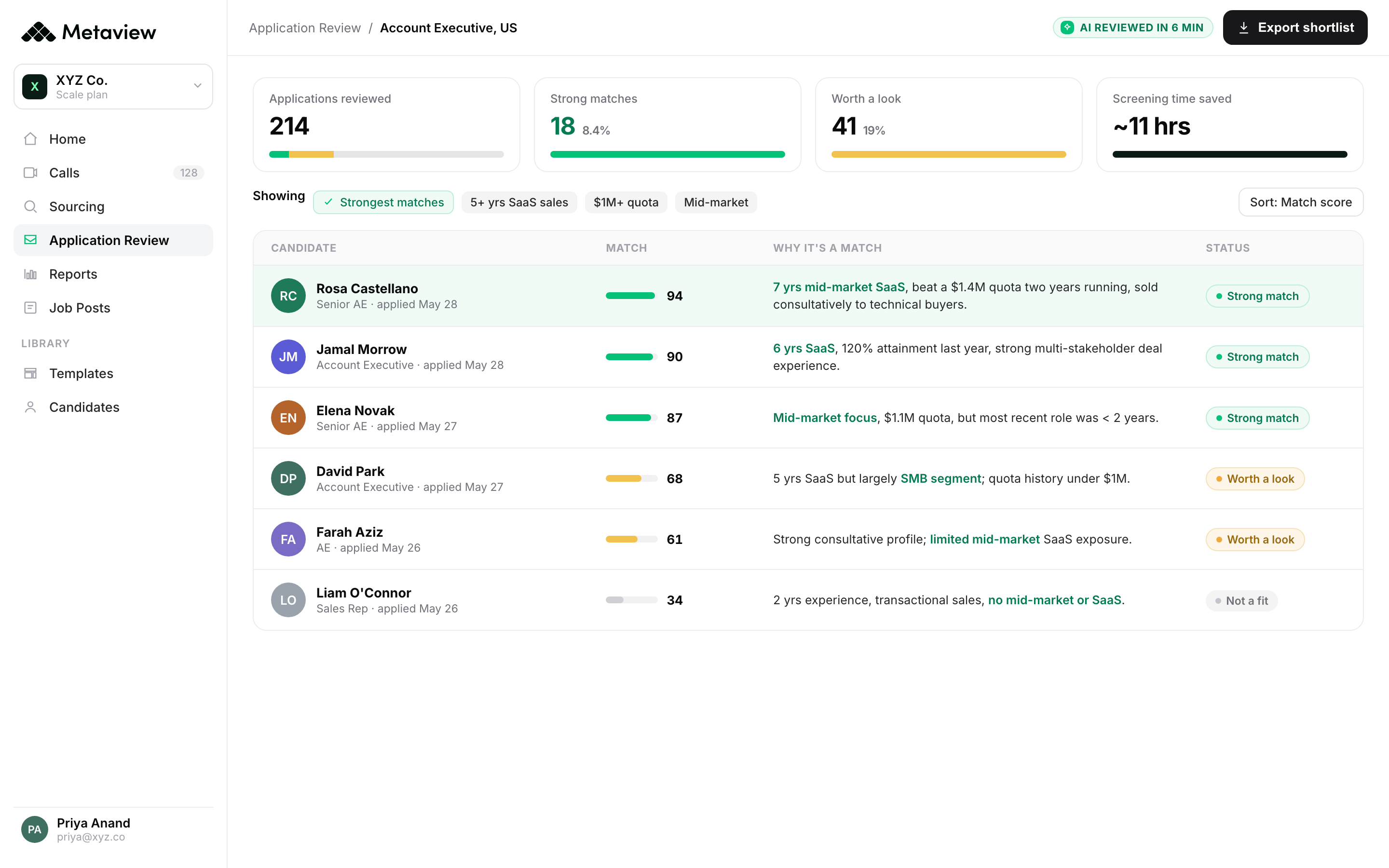
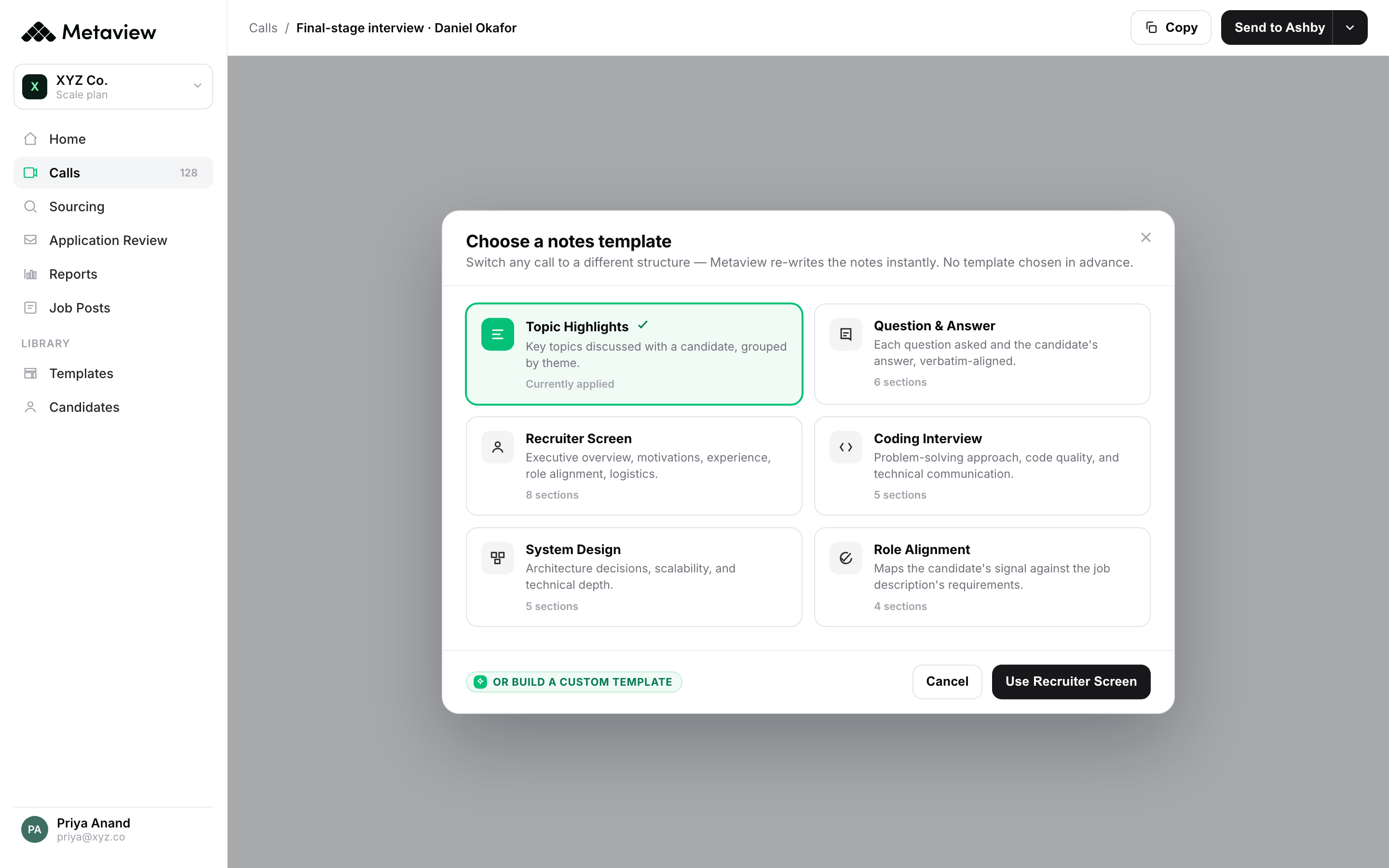
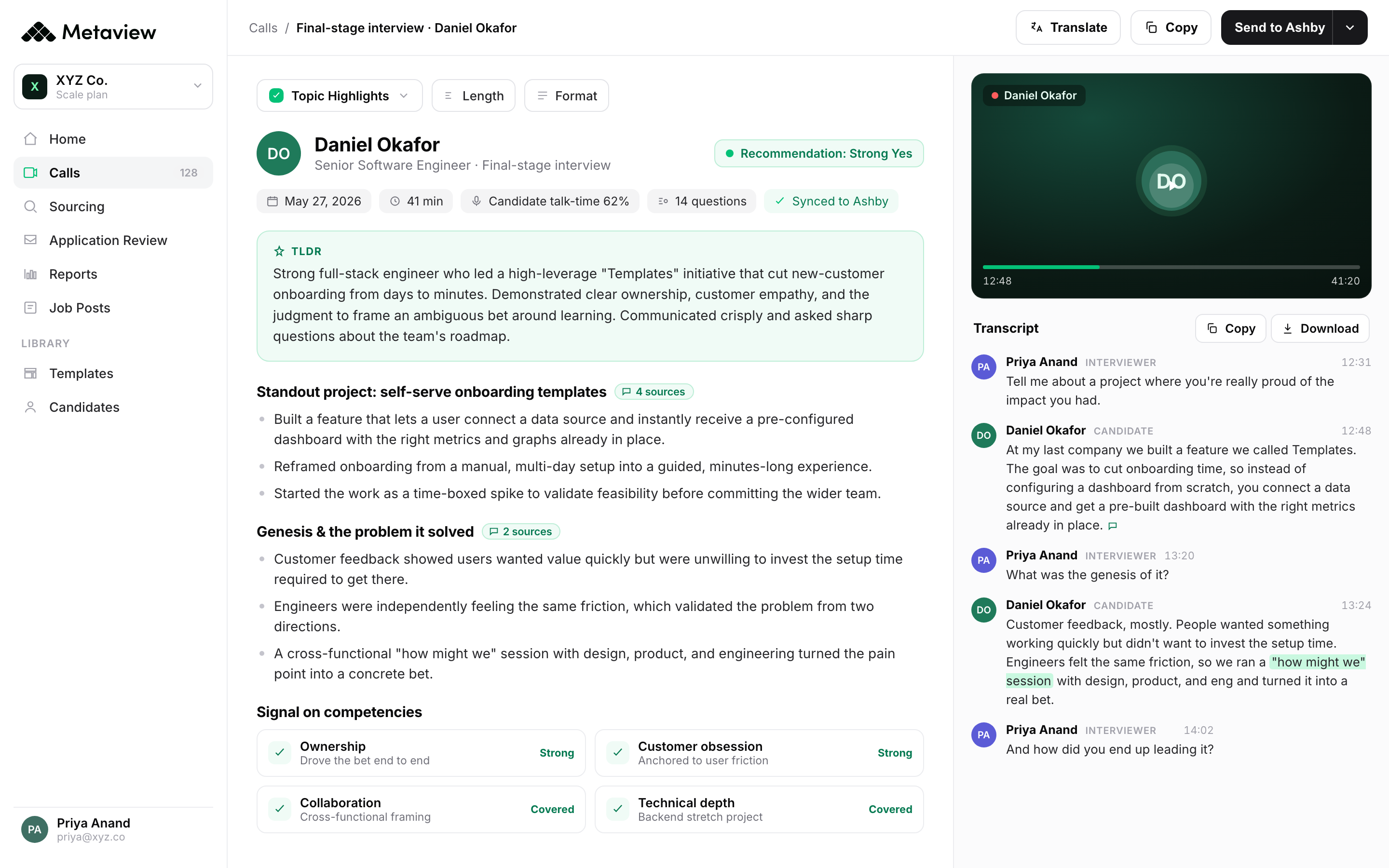
Operationally, Metaview joins the call as a Notetaker, captures the panel verbatim, and produces a structured artifact against whatever interview template the team has set up for the role. The template is where the energy-specific structure lives: certification questions, scenario prompts, safety-incident probes, role-specific competency dimensions. The output lands in the ATS automatically, and is searchable across the entire interview history for the candidate, the role, and the team. Application Review handles the top-of-funnel triage, surfacing certification and compliance flags before the recruiter screen. AI Filters lets the recruiter ask plain-language questions across every interview captured against that role's template.
What it does not replace: the discipline lead, the safety lead, the operations manager. They are still the people deciding the hire. What it changes is what they see when they decide, and what survives after they have decided.
 Metaview Technologies
Over the last few months, our Talent Acquisition team has been using Metaview, and it has made a significant impact. While the AI handles the heavy lifting of summarizing discussions, we are able to engage in more meaningful conversations with candidates. We are now even using Metaview for our briefing calls with Hiring Managers, allowing us to gain a deeper understanding of the roles we are sourcing for.”
The 30-day rollout for a specialized-roles TA team.
The fastest path to signal infrastructure in an energy TA team is not a tool selection cycle. It is a 30-day rewrite of the interview structure for one or two role families that hire most often. The rollout below assumes the team has already chosen a capture layer (Metaview or otherwise). If the team has not, replace step 2 with a 5-day evaluation cycle on a single role and budget accordingly.
- Days 1 to 3. Pick the two role families that hire most. Substation tech, control-room operator, EHS coordinator, project engineer, lineman, instrument tech. Pull the last 8 hires per family. Reconstruct what the interview signal was supposed to capture, and where it was lost.
- Days 4 to 7. Define the competency template for each role family. 5 to 7 specific behaviors. For each, the verbatim scenario prompt the technical lead would ask, the safety follow-up the safety lead would ask, and the operations probe the manager would ask. Two pages per role family, no more.
- Days 8 to 10. Configure the capture layer. Set the role-family template inside Metaview (or equivalent). Verify the ATS sync end-to-end. Run a test capture on a real interview with consent and check the output against the template.
- Days 11 to 18. Run the first 5 interviews per role family against the new structure. Have the technical, safety, and operations leads each review one captured interview each before moving to the next candidate. The point of the first wave is the calibration, not the offer.
- Days 19 to 22. Run the first cross-panel synthesis. Pull the verbatim scenario answers, the safety follow-ups, and the operations probes side-by-side. Identify which panelist is over-indexing on a competency and which is under-indexing. Adjust the template if any competency is producing no useful variance.
- Days 23 to 27. Wire the audit trail. Confirm every captured interview lands in the ATS with the competency-tagged Q&A. Run a mock audit pull: pretend an OSHA-style discovery request just arrived for one of the closed hires. How fast can you produce the evidence, and is it complete.
- Days 28 to 30. Hand the playbook to the rest of the team. The first two role families have the structure validated. Brief the discipline leads on the new interview template, the safety leads on how the cross-panel synthesis works, and the hiring managers on what to expect from the new debrief. Schedule a 60-day review on the metrics that actually moved.
Bring Metaview into your hiring stack.
Live notes, structured scorecards, and ATS sync - set up in under 10 minutes.
Frequently asked questions.
How is energy sector recruitment different from other industries?
Three structural differences. First, the certification stack is heavy and regulated: OSHA 30, NFPA 70E, IECEx, NERC, AWS welding codes, plus role-specific credentials. Second, hires travel through more handoffs than almost any other industry (technical, safety, operations, plus the recruiter and hiring manager). Third, a bad hire carries on-site safety risk, not just productivity loss. Those three together make signal capture, not sourcing speed, the load-bearing problem.
Can energy companies hire faster without compromising on safety?
Yes, but not by optimizing time-to-fill. Time-to-fill goes down as a side effect of compressing the handoffs between the technical interview, the safety review, and the operations debrief. When each handoff carries the verbatim scenario answer with it, the safety lead does not have to re-interview the candidate to confirm the technical lead's read, the operations manager does not have to re-ask the same questions, and the offer can land on a single round of synthesis rather than three.
What is the best way to handle high-volume hiring for large energy projects?
Two parallel moves. First, top-of-funnel triage that surfaces certification and compliance flags before the recruiter screen, so the recruiter spends their time on candidates who actually clear the credential floor. Second, role-family interview templates rather than role-specific templates: substation tech, line worker, instrument tech, project engineer. The template captures the competency scaffolding; the role specifics get layered on top. That combination handles 50 to 100 hires per quarter without losing signal on any individual hire.
How do you assess candidates for field-based energy roles when you cannot run a site visit?
Scenario-based interviews with verbatim capture. Ask the candidate to walk through a specific recent moment when they applied the credential under field conditions: the last lock-out/tag-out they performed, the last near-miss they witnessed, the last permit chain they coordinated. The detail and the absences in the answer carry the signal. The verbatim capture preserves both for the safety lead three days later, who can pressure-test the story against their own field experience without re-running the interview.
Does AI in energy hiring create more compliance risk or less?
It depends entirely on whether the AI is a sourcing-and-screening layer or a capture-and-audit layer. AI sourcing tools that filter candidates without a verifiable audit trail add compliance risk: you end up unable to defend why a particular candidate was excluded. AI capture tools that record and structure every panelist's verbatim assessment reduce compliance risk: every competency-related question and answer is in the system of record, retrievable inside an hour. The category matters more than the buy decision.


