Forty-nine percent of teams without AI start a search with you and your hiring manager actually aligned on what the role is. Sixty-eight percent of teams with AI core to their hiring do. That nineteen-point gap is the cheapest, most leveraged lift available to a TA leader right now, and it shows up later as the cost of a misaligned panel: phone screens that argue against the rubric, debrief meetings that re-litigate the spec, and an offer that hangs in committee because nobody can agree what "strong" looked like in the first place.
Hiring needs are not a one-hour intake meeting and a tidy doc in Notion. They are the operating model that decides which candidates make it to a phone screen, which competencies the panel actually probes, and whether the hiring manager recognizes the person who walks in the door. Treated as a kickoff, they decay the moment the recruiter starts sourcing. Treated as infrastructure, they get sharper with every interview.
This post is the workflow for the TA leader who has run kickoffs that didn't survive contact with the first candidate. We cover what hiring needs actually are (and what they aren't), the eight steps to define them once and refine them continuously, the four bottlenecks that quietly destroy intake, and the surfaces that turn the whole exercise from a slide deck into a ten-minute workflow.
Why 49% of kickoffs leak alignment before the first screen.
The traditional intake meeting is a recruiter and a hiring manager in a thirty-minute calendar slot, a Google Doc that gets edited once, and an ATS requisition that captures none of it. The recruiter walks out with a list of must-haves. The hiring manager walks out remembering only the parts that resonated. The panel never sees either version. By the third interview, every interviewer is calibrating on their own internal definition of the role, and the rubric becomes a vote count.
The 2026 AI & Hiring Alignment Report puts numbers on what this costs. Among teams who run hiring without AI in the loop, only 49% say their searches start with the recruiter and hiring manager aligned on requirements. Among teams who treat AI as core to hiring, that figure jumps to 68%. The same report finds that teams with excellent alignment exceed their business goals at more than twice the rate of teams with fair-or-poor alignment, and that poor partnerships are 3x more likely to miss their hiring goals outright.
The numbers come from Metaview's 2026 AI & Hiring Alignment Report - surveying 505 recruiting leaders and hiring managers across North America and EMEA, with hiring managers and recruiters answering the same questions so the gap between them is measurable. The four stats below are the business case for treating hiring needs as a system, not a slide.
I've interviewed a lot of recruiters recently. One thing I notice: it's kind of the same playbook and the same script with everybody. The role of the recruiter going forward is being a true business partner, understanding the business, the goals, the health, the finances, the products. That's what will let you identify the right people.”
Hiring needs vs. headcount: the language gap that wrecks panels.
Most teams use "hiring needs" interchangeably with three other phrases that mean different things. Headcount is a number that lives in Finance. Requisitions are ATS rows that authorize the recruiter to run a process. Job descriptions are externally-facing prose. Hiring needs are the internal operating spec that tells the panel what "strong" looks like for this specific role, at this specific stage of the company, evaluated against this specific bar. Treat them as the same thing and the panel ends up arguing about candidates who never had the same definition of "strong" in the first place.
The teams who keep these straight have one document that the recruiter, the hiring manager, and every interviewer all see before the first phone screen. It is short, it is outcomes-led, and it survives because it is regenerated from real interview data after every hire, not redrafted from scratch when the requisition reopens.
The 8-step hiring-needs workflow.
The workflow below is sequential. Skipping forward to step seven (evaluation criteria) is the single most common cause of misaligned panels, because the criteria fall out of steps one through six, not the other way around.
1. Confirm business objectives and growth plans.
Start with the company plan, not the requisition. What does the business need this person to make true in the next four quarters? If the recruiter cannot finish the sentence "this hire exists because the business is trying to ..." in one breath, the kickoff is not done. Evan, the Recruiting Lead at Ambient quoted above, makes the same point: the recruiter is a business partner first, a process operator second.
2. Review current skills and competencies.
Map the team's existing capabilities before defining what the new hire adds. Pull from real interview signal where you have it: which competencies are over-indexed, which are scored low or inconsistently, which interviewers always agree and which always argue. If you've been running structured interviews for six months, the signal is in your interview data, not the org chart.
3. Identify and analyze skills gaps.
The gap is the delta between the business objective and the team's current capability. Be specific about whether the gap is volume (we need three more of the same), depth (we need one senior of what we have), or breadth (we need a competency the team doesn't have at all). Each shape of gap implies a different sourcing strategy and a different interview loop.
4. Decode your top performers' actual qualities.
Pull the scorecards and notes from the last three hires the panel rates as a 9-out-of-10 today. Ignore the post-hoc story everybody tells about why they were great; look for the specific signals that showed up in their interview loop. "Strong communication" is not a signal. "Restated the problem before answering and named two assumptions" is.
5. Define outcomes, not responsibilities.
A responsibilities list is a job description. An outcomes list is the hiring needs spec. For a Senior Account Executive, the difference is between "manage a book of named accounts" (responsibility) and "close $1.2M in new logo by Q4 from a self-built pipeline of mid-market commercial accounts" (outcome). Outcomes give the panel something to interview against.
6. Align stakeholders early, in writing.
Every interviewer on the loop sees the same four-line summary before they pick up the slot: business goal, outcome, must-have competencies, deal-breakers. If two interviewers would disagree about a deal-breaker, the kickoff is not done. Resolve before the first phone screen, not in the debrief.
7. Translate hiring needs into structured evaluation criteria.
Each must-have competency becomes one scorecard line item with three things attached: the signal you're looking for, the question template that elicits it, and the example of a 7-out-of-10 answer. Without those three, "structured interview" is just "the questions everyone happens to ask in the same order." See our scorecard playbook for the template.
8. Validate and refine after every hire.
After the first three hires close, re-run the kickoff against what the interview data shows. Did the rubric predict the offers that got accepted? Did the competencies you marked as "must-have" actually correlate with the people you hired, or did they get traded off in the debrief? If the rubric never gets updated, it's not a hiring-needs spec. It's a job description in a Notion page.
The four bottlenecks that quietly destroy intake.
The eight-step workflow looks clean on paper. In practice, four bottlenecks reliably break it, and they break it in the same order every time.
Bottleneck one: the hiring manager has not written the spec themselves. If the recruiter ends up drafting the role outcome, the hiring manager will tell the panel something different in the debrief because they never owned the words. Bottleneck two: the kickoff document is not regenerated from real interview data. A spec written from a Notion template is a guess; a spec written from the last ten interviews is calibrated. Bottleneck three: interviewers see the spec for the first time when they accept the calendar invite. By then it's too late to negotiate the deal-breakers. Bottleneck four: the spec is never updated after the offer is signed. The next req in this role reopens with the same template the first one used, and the cycle restarts.
How Metaview operationalizes alignment at kickoff.
The eight steps above are work the recruiter would do anyway. The lift is not new effort, it is removing the manual translation between systems. Metaview sits on the interview layer (intake call, phone screens, panels, debriefs) and captures the spec, the rubric, and the calibration loop in the same surface, so none of it has to be re-typed into a doc or a slide. Below is how each kickoff lift maps to the equivalent manual or generic-AI workflow.
| Kickoff lift | Manual | Generic AI | Metaview |
|---|---|---|---|
| Capturing the hiring manager's actual ask | Whiteboard, then re-typed into a Google Doc | Generic transcription, no template, no scorecard | Intake call auto-classified, captured against a role-outcome template |
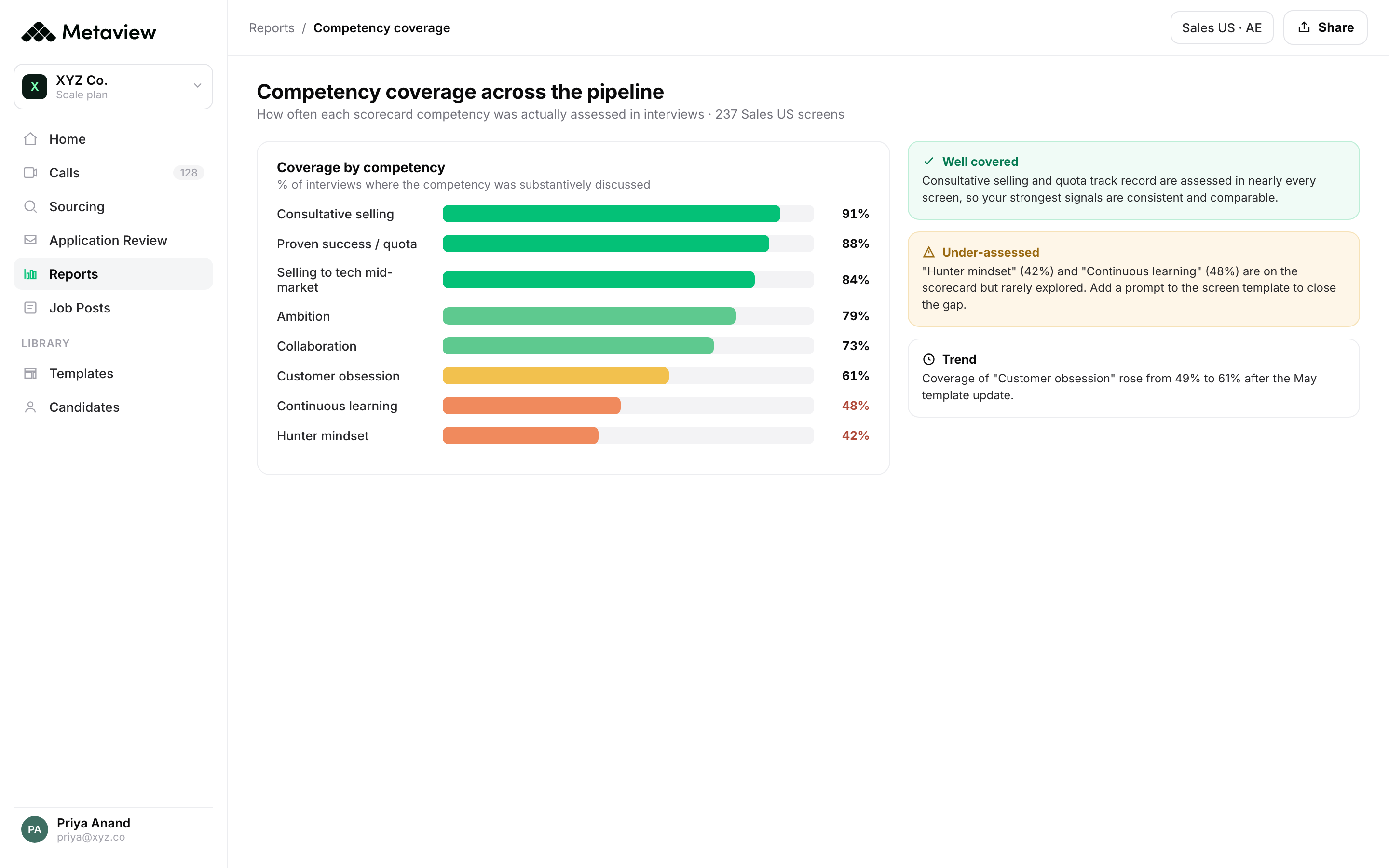
| Translating goals into evaluation criteria | Recruiter retypes into the ATS scorecard | Bullet-list summary, not tied to any rubric | Structured scorecard tied to named competencies, regenerated each round |
| Pushing criteria to every interviewer | Email or kickoff deck attached to the invite | Manual share of the AI summary | In the calendar invite + interviewer worksheet + ATS field |
| Validating the ask after the first five hires | Quarterly retro, mostly anecdotal | Not supported | Reports / Insights table showing capture per competency across candidates |
Once the kickoff is captured against a template, sourcing can run against the actual spec. Walkthrough of how Metaview's AI Sourcing agent uses intake-call signal to build its first slate.
What customers running this play are seeing.
The teams operationalizing the eight steps are not running a different process. They are running the same process with less re-typing, and the time they save shows up as consistency. The customer case below sits at the cluster the report calls "alignment as infrastructure": every interview is captured against the same template, the same rubric, and the same definition of "strong," so the panel actually compares like with like.
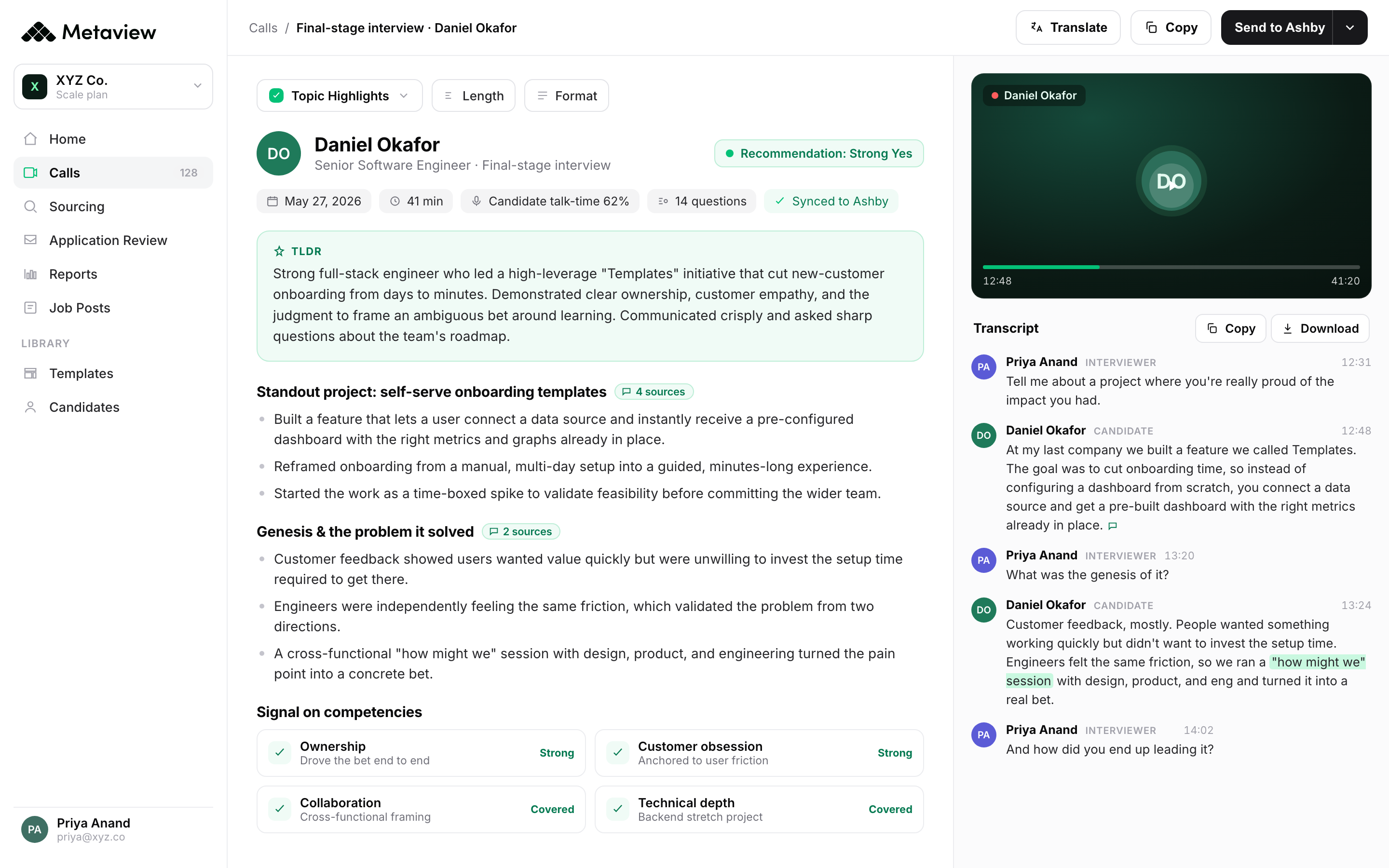
Hiring managers can be less experienced or newer to hiring, so being able to structure their questions and give them guidance on the questions to ask, which are then represented in the scorecard and their notes, makes it more consistent. People are following the same line of questioning, and we can compare and contrast.”
 Metaview
The 8-step hiring-needs workflow in one screen.
- Step 1. Confirm business objectives and growth plans before the requisition is opened.
- Step 2. Review current team skills and competencies against real interview signal.
- Step 3. Identify the gap by shape: volume, depth, or breadth.
- Step 4. Decode the specific signals top performers showed in their interview loops.
- Step 5. Define outcomes, not responsibilities, in writing.
- Step 6. Align every interviewer in writing before the first phone screen.
- Step 7. Translate must-haves into scorecard lines with signal, question, and 7-out-of-10 answer.
- Step 8. Validate the rubric against actual hires every quarter, regenerate from interview data.
Bring Metaview into your hiring stack.
Live notes, structured scorecards, and ATS sync - set up in under 10 minutes.
Frequently asked.
What's the difference between hiring needs and a job description?
A job description is externally facing: it tells a candidate what the role looks like from the outside. Hiring needs are internally facing: they tell the recruiter, the hiring manager, and every interviewer what "strong" means for this specific role, what the deal-breakers are, and what outcomes the hire is responsible for delivering. You can write a perfectly good job description without ever clarifying the hiring needs. Most teams do.
How long should a hiring-needs kickoff take?
Forty-five minutes of structured conversation, then twenty minutes of writing. The structure is what makes it short: business goal, outcome, top-performer signals, must-have competencies, deal-breakers, deal-makers. If a kickoff takes two hours, the conversation is wandering because no template is forcing it forward.
Who should own the hiring-needs document, the recruiter or the hiring manager?
The hiring manager owns the spec. The recruiter owns the operational scaffolding around it (the kickoff agenda, the scorecard build, the interviewer briefing). If the recruiter ends up authoring the role outcome, the panel will get a different version in the debrief because the hiring manager never owned the words.
How often should hiring needs be reviewed?
After every three hires in the role, or after any business event that changes the underlying objective (a strategy pivot, a budget reset, a new top performer who changes the bar). Reviewing means re-running the kickoff against the interview data you now have, not redrafting from scratch.
Can AI define hiring needs for me?
No, and any tool that claims to is selling a slide deck. AI can structure the intake conversation, capture the spec against a template, generate the scorecard from the captured signals, and surface where the rubric and the actual hires diverge. The judgement (what the business actually needs) stays with the humans. The 40% lift the 2026 Alignment Report finds is in alignment, not in autonomy.
What happens if hiring needs aren't clearly defined?
The panel argues in the debrief instead of in the kickoff, which is expensive: it slows decisions, surfaces deal-breakers the hiring manager already knew about but never wrote down, and leaves the offer hanging while the team relitigates the spec. The 2026 Alignment Report finds teams with poor alignment are 3x more likely to miss their hiring goals outright, and the same teams report 2.2x worse business outcomes.
Subscribe to Metaview Builds
Stay up to date. Get all the latest posts delivered straight to your inbox.
Unsubscribe with one click.