
Agency recruiters have spent the last two years adopting AI productivity tools alongside in-house teams. Generic transcription, AI-generated summaries, ChatGPT-drafted intake briefs. The result is a flattening I see across the industry: the operational moats that used to separate top agencies from in-house teams (note-taking discipline, structured candidate write-ups, rapid client recap turnaround) are now table stakes for everyone.
The agencies winning new retainers in 2026 aren’t competing on AI tool count. They’re competing on something tighter: the structured interview signal underneath every client-facing artifact. Every intake call, screening conversation, debrief, and pitch is captured against the same rubric the firm agreed on, then stored as queryable data instead of free text in a CRM field. The result is recruiter consistency across accounts, client-ready reports in minutes, and a defensible moat that in-house teams can’t easily replicate.
I see this play running across more than 4,000 agencies, search firms, and embedded talent partners that use Metaview today. Below is the playbook: the five workflow shifts that take an agency from notes admin to client outcomes, the four product surfaces underneath each shift, where structured signal actually changes client cadence, and a 5-day rollout you can run on your own firm without breaking client commitments.
Why agency AI is a different category than in-house AI.
In-house and agency recruiters look like they do the same job: interview candidates, write notes, decide who advances. The economics are completely different. In-house teams optimize for fewer, deeper hires against a fixed headcount target. Agencies optimize for high-volume submittals across a portfolio of clients, each with their own rubric, comp band, hiring philosophy, and timeline. The AI stack that works for one is the wrong stack for the other.
The most visible gap is cross-account memory. An in-house recruiter learns one company’s bar over hundreds of interviews and uses notes mostly as a personal aid. An agency recruiter walks into three different rubrics in a single afternoon. Generic AI notetakers transcribe, but a transcript without the rubric is just a recording. The agency-specific play is to capture every conversation against the structured rubric the firm and the client agreed on at intake, so the recap doesn’t need to be reverse-engineered by the recruiter at the end of the day. Reports and Integrations are where this lives in the product.
According to Metaview’s 2026 AI & Hiring Alignment Report - surveying 505 recruiting leaders and hiring managers across North America and EMEA - 67% of teams lose qualified candidates to competitors who move faster every month. For an agency, that loss is a missed retainer, not just a missed hire. The lift comes when AI is structured into the workflow rather than bolted onto the side: teams treating AI as core to hiring are 3.8x more likely to rate cross-functional relationships as excellent, and see a 40% lift in initial alignment at search kickoff. Agencies that own the alignment layer become the firm clients call when in-house hiring stalls.
We’ve encouraged everybody across the firm to limit the amount of physical notetaking they’re doing, not focusing on the conversation that you’re having.”
The five workflow shifts that separate top agencies from the rest.
The headline benefit of AI for agencies isn’t time saved per call. It’s the structural shift in what an interview is for. Each of the five shifts below replaces a manual workflow with a captured signal that the rest of the firm can reuse. They compound: the firm running all five has a different client-report cadence than the firm running one.
1. Capture every intake against the client’s actual rubric, not memory.
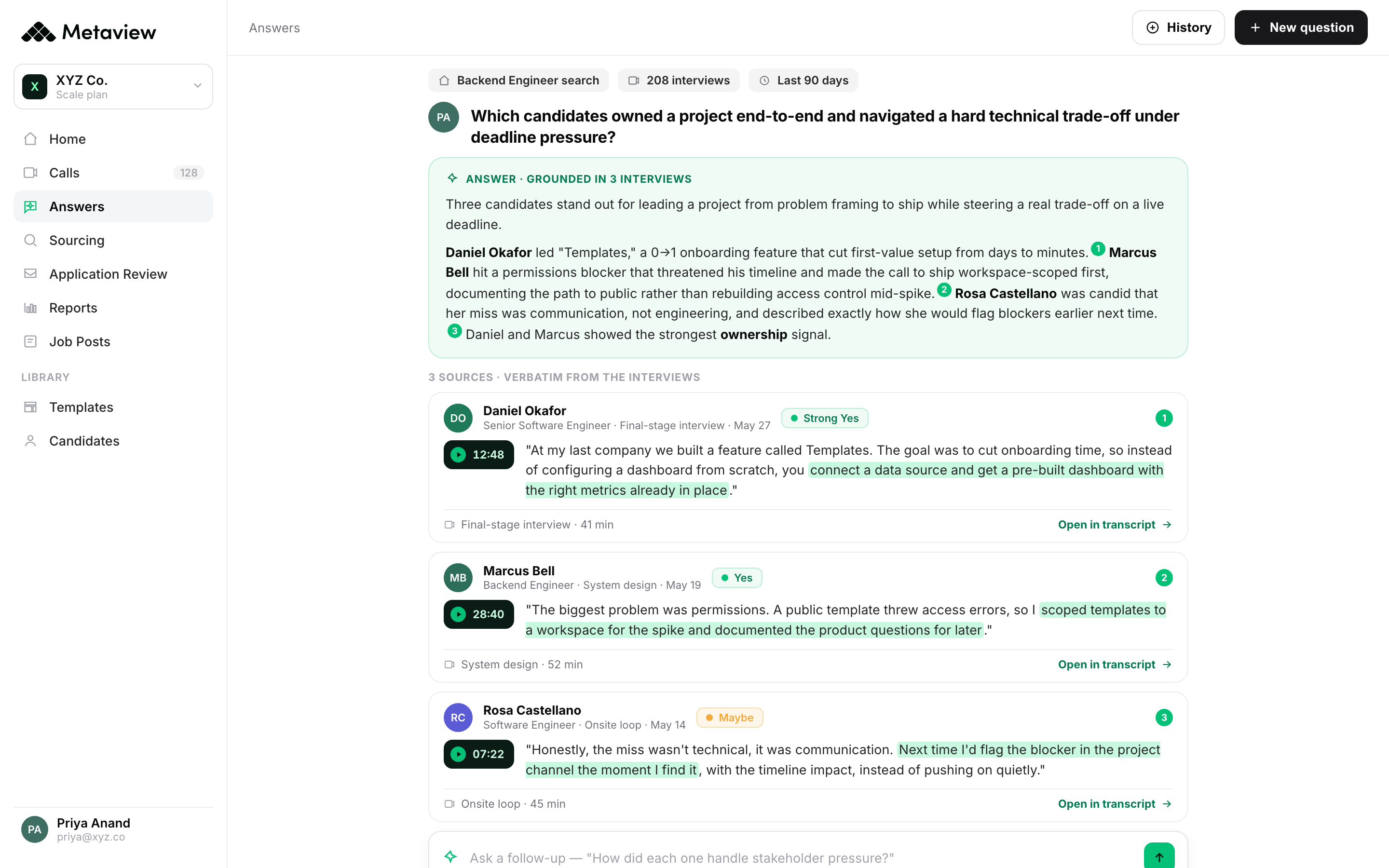
The intake is where agency work either compounds or evaporates. A 45-minute kickoff with a Director of Engineering surfaces eight to ten implicit must-haves: specific stack experience, the previous hire’s failure mode, the comp band ceiling, the political dynamics on the team. Most of that lands in a recruiter’s notebook or a CRM free-text field, where it dies inside a week. The first shift is to capture the intake itself as structured signal: competencies, deal-breakers, trade-offs, comp bands, client-specific scorecard rubric. Every subsequent screen and debrief on the search then runs against the same captured agreement. Notetaker captures the call and renders the intake as a structured brief that follows the search through every panel round.
2. Make the screen a real filter against the rubric, not a logistics check.
Generic agency screens test for availability, current comp, and a surface read of relevance. The signal that actually matters to the client (the four competencies the rubric prioritizes) gets pushed into the next round, which means the next round is a re-screen instead of a deeper evaluation. The second shift is to grade the screen against the client’s rubric directly. Application Review reads the inbound against the captured intake brief, flags the candidates that match the prioritized competencies, and surfaces rejection reasons in the same vocabulary the client will see in the report.
3. Every debrief captured against the same rubric every interviewer uses.
The agency runs panels for a client that doesn’t have its own structured panel discipline. That means every panelist evaluates against a slightly different version of the role unless someone enforces the rubric. The third shift is to capture the debrief against the rubric (not as free-text scorecard fields). The panel’s evidence on each competency becomes a structured field on a structured record: queryable across the search, comparable across candidates, citable in the client report. The same Notetaker that captured intake captures the debrief and writes the scorecard against the rubric.
4. Multi-Source Summaries replace the post-interview write-up.
The single biggest time cost in agency work is the client-ready write-up: the candidate report that summarizes interview rounds, comp expectations, deal-breakers, and the agency’s recommendation. Doing it well takes an hour per candidate. Doing it badly costs the retainer. The fourth shift is to let Multi-Source Summaries compose the write-up from the captured signal automatically: the screen evidence, the panel evidence, the comp band data, all collapsed into a single client-ready brief. The recruiter spends the saved hour on the offer-prep conversation, not the write-up.
5. Portfolio-wide pattern detection becomes a real product.
When every search runs on structured signal, the data composes upward. The agency leader can look across a quarter of activity and see: which roles convert at what stage, which clients have rubric drift between intake and panel, which sourcing channels produce candidates that match the rubric, which competencies the firm keeps falling short on. The fifth shift turns the agency’s interview corpus into a product the principal can sell back to the client: “here are the four patterns we see across your last six searches.” Reports surfaces the cuts; AI Filters lets the principal ask natural-language questions of the corpus.
What structured signal does for client reports.
The agency-side artifact most affected by AI is the client report. Not the candidate notes (which only the recruiter reads), not the internal tracker (which only the agency sees). The report. The document that goes to the hiring committee, the CRO, the founder. The document the client uses to decide whether to keep the retainer.
With structured interview signal underneath every search, the report stops being a 60 to 90 minute writing exercise. It becomes a generated artifact composed from captured data: the candidate’s evidence on each prioritized competency, the gaps the panel flagged, the comp expectations, the references-callable signal. The recruiter’s value-add moves from formatting the report to fine-tuning the recommendation. The client gets a sharper, more evidence-led artifact in less time, which is exactly the agency moat that’s hard to replicate from inside an in-house team.
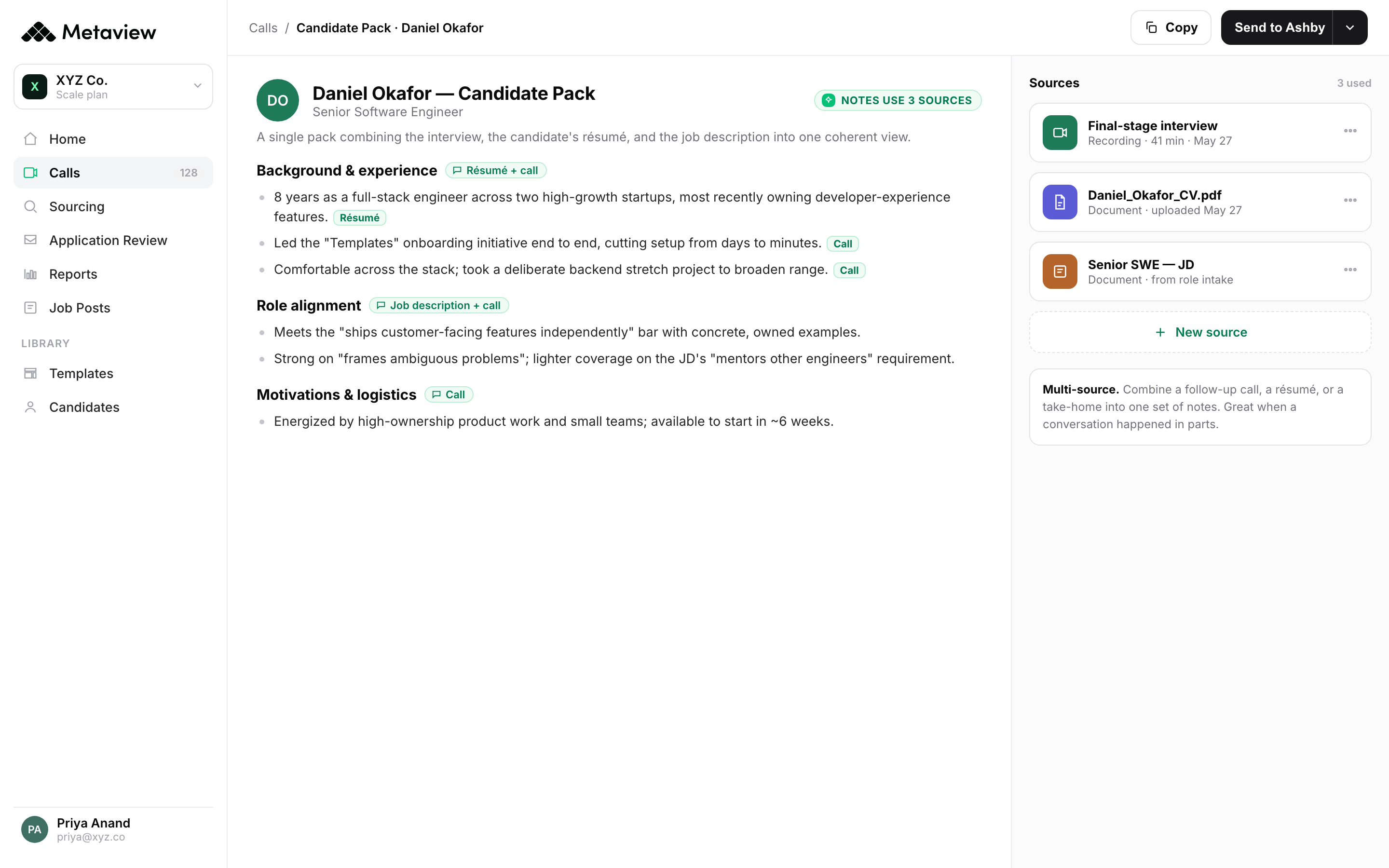
- 1Cross-panel evidence collapsed into one view per competency, ready to lift into the client report.
- 2Action items the recruiter can copy directly into the offer-prep brief.
- 3Multi-Source Summaries surface the questions the panel didn’t ask but should have.
Where the time actually comes back (and where it doesn’t).
Agencies running this play save 1 to 2 hours per recruiter per day, conservatively. The hours don’t come back equally across the workflow. The biggest single bucket is the client write-up: 30 to 45 minutes per candidate when done well, compressed to 5 to 10 minutes with the structured-signal layer underneath. The second-biggest is intake recall: not having to mentally reconstruct a 45-minute kickoff in week four of a search saves 15 to 20 minutes per scheduled call. The third-biggest is cross-account context switching: when the firm-level rubric is queryable, jumping between accounts stops costing 10 minutes of relogging context per switch.
Where it doesn’t help: the relationship layer (founder coffees, retainer pitches, candidate negotiation calls) stays human-paced. Trying to AI-augment those parts of agency work produces worse outcomes, not better ones. The right model is that AI runs every workflow that needs to scale across the portfolio; the senior recruiters spend the saved hours on the relationships and judgment calls that win the next retainer.
What agencies running this play are seeing.
The clearest pattern across the 4,000+ agencies and search firms on Metaview is a flattening of the time-to-shortlist curve. Riviera Partners, an 80+ recruiter executive search firm, infused structured-signal capture across intakes, screens, debriefs, and client pitches. The cross-account memory layer is what they emphasize when describing the lift: recruiters jump between accounts without re-loading context, and the firm-wide template discipline became a real operating tool instead of an aspiration.
At Bowdoin Group, a healthcare and life-sciences search firm, the move was to limit physical notetaking across the firm, which pulled the recruiter’s attention back into the conversation. The downstream effect was sharper candidate-side rapport and more reliable structured records of every client meeting. At Alexander Hughes, the executive search firm, the saved time on client write-ups got reallocated to fine-tuning the recommendation. The compounding effect: faster retainer renewals because the client artifact got sharper, not because the agency got bigger.
| Dimension | Generic agency AI | Structured-signal AI (Metaview) |
|---|---|---|
| Capture scope | Audio transcript per call | Audio plus meeting type, rubric, competencies, structured scorecard |
| Note format | Raw transcript or free-text summary | Per-competency evidence tagged to the captured rubric |
| Cross-account memory | None, each call is independent | Queryable across the portfolio, scoped by client, recruiter, and role |
| Client report cadence | Recruiter writes the report from scratch | Multi-Source Summaries compose the draft from captured signal |
| Rubric alignment | Recruiter applies the rubric mentally, post-hoc | Rubric captured at intake; every screen and debrief grades against it |
| Recruiter onboarding | New hires learn the firm’s bar over months of trial | New hires inherit the firm-wide rubric on day one |
I can be more present and engaged in the conversation, which helps to assess candidates more thoroughly and to look out for subtle red flags I might not pick up on when trying to transcribe everything the candidate is saying. The same goes for status calls and kickoff calls, I can be far more engaged with a client knowing that the call is being recorded and transcribed.”
 Metaview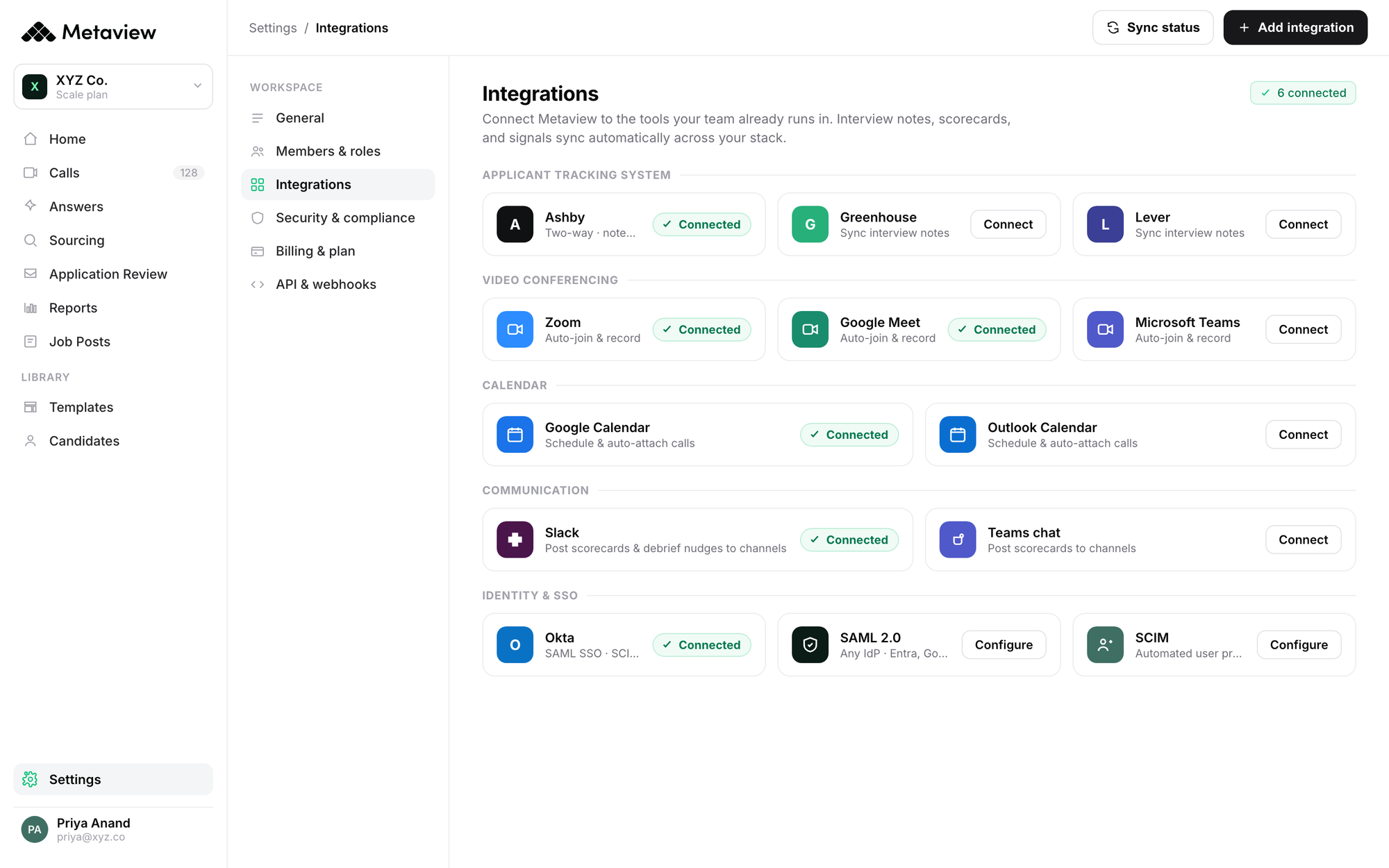
See how the live capture and auto-scorecard flow works on a real interview.
A 5-day rollout for your agency stack.
A practical sequence for an agency principal who wants to make this real in one week. The goal isn’t to ship every workflow shift at once. It’s to lock the intake and debrief capture loops first, prove the report-quality lift, then layer in Application Review and Reports across the second week.
- Day 1. Pick one active search. Run the next intake meeting on Notetaker. Capture the four prioritized competencies, two trade-offs, and one deal-breaker as a structured intake brief. Share with the panel.
- Day 2. Take the next screen call on that same search through Application Review or a Notetaker-captured screen. Tag the rejection reasons against the captured rubric. Compare the structured rejection to the recruiter’s gut read.
- Day 3. Run the first panel debrief against the same rubric. Have every interviewer grade the four competencies on a 1-to-5 scale with evidence pulled from the captured interview signal. The disagreement points become the second-round questions.
- Day 4. Compose the first client report from the captured signal using Multi-Source Summaries. Time the write-up against your last manually-written report on a comparable search. The 30 to 60 minute gap is your retainer-ROI lift.
- Day 5. Pull the firm-level pattern across the last three searches: what’s the most common rejection reason? Which competency does the panel keep missing? The pattern is the agency’s next pitch artifact, the proof that you operate differently than in-house teams or generic agencies.
Bring Metaview into your agency stack.
Structured intake capture, client-ready reports, ATS sync, set up in under 10 minutes.
Frequently asked.
What’s the difference between generic AI tools and recruiting-trained AI for agencies?
Generic AI tools treat every call as an independent audio file and produce a transcript or summary. Recruiting-trained AI starts from a captured rubric (the competencies, deal-breakers, and trade-offs agreed at intake) and grades the conversation against that rubric. The result is structured data per competency, queryable across the search and the firm. For an agency running 30 to 40 active retainers, the difference shows up first on client-report quality and second on cross-account context switching.
Will my recruiters spend less time on calls because of AI?
Time spent on calls stays roughly flat. Interviews still take 30 to 60 minutes. What changes is the surrounding admin layer. Recruiters save 1 to 2 hours a day on notes, scorecard write-ups, and client-report drafting. That time is reallocated to the parts of agency work AI cannot do: candidate negotiation, founder relationship management, and judgment calls on high-risk placements.
How does this play out across multiple clients with different rubrics?
This is the agency-specific use case. Cross-account memory is the gap generic AI tools can’t close. With structured-signal capture, each client’s rubric and intake brief is stored as queryable data on the search. When a recruiter jumps between accounts, the right rubric loads with the call, the meeting template auto-detects from calendar metadata, and the scorecard generates against the right client’s vocabulary. The recruiter doesn’t have to mentally reload the context every time.
What about candidate privacy and data security for client work?
Recruiting-trained AI built for interview workflows handles candidate consent flows, data residency, and audit logs as first-class concerns. Metaview runs on SOC 2 Type II compliance, with explicit consent capture per call and per candidate, and audit logs that satisfy client procurement requirements. Generic productivity AI typically does not meet these bars and shouldn’t be used for client-facing interview work.
Where does AI fail agencies, and what should we plan around?
AI fails on the parts of agency work that depend on relationships and human judgment: retainer renegotiation, founder-CEO trust building, candidate counter-offer conversations, sensitive references. Trying to automate those produces worse outcomes than not using AI at all. The right model is to use AI to compress the admin and capture layer toward zero, and to spend the saved hours on the human-paced parts of the work that actually win retainers.
How long does it take to roll this out across a 20 to 50 recruiter agency?
A focused two-week rollout covers most of the value. Week one is the intake plus debrief capture loop on a single active search per recruiter. Week two is Application Review on inbound and Reports on the firm-level pattern view. By the end of week two, every recruiter is running the new workflow on at least one search, and the firm-level dashboards have enough captured signal to surface the first portfolio-wide pattern.


