
The U.S. Bureau of Labor Statistics tracks annual turnover in manufacturing at roughly 40%. Most plants treat that number as a sourcing problem and pour budget into job boards, referral bonuses, and shift-incentive headlines. The job boards refill the seats. The 40% holds.
It is not a sourcing problem. It is a signal-capture problem. The signals that predict whether a maintenance tech, machine operator, or assembly lead will still be on the shift floor at day 90 don't show up on the resume. They live in the 30-minute screening conversation: how the candidate talks about their last supervisor, the way they describe a near-miss, the specificity with which they name the equipment they ran, whether they answer a commute question with a real number or a shrug. None of that survives the recruiter's notepad.
The plants that have started compressing turnover aren't hiring different candidates. They're capturing different signal, and they're capturing it on every shift interview, structured the same way every time, so the hiring manager's gut read can be checked against the actual conversation. This piece walks through the five plant-floor signals that predict 90-day retention, how to capture them on every screening call, and the workflow shift that turns shift interviews into a retention loop that compounds across the plant.
Why manufacturing recruiting actually breaks.
Walk into any 200 to 2,000-employee plant and ask the talent leader where the hiring engine is leaking. You'll usually hear four answers, in some order. None of them is the actual problem; all of them are downstream of it.
The skills math has changed. Robotics cells, vision systems, and PLC programming now sit alongside the legacy maintenance tech and machine operator slots. Resumes lag the real toolset by two to three years. A candidate who says they ran a press brake might mean a 1998 Amada with a foot pedal or a 2022 LVD with adaptive bending; the resume word is identical.
Turnover at 40% per year is the structural baseline. Every TA leader is replacing roughly a third of the workforce annually before any growth headcount. If the screening pipeline isn't surfacing retention signal, the plant runs the same 12-month cycle next year, with the same churn, against a tighter labor market.
Recruiting bandwidth is thin. A typical mid-size plant runs with one recruiter for every 200 to 500 hires per year, roughly half the SaaS ratio. There is no room for the high-touch, structured screening that TA leaders in tech take for granted. The recruiter has 30 minutes; the notepad has to do the rest.
The talent pool is geographically bounded. You hire who can drive to the gate. That should make signal capture more important, not less, because you're not going to fix a thin local market by adding another sourcing channel; you're going to fix it by getting more out of every conversation you already have.
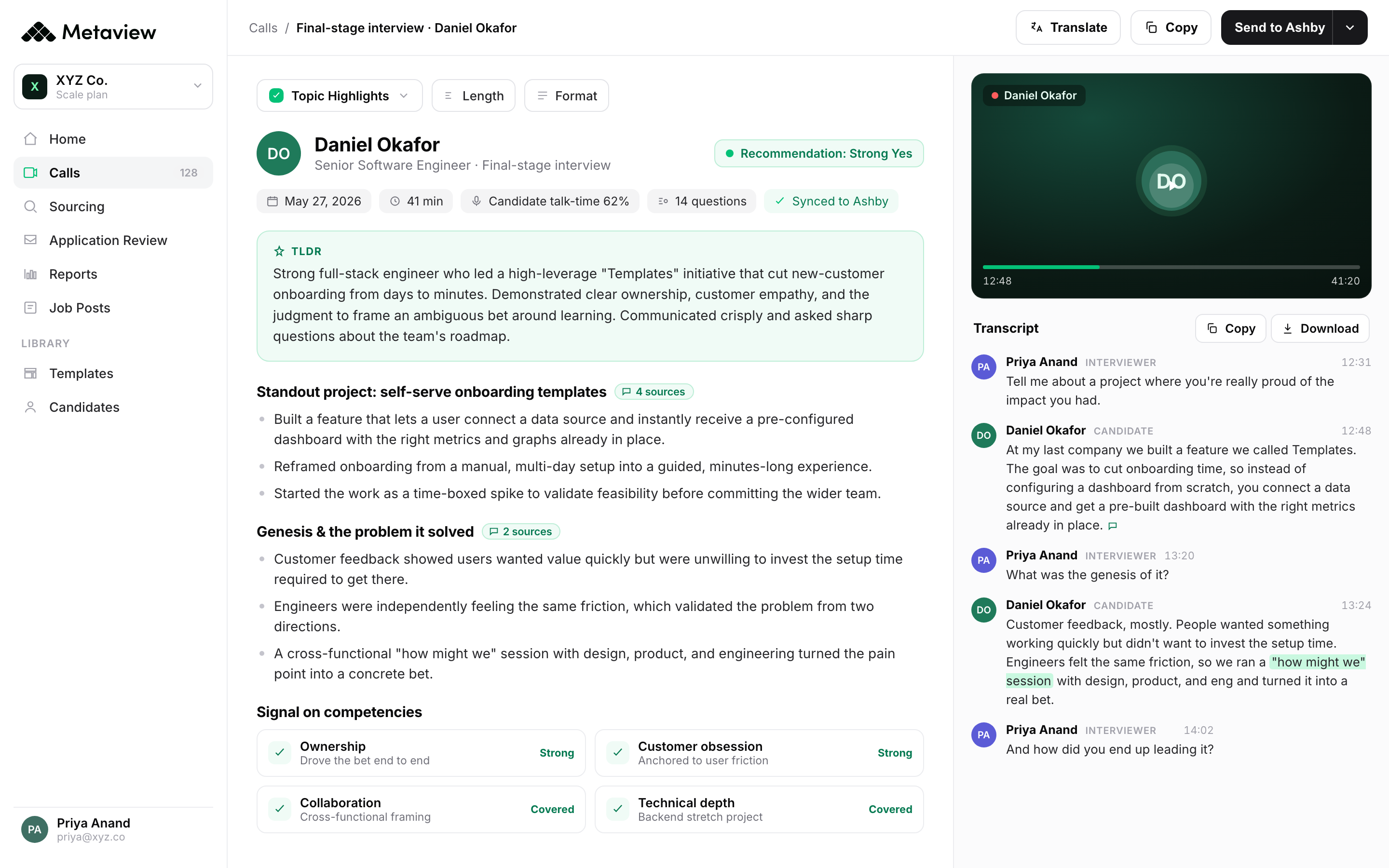
None of those four constraints is fixed by another job board. They're all signal-capture problems. According to Metaview's 2026 AI & Hiring Alignment Report - surveying 505 recruiting leaders and hiring managers across North America and EMEA, 67% of teams lose qualified candidates to faster-moving competitors every month, and the loss rate climbs to 8 out of 10 inside teams whose recruiter-hiring-manager partnership rates good or below. Manufacturing recruiters are losing the same way, in shorter pipelines, against same-day cash offers from the plant down the road.
Over the last few months, our Talent Acquisition team has been using Metaview, and it has made a significant impact. What excites me most is how Metaview is freeing up our time. While the AI handles the heavy lifting of summarizing discussions, we're able to engage in more meaningful conversations with candidates. We're now even using Metaview for our briefing calls with Hiring Managers, allowing us to gain a deeper understanding of the roles we're sourcing for.”
The 5 plant-floor signals that predict 90-day retention.
None of these signals require a different candidate pool. They require a different conversation, captured the same way every time, so what the recruiter heard at 9 a.m. on first shift is reviewable by the night-shift supervisor at 8 p.m. without anyone reconstructing it from memory.
1. Shift-reliability tells.
How does the candidate answer 'what does your commute look like on the second shift?' A real answer ("27 minutes door-to-door, my partner picks up our kid at 5:45 so I'd leave the plant at 11:00") predicts retention. A shrug or "I can make it work" predicts a no-show within 60 days. Same question about overtime: a candidate who has done the math on what their take-home looks like with the OT premium is operating in the same frame as the hiring manager. A candidate who says "I'll do whatever" is not yet on the floor.
2. Safety language.
Ask about a near-miss they've witnessed. The candidates who say "someone got hit by a fork" (passive, distancing) churn at a higher rate than the candidates who say "I saw a forklift cross the painted lane and I flagged it to the shift lead" (active, owned). Safety culture isn't a poster on the wall; it's what comes out of an interviewee's mouth when nothing is at stake. The recruiter who hears the difference and tags it in the scorecard hands the hiring manager a leading indicator. The recruiter who summarizes both answers as "candidate has safety awareness" hands them nothing.
3. Equipment fluency.
"I ran the brakes" vs "I ran a 2018 LVD Strippit press brake, 175-ton, and I was the one who did the daily greasing." The second candidate has actually touched the machine. The first might have stood next to it. Specificity in equipment naming and care routines predicts ramp speed; vagueness predicts a 30-day washout where the supervisor realizes the candidate can't run the line solo. Capture the specificity verbatim; don't paraphrase it into the scorecard.
4. Supervisor-relationship cues.
The "why did you leave?" answer is the highest-signal question in a plant-floor interview, and it's the one most recruiters do worst with. "My supervisor changed shifts and I couldn't make the new schedule work" is an honest answer that tells you something concrete about the candidate's constraints. "It just wasn't a fit" usually means the candidate left under a conflict they don't want to relive on a screening call. Both answers should make it into the transcript verbatim; both predict different things at the 90-day mark. If you're paraphrasing either into the scorecard, you're throwing away signal.
5. Team-floor fit.
Candidates who ask questions about the actual line, "what's the cycle time on station 3?", "who runs the maintenance ticket queue?", "how does the shift handoff work between second and third?", are mentally already on the floor. Candidates who make statements about themselves, "I'm a hard worker, I show up on time, I'm a fast learner", are still selling. The first group retains at 90 days; the second group selects out around day 45 when the day-to-day reality stops matching the pitch they made in the room. The recruiter's job is to keep both kinds of utterance in the transcript; the hiring manager's job is to weight them.
How to capture them on every shift interview.
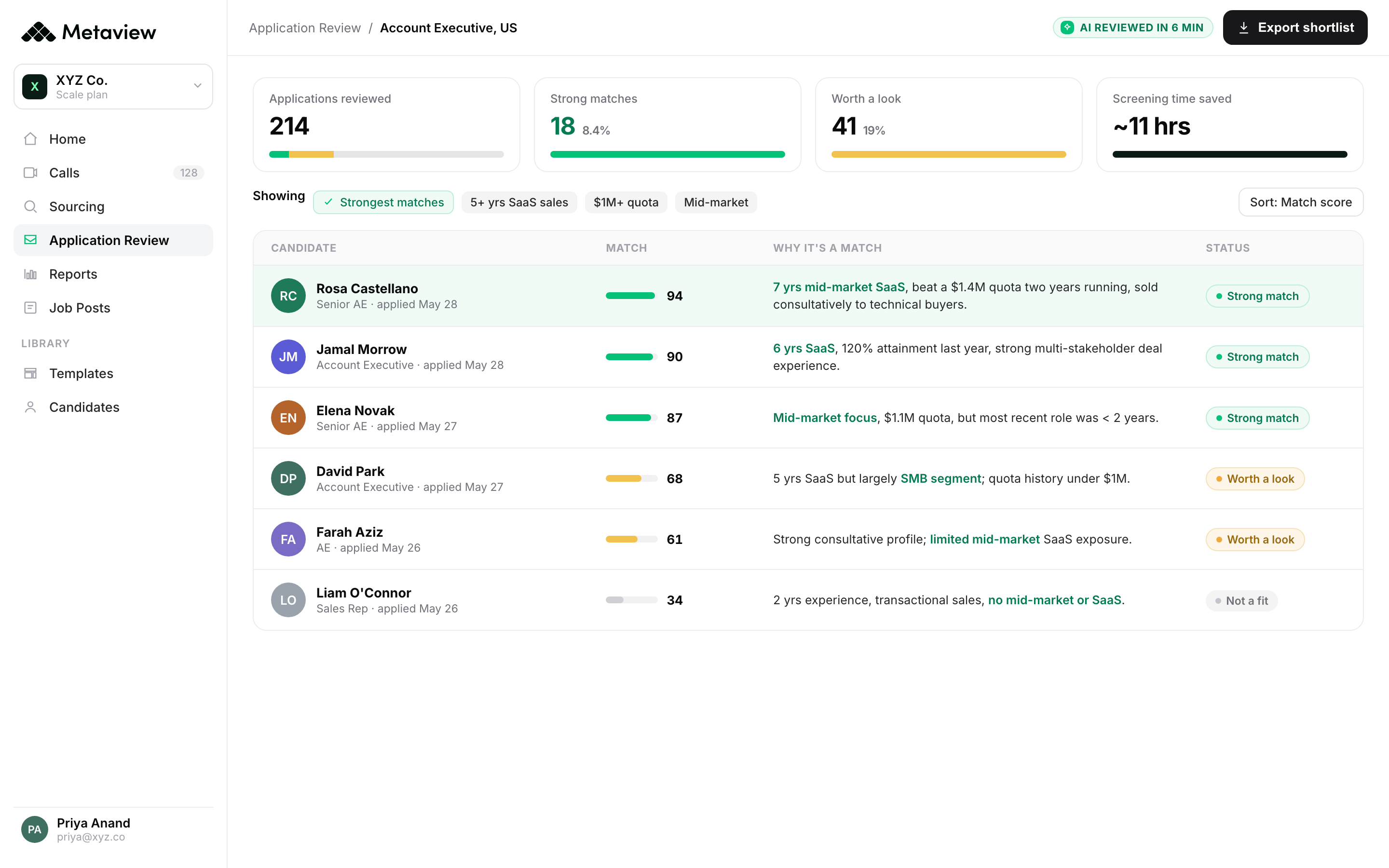
The five signals are not new. Good recruiters have been hearing them for years and writing fragments of them on paper. What's new is that the fragments don't have to evaporate. The capture layer runs in the background of whatever video or phone tool the screening already uses; the recruiter doesn't change their flow, they just stop typing. The structured scorecard fills itself from the conversation, scoped to the five signals, and the hiring manager gets a transcript and a 5-signal rating on their phone within minutes of the call ending.
Same scorecard every time. Maintenance tech, machine operator, assembly lead, shift lead, plant engineer, each role family gets the five signals weighted differently, but the scorecard structure is identical. That's what makes the first-shift recruiter's screening reviewable by the third-shift supervisor without anyone explaining the format.
Verbatim quotes, not summaries. The recruiter's job is to keep the candidate's actual language in the transcript, including the awkward parts. Summaries collapse signal; verbatim quotes preserve it. The hiring manager re-reads the equipment-fluency quote in the candidate's own words and either feels their gut read confirmed or revises it.
Cross-shift comparability. Signal #3 (equipment fluency) is the same scorecard cell whether the candidate interviews on first shift or third. That sounds trivial; in practice it's the difference between three plants running three idiosyncratic processes and one calibrated screening function across the operation.
Hiring-manager re-watchability. If the night-shift supervisor disagrees with the recruiter's "fit" rating, they pull the relevant transcript segment from their phone and review the actual exchange. Disagreements get resolved against the audio, not against gut. That alone closes a meaningful share of bad hires.
The workflow shift: without signal capture vs with.
The cost of running plant-floor hiring without structured signal capture isn't a number on a slide. It's the same five conversations the recruiter has every Monday and can't quite remember on Friday. Side by side:
- The recruiter's notepad summary is the only artifact of a 30-minute conversation.
- Shift-reliability cues live in the recruiter's memory and fade by day three.
- The hiring manager's gut read can't be cross-checked against the actual exchange.
- 90-day turnover arrives as a surprise; the role is back at the top of the funnel before anyone debriefs the loss.
- Each plant rebuilds the same screening process from scratch with the same blind spots.
- Full transcript plus structured 5-signal scorecard on every screening, automatically.
- Shift-reliability cues are time-stamped quotes the hiring manager can replay in 30 seconds.
- Disagreements between recruiter and hiring manager get resolved against the audio, not against gut.
- 90-day turnover triggers a feedback loop back into the ICP; the next interview screens for the missed signal.
- Multi-plant rollup: the calibration one plant earned compounds for the next.
The 4 Metaview surfaces that turn shifts into signal.
At plant scale, the answer isn't a vendor sprawl. It's one capture layer wired into your existing ATS, with four product surfaces doing the work.
The shift this enables isn't tooling for tooling's sake. It's that the recruiter on the plant floor stops being a job-board operator and starts being a full-stack operator who owns capture, calibration, and the feedback loop. Evan Connor (VP of Talent, Ambience) made the broader version of this argument on 10x Recruiting:
It's not just a transcription tool; it's like having a brilliant co-interviewer who never misses a beat. Metaview catches nuances that might otherwise slip through the cracks, providing us with rich, AI-analyzed, interview content that highlights key points and potential red flags.”

The 90-day retention playbook.
Six steps, in order. The first three turn screening into a structured capture surface; the last three close the loop back to the ICP and across plants. Run all six or none of them; halfway is the worst spot, because the recruiter is doing extra work to feed a system that nobody is reviewing.
- Define the 5-signal scorecard for the role family. Maintenance tech, machine operator, assembly lead, shift lead, plant engineer, each gets the five signals weighted to the actual job. Build the templates once and version them.
- Pipe the scorecard into the live-capture template. Every screening opens with the same five prompts; the AI notes structure follows the scorecard so the recruiter never moves between tools.
- Tag every transcript with role family, plant, and shift. Tags are what drive the Reports rollup. Without them, you have 4,000 transcripts and no way to slice them.
- Run a 7-day debrief loop. Recruiter plus hiring manager plus shift lead review the prior week's screenings every Friday. Calibrate which signals are converting to retained hires and which aren't.
- Pipe 90-day retention data back into the ICP. Every loss tagged to the missed signal updates the next round's screening template. This is the part that actually compounds.
- Build the multi-plant rollup at quarter end. Cross-site Reports tells you which plant's screening calibration is working and which is overweighting the wrong signal. The plant that's getting it right is the one to copy.
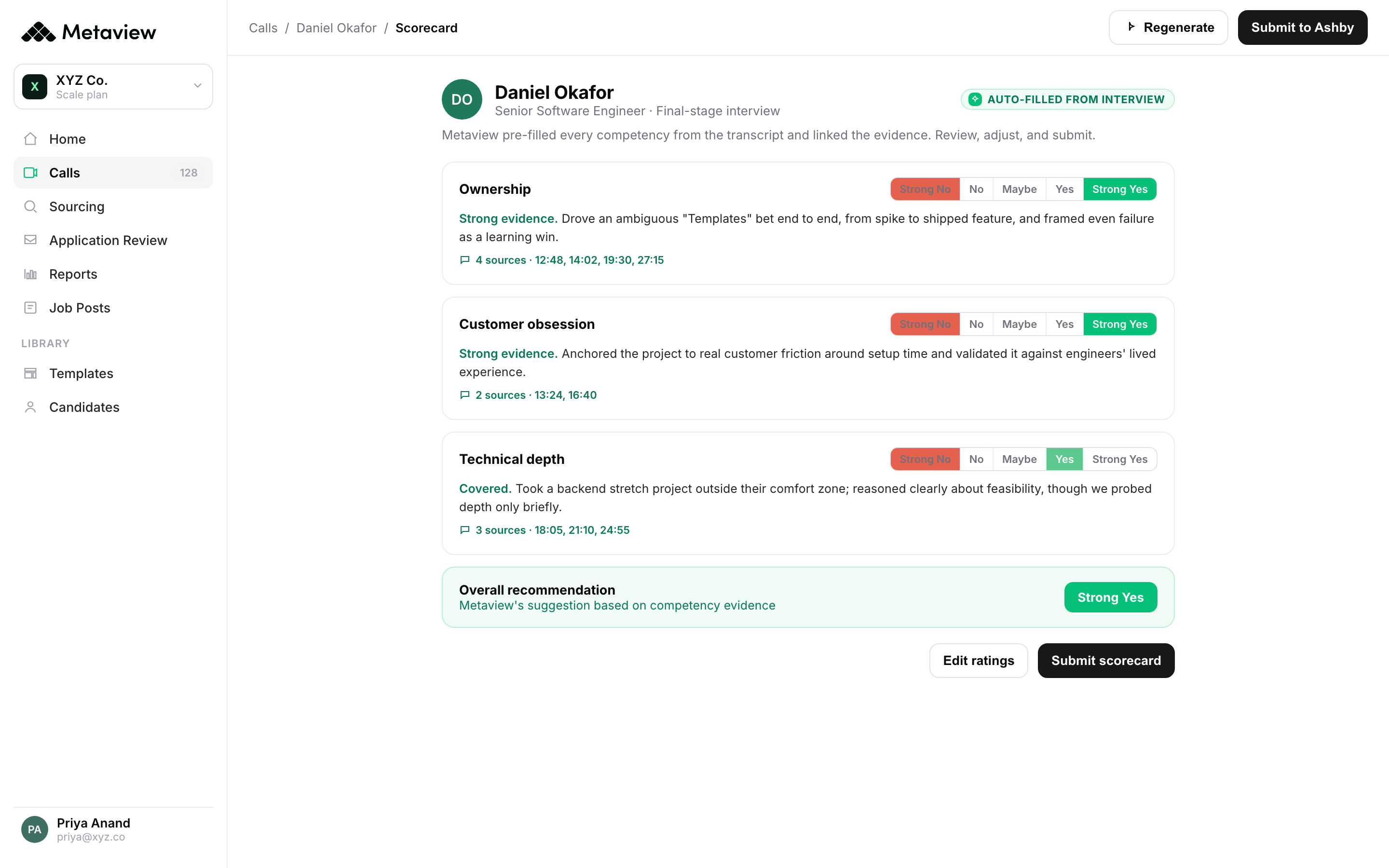
When the screening signal is captured the same way on every shift across every plant, querying that data across the operation becomes the actual TA leader's job. Metaview's MCP turns the interview library into a queryable layer; you ask a question, you get an answer grounded in actual screening transcripts, not a dashboard guess.
 Metaview Technologies
Bring Metaview into your hiring stack.
Live notes, structured scorecards, and ATS sync - set up in under 10 minutes.


