Teams that build the structure get reliable signal in less time. Teams that skip it hit the same problems every panel: multitasking interviewers, inconsistent feedback, unclear room ownership, debriefs that drag for days. It's a structure problem.
This post walks the structure end to end. Preparation, interview, debrief, capture. Without the capture layer, the rest collapses at the debrief. AI Notes is the layer that makes panels run at scale.
What a panel interview is.
A panel interview is a single candidate, multiple aligned interviewers, one shared objective. Same conversation, same calibration, same scoring rubric. It's different from a multi-candidate group interview, where multiple candidates are assessed together in a sequence.
The interviewers usually represent different functions, seniority levels, or perspectives relevant to the role. The point isn't redundancy. It's parallel signal collection.
The candidate has to communicate clearly, respond to diverse viewpoints, and manage a more dynamic exchange. That's a feature, not a bug. The format itself tests how someone handles a multi-stakeholder room, which is what most senior or cross-functional roles ask for.
Designed intentionally, the signal compounds: four people evaluate the same answer against the same rubric they already agreed on. Without that, signal fragments.
The loudest voice anchors the debrief, the candidate experience drops, and interviewer bias creeps in by default.
The structure that makes panels work.
Structure is three moves: preparation, the interview itself, and the post-call debrief. Skip any one and the other two collapse.
Preparation.
Preparation turns a chaotic group interview into a fair, repeatable assessment. Most panel failure traces back to here.
- Define the competencies first. Decide what the panel is assessing: role expertise, collaboration, leadership, values. Without this, every interviewer drifts toward the answer they already wanted.
- Assign panelist roles up front. Common roles include lead interviewer or facilitator, functional or domain expert, culture or values interviewer. Each panelist owns their slice; nobody covers everything.
- Calibrate questions and scoring. Each interviewer knows which questions they're responsible for and what a 1, 3, and 5 look like on each competency. Calibration sessions before the first panel are where consistency comes from.
In the room.
The interview itself should feel focused and intentional, for the panel and for the candidate. Structure here lets everyone get signal without overwhelming the conversation.
- Set the format up front. Explain timing, question flow, and what to expect. The candidate performs better when they know what's coming, and the panel performs better when the schedule is visible.
- Rotate questions deliberately. Free-for-all questioning overwhelms the candidate and skews feedback toward whoever spoke last. Sequence the panel. One interviewer leads each block.
- Leave space for follow-ups. Panels work best when interviewers can probe deeper without drifting off topic. Build pauses into the schedule, not just question slots.
After the room.
The hour after the panel is where most decisions get made and where most decisions get broken. Independent feedback first, then discussion. The wash-up debrief only earns its place when every panelist has already locked in their scorecard.
- Capture feedback independently first. Every interviewer writes their scorecard before any debrief conversation starts. Groupthink begins the moment someone says, "what did you think?" out loud.
- Debrief with evidence. Decisions should be grounded in what was said in the room, not what someone remembers feeling. The interviewer with the loudest opinion is rarely the one with the strongest evidence.
- Move fast on the debrief. Panel interviews are meant to reduce rounds, not create extra delays. If the debrief slips a week, the candidate is already deep in someone else's process.
Where panel interviews fit in the cycle.
Panel interviews are most valuable when used at the right moment. They're designed to validate signal and align stakeholders, not to replace early screening. Placed correctly, they shorten the funnel. Placed wrong, they extend it.
- You're screening high volumes of early-stage candidates
- The role has narrow or repetitive skill requirements
- Panelist availability or seniority can't be balanced
- The role is cross-functional or high-impact
- The decision needs sign-off from three or more stakeholders
- You've already screened for basic fit and motivation
Used correctly, panel interviews shorten hiring cycles. Used wrong, they add complexity without improving outcomes. The placement decides the upside.
The questions that earn their place.
The best panel interview questions generate signal across multiple dimensions without duplicating effort between interviewers. The point isn't to ask more questions, it's to ask the right ones in the right roles. Depth, not coverage.
Collaboration and communication.
Panels are uniquely effective at revealing how candidates communicate with multiple stakeholders at once. Communication skills questions test for clarity, adaptability, and how candidates navigate competing perspectives.
The setup is real working conditions: competing priorities, real-time adaptation, no script.
One question that lands the test: "Tell us about a time you had to align stakeholders with very different priorities."
Role-specific depth.
Panels let different interviewers probe expertise, judgment, and decision-making from their own perspective. Depth matters more than coverage here. Three good probes beat ten surface questions.
One question that lands the test: "Walk us through a challenging decision you made in a similar role."
Culture and values alignment.
Culture and values are best assessed through discussion, not hypotheticals. Panel interviews surface how candidates respond to disagreement, feedback, and shared decision-making. The conversation is the test.
One question that lands the test: "How do you handle disagreement in group decisions?"
Panel-specific behavioral signals.
Beyond the answers themselves, panel interviews reveal what no other interview format can. How a candidate manages a room. That's the panel-only signal.
These signals are difficult to capture in one-to-one interviews. They're central to why the panel format exists in the first place.
The capture problem and the AI Notes fix.
Most panel interviews break down after the call ends. Notes are uneven and incomplete. Important details get missed or remembered differently across the panel.
The loudest voice anchors the debrief. Decisions rely on impressions instead of evidence. And the panelist who got assigned note-taking is half-present in the room.
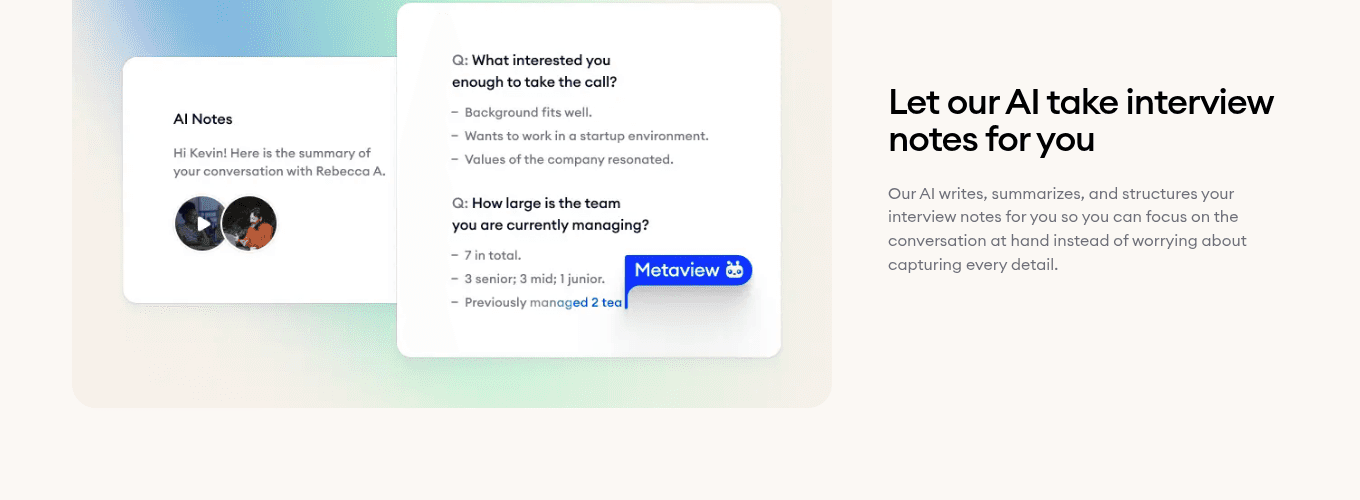
- 1Auto-detected meeting type loads the right panel template before the call starts.
- 2Structured summary maps spoken evidence to the rubric per competency.
- 3Topic chips let panelists jump to the exact moment a topic surfaced.
More panelist discipline doesn't fix the capture problem. Removing the capture from the room does. The capture is the bottleneck, and AI Notes is the layer that solves it.
Notes write themselves. The recording is searchable. Every panelist sees the same source of truth before the debrief opens.
That changes what the debrief feels like. The scorecard is already drafted from the rubric. Topic chips let panelists jump to the exact line where a candidate addressed a competency. Disagreement gets resolved by listening to the actual exchange, not by re-debating impressions.
There's a precondition for any of this working.
According to Metaview's 2026 AI & Hiring Alignment Report, surveying 505 recruiting leaders and hiring managers across North America and EMEA, teams that put AI at the core of hiring rate their cross-functional relationships dramatically better than teams that don't.
That relationship quality isn't a coincidence. It happens when interviewers see the same evidence from the same source. The Metaview Reports view makes that visible across every panel a team runs.
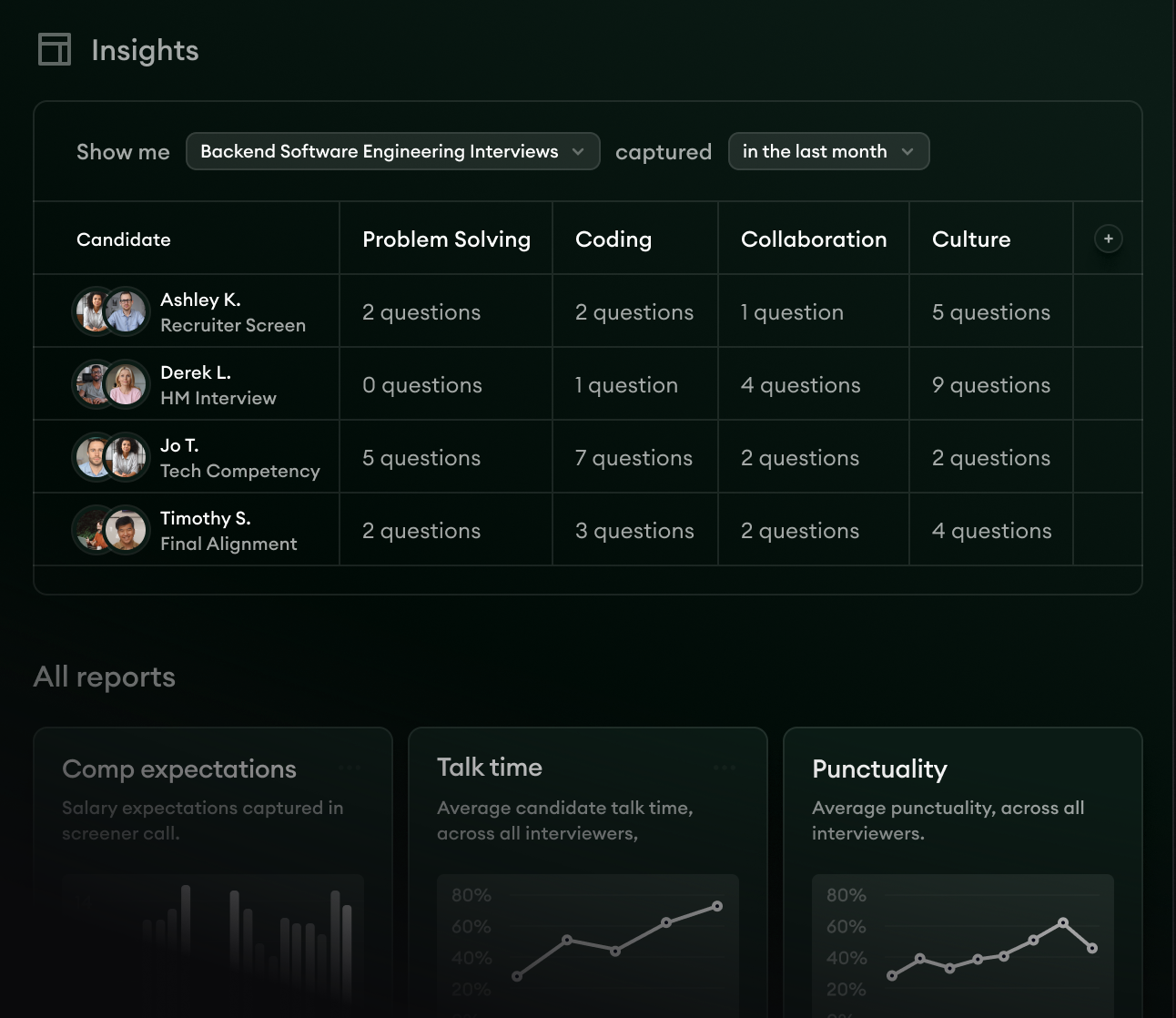
- 1Per-competency capture pulled from the structured notes of every panel call.
- 2Interviewer-level views surface who's calibrated and who's drifting on the same rubric.
- 3Candidate-level rollup shows the rubric coverage across the panel before the debrief opens.
That visibility is what the SoSafe team named.
We're using Metaview to create stronger hiring signals, better calibration across interviewers, and a really high-quality experience for candidates as well, regardless of the interviewer.”

Calibration across interviewers, regardless of who's in the room. That's the structural fix. Panels can be planned forever, but they don't compound until the capture is automated and the evidence is shared.
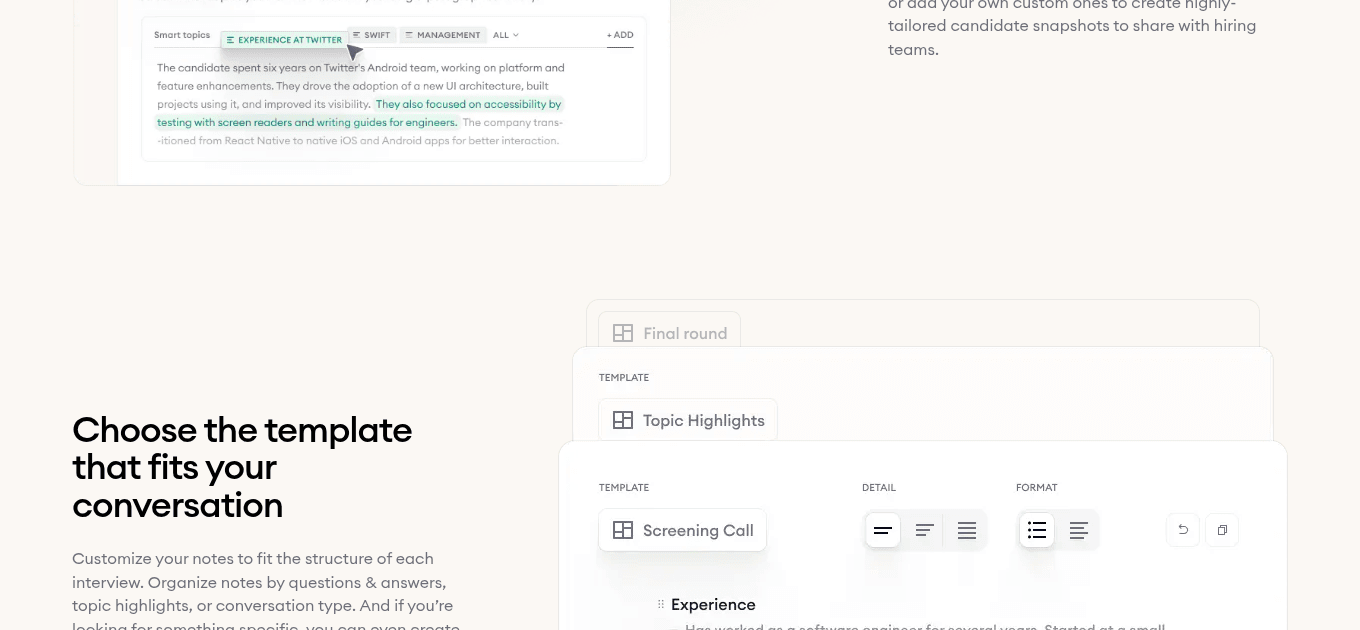
- 1Calendar metadata auto-classifies the panel call before it starts.
- 2Template selector loads the right rubric for the meeting type.
- 3Format and detail level set the depth of the auto-summary.
That's the system. Panels run on prepared structure, real-time presence, and post-call evidence. The capture layer is what makes the rest sustainable beyond a handful of carefully-managed roles.
Frequently asked.
How many interviewers should be on a panel?
Three to five is the sweet spot. Fewer dilutes the perspective the format exists to gather; more overwhelms the candidate and dilutes accountability for each panelist's slice. If you find yourself wanting six, you probably have one panelist who could send written feedback instead.
How long should a panel interview last?
Typically 45 to 75 minutes, scaled to role seniority. Junior IC roles run tighter; senior leadership roles run longer because the questions test for nuance, not just facts. Past 90 minutes, signal quality drops and the candidate is performing fatigue, not capability.
How do you avoid groupthink when interviewers debrief together?
Two procedural fixes do most of the work. Every panelist submits a written scorecard before the debrief discussion opens. Then the most-junior panelist speaks first, so seniority doesn't anchor the conversation. Metaview's structured scorecards enforce the first one by default; the second is a team agreement.
How do you ensure consistency across panel interviews for the same role?
Run a calibration session before the first panel. Walk through two or three sample answers as a group and agree on what a 1, 3, and 5 look like for each competency. Once panels are running, the Metaview Reports view surfaces which interviewers drift on which competencies, so calibration becomes a continuous check, not a one-time event.
What signals does the panel format reveal that one-to-one interviews don't?
The biggest one is real-time multi-stakeholder management. How a candidate handles competing questions, adjusts their style mid-answer, and stays composed under cross-functional probing. These signals only surface when the room is genuinely multi-stakeholder. For senior or cross-functional roles, this is often the deciding factor in the debrief.
Panel interviews are one of the most powerful tools in modern hiring. They're also among the easiest to break. Structure decides the outcome, and capture decides whether it compounds.
Roles defined, questions calibrated, scoring independent. AI Notes carries the call so panelists hear the candidate, and the Reports view gives the debrief shared evidence instead of competing memories.
Compare the resulting debrief workflow against a memory-led debrief and the structural difference is obvious.
Structure plus capture wins. Panels that compound do both.
Bring Metaview into your hiring stack.
Live notes, structured scorecards, and ATS sync - set up in under 10 minutes.