
The candidate experience your team thinks it's delivering is rarely the one candidates actually have.
The reject who was a top finalist last quarter just told 12 of their colleagues about the radio silence after the final round. The "we'll be in touch soon" that became three weeks of nothing. The interviewer who spent the whole call typing.
These aren't strategic failures. They're operational ones - common, repeated, and almost always fixable without slowing hiring down. Here are the 12 most common mistakes and how to avoid them.
All 12 mistakes at a glance.
| # | Mistake | What candidates feel | Fastest fix |
|---|---|---|---|
| 1 | Radio silence after application | Invisible, dismissed | Automate the receipt + status emails |
| 2 | Interviewer typing during the call | Talking to a stenographer | AI notetaking on every interview |
| 3 | Slow feedback between rounds | Forgotten, deprioritized | Pre-populated structured scorecards |
| 4 | Vague rejection emails | Confused, embittered | One real reason per reject |
| 5 | Repetitive questions across rounds | Process is broken | Per-stage question kits |
| 6 | Poorly briefed interviewers | Nobody read the resume | Pre-interview brief from intake |
| 7 | Scheduling tetris on the candidate | Disrespected | Self-serve scheduling |
| 8 | Unclear process timelines | Anxious, ghosted by intent | Spell out next steps every email |
| 9 | One-size-fits-all comms | Templated, low-effort | Customize the first line |
| 10 | Unbriefed final-round panel | No coherence to the day | Pre-panel brief from prior rounds |
| 11 | Offer-stage fumbles | Last impression is administrative | Personalize the close |
| 12 | Post-decision ghosting | Used and discarded | Hand-off message to alumni network |
1. Radio silence after application.
The application form thanks them. Then nothing for two weeks. By the time the recruiter screen invite arrives, the strong candidates have accepted somewhere else.
The fix: automate three emails. Application received within minutes. Status check at five business days. Decision notification at 10 days. The recruiter doesn't draft any of these; the ATS triggers them on stage transitions.
2. Interviewer typing during the call.
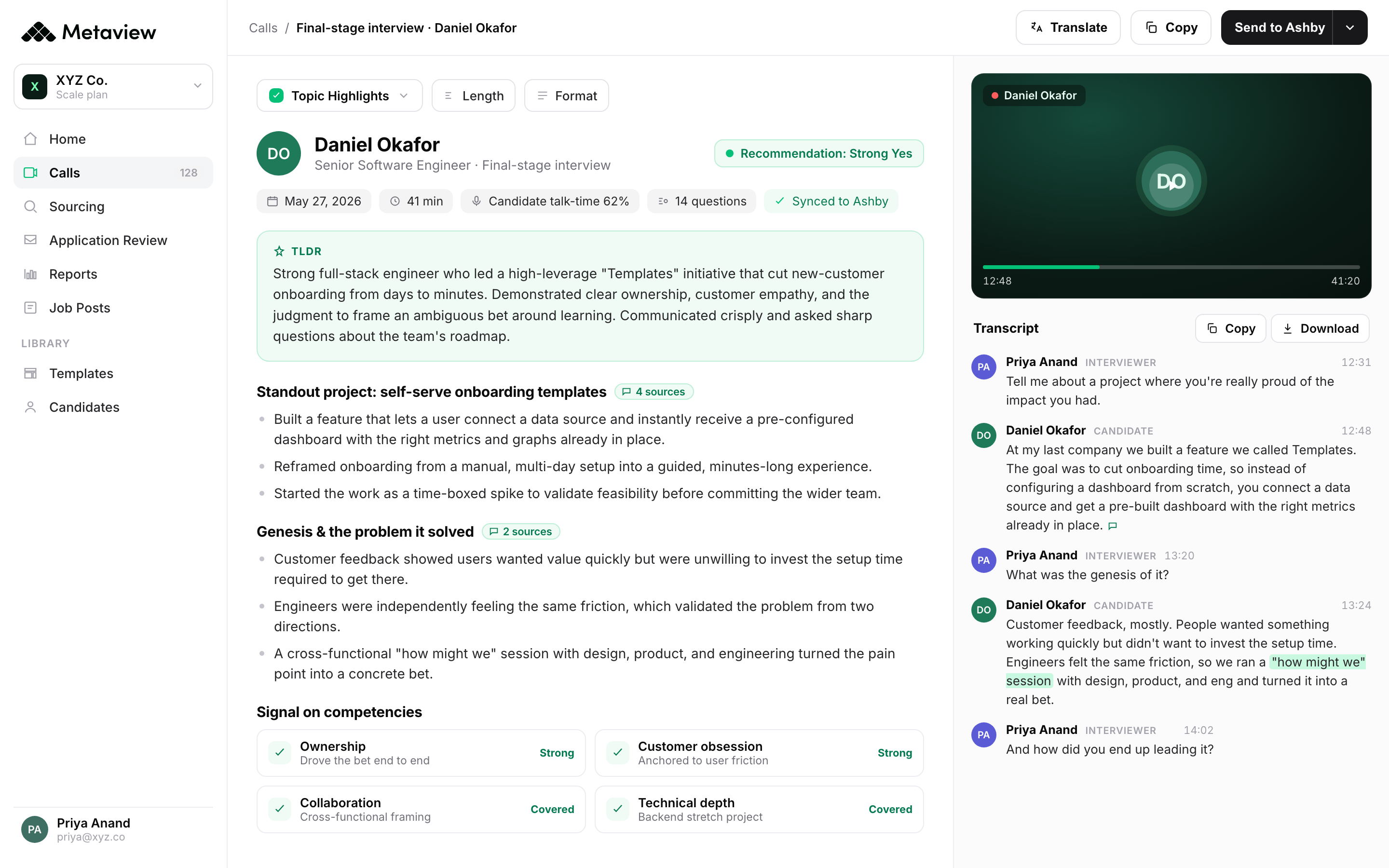
A highly visible CX problem in hiring. The candidate sees the interviewer's eyes on the laptop, hears the keyboard, knows they're not listening.
The fix: AI notetaking across every interview. The interviewer makes eye contact and asks follow-ups; the structured notes show up automatically afterward.
I can be more present and engaged in the conversation, which helps to assess candidates more thoroughly and to look out for subtle red flags I might not pick up on when trying to transcribe everything the candidate is saying.”
3. Slow feedback between rounds.
Five days between interview and "you're moving forward" means five days the candidate spent assuming they weren't. Half of them accepted somewhere else by day three.
The fix: structured scorecards pre-populated from the captured interview. The hiring manager fills in 60% of the form by reviewing the AI output and clicking through a rubric.
4. Vague rejection emails.
"We've decided to move forward with other candidates" tells the candidate nothing and makes them feel disposable. Worse, they tell everyone they know.
The fix: one concrete reason per rejection. It can be the same paragraph reused across similar candidates, but it has to name a real thing.
5. Repetitive questions across rounds.
The candidate explains their career arc to four different interviewers. By the third, they're noticeably impatient.
The fix: per-stage question kits with assigned competencies. Each interviewer probes a different dimension. The recruiter shares prior-round summaries with later interviewers before they meet the candidate.
6. Poorly briefed interviewers.
"So tell me about yourself" three rounds in. The candidate realizes nobody actually read the resume.
The fix: the recruiter shares a 3-sentence briefing per interviewer: who the candidate is, what prior rounds revealed, what this interviewer needs to assess. Takes two minutes to write, prevents 20 minutes of candidate frustration.
7. Scheduling tetris on the candidate.
Eight emails to find a 30-minute slot. The candidate is doing this on top of their day job.
The fix: self-serve scheduling. The candidate picks from open slots in a single click. The system handles reschedules without a human in the loop.
8. Unclear process timelines.
The candidate doesn't know how many rounds there are, what each one tests, or when a decision is coming. They fill the silence with anxiety.
The fix: a process map in the first post-screen email. Reuse it per role family.
9. One-size-fits-all communications.
The candidate gets the same form-letter email every other candidate got. The first sentence is generic. They know it's templated.
The fix: customize the first line of every candidate-facing email with one specific reference (a project, a previous round, a stated preference). The rest can be templated.
10. Unbriefed final-round panels.
The CEO walks in for the final round having never seen the candidate's name. The candidate walks out wondering if the company is serious.
The fix: a final-round panel brief that includes the candidate summary, prior-round flags, and the specific questions the panel should probe. Sent 24 hours before, not five minutes.
11. Offer-stage fumbles.
Three weeks of careful conversation followed by a PDF in an email. The last impression of the company is administrative.
The fix: a real conversation at offer. The recruiter calls, walks through the numbers, names the specifics that came up at interview. The PDF arrives after, not instead.
12. Post-decision ghosting.
The candidate accepts. The recruiter disappears. Day one onboarding feels disconnected from the recruiting conversation.
The fix: a handoff email from recruiter to hiring manager that includes the candidate (cc'd). The recruiter checks in at day 5, day 30, day 90. Same idea on the reject side: a place for strong-but-not-this-time candidates in your alumni network.
How to fix it fast.
The 12 mistakes above share two root causes: silence between stages, and operational friction the candidate sees.
The fix with the biggest payoff is interview capture. Once the interview is recorded, transcribed, and structured automatically, the interviewer stays present and the scorecard pre-populates.
Time-to-feedback collapses, and the recruiter has the material to write specific candidate-facing comms.
Next comes status communication automation. Three triggered emails per candidate (received, status, decision) covers 80% of the silence problem and requires zero recruiter time.
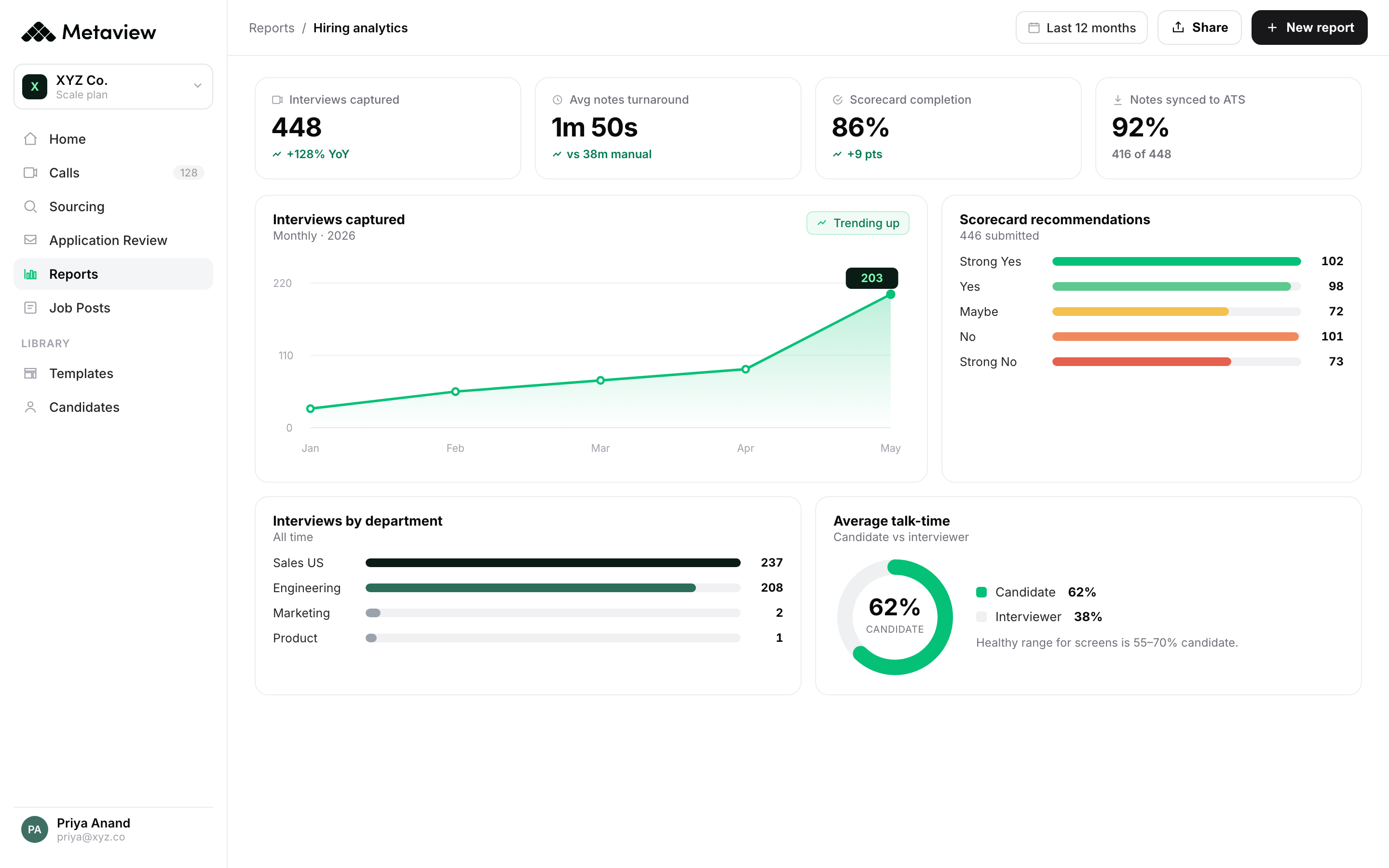
Metaview captures every interview across Zoom, Google Meet, Microsoft Teams, and phone, maps answers to your rubric, and writes back to your ATS automatically.
4,000+ organizations run hiring on Metaview, including Riviera Partners, Brex, emnify, Quora, Workleap, Catawiki, Robinhood, and Automattic.
Bring Metaview into your hiring stack.
Live notes, structured scorecards, and ATS sync, set up in under 10 minutes.
Frequently asked.
What's the single biggest cause of poor candidate experience?
Silence between stages. Days where the candidate doesn't know whether they're moving forward erode trust faster than any other operational mistake. Status automation is the highest-leverage fix most teams haven't turned on.
How do I improve candidate experience without slowing hiring?
Most CX improvements speed hiring rather than slow it. Interview capture cuts time-to-feedback; structured scorecards cut debrief length; self-serve scheduling cuts coordinator hours. Speed and experience move together.
How do I measure candidate experience?
Post-process survey to every candidate, including rejects. 4.2/5 or higher is the healthy range. The honest signal usually comes from candidates you didn't hire; survey them too.
What should a rejection email actually say?
One concrete reason. It can be the same paragraph used across similar candidates, but it has to name a real gap or constraint. "We loved your X but the role requires Y" beats "we've decided to move forward with other candidates" by a wide margin.
Should I tell rejected candidates we'd consider them for other roles?
Only if you mean it. A vague "stay in touch" reads as templated. A specific "we'd like to keep you in mind for X next quarter" is real, but only send it to candidates you'd actually contact.
How does AI improve candidate experience?
By removing the operational friction the candidate sees. AI notetaking lets the interviewer stay present. Structured scorecards collapse time-to-feedback. Both address two of the most common CX complaints.


