
Applicant screening used to be a quiet back-office task. Open the inbox, work down the pile, move the obvious yeses forward. That job doesn’t exist anymore.
One-click apply, remote-eligible roles, and AI-written resumes have pushed application volume up sharply, with no matching lift in fit. A single mid-level req can bury a recruiter for a week. Working that pile the old way loses the candidates worth hiring while you are still reading.
This is the recruiter’s playbook for screening at that volume: a four-stage framework, the numbers behind it, and an honest read on where AI helps and where it creates new risk.
Why applicant screening is where the funnel is won or lost.
67% of recruiting teams lose qualified candidates to faster-moving competitors every month, according to Metaview’s 2026 Alignment Report, surveying 505 recruiting leaders and hiring managers across North America and EMEA. Most of those candidates don’t disappear because the offer was wrong. They disappear because nobody got to them in time.
That’s the cost of weak screening. The candidate the team would have hired sits in the queue for nine days. By day six, three competitors have already pinged them.
The teams winning right now are the ones who treat screening as the highest-yield point in the whole funnel, not as the admin task the most junior person on the team owns. For the cluster-level view above this, the Screening Calls hub is where the long-form playbook lives.
What applicant screening is.
Applicant screening is the process of reviewing and prioritizing job applications to decide which candidates move forward to a phone screen, an assessment, or a hiring-manager review. It happens right after applications are submitted and before structured interviews begin.
The purpose is prioritization. Strong screening doesn’t try to catch the bottom, because that’s a losing game when volume is high. Strong screening surfaces the top 5% inside 48 hours, so the team can move on candidates the competition is also moving on.
A good screening pass evaluates each applicant against four signals:
- Skills and experience match to the role’s must-haves, not the nice-to-haves
- Eligibility for the role, covering work authorization, location, and comp expectations
- Intent signals that distinguish a tailored application from a mass-submit
- Coherence across the materials, between the resume, the application answers, and any linked work
Done well, the same four signals get evaluated the same way on every application. The recruiter only personally reviews the candidates the top of the funnel earned.
The signal-vs-noise framework.
The strongest screening operations all run some version of the same four-stage flow. Call it the signal-vs-noise framework. Build the funnel in this order.
Stage 1: define the must-haves before the req goes live.
The single highest-yield fix on most screening operations is the intake call. If the recruiter and the hiring manager haven’t agreed on the three to five must-haves for the role before applications start landing, no screening process can rescue the rest of the funnel.
Per the 2026 Alignment Report, 68% of searches start with high alignment when AI is core to hiring, versus 49% when teams don’t use AI. Both figures are self-reported by recruiting leaders and hiring managers. The screening downstream gets easier when the kickoff is sharper.
This data shows that hiring managers and recruiters don’t fully trust each other’s judgment. This creates friction that tools alone cannot solve. The orgs that recognize this and help individuals collaborate more effectively will see dramatically better outcomes.”

Stage 2: sort, don’t reject.
The first pass on every application is a sort rather than a reject. AI reviews and sorts applications into clear outcome categories: strong match, worth a second look, or not a match for this role. Recruiters retain every hiring decision. AI removes the manual triage step.
The “not a match for this role” bucket doesn’t go to the bin. It goes to the talent pool, with a reason attached, so a future req in a different cluster can re-surface it.
Stage 3: spend recruiter attention on the top of the funnel.
This is the step most screening operations get backwards. Recruiters spend their week working through the middle of the funnel: applications that are probably no, applications that need a closer look but aren’t urgent, applications that might be a fit if the candidate clarifies one thing. That work is what the sort step in stage 2 is for.
Recruiter attention compounds when it’s spent on the top 5%. A 15-minute phone screen with a strong-match candidate inside 48 hours of application keeps you in the running while they are still deciding.
Stage 4: build the feedback loop.
Every hire and every regret-decline becomes signal for the next req. Which intake decisions held up? Which must-haves turned out to be nice-to-haves? Which “not a match” candidates ended up being a great fit for an adjacent role you opened six weeks later?
Without this loop, screening stays a series of one-off judgment calls. With it, screening becomes a system that compounds.
What strong screening looks like in the numbers.
Two published customer accounts, and the volumes they were screening against.
Workleap reduced screening time by up to 50%, per its own case study. Johnny Drexhage, Senior Recruiter at Workleap, was working 200 to 300 candidates per role at 30 to 45 seconds a profile before the change. Both figures are Workleap’s own, and both are self-reported.
Charlie, in TA Ops, used to spend 2 to 3 days screening 100 to 150 candidates per role. After running Application Review on the same pile: 15 minutes. Two candidates moved to second stage on day one. “It was honestly, it was unbelievable. Saved me 2 days.”
A separate instrument points the same way. Metaview’s survey of 380 recruiters found 66% more screens per recruiter per week when a team implements AI across the whole team instead of person by person. That figure measures AI adoption in general rather than any single product, and it is self-reported with no control for team size. The useful lesson is about rollout: team-wide beats seat by seat.
The pattern is consistent. The teams that move screening from manual judgment to structured signal don’t end up with fewer humans in the loop. They end up with humans who spend their week on the candidates worth a conversation instead of on the queue.
The product context: Application Review.
Metaview captures every spoken word in your interviews, which means the screening question, who’s worth a phone screen, gets answered against the same context layer that already informs every other agent on the platform. Application Review reads what you’ve said in past hiring panels, what the hiring manager flagged in the intake call, and what the role’s must-haves are, then sorts the inbound against that context.
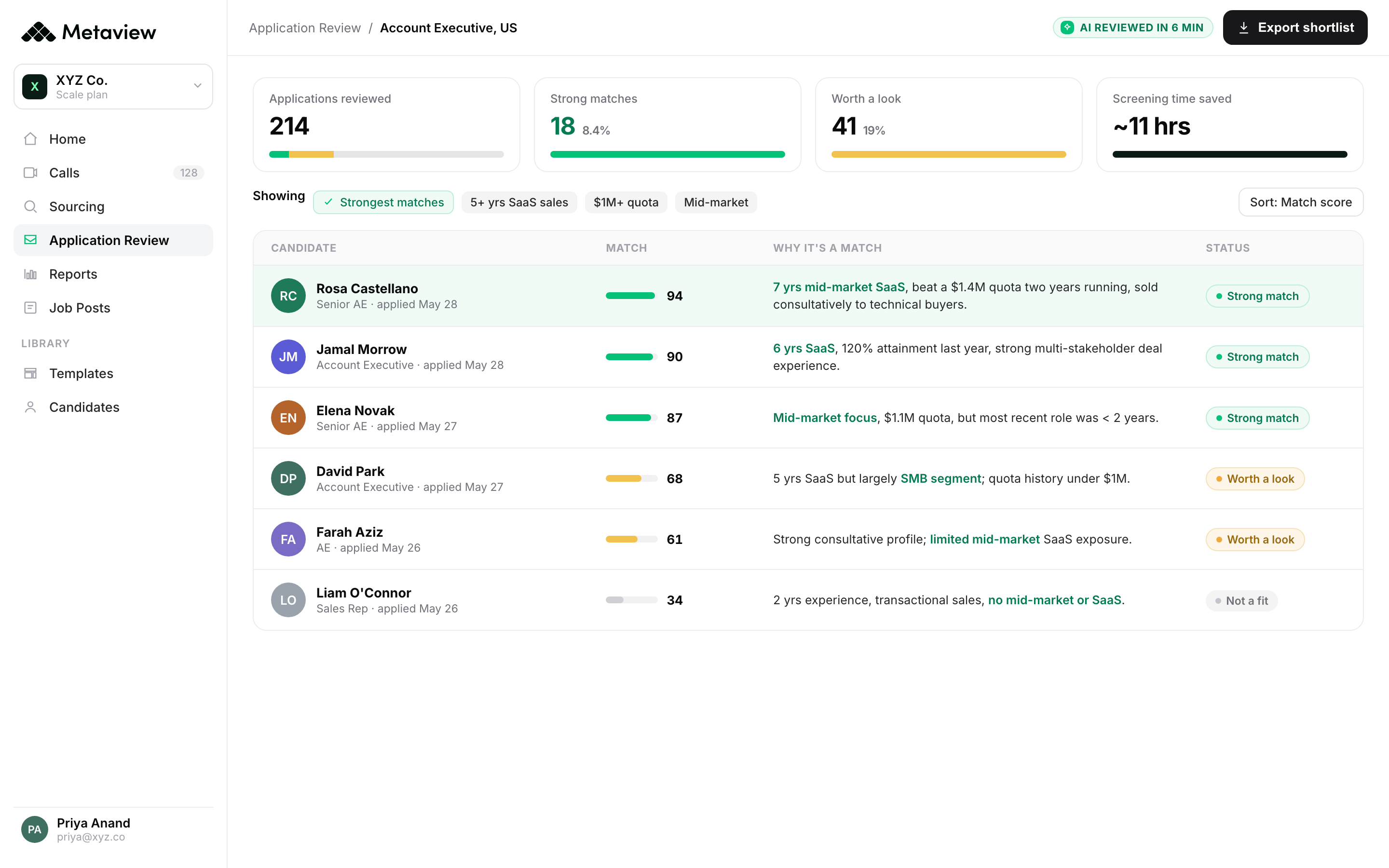
Three things it does that a generic AI screening tool doesn’t:
| Capability | What it means in practice |
|---|---|
| Reads the intake call | The must-haves the recruiter and hiring manager agreed on get carried into the screening sort. The applicant doesn’t have to game keywords; the system already knows what the panel cares about. |
| Flags fraud and AI-generated patterns | High-volume inbound now includes mass-submitted, AI-generated resumes. Application Review flags coherence breaks, identical content across applications, and known fraud patterns. The recruiter sees the flag with the reason. |
| Routes by outcome category instead of by score | Each applicant lands in a clear bucket with a one-line reason. Recruiters retain every advance and decline decision. The system handles the triage. |
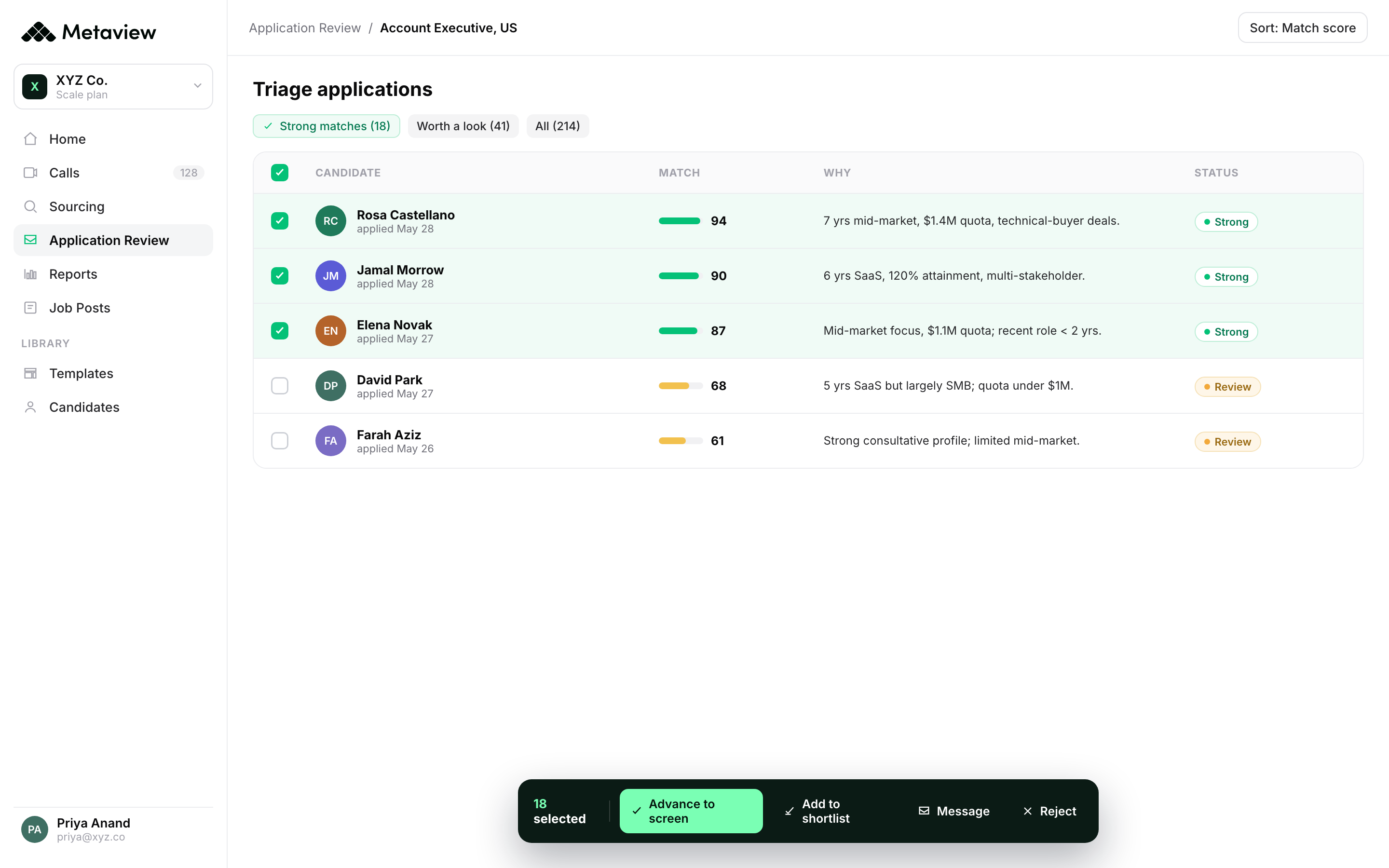
The compliance frame matters here. AI reviews and sorts applications so recruiters can decide on the top candidates faster. The recruiter is the decision-maker on every advance, every decline, and every move to a talent pool. The system removes the manual triage step. It doesn’t remove the judgment.
Manual screening versus AI-assisted screening versus Application Review.
If you’re evaluating a switch, this is the comparison that matters.
| Dimension | Manual screening | Generic AI screening tool | Application Review |
|---|---|---|---|
| Speed | Days per role at high volume | Minutes per batch | Minutes per batch, with context |
| Consistency across recruiters | Varies by recruiter, role, and time pressure | Consistent within the tool | Consistent across the team, anchored to the intake call |
| Context from intake | In the recruiter’s head | None | Inherited from the captured intake conversation |
| Fraud and AI-resume detection | Recruiter judgment | Limited | Built in |
| Outcome on the candidate | Inconsistent response times | Faster response, generic feedback | Faster response, role-specific feedback |
| Compliance posture | Judgment-based | Variable | AI reviews and sorts. Humans decide. |
The third column is the one most teams haven’t seen yet. A screening tool that knows what the hiring manager asked for in the intake call is a different category of capability than a screening tool that pattern-matches on resume keywords.
Three things to fix before you switch tools.
A new tool won’t fix a broken process. Three diagnostics worth running before you spend a budget cycle on screening software:
- Pull last quarter’s intake calls. How many of them produced a written, agreed list of three to five must-haves? If the answer is “less than half,” screening isn’t your bottleneck. The intake is.
- Measure response time to the top 5%. How long, in hours, from application submitted to first recruiter response, for the candidates you eventually hired? If it’s more than 48 hours, the candidates you’re losing are lost in the queue rather than in the screening interview.
- Audit the “not a match” pile from last quarter. How many of those candidates would have been a fit for a role you opened two months later? Talent pools that don’t get re-surfaced are talent pools that decay.
If two of the three diagnostics come back clean, you’re ready to move on screening tools. If they don’t, fix the intake and the response time first.
What changes Monday morning.
The shift from manual screening to a system is an operating-model decision. The tool comes after the system.
Bring Metaview into your hiring stack.
Live notes, structured scorecards, and ATS sync.
Frequently Asked Questions.
How can recruiters handle hundreds or thousands of applications without dropping strong candidates?
Define three to five must-haves in the intake call. Sort inbound into outcome categories on day one. Spend recruiter attention on the strong-match bucket inside 48 hours. Route the rest to a talent pool with a reason attached. The combination is the lift. No single step does the work alone.
What are common signs of fake or AI-generated applications?
Generic resumes that don’t reference the role, contradictory information across the application and the resume, identical paragraphs appearing across multiple submissions in the same window, and tailored answers that don’t match the candidate’s experience level. Application Review flags these patterns at the sort stage so the recruiter sees them before time gets spent.
Can applicant screening be automated from start to finish?
Yes, automated candidate screening is viable and valid. But while triage can be automated, decisions shouldn’t be. AI reviews and sorts. The recruiter advances, declines, or pools every candidate. Anything more aggressive than that creates fairness and legal exposure.
Does AI-assisted screening risk dropping good candidates?
The risk is real for generic AI tools that score-and-cut. The risk is much lower for tools that sort into outcome categories and surface the worth a second look bucket for human judgment. Configure for sort rather than cut.
How does Metaview support applicant screening?
Application Review reads the intake conversation, sorts inbound against the must-haves the team agreed on, flags fraud and AI-generated content, and routes each candidate into an outcome category. Recruiters retain every hiring decision. The system removes the manual triage step.
How is Metaview’s screening framing different from generic AI screening tools?
The framing is “AI reviews and sorts.” The system triages applications into outcome categories the recruiter then acts on. Generic tools use stronger framing that suggests the AI makes the advance and decline call itself. The legal and fairness posture matters. The language is precise on purpose.
Most AI screening tools are too rigid and simplistic to achieve this.


