
Every interview is data. Most teams don't store it like data.
The recruiter takes the call, scribbles a few lines, and uploads a sentence to the ATS. The hiring manager reads the sentence and signs off. The next interviewer walks in with no idea what already came up, and the panel debriefs on memory that's already half gone.
The gap between that and a hiring team that gets sharper every quarter is the layer underneath, the substrate that turns each conversation into structured evidence the whole team can read.
Why the call is the data event.
Interviews look like conversations. They are structured proceedings the moment a recruiter assigns them a rubric, picks a competency, or writes a question down. The data is already there. Most teams just don't capture it in a form anyone else can use.
The cost of that gap is concrete. The recruiter-and-hiring-manager partnership runs on shared evidence, and most partnerships don't have any.
According to Metaview's 2026 AI & Hiring Alignment Report, surveying 505 recruiting leaders and hiring managers across North America and EMEA, the numbers spell the gap out plainly.
The lever isn't more recruiters or more requisitions. It is the substrate every surface needs.
When the interview becomes structured data, every downstream surface gets sharper. The scorecard, the ATS record, the team-level report. When it stays a verbal conversation, every downstream surface stays a guess.
The rest of this post walks the five Metaview surfaces talent teams use to turn each conversation into that substrate, and what changes once it is.
Capture the call automatically.
The first move is the simplest one to under-invest in. If the call isn't recorded, every downstream surface is reconstructed from memory, and memory is the wrong system of record.
Metaview's Notetaker joins each scheduled interview from the calendar invite, silently, and writes a verbatim record with speaker labels.
The recruiter doesn't have to remember to hit record. Co-interviewers can mark moments mid-call without breaking eye contact. Audio and transcript are searchable the moment the call ends.
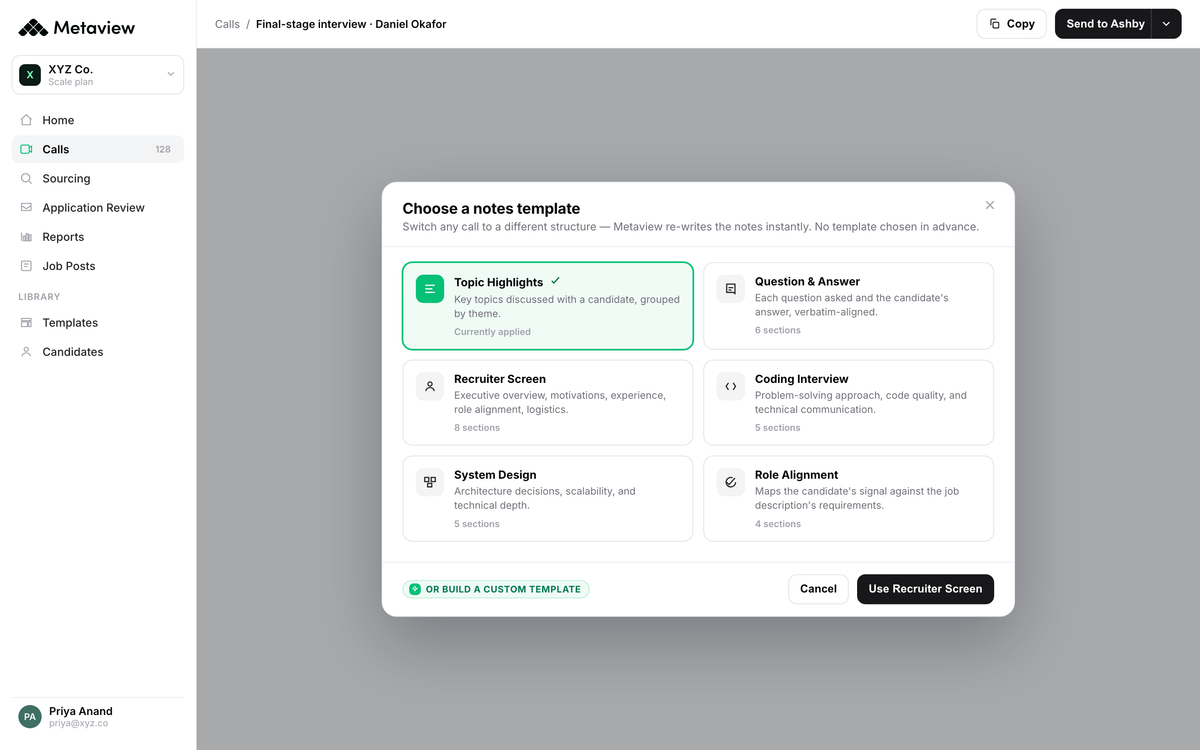
Two operational moves are worth front-loading in the first week. Set the calendar-based join to default on, and confirm the candidate-consent script with the team so it's the same line on every call. Both are one-time toggles in Settings > Integrations.
Structure the transcript into evidence.
A raw transcript is useful to one person and overwhelming to everyone else. The next move is to compress it into the artefacts the rest of the hiring team will read.
Within minutes of the call ending, AI Notes lands a 90-second candidate brief, a competency-tagged scorecard with the underlying evidence quotes, and a one-paragraph summary the hiring manager can scan before the debrief.
The recruiter reviews, edits, and pushes to the ATS in one click.
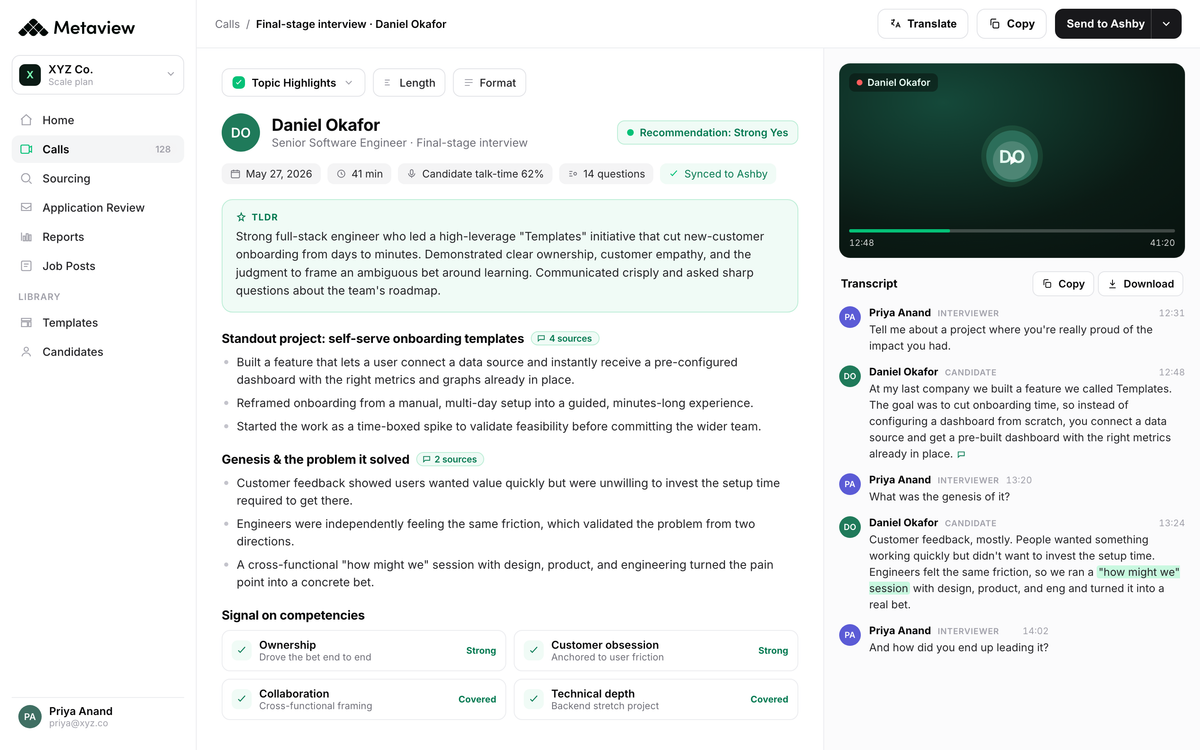
The discipline that pays off here is template consistency. Once two or three roles share the same interview template, the scorecard format becomes comparable across candidates.
The hiring manager starts reading three scorecards side by side instead of one at a time. Most teams hit that point around week four.
Sync to the ATS automatically.
The ATS stays the system of record. Hiring decisions, candidate stages, offer status, all of that lives there. Metaview's job is to make sure every interview artefact lands on the right candidate profile, on time, without the recruiter rebuilding it by hand.
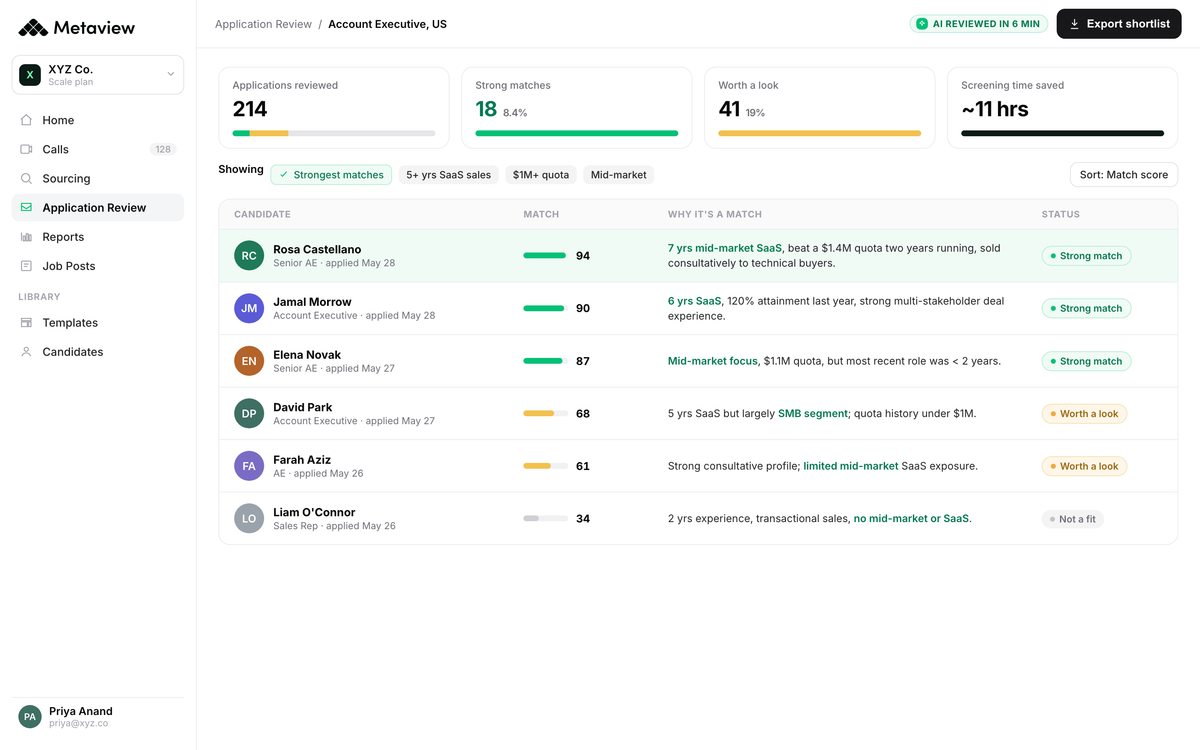
Native integrations with Ashby, Greenhouse, Lever, Bullhorn, SmartRecruiters, and Workday handle the sync. Scorecards land on the candidate's record with the role's rubric attached.
Transcripts and AI Notes attach as artefacts the hiring manager can open without leaving the ATS. Application Review picks up the inbound feed and adds an ICP-fit signal so triage doesn't start cold.
The principle to hold onto: the ATS stays canonical, and Metaview makes the record richer without asking the team to switch tools.
Most rollouts hit ATS sync in week eight, once a few roles have proven the pipe is reliable.
Surface signal across the team.
The fourth move is where the data layer earns its name. With every interview captured, structured, and routed, the next ask is what the data looks like in aggregate, across the team.
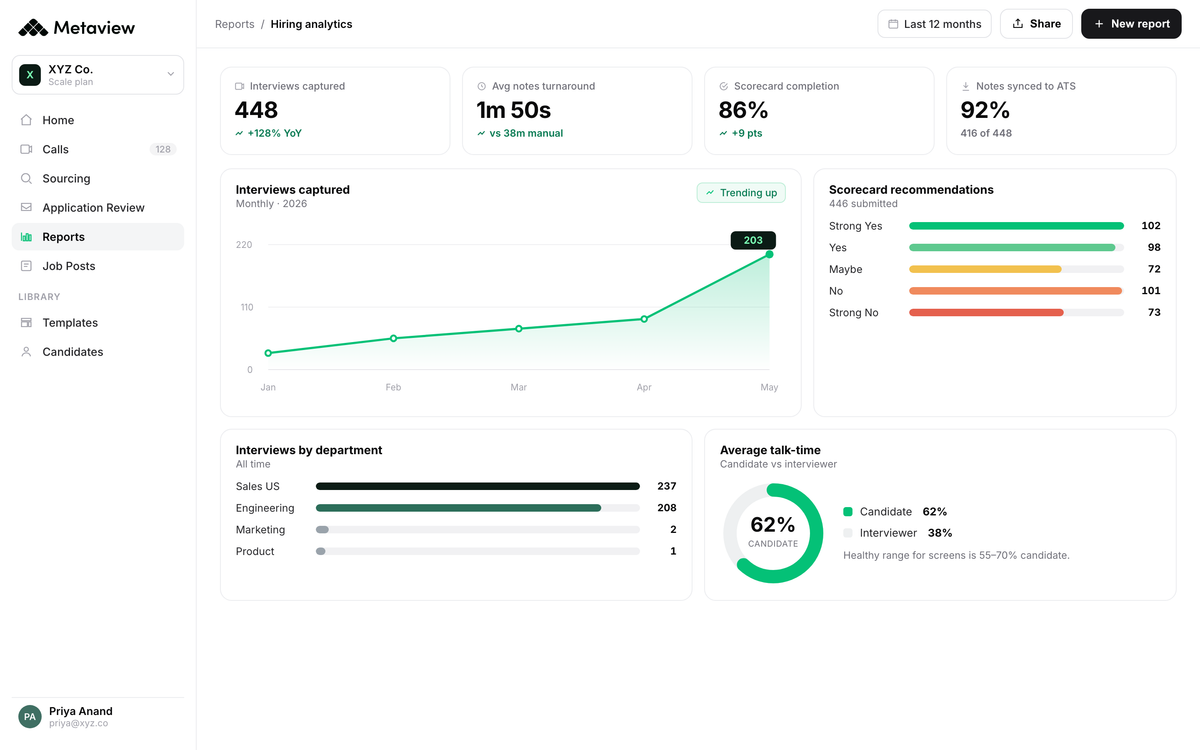
Reports rolls signal up across the corpus. Per-competency capture rates show whether the rubric is being run consistently. Talk-time ratios flag the interviewer who is doing 70% of the speaking.
Calibration drift surfaces when two interviewers consistently rate the same competency a point apart. Recurring objections from candidates show up as a topic chip that hits five different debriefs.
Multi-Source Summaries pull all of it into an offer-prep brief before the panel decision. The hiring manager arrives at the debrief with the team-level view in hand, not just their own slice.
The team-level payoff.
Each surface on its own is a productivity win. Capture saves the recruiter from typing during the call. Structure saves the hiring manager from rewatching the recording.
Routing saves the team from rebuilding the candidate profile in two places. Surfacing saves the leader from running calibration sessions on a hunch.
What changes when all four run together is different in kind, not just degree. The interview stops being a one-time event and starts being a contribution to signal across the team, not just the candidate.
A recruiter at the end of a quarter doesn't have eighty conversations to remember. They have a queryable record of every objection, every strength, every calibration drift, and every coaching moment, indexed against the rubric the team agreed on.
That's the layer talent teams using Metaview build through every call. Brandon Miles, who runs executive recruiting at Brex, put it more plainly than this post can.
I live and breathe Metaview. Whether it's doing a catch-up call with a candidate, super informal, checking in with a hiring manager, or trying to close a candidate, we're using Metaview and leveraging the data to influence our ability to hire really good folks.”
By the end of a quarter, every conversation has added to a queryable record competitors can't copy on a 30-day evaluation. That's the long-run lever.
The recruiter who runs every interview through this loop, by the time a counter-offer hits, has more context on the candidate than the competing recruiter who just opened a fresh requisition. That asymmetry is what wins.
Bring Metaview into your hiring stack.
Live notes, structured scorecards, and ATS sync - set up in under 10 minutes.
Frequently asked.
Does Metaview replace our ATS, or sit alongside it?
Alongside. Ashby, Greenhouse, Lever, Bullhorn, SmartRecruiters, Workday, and more sync natively, with the ATS staying as the system of record for stage, status, and offers. Metaview adds the captured call, the structured notes, the scorecard, and the team-level reports as attached artefacts on the candidate profile.
How long does the rollout typically take?
Capture lands in week one (silent recording on a pilot role). Template standardization lands in week four (two or three roles sharing a rubric). ATS sync lands in week eight. Team-level Reports start to show meaningful signal in week twelve, once enough interviews share the same template that comparisons hold up. The 90-day curve is the canonical one customers see.
What about data privacy and candidate consent?
Metaview is GDPR, CCPA, and SOC II compliant. Consent runs through an opt-in toggle the recruiter confirms at the top of the call, with a default consent script the team can edit once and reuse. Retention windows are configurable per workspace through the Admin Panel. Sensitive sectors (finance, healthcare, regulated EU geographies) typically tighten the defaults. Most teams keep the standard ones.
How do we measure if the rollout is working?
Three leading indicators in the first 60 days: capture rate (percentage of scheduled interviews that produce a transcript), scorecard-completion-on-time (the rate at which interviewers close out within 24 hours), and hiring-manager response latency (how fast the HM acts on the brief). When all three trend up together, the discipline is sticking. When one drags, the bottleneck is usually a habit, not a tool gap.
Can hiring managers use Metaview without changing how they interview?
Yes. Hiring managers receive the brief, the scorecard, and the offer-prep summary in their inbox or directly inside the ATS. They don't run the tool itself. The behavioral change is on the recruiter side (template setup, consent script, capture toggle). The HM workflow is read-only by default, and that's deliberate. It keeps adoption friction concentrated where the leverage is highest.


