
The last interview of a long afternoon tends to go to a tired interviewer and a candidate answering a question somebody already asked them that morning, and the hiring decision still weighs that hour the same as the first.
That’s interview fatigue, and I’d expect it to hurt your hiring from both ends: notes from the last slot of the day saying less than notes from the first, and a candidate with less left for the rounds that test the job hardest. Before changing the loop, I’d count two things: interviews per interviewer per week, across every role they sit on, and the hours each candidate spends with you from the first call to the final round.
The two counts usually point at different problems, so the next two sections take the recruiter and interviewer side first and the candidate side second.
Why interview fatigue builds on both sides of the table.
Each side of the table runs out of energy for its own reasons, and the two show up at different points in the loop.
The interviewers a team trusts most get put on every open role’s loop, and their calendars fill with slots that run straight into one another, so the notes from one interview get written after the next, from a memory that now holds two candidates. Recruiters get a denser version of the same calendar on screening days.
Candidates tire from repetition and from length. They tell the story of their last job to the recruiter and then again to each interviewer after, because the notes from earlier rounds never reached whoever spoke to them next. A full interview day then stacks those conversations without a break, and the hardest session can land last, when the candidate is running on empty.
I’d expect the scorecard from an interviewer’s fourth slot of the day to say less than the one from their first, and the debrief to lean on whichever interviews were written up while people were fresh. A candidate who spent the morning retelling their background has less for the round that tests the hardest part of the job.
Fewer interviews sounds like the obvious cure, and I think it treats the smallest part of the problem. Take a stage out and the candidate’s day gets shorter, but its questions move into the stages that remain, and the interviewer who sits on several loops a week still sits on all of them.
Fix interview fatigue for recruiters and interviewers.
The fixes on this side change who carries the interviewing and how a recruiter’s or interviewer’s day is laid out.
Count the load on each interviewer across every open role.
A calendar shows one role’s interviews at a time, which hides the senior engineer who sits on three loops this month. Pull a week of interviews from your calendars or your applicant tracking system and count them per person, across every role. Where a handful of names carry most of the week, that’s where the tiredness in your loops starts.
Widen the bench. Have each new interviewer shadow a trusted one, then run the round while being shadowed, and add them to loops as they’re ready. The habits a new interviewer has to learn first, from preparing against a rubric to scoring the candidate while the conversation is fresh, are set out in how to be a good interviewer. Agree a weekly ceiling for each interviewer with their manager, and route new loops to whoever is under it.
Give recruiters a screening day they can keep up with.
A recruiter’s fatigue shows on screening days, when calls for several roles follow each other all afternoon and every candidate’s details have to be written down before they blur into the next. Agree a daily ceiling on screens with the recruiting manager, the same way you cap interviewers, and space the calls so the notes from one screen are finished before the next candidate joins. Hiring managers and panel interviewers need the same spacing on their heavy days.
Take the typing out of the interview.
Ask interviewers to note only what to revisit, such as a claim they want to test or the moment an answer turned, and to write the full notes once the call ends, because typing up one answer takes attention from the answer being given now. Where your policy allows interviews to be recorded, they can work from the recording rather than memory.
Lighten the loop for candidates.
A candidate’s fatigue is the easier side to fix, because your team sets the whole schedule. You can take out the repeats and the spare hours, and every round still tests what it was there to test.
Count the hours a candidate spends in your loop.
A loop described as four rounds can hide a take-home task that eats an evening and an onsite that runs most of a day. Add up every hour the candidate spends with you, from the first call to the last interview, and include any preparation you asked for.
Then decide what total you’d accept for the role’s level, and cut from the biggest block first. I’d look at the take-home before anything else, because it can often be replaced by a shorter exercise worked through together in a round you already run. Taking out a whole stage is a bigger decision, and checking a stage before you cut it is its own subject.
Ask each question once across the loop.
Candidates repeat themselves when the team never decided who asks what. Give each interviewer the competencies they own in the interview kit before the first round is booked, so two rounds never set out to test the same thing.
Make sure the resume walkthrough happens once, in the first conversation, and that its notes reach every interviewer who comes after. A candidate who tells that story once keeps the energy three more tellings would have cost for the technical rounds later in the loop.
Build the long interview day around breaks.
When several interviews run on one day, put a break between sessions long enough for the candidate to eat or step outside, and tell them when it is before the day starts. Keep the hardest session in the morning, such as the system design round or the case exercise.
Give the final slot to the conversation that asks least of the candidate, such as meeting a future teammate or time for their own questions.
Where Metaview fits in interview fatigue.
Most of the fixes above are scheduling decisions your team makes. Metaview’s part is the record of each interview and a count of who runs them.
Listen in the interview while the Notetaker keeps the record.
The Metaview Notetaker records the interview and transcribes it, laying its notes out under the headings your team chose. It captures every spoken word while the interviewer listens, so they can stay with the candidate for the whole call and check the notes against what was said afterward, with nothing to type in between.
On the candidate side, Metaview can generate a summary across the conversations attached to a candidate, so the next interviewer reads one link before their round instead of three sets of notes. Each type of conversation gets a notes template of its own, which is how a debrief and a screen end up with different headings.
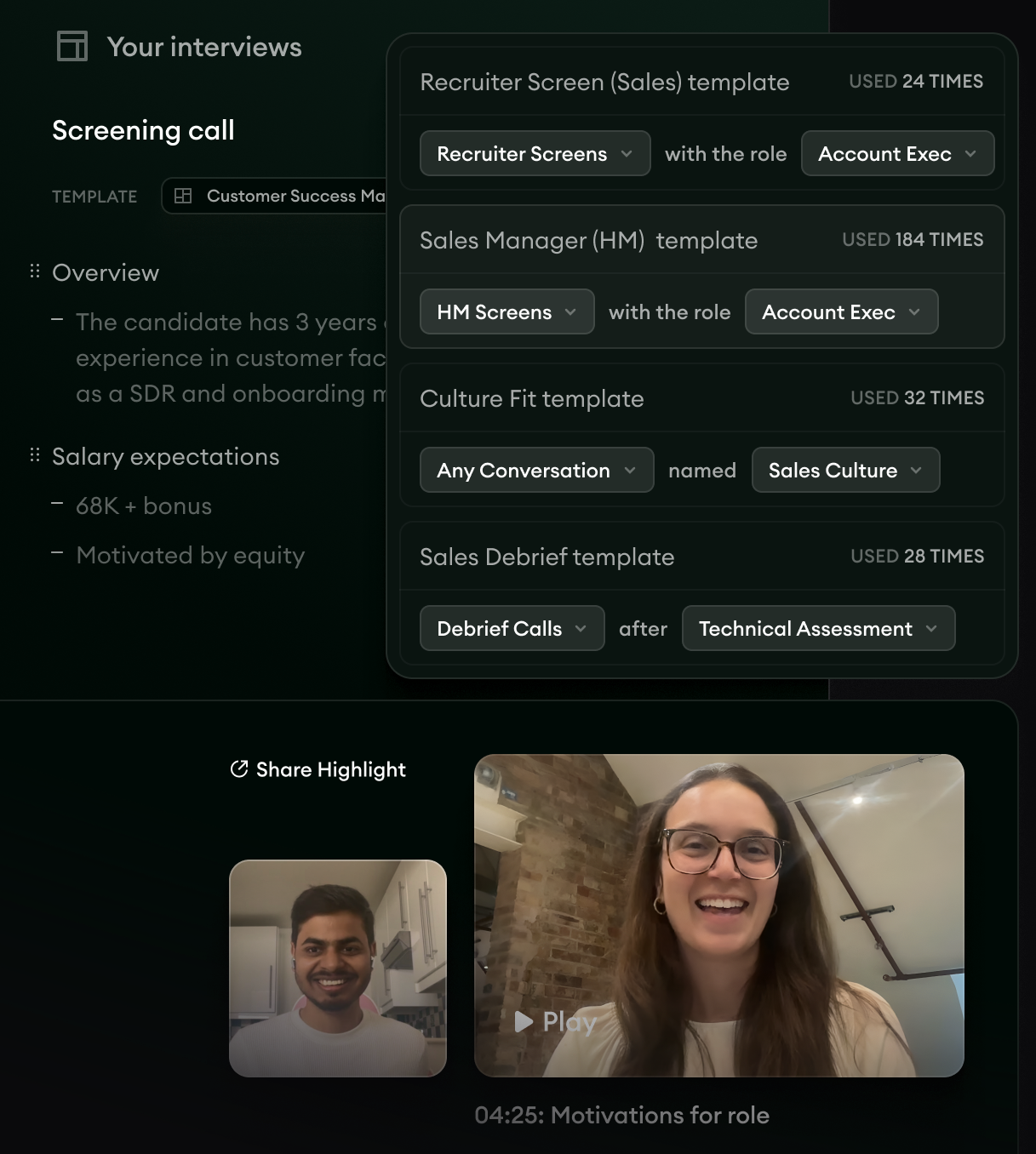
- 1The notes for one screening call, laid out by the template chosen for that call.
- 2Templates vary by conversation, so a debrief after a technical assessment gets a layout of its own.
- 3A moment from the call can be shared with the team as a short clip.
That clip is a snippet: a short video cut from the interview, which a recruiter can send to a hiring manager so they hear the answer itself. At Catawiki, hiring managers can review interview clips instead of attending every interview, and James Lesner, the company’s director of talent management, says, “Interviewers, who are often busy with other responsibilities, have found Metaview incredibly helpful.” For a hiring manager who sits on every loop their team runs, a clip of the one answer they care about can stand in for an hour in the room.
Interviewing well is tiring in itself, and one of Metaview’s co-founders, who has written about what separates good interviewers from bad ones, says so plainly.
A good interviewer is mentally fatigued by the end of an interview.”

I agree, with one condition: that tiredness should come from listening to the candidate. When it comes from typing and from a fourth slot in a row, the team is spending attention the candidate never got.
See where each interview spends its questions in Reports.
Metaview Reports counts the questions each captured interview spends on each competency, and it can compare that across interviewers and roles. When two rounds in the same loop both lean on one competency, that’s where a candidate is likely to hear similar questions twice, and it’s the overlap I’d fix first.
Metaview Reports also shows how many interviews each recruiter and interviewer runs, which saves building the first count from calendars by hand. I’d read it by interviewer before planning next month’s loops.
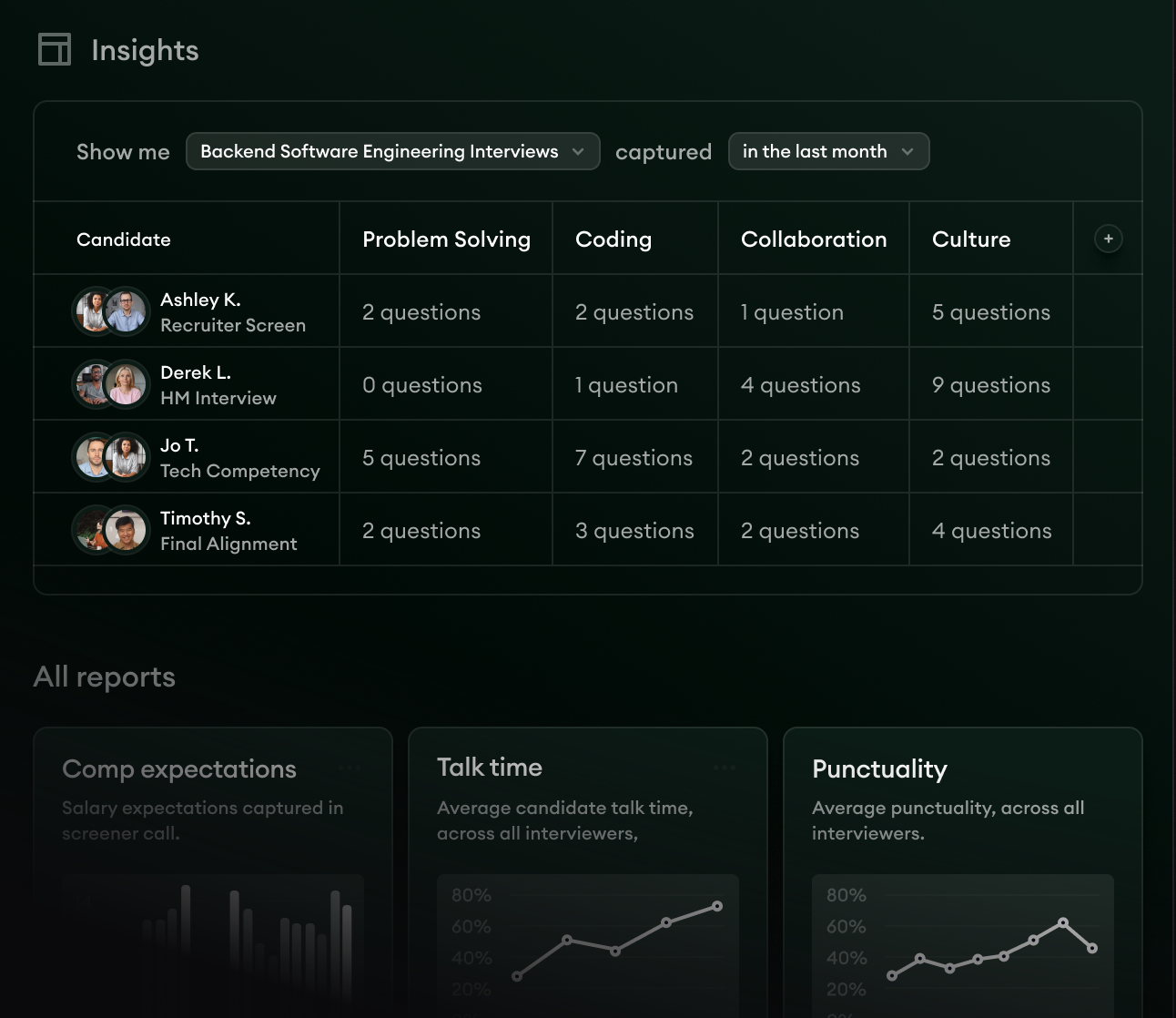
- 1Every competency gets its own column, and each cell tallies one interview’s questions on it.
- 2Each row is a different candidate’s interview, labeled with its stage.
- 3Underneath the table sit other reports, among them candidate talk time averaged across interviewers.
Check your next loop for fatigue on both sides.
The last role you filled holds most of what you need. Each item pairs a sign of fatigue with the change I’d make for it.
- Count last week’s interviews per interviewer. If a few names carry most of them, widen the bench before changing anything else.
- Open the calendars of your busiest interviewers. If their slots touch end to end, space them so each interview’s notes are done before the next begins.
- Look at a recruiter’s heaviest screening day. If screens for different roles alternate through it, group them by role and set a daily ceiling.
- Set an interviewer’s first and last scorecard from a heavy day side by side. If the last one says much less, start by taking the typing out of the interview and adding the gap.
- Add up the hours your last finalist spent with you. Where the take-home or a repeated session is the biggest block, cut there first.
- Ask candidates who finish the loop which question they heard more than once. If anyone names one, give that competency a single owner.
On the interviewer side I’d start with the bench, since training new interviewers takes weeks and the other fixes there assume it. The candidate side moves faster: the hours your last finalist spent with you show which block of time to cut from the next loop. The recruiter fix and the candidate fix are rarely the same change, so I’d start both this month and let the next loop show which one the team felt first.
Find the interview rounds that lean on the same competency.
Metaview Reports counts the questions each captured interview spends on each competency, and how many interviews each recruiter and interviewer runs.
Frequently asked.
How many interviews a day is too many for one interviewer?
Ask your busiest interviewers which slot of a heavy day they’d least want their judgment checked on, and set the daily cap below it. Expect the answer to differ by interview type, since a structured screen asks less of an interviewer than a system design round.
Is a one-day onsite less tiring for candidates than spreading interviews out?
A single day means one absence from their current job and a quicker answer, but it asks for hours of attention in a row. Spreading the interviews over a week asks less of each day and makes the wait longer. Offer both where you can and let the candidate choose: someone taking leave to interview may prefer one day, and someone with caring duties may prefer shorter sessions.
Should the hiring manager sit in every interview round?
Only their own round and the debrief, in most loops. A hiring manager in every round is often the most overloaded interviewer on the team, and the candidate meets the same person several times over. Give them one round of their own plus the debrief, and ask them to read the notes from the other rounds before the debrief starts.
Does a panel interview reduce interview fatigue?
For the candidate it often does, because one panel replaces several back-to-back conversations and the repeated introductions that come with them. For interviewers a panel costs more, since several people spend the same hour with one candidate. Making a panel work depends on each panelist owning different questions, which is the core of running panel interviews well.


