
A recruiter has a question about a candidate. What were their comp expectations? What did they actually say about hybrid? Which competency did the senior IC push back on? The answer is in the interview. Somewhere. It sits inside a transcript PDF, inside a Slack thread with the hiring manager, inside a feedback form that was scribbled an hour after the call ended, or inside the recruiter's faint memory of a 45-minute conversation they had three weeks ago.
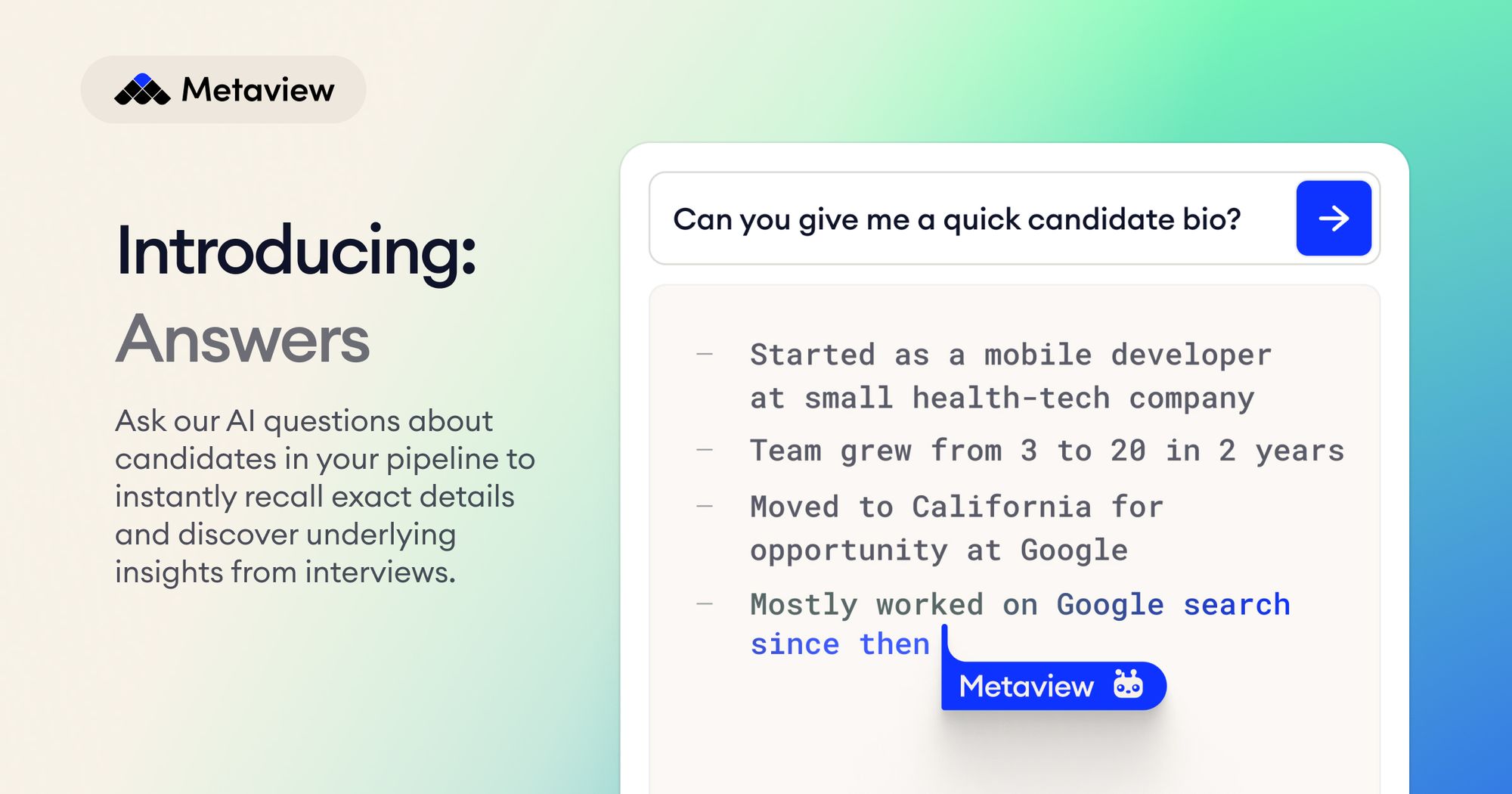
Today, you ask. Answers turns every interview Metaview captures into a queryable record. Type the question the way you'd ask a colleague. "What did the last 15 backend engineers say about remote work?" "Which candidates flagged hybrid as a deal-breaker?" "What motivations came up in this morning's screens?" The answer lands in seconds, grounded in the actual transcript, attributed to the candidate it came from.
Answers wasn't a one-off when it launched in May 2023. It was the first conversational surface on top of the interview record. Three years on, that surface has multiplied. AI Filters runs natural-language queries across the candidate pipeline. The Reports MCP lets Claude do the same against your hiring data. AI Sourcing pulls candidates from prior captured conversations rather than just LinkedIn. The capability still lives at metaview.ai/answers. Everything else extends it.
The trawl Answers replaces
Recruiters have lived with this for the entire history of structured interviewing. The data is there. The candidate said the thing. It's recorded, transcribed, sitting in a system the recruiter has access to. But the data isn't reachable at the speed the next step in the process needs it. So the recruiter pulls the transcript, Ctrl-F's a guess at the keyword, scans five pages, gives up, pings the hiring manager on Slack, and waits.
That gap, between data captured and data usable, is where most of the recruiter's day used to disappear. It's also where most of the cross-functional friction lives. The recruiter can't easily share what the conversation actually surfaced. The hiring manager makes the next decision on faint memory. The candidate gets the version of the story the panel could reconstruct from notes, not the version they actually told.
According to Metaview's 2026 AI & Hiring Alignment Report, surveying 505 recruiting leaders and hiring managers across North America and EMEA, 58% of recruiting leaders and hiring managers actively contemplate working around their counterpart. Most of that traces back to friction at exactly this layer. When the captured signal can't be queried in seconds, both sides start working from their own version of the conversation.
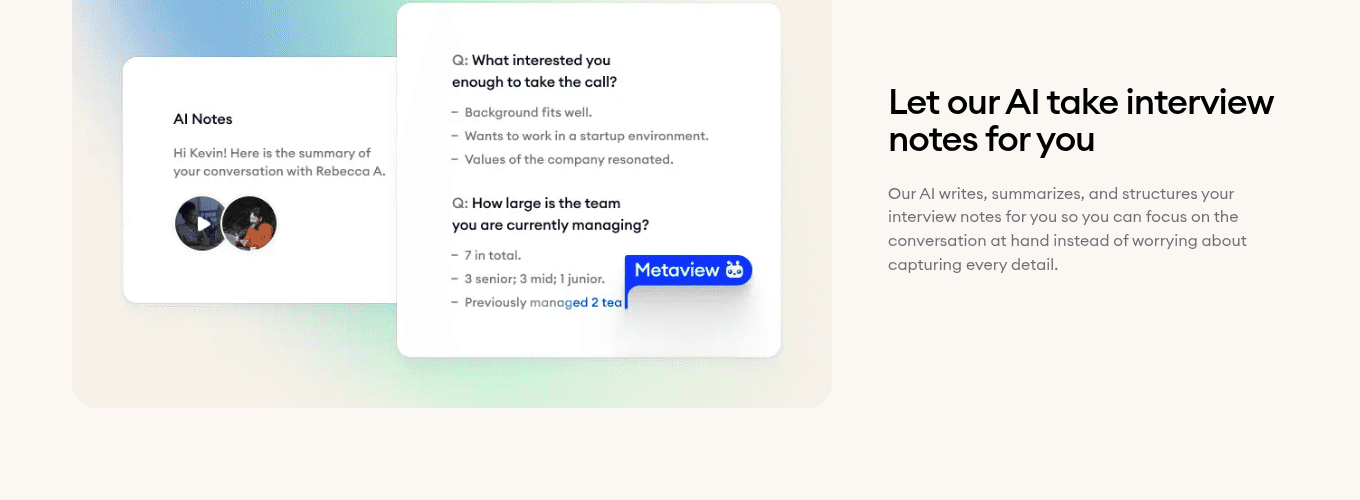
After testing out a few different recruiter AI notetakers, I am obsessed with Metaview. It takes notes in various formats depending on your interview style: question and answer, topic highlights for those of us who enjoy a conversational interview, tailored to HM discovery calls, technical and non-tech debriefs. The best part is it allows me to be fully present in the conversation with the candidate. I'm no longer worried about typing away and missing important parts of what was discussed.”
What you can actually ask
The question shape matters more than the keyword. Answers takes natural language. You don't write a query, you write the question the way you'd say it out loud to a teammate. Three patterns recruiters reach for most often:
Single candidate, one specific moment
"What did Sarah say about her current comp band?" "Did the senior IC give an example of a system they designed end-to-end?" Answers pulls the moment from the transcript, attributes it to the speaker, and shows the timestamp. The recruiter walks into the offer-prep conversation with the candidate's actual words, not a paraphrase from the feedback form.
Across a role, across a time window
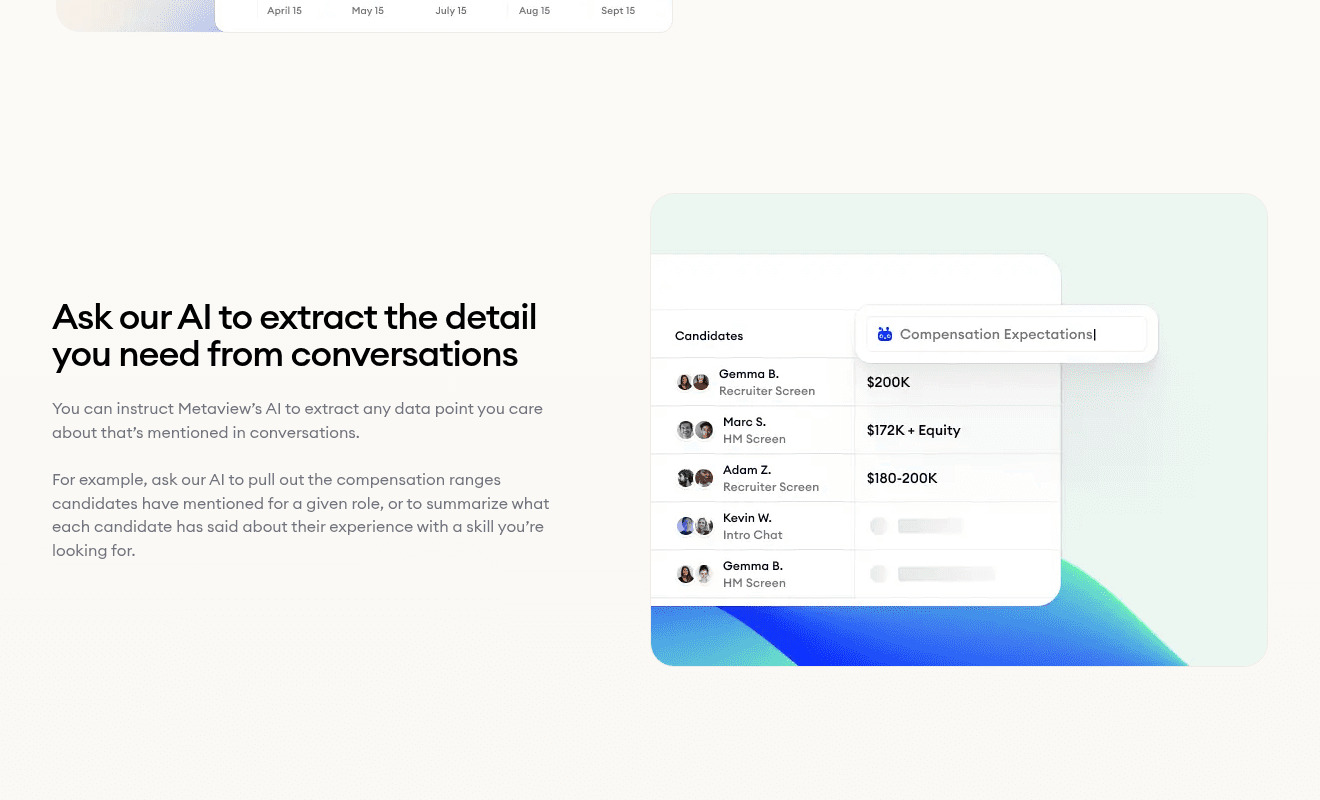
"What were the main reasons backend engineer candidates dropped out of the process this quarter?" "Across all senior IC interviews this month, what came up most about hybrid?" Answers aggregates across the captured set, grounded in the same conversational data, with the structured tags Notetaker generated already in place. The output is closer to a research note than a search result.
Calibration questions for the hiring panel
"Did the panel ask about systems-design depth on this candidate?" "Where did the interviewers disagree on the technical signal?" Answers maps panel agreement and disagreement across the captured rounds. The debrief becomes a calibration meeting rather than a memory test.
How it works under the hood
Three components, all already part of the platform: capture, structure, query.
Capture. The Notetaker joins the meeting, transcribes the conversation, identifies speakers, and ships structured notes the moment the meeting ends. The capture is the same agent already running on intake calls, recruiter screens, hiring manager rounds, and candidate debriefs. The data Answers queries is the same data the rest of the platform reads from.
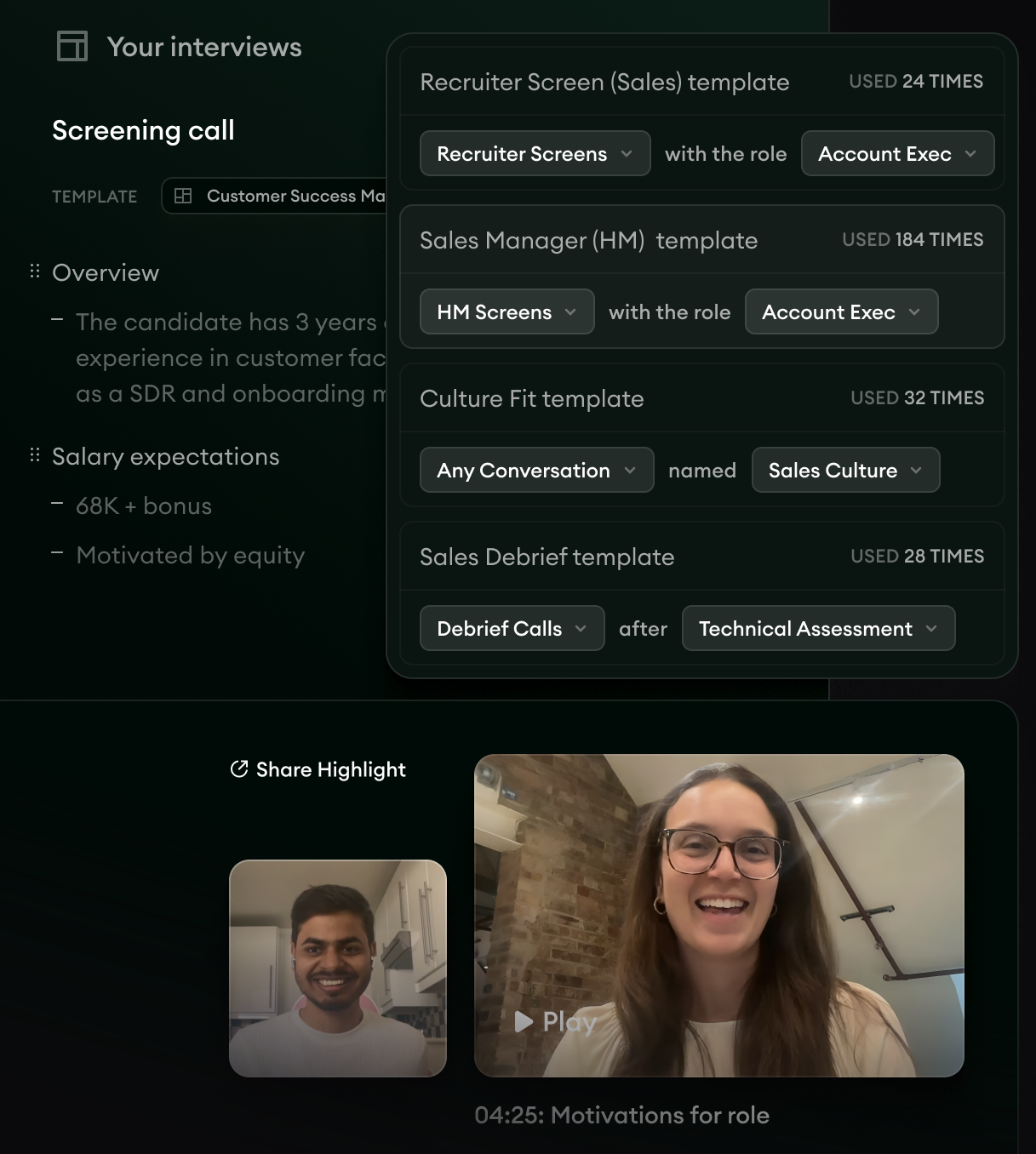
Structure. Each captured conversation gets parsed against the meeting type and the role's competency template. Comp expectations, motivation signals, deal-breakers, technical answers, panel agreement, and the dozens of softer signals that show up across an interview round all get tagged inside the underlying transcript. The structure is what makes the natural-language query work. Without it, Answers would be Ctrl-F.
Query. The conversational layer sits on top. The recruiter asks the question. Metaview retrieves the relevant spans from the structured transcript layer, generates an answer grounded in the actual conversation, and returns the candidate name plus the timestamp the answer came from. Every response is attributable to the underlying source.
Old workflow vs Generic AI vs Metaview Answers
The contrast isn't between Metaview and the generic notetaker. The contrast is between three different workflows for the same question.
| Dimension | Old workflow | Generic AI notetaker | Metaview Answers |
|---|---|---|---|
| Where the data lives | Transcript PDFs, hiring manager's memory, recruiter's notes | A summary or a searchable transcript | The captured interview record, structured per competency |
| How you ask the question | Scroll the transcript, Ctrl-F a guess, ping the hiring manager | "Summarize this meeting" | "What did the last 15 backend engineers say about comp?" |
| What you get back | A faint memory or a screenshot from a Slack thread | A general summary | The structured answer, with the candidate name and timestamp it came from |
| Scope of the query | One candidate, one meeting | One meeting | One candidate, one role, the full pipeline, or all conversations on file |
| Audit and permission | None | Limited; whoever has the transcript link | Role-based access; the recruiter sees only the candidates they're cleared to see |
The category-level frame: the answer to a recruiter's question is only as good as the structure of the data underneath it. Generic AI summaries are downstream of an unstructured transcript. Answers is downstream of the structured interview record.
Where Answers shows up in the rest of the stack
The conversational query layer isn't only at metaview.ai/answers anymore. Three years of platform work later, it sits underneath multiple surfaces, all reading from the same captured interview record.
- Answers (in the post-meeting view). The original surface. Type a question about the candidate from inside their interview record. The same product that launched in May 2023, now extended.
- AI Filters (in candidate search). Natural-language queries applied across the candidate pipeline instead of a single interview. Shipped in February 2026. Pre-set filters like "likely needs visa sponsorship" and "job hopper" sit alongside the manual filter flow.
- Reports MCP. Connect Metaview Reports to Claude or any MCP-compatible AI client and query your interview data in natural language. The agent runs the same retrieval against the same captured record. In Beta at internal launch.
- AI Sourcing using captured conversations. The Sourcing agent treats prior interviews as a sourcing pool. Find candidates who mentioned a specific company in past calls, or surface anyone whose conversation matched a new role's motivation profile. Captured conversations become a proprietary sourcing layer.
The point of the multi-surface buildout is that the answer to a recruiter's question doesn't need to live where they happen to be working. Asking it in the candidate's interview view, in the candidate search, inside Claude, or inside the sourcing agent should return the same answer from the same underlying conversation.
We may need to know whether a recruiter or hiring panel went deeper on a certain topic. Being able to go back to Metaview, pull those exact notes, and see exactly what was said has been really helpful.”

What customers are seeing
Quora is one of the longest-running customer deployments of the Notetaker layer that Answers queries. Hannah Wardle, Global Head of Recruiting at Quora, ran the rollout against a baseline where hiring manager feedback used to take two full days to come back. The team's recruiting org is distributed across the globe; the latency on the feedback loop was the binding constraint on time-to-hire.
After the rollout, the same hiring manager feedback turnaround compressed to between 10 and 20 minutes, with the structured notes from the interview already in the recruiter's hands by the time the conversation about the candidate started. Across the recruiting team, the average time saved per recruiter is 10 hours per week, and every member of the hiring team reports a time saving.
The compression matters more than the time savings line item. When the answer to "what did this candidate say" lands inside the same hour as the interview, the next step in the process happens that day rather than three days later. The candidate decides what their next conversation looks like with less time to disengage. The recruiter sets the offer-prep conversation with the candidate's actual words, not a paraphrase reconstructed from feedback forms.
What's available today
The conversational layer is live across the platform. Some pieces have been available since 2023, others shipped in the last year.
- Answers at metaview.ai/answers. Open to all customers. The original conversational interface for a captured interview record.
- AI Filters in candidate search. Shipped February 2026. Natural-language and pre-set filters running alongside the manual filter flow.
- Reports MCP for Claude or any MCP-compatible AI client. Beta at internal launch. Setup via Settings, then MCP. Same permissions model as Reports.
- AI Sourcing on captured conversations. Attach prior calls to any sourcing search via the paperclip button. Workspace conversations available across the platform.
- Multi-Source Summaries. Cross-meeting synthesis sits behind the conversational layer for cross-round and cross-candidate questions.

See how recruiters query the captured interview record from inside the platform.
Frequently asked
What's the difference between Answers and AI Filters?
Answers is the conversational query interface for a single captured interview record. AI Filters applies the same natural-language layer across the candidate pipeline. Same underlying interview data, different scope per query.
Can I ask Answers about a candidate I didn't interview?
Only if you have role-based access to that candidate's interview record. Customer admins control permissions inside the workspace. The recruiter sees only what they're cleared to see.
Where does Answers get the answer from?
From the captured interview transcripts and the structured notes Metaview generates from them. Every answer is grounded in the underlying conversation and attributed to the candidate it came from.
What about candidates whose interview wasn't captured?
Answers can only return answers from interviews on file. For sessions where capture is disabled or Transient Mode runs, the raw audio and transcript aren't retained, so Answers won't index them.
Is Answers an additional license for existing customers?
No. Answers is part of the platform. No additional license needed for existing Notetaker customers.


