
LinkedIn Hiring Assistant speeds up the work a recruiter is already doing. Metaview AI Sourcing replaces most of it.
Inside LinkedIn Recruiter, Hiring Assistant suggests profiles, recommends similar candidates, and surfaces matches based on your saved searches. The recruiter still drives every step. Build the search. Refine the filters. Send the InMail. Repeat per role.
Metaview runs a different model. The AI Sourcing agent works off the intake call, scans the wider talent market continuously, and delivers a ranked shortlist before a recruiter opens a search bar.
This guide breaks down what each one is, where each one fits, and how to choose between them.
LinkedIn Hiring Assistant vs Metaview AI Sourcing at a glance.
Five dimensions that decide which model fits your team. Talent coverage, search model, skill understanding, workflow, and the analytics you get out the other side.
| Dimension | LinkedIn Hiring Assistant | Metaview AI Sourcing |
|---|---|---|
| Talent coverage | LinkedIn profiles only | Multi-source talent graph beyond LinkedIn |
| Search model | Recruiter-driven assisted search | Autonomous agent running in the background |
| Skill understanding | Pattern matching on structured profile fields | Semantic understanding of role and candidate context |
| Workflow | Build search, refine, send InMail, repeat per role | Intake call in, ranked shortlist out, continuous re-ranking |
| Analytics | Recruiter-level activity metrics | Cross-role sourcing performance and pipeline health |
What LinkedIn Hiring Assistant is.
LinkedIn Hiring Assistant is the AI layer inside LinkedIn Recruiter that suggests candidates, recommends similar profiles, and refines searches based on recruiter activity. It is assisted search, not autonomous sourcing.
The recruiter remains the driver. You define the search with filters and Boolean logic, LinkedIn suggests adjacent profiles, and you decide who to message. The AI improves ranking and surfaces alternatives. It does not generate a shortlist on its own.
Where it works: teams already standardized on LinkedIn Recruiter who want incremental productivity gains without adopting a new tool. Generalist recruiters covering LinkedIn-heavy roles get real value from the recommendations.
Where it falls short: the model breaks down at scale and on specialized roles. Manual setup time stays constant per req. Talent coverage stops at the LinkedIn profile boundary. Cross-role analytics are limited to activity metrics inside LinkedIn.
What Metaview AI Sourcing is.
Metaview AI Sourcing is an autonomous sourcing agent. It runs off the intake call, scans the wider talent market continuously, and delivers ranked shortlists without a recruiter building a single search.
The model is structural, not incremental. Instead of speeding up clicks inside a single network, Metaview replaces the click-based workflow entirely. The agent works in the background, learns from your accept and reject decisions, and re-ranks the pipeline as your criteria sharpen.
Where it works: teams hiring at volume, teams with specialized or technical roles where pattern matching falls short, and recruiting ops leaders who need cross-role sourcing performance data that LinkedIn does not surface.
Where it falls short: if your only sourcing need is light InMail outreach to LinkedIn-active candidates on a handful of standard roles, an autonomous recruiting agent is more product than you need.
Where they overlap.
Both reduce time spent on manual Boolean search. Both surface candidates a recruiter would not have found in raw filter results.
The split is whether the recruiter remains the driver. LinkedIn keeps you in the driver's seat with better suggestions. Metaview moves you out of it entirely and lets you focus on the part of sourcing that still needs human judgment.
How to choose.
Four scenarios that map cleanly to one model or the other.
Where Metaview fits.
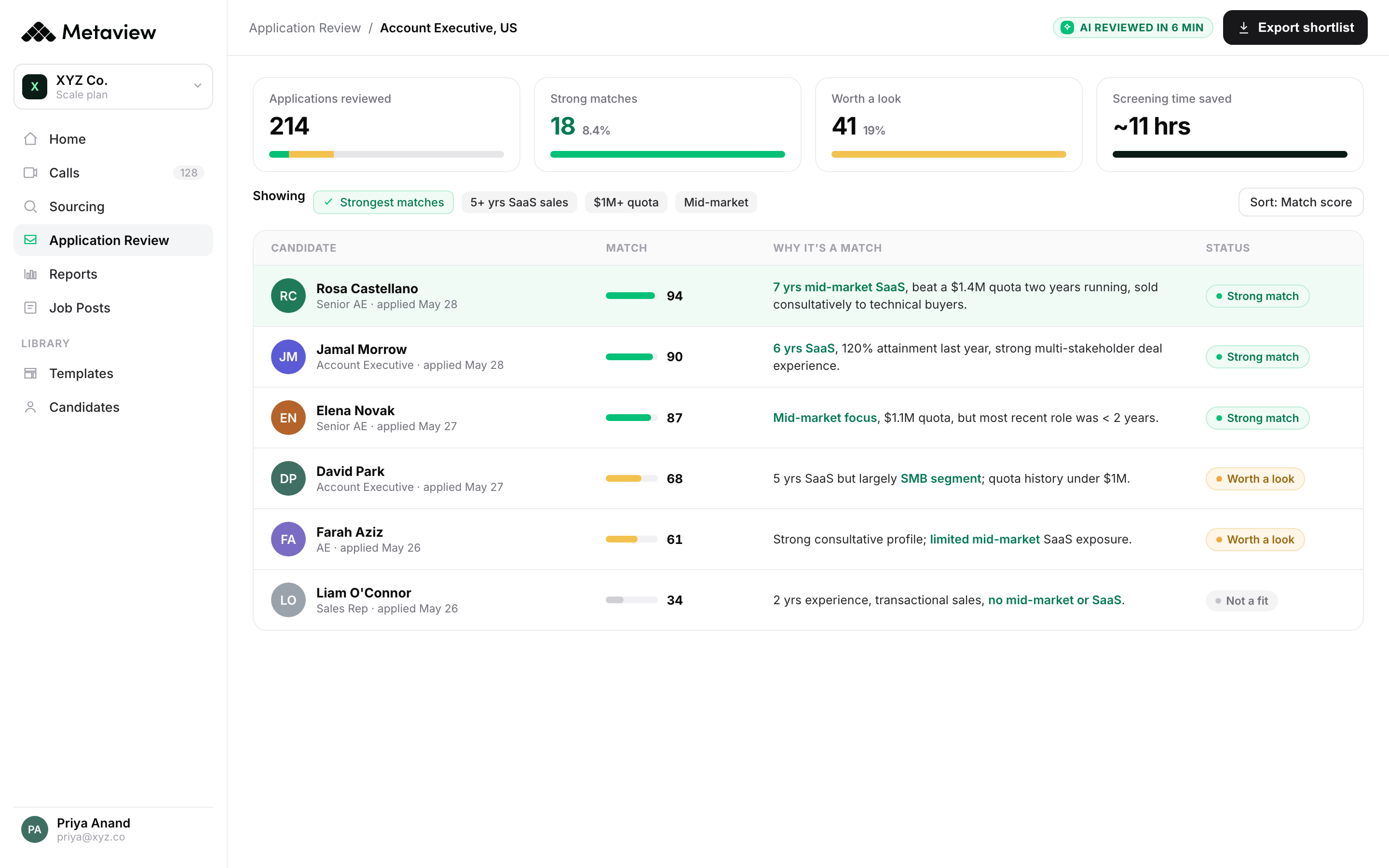
Metaview works as the autonomous layer on top of whatever you keep LinkedIn for. The AI Sourcing agent runs off intake calls, generates shortlists in the background, and continuously re-ranks the pipeline as you accept and reject candidates. The recruiter still owns engagement and decisions; the platform absorbs the search-build work.
The semantic understanding is the differentiator on specialized roles. Cybersec, niche engineering, nontraditional backgrounds, the candidates a profile-pattern model would never surface end up at the top of the Metaview shortlist.
Charles Hein Wroth, a Headhunter using Metaview AI Sourcing, described that difference on technical roles.
It works really well with the complex nuanced Technical Cybersec roles I work, and found some people I have never seen before.”
Comparing other LinkedIn-adjacent recruiting tools? See our guides on LinkedIn Recruiter alternatives and the best candidate sourcing tools.
Bring Metaview into your hiring stack.
Live notes, structured scorecards, and ATS sync - set up in under 10 minutes.
Frequently asked.
Is LinkedIn Hiring Assistant included with LinkedIn Recruiter?
LinkedIn Hiring Assistant capabilities are bundled inside LinkedIn Recruiter and LinkedIn Talent Solutions. Access depends on your subscription tier and seat count, not a separate product purchase.
Can Metaview replace LinkedIn entirely?
Most teams do not replace LinkedIn outright. They keep LinkedIn for brand presence and outreach and let Metaview handle continuous discovery, ranking, and sourcing performance visibility across the wider market.
What is the difference between assisted search and autonomous sourcing?
Assisted search reacts to inputs from a recruiter. The recruiter defines the query, the AI refines results. Autonomous sourcing works the other way: the system runs continuously off your role criteria, surfaces ranked shortlists in the background, and learns from your accept and reject decisions.
Does Metaview work for technical and specialized roles?
Yes. The semantic understanding of skills and context is the strongest fit for roles where pattern matching on titles or keywords misses strong candidates with nontraditional backgrounds.
When should a team look beyond LinkedIn Hiring Assistant?
When hiring volume grows past what assisted search can handle without burning recruiter time, when roles get specialized enough that LinkedIn profile data alone is not enough signal, or when recruiting ops needs cross-role performance visibility that LinkedIn does not provide.


