Pick the wrong dominant motion for a role and a brilliant outbound campaign produces fewer hires than a tepid inbound funnel.
The opposite holds too. Run inbound by default on a Director of Engineering search and you wait six months for a candidate who was never going to apply.
Outbound recruiting is the decision before the workflow. The choice of which motion dominates per role settles whether the rest of the playbook even matters.
When outbound vs inbound dominates per role.
Four dimensions decide which motion leads on a given req. Candidate availability, employer-brand pull, market intensity, and seat seniority. Walk the matrix per role at intake.
| Role profile | Inbound dominant when | Outbound dominant when |
|---|---|---|
| Senior IC or leader | Rare. Strong brand plus relaxed market. | Default. The seat is too consequential to wait on applications. |
| Specialist or niche skill | Adjacent skill pool is large and active. | Talent pool is small and rarely listed on job boards. |
| High-volume role | Default. Pipeline scales with employer brand and ads. | Specific cohort gaps (region, language, certification) the inbound funnel never hits. |
| New market entry | Brand is established in the region. | Brand has no pull yet. Every hire teaches the market the company exists. |
The matrix runs per-role, not once-only. A team that defaults to outbound everywhere burns recruiter time on seats inbound would have filled. A team that defaults to inbound watches its most consequential roles stay open.
The 5-stage outbound motion.
Five stages, in order. Each one earns its place because skipping it costs the next one. The handoff between stages is where most outbound efforts quietly lose hires.
Step 1: Calibrate the target before the search.
Outbound that fails on reply rates usually traces back here. The recruiter and the hiring manager never agreed on what "great" looked like, so the recruiter sent messages built around a sketch the hiring manager later rejected.
Twenty minutes before any search tab opens. Walk the experiences that predict success, the career motivations that would make someone open to a move, and the real deal-breakers separated from the wish-list.
According to Metaview's 2026 AI Hiring Alignment Report, surveying 505 recruiting leaders and hiring managers across North America and EMEA, the calibration gap is measurable.
A sharp brief writes sharper messages, which earn more replies, which produce better conversations, which compound to a shorter time-to-hire. Alignment before the search is the move every other stage rests on.
Step 2: Identify, don't just search.
Once the spec is sharp, the work shifts from "find people who look right on paper" to "find people whose trajectory and recent context suggest they'd consider this move." Targeting beats volume on every metric that matters.
Career trajectory, problem-space context, company-size pattern, and signals of openness produce a working shortlist in hours. Keyword stacks produce a long list that takes two weeks to sift through.
Step 3: Write outreach that earns the reply.
The goal of the first message is the reply, not the hire. A short note that names what caught your attention about this specific person, frames the role in one line, and asks for a low-commitment next step beats the long pitch every time.
Most outbound fails at the first message because it reads like every other inbox arrival. Templated. Generic. Optimized for the sender's funnel, not the candidate's day.
Three properties separate replies from deletes: relevance to the person's trajectory, a concrete reason this role might be worth a conversation, and a low-pressure way to say yes to a fifteen-minute call.
The mechanics live in deeper detail across candidate outreach and personalized outreach emails.
Step 4: Turn replies into two-way conversations.
A reply is the start of the real work. The first call shifts from pitching to discovering: open questions about what the candidate is solving today, what's missing from the current role, and what would have to be true about the next one.
The trap is treating the first call as a screen. Outbound candidates didn't apply. They agreed to talk because the message earned the time. A thirty-minute interrogation against a checklist closes the door on a candidate who would have moved for the right pitch.
Capture the nuance the candidate volunteers. Motivations, concerns, comp signals, partner-location constraints, timing. Each one is something the hiring manager will read cold before the panel.
Most of it lives only in the recruiter's head ten minutes after the call ends. Capture the nuance early or watch the handoff collapse.
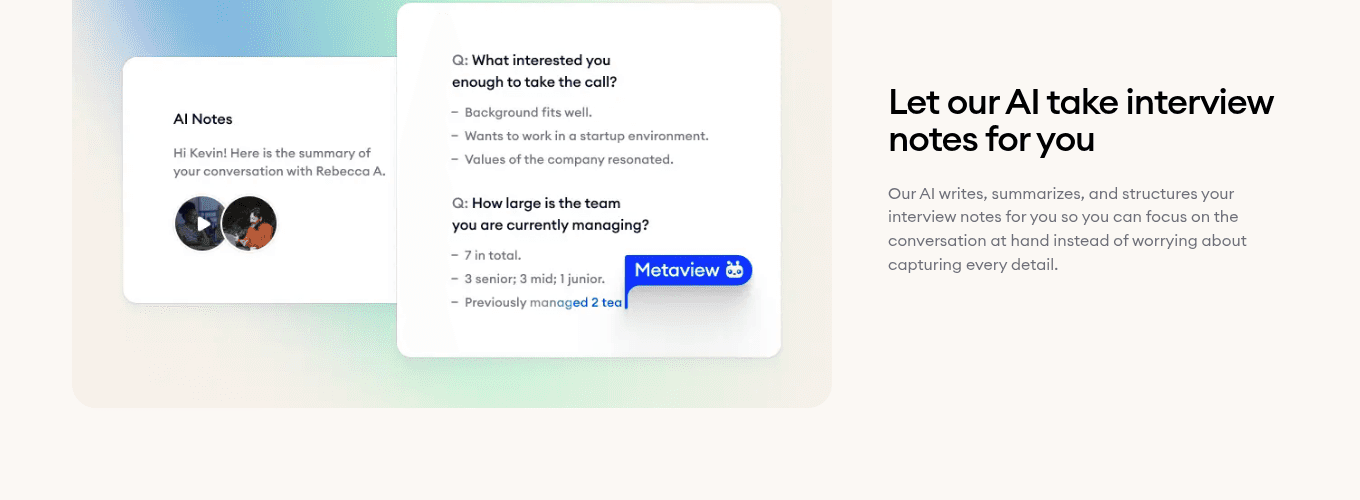
- 1The Q&A summary captures what the candidate said about motivations, comp, and timing.
- 2Topic chips group the signal so the hiring manager can scan instead of replay.
- 3The full recording stays one click away if the panel needs the raw quote.
Step 5: Run high-bar interviews on outbound candidates.
Outbound candidates didn't choose you. They agreed to consider you. The interview either compounds that trust or rebuilds it from scratch every round.
The expensive failure mode is the interview that asks the candidate to repeat themselves. The recruiter screen captured the motivations. The first round didn't read the screen. The second round didn't read the first.
By the panel, the candidate has answered "what are you looking for?" three times and decided the team isn't paying attention.
The fix is structured capture that survives the handoff, paired with a debrief that pulls from the captured signal rather than from each interviewer's memory.
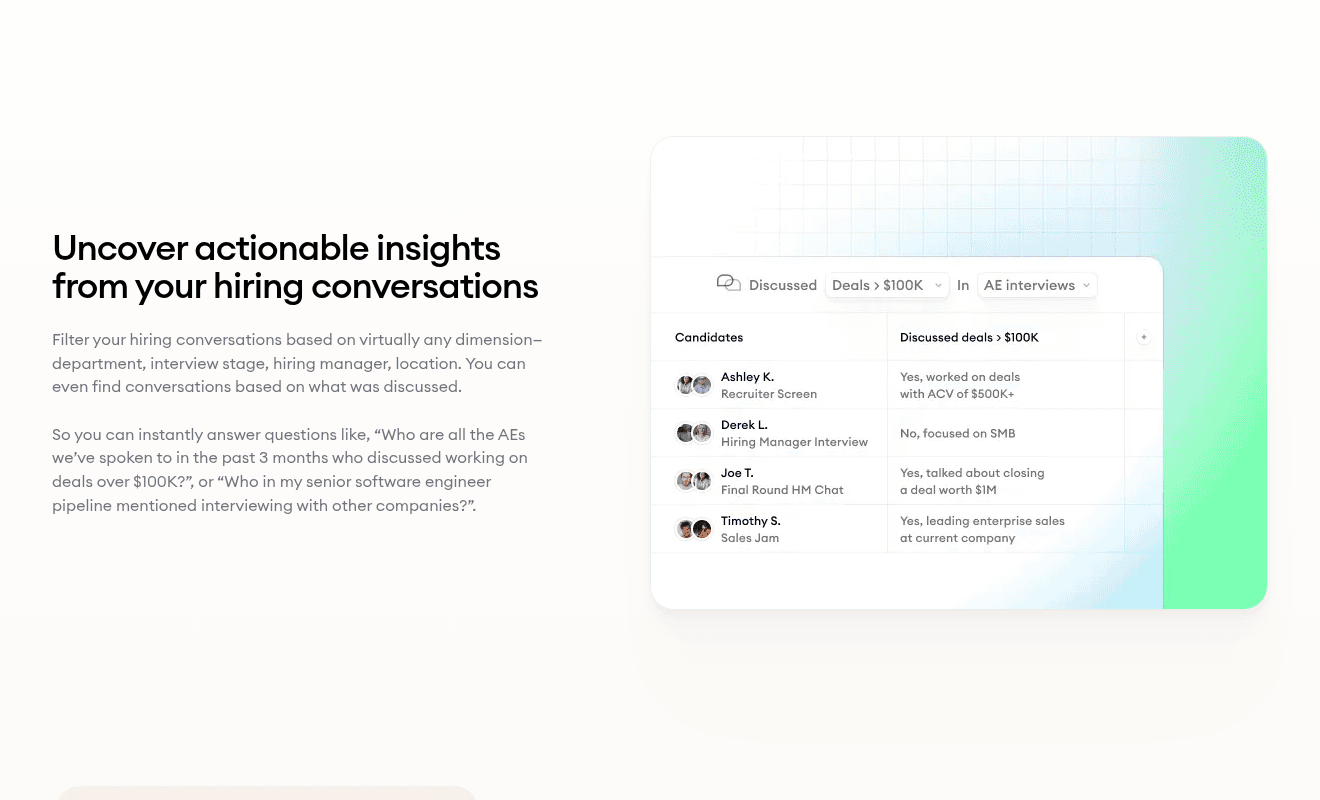
- 1Cross-round summary pulls motivations, themes, and concerns from every recorded touchpoint.
- 2Per-interviewer scorecards anchor against the same calibrated rubric from Step 1.
- 3The panel reads the brief before the debrief, and stops asking the candidate to repeat the basics.
Each round earns more candidate trust because each round demonstrably read the last. The candidate's last interview is the one where they decide.
A high-bar loop on someone you sourced cold compounds with every reply. By the offer stage the candidate has had four conversations that each built on the previous one.
How to measure outbound the right way.
"We sent 200 messages this month" is a tally, not a measurement. The motion either produced qualified replies the hiring manager wanted to talk to, or it didn't. The metrics that surface the difference look almost nothing like the volume dashboards.
It's not just the hours saved, but also the time you can use to focus on what really matters: getting the signal we need to make the best hiring decisions.”
Four metrics cover the motion end to end:
- Reply rate per cohort. Under 15% on a clean list is a targeting fault, not a message fault. Above 30% on a calibrated cohort means the message is working and the bottleneck has moved to targeting depth.
- Outreach-to-interview conversion. The reply that doesn't become a first-round conversation is a wasted hour. Track the drop-off; that's where the message-to-spec mismatch lives.
- Time-to-hire on outbound roles. Measured separately from inbound. Roll the average across the quarter, not the month, or the early-stage calibration investment looks like a loss.
- Hiring-manager satisfaction on candidate quality. A single question after every loop: "Did the candidate meet the bar you set at intake?" When the answer drifts down for three searches in a row, the calibration session is the place to look.
Across the playbook, our AI Sourcing agent compounds targeting work into a standing shortlist. Our Notetaker preserves the nuance from the calls. Our Reports surface which cohorts and which messages converted at the offer stage. The next req opens against a sharper brief.
Outbound recruiting earns its place when the team treats it as orchestration. The decision frame picks the dominant motion per role. The 5-stage motion turns proactive intent into qualified pipeline.
The measurement loop separates the working motion from the busy one. Each turn produces a smarter brief for the next role.
Bring Metaview into your hiring stack.
Live notes, structured scorecards, and ATS sync - set up in under 10 minutes.
Frequently asked.
What's a realistic reply-rate range for outbound, and what does a bad reply rate tell you?
Most teams land in the 20-40% range on a calibrated list. The diagnostic split matters more than the headline. Sub-15% points at a targeting problem, not a message problem; the cohort is too broad or the spec is too vague. Above 30% with low conversion to first-round means the message is overselling, and candidates self-select out when reality lands.
How long should outbound take to show pipeline results?
Two-to-three weeks to validate that message and targeting are in sync. Six-to-eight weeks for the second-touch nurture to convert candidates who said "not right now" the first time. Twelve-plus weeks for the slow-burn conversations to become interviews. Watch the cumulative pipeline curve, not the first-month tally.
Should the hiring manager send the outreach themselves?
For VP-and-above roles, hiring-manager-sent outreach lifts reply rates 15-30% over recruiter-sent and is worth the time investment. For senior IC and below, the recruiter leads with the hiring manager available for the first call. Co-send works when the hiring manager personally knows the candidate, but it doesn't scale.
How does Metaview handle outbound candidates who don't become hires this cycle?
The captured signal from those calls (motivations, comp expectations, partner constraints, timing) feeds back into AI Sourcing as enriched context. When the next role in the same skill family opens, the agent surfaces the candidate against the fresh brief with the prior context attached, so the second outreach picks up where the first left off.
Is outbound still worth it when the employer brand is weak and recruiters are stretched?
Yes, with a higher floor on calibration. The minimum-viable motion is three calibrated targets per recruiter per week, each receiving two personalized messages over ten days. Below that cadence, the motion doesn't compound and the time spent is sunk cost. The unblock isn't more recruiter hours; it's tighter targeting against a sharper brief.