Most teams shopping for recruiting tech start with a feature checklist. The tools that actually improve efficiency solve a different problem.
They take a specific bottleneck, the one stage of your funnel where recruiter time is leaking, and put a system against it without forcing your team to rebuild around new software.
The wrong question is which platform has the most features. The right one is which stage of your funnel is costing you the most recruiter time, then which tool can sit on top of your ATS and remove that work without becoming a project.
This guide compares the 10 recruiting efficiency platforms talent teams pick in 2026, mapped to the bottleneck each one actually solves.
The 10 platforms at a glance.
Quick read on what each platform is built for and the bottleneck it fits. Details and honest trade-offs in the per-tool sections below.
| Tool | Category | Best for |
|---|---|---|
| Metaview | AI Notetaker plus autonomous sourcing on top of your ATS | Teams that want one platform to remove interview and sourcing admin without changing their ATS |
| SeekOut | Talent intelligence and sourcing | Enterprises that need diversity insights and market-level talent visibility |
| hireEZ | Outbound sourcing automation | Teams whose bottleneck is outbound volume and response rates |
| Gem | Recruiting CRM and engagement | Teams running continuous outbound that need pipeline visibility and engagement analytics |
| Ashby | All-in-one ATS with built-in analytics | High-growth tech teams that want analytics-led workflows in one tool |
| BrightHire | Interview intelligence and panel coaching | Enterprise teams focused on interview consistency and compliance |
| Greenhouse | Structured hiring ATS | Mid-market and enterprise teams running multi-stage processes that need standardized scorecards |
| Lever | ATS plus CRM hybrid | Teams balancing inbound and ongoing passive-candidate nurturing in one tool |
| Eightfold AI | Skills-based talent intelligence | Enterprises connecting external hiring with internal mobility |
| Phenom | End-to-end talent experience platform | Enterprise organizations unifying career sites, CRM, and recruiting AI in one ecosystem |
Where time actually leaks in the recruiting funnel.
Most recruiting teams have the same five time leaks. The right tool depends on which one hurts most.
Outbound research and Boolean search. Recruiters build the same kind of search 30 times a year per role. AI sourcing tools eat that work.
Inbound application review. Hundreds of resumes per req, most irrelevant, the strongest candidates buried. AI screening layers triage this 24/7.
Interview notetaking and scorecard completion. The cost is invisible but compounds: a recruiter loses 15-30 minutes per interview to admin that an AI Notetaker absorbs automatically.
Scheduling and candidate communication. Calendar Tetris and follow-up chase eats hours per req. Scheduling automation and conversational AI fix this.
Reporting and pipeline analytics. Most teams cannot answer which sourcing channel actually produces hires without manual spreadsheet work. Built-in analytics close that gap.
1. Metaview.
Category: AI Notetaker plus autonomous sourcing on top of your ATS
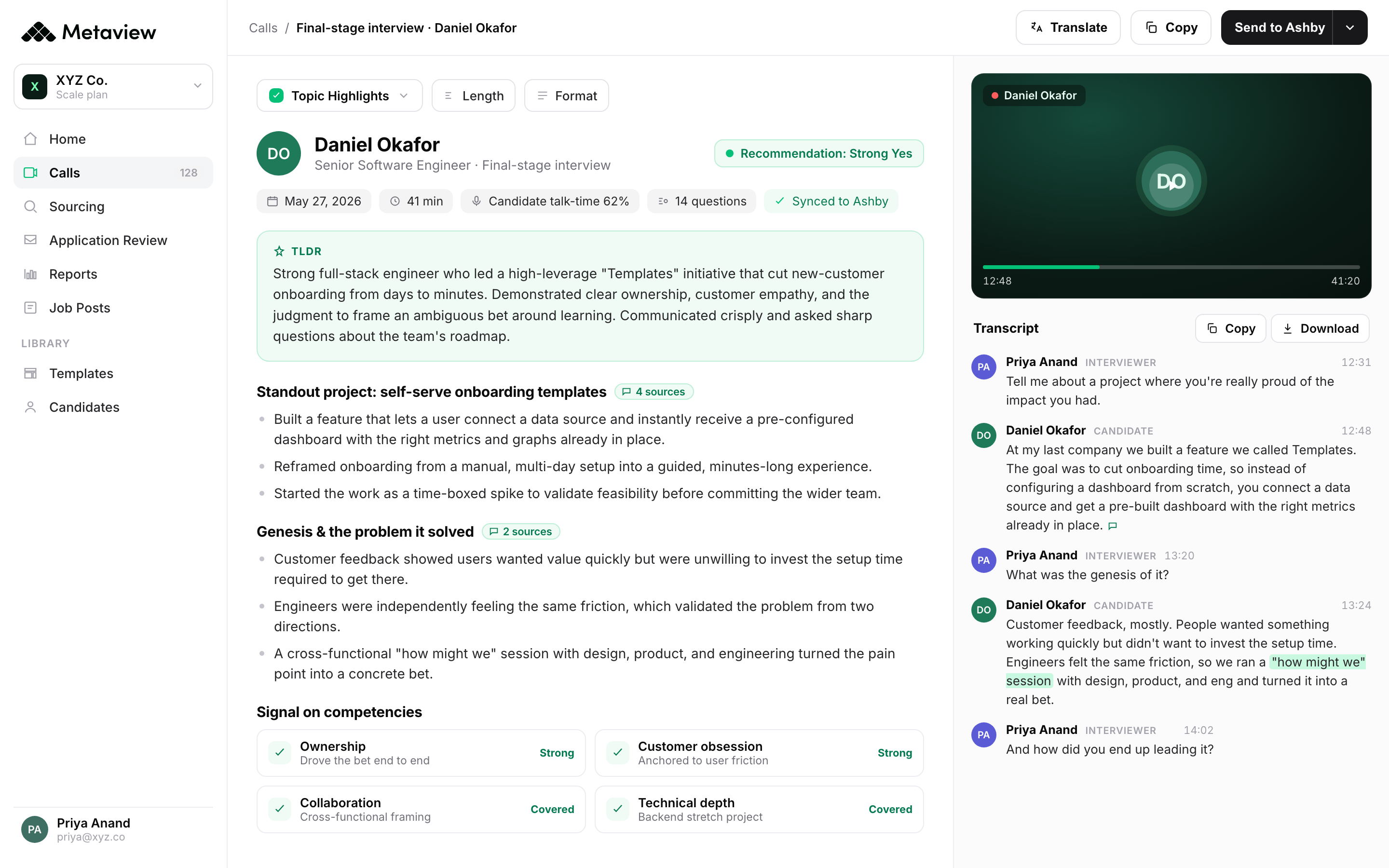
Metaview eliminates manual work in two of the most time-consuming stages: interviews and sourcing. The AI Notetaker captures structured, scorecard-aligned interview notes grounded in your specific role context, not a generic transcript. The AI Sourcing agent runs off the intake call and builds shortlists continuously, no Boolean iteration required.
Setup is under 10 minutes and the platform layers onto your existing ATS rather than asking you to migrate. That is what makes the payback compound.
What it covers:
- AI-generated structured interview notes mapped to your scorecards
- Continuous AI Sourcing agents running off intake calls
- Native ATS integrations with Greenhouse, Ashby, Lever, Workable, Teamtailor
- Works across video and phone interviews
- Application Review for inbound triage with self-calibrating ICP
- SOC 2 Type II, GDPR, and CCPA compliant
Where it falls short: not the right pick if your team is already at enterprise scale and you need an end-to-end ATS replacement. Metaview sits on top of an ATS, not instead of it.
Best for: teams that want one platform to remove interview and sourcing admin without changing their ATS or rebuilding the process.
Marisa Uranga Bradwell, Director of Recruiting Ops at Deliveroo, described what the efficiency gain unlocks in practice.
It’s not just the hours saved, but also the time you can use to focus on what really matters: getting the signal we need to make the best hiring decisions.”
2. SeekOut.
Category: Talent intelligence and sourcing
SeekOut combines candidate search with diversity insights, workforce analytics, and competitive intelligence. The strongest fit is enterprise teams running complex sourcing strategies across geographies or specialized industries.
What it covers:
- Advanced candidate search across multiple data sources
- Diversity analytics and reporting
- Talent market insights and competitive benchmarking
- CRM capabilities for pipeline management
- Integrations with major ATS platforms
Where it falls short: the value compounds at enterprise scale. For sub-enterprise teams the platform footprint is more than the bottleneck demands.
Best for: enterprise teams needing diversity insights and market-level talent visibility.
3. hireEZ.
Category: Outbound sourcing automation
hireEZ is built around outbound recruiting at scale. It identifies passive candidates, predicts response likelihood, and runs multi-channel outreach sequences. The platform pays back fastest when pipeline generation is the bottleneck.
What it covers:
- AI-powered candidate sourcing
- Multi-channel outreach automation across email and LinkedIn
- Response prediction modeling
- Built-in CRM capabilities
- Talent rediscovery tools
Where it falls short: ends at engagement. Interview signal, screening structure, and decision-making sit outside the platform.
Best for: teams whose bottleneck is outbound volume and response rates.
4. Gem.
Category: Recruiting CRM and engagement
Gem sits as the relationship layer on top of sourcing. It tracks every candidate touchpoint, structures outreach campaigns, and reports on pipeline conversion at every stage. Most outbound-heavy teams pair Gem with whatever they use for raw sourcing.
What it covers:
- Candidate relationship management and pipeline tracking
- Outreach sequencing and automation
- Engagement analytics and conversion tracking
- Talent rediscovery tools
- Integrations with ATS and sourcing tools
Where it falls short: light on screening and interview structure. The platform optimizes the outreach-to-screen handoff, not what happens after.
Best for: teams running continuous outbound that need pipeline visibility and engagement analytics.
5. Ashby.
Category: All-in-one ATS with built-in analytics
Ashby combines ATS, scheduling automation, and recruiting analytics in one platform. The analytics layer is the differentiator: pipeline conversion by source, role, and interviewer in one view without exporting data.
What it covers:
- Full-featured ATS with customizable workflows
- Built-in scheduling automation
- Advanced recruiting analytics and dashboards
- CRM functionality
- Integrations with sourcing and interview tools
Where it falls short: ATS migration is a real project. If you are happy on Greenhouse or Workable, the switching cost is higher than the analytics upgrade often justifies.
Best for: high-growth tech teams that want analytics-led workflows in one tool.
6. BrightHire.
Category: Interview intelligence and panel coaching
BrightHire records interviews and generates structured highlights for consistency and panel alignment. The focus is interview quality and defensibility through documentation and interviewer coaching.
What it covers:
- Interview recording and transcription
- Structured highlights and summaries
- Interviewer coaching insights
- Panel collaboration tools
- Enterprise security controls
Where it falls short: focused on the interview stage only. No sourcing layer, no application review, no upstream pipeline tooling.
Best for: enterprise teams focused on interview consistency and compliance.
7. Greenhouse.
Category: Structured hiring ATS
Greenhouse is the structured-hiring ATS most growth-stage and enterprise teams default to. It serves as the system of record for workflows, approvals, and scorecards across multi-stage hiring processes.
What it covers:
- Structured hiring workflows
- Customizable scorecards and interview kits
- Interview scheduling tools
- Extensive integration marketplace
- Reporting and compliance support
Where it falls short: the AI layer is bolt-on, not native. For teams whose biggest leak is interview admin or sourcing, Greenhouse is the foundation but not the efficiency unlock on its own.
Best for: mid-market and enterprise teams running multi-stage processes that need standardized scorecards.
8. Lever.
Category: ATS plus CRM hybrid
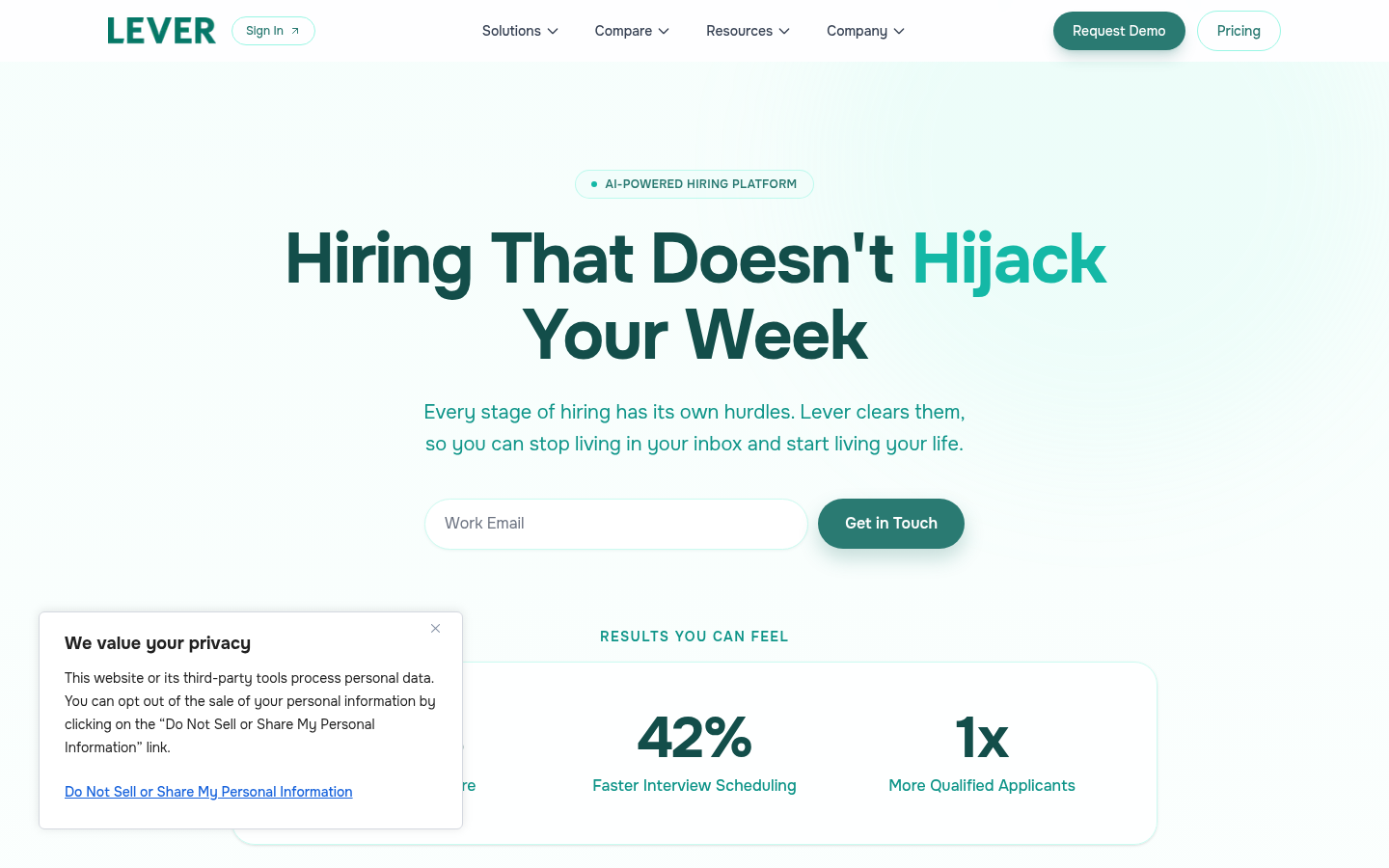
Lever combines ATS and CRM functionality in one platform. The emphasis is on candidate nurturing alongside applicant tracking, which works for teams that balance inbound applications with ongoing passive-candidate relationships.
What it covers:
- ATS plus CRM hybrid
- Candidate nurturing workflows
- Automated email sequences
- Pipeline visibility tools
- Analytics dashboard
Where it falls short: the CRM half is lighter than dedicated tools like Gem; the ATS half is lighter on analytics than Ashby. Lever optimizes for the middle ground.
Best for: teams balancing inbound and ongoing passive-candidate nurturing in one tool.
9. Eightfold AI.
Category: Skills-based talent intelligence
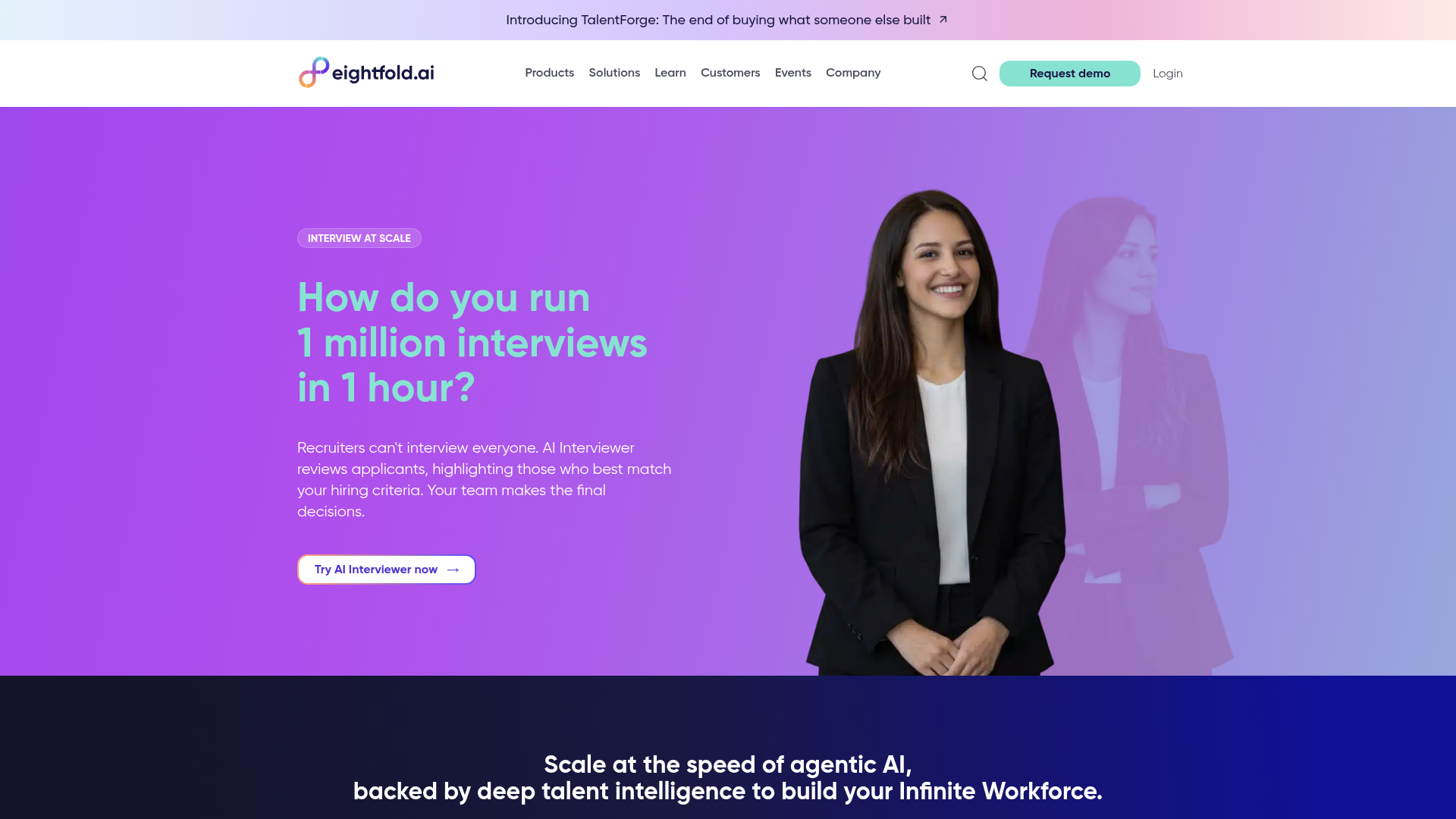
Eightfold AI uses deep-learning skills inference to match candidates to roles based on capabilities beyond what is on the resume. It is also used for internal mobility, surfacing employees for open positions.
What it covers:
- AI-powered skills matching
- Talent rediscovery
- Internal mobility tools
- Workforce planning insights
- Diversity analytics
Where it falls short: enterprise-scale only. The implementation footprint and contract size do not fit smaller teams.
Best for: enterprises connecting external hiring with internal mobility.
10. Phenom.
Category: End-to-end talent experience platform
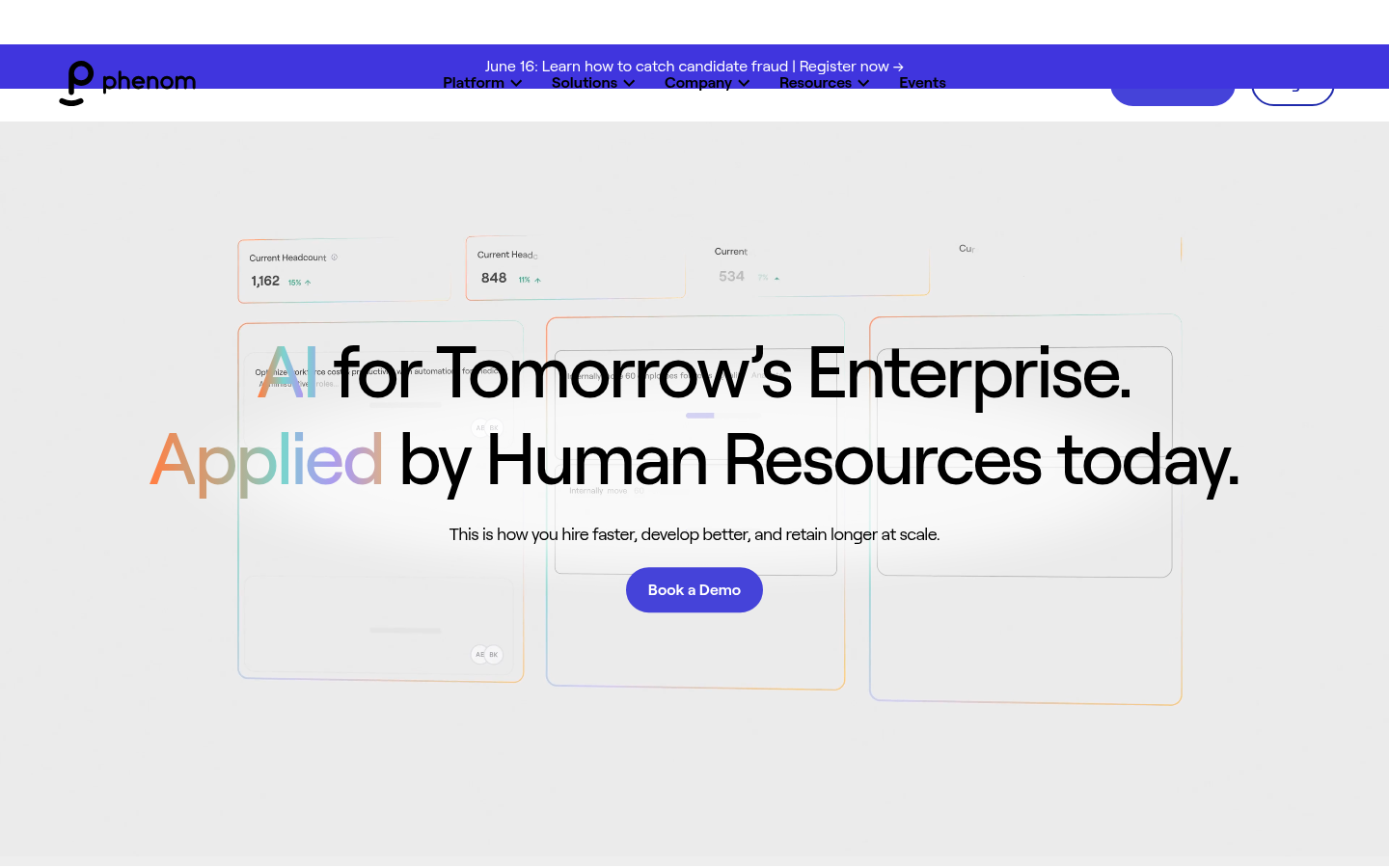
Phenom unifies career sites, recruiting CRM, AI chatbots, and analytics across the candidate journey. The thesis is one ecosystem for the entire candidate experience, from awareness to onboarding.
What it covers:
- AI-powered career sites
- Recruiting CRM
- Chatbots and automation
- Interview scheduling
- Analytics and reporting
Where it falls short: the breadth is the trade-off. Specialized tools at each layer (notetaker, sourcing, ATS) tend to outperform Phenom's coverage of those specific stages.
Best for: enterprise organizations unifying career sites, CRM, and recruiting AI in one ecosystem.
How to choose a recruiting efficiency tool.
Pick based on the time leak that hurts most. Six scenarios below.
Comparing tools at adjacent layers of the stack? See our guides on the best applicant tracking software and CRM vs ATS for recruiting.
Bring Metaview into your hiring stack.
Live notes, structured scorecards, and ATS sync - set up in under 10 minutes.
Frequently asked.
What is a recruiting efficiency tool?
A platform that reduces the manual work in one specific stage of the recruiting funnel. Categories cover AI sourcing, AI Notetakers, recruiting CRM, applicant tracking, interview intelligence, and talent experience. The best fit depends on which stage costs your team the most recruiter time.
How do I figure out which efficiency tool to buy first?
Map where your recruiters spend their week. If most time goes to outbound sourcing, start with a sourcing layer. If most goes to interview admin and scorecard chasing, start with an AI Notetaker. The tool that solves the largest time leak pays back fastest.
Do these tools integrate with my ATS?
Most do, but integration depth varies. Native bidirectional sync with Greenhouse, Ashby, Lever, Workable, and Teamtailor is the baseline to look for. Webhook-only or Zapier integrations usually mean you still copy data between systems.
How long does implementation usually take?
AI Notetakers and sourcing layers can be live in minutes. Full ATS migrations and enterprise talent platforms take weeks to months depending on data complexity and integrations. Ask vendors for typical timelines from teams your size.
How do I measure ROI on a recruiting efficiency tool?
Time saved per interview, time-to-hire reduction, cost-per-hire impact, and interview-to-offer ratio. The last one is the most useful because it tells you whether speed gains are also translating into better decisions, not just faster activity.