
Most recruiting tech budgets in 2026 are bigger than they have ever been, and most hiring leaders will privately tell you the spend hasn't moved the needle on quality of hire. Both can be true at the same time.
According to Metaview's 2026 AI & Hiring Alignment Report, surveying 505 recruiting leaders and hiring managers across North America and EMEA, 85% of companies exceeding their hiring goals use AI in hiring. The teams that are missing their numbers? Their stacks aren't smaller. They're just wired differently.
The pattern we see across portfolio reviews and stack audits: most recruiting stacks are tooled for process (move candidates through faster) and under-tooled for decisions (improve every judgement call). The layers that compress time-to-hire are well-served. The layer where you actually pick the right person is starved. This guide is about how to invert that.
Why most stacks underperform.
If you walk into a typical 200-to-2,000 person company today, the recruiting stack looks impressive on paper. An ATS. A sourcing tool. A scheduler. An assessment vendor. A few AI copilots stitched in around the edges. Heads-of-talent can usually rattle off ten brand names without notes.
What they can't always articulate is which of those tools actually changes a hiring decision. And that gap is the real signal. The report shows 85% of companies exceeding hiring goals use AI in hiring, while only 14% of teams that don't use AI rate their cross-functional recruiting relationship as excellent. The differentiator isn't headcount of tools. It is whether the stack is wired to make every decision better.
The over-investment pattern is almost always the same: layers 1 and 2 (sourcing and screening) get all the budget and all the AI, while layer 4 (interview and evaluation) is still resumes, panel notes, and a Google Doc. Then leadership wonders why faster pipelines don't translate to better hires.
We're still in a world where a lot of these AI tools are very fragmented when it comes to the recruiting landscape, and we're seeing this change incredibly quickly with things that are getting integrated or bundled. I'm excited for the future of that.”

The 5-layer funnel (and where the leverage actually is).
The cleanest way to audit a stack is to map every tool to one of five funnel layers. The exercise tends to surface two truths in the same hour: which tools are duplicative, and which layer is starved.
Layer 1: Sourcing and attraction.
Inbound demand generation, employer brand surfaces, talent CRMs, paid job advertising, outbound search tools. Some companies also bring in outside help with advanced branding solutions to sharpen the employer brand candidates see. This is where the funnel starts. Most teams over-invest here because it is the most visible layer to the business: more pipeline feels like more progress.
Leverage check: adequate sourcing means you can fill a typical req with 3 to 5 qualified candidates inside the average time-to-slate. Anything beyond that becomes noise the rest of the stack has to absorb.
Layer 2: Application screening and matching.
Resume parsing, ICP-fit scoring, AI filters, knockout questions, fraud and AI-generated application detection. With application volume exploding (and a meaningful share of inbound now AI-generated), this layer has shifted from "nice to have" to load-bearing. If layer 2 is weak, your recruiters spend their week triaging instead of interviewing.
Leverage check: a recruiter should never read a resume that hasn't already been ranked against the role's actual signals. If they are, layer 2 is broken.
Layer 3: Applicant tracking system (ATS).
Pipeline orchestration, stage management, candidate communications, source-of-truth for who is where in the process. Most teams have an opinion about their ATS the way most people have an opinion about their bank: not in love with it, not switching either.
Leverage check: the ATS is the spine, but it is not where decisions get made. It just records the decisions. Optimize for integration breadth, not feature count.
Layer 4: Interview and evaluation.
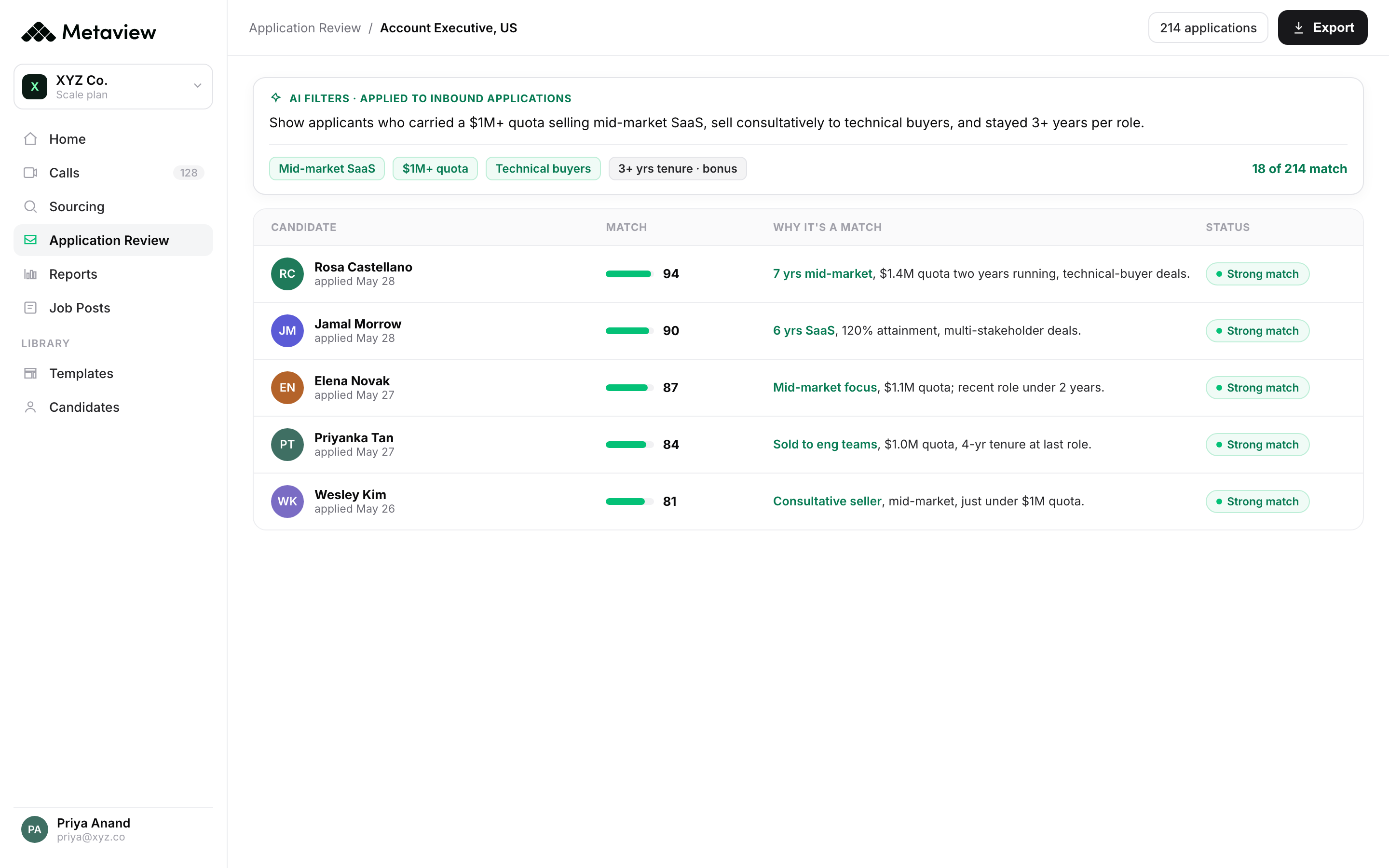
Structured interview design, scorecard capture, panel calibration, debrief signal, decision-quality data. This is the layer where the actual judgement happens. It is also the layer most stacks under-invest in. The audit pattern is consistent: 5 tools at the top of the funnel, 0 tools at the moment a hire is being decided.
Leverage check: if you can't tell me, for the role you closed last month, which interviewer asked the strongest questions and which competency had the weakest evidence behind the hire decision, layer 4 is the bottleneck.
Layer 5: Offer, onboarding, analytics.
Offer management, signing flows, onboarding handoff, quality-of-hire tracking, recruiter scorecards, hiring manager NPS. This is the feedback layer: the loop that tells you whether the previous four layers are calibrated correctly.
Leverage check: a stack without a working feedback layer can't get smarter. You can't see what's wrong. So you can't fix it.
- Each layer's tool optimizes its own metric in isolation.
- Interview signal lives in panel notes that nobody re-reads.
- Recruiters retype context into the ATS after every call.
- No way to tell which tool actually improved a hire decision.
- Every tool resolves to a specific judgement call: who to advance, who to coach, who to hire.
- Interview signal is captured structurally and queryable across roles.
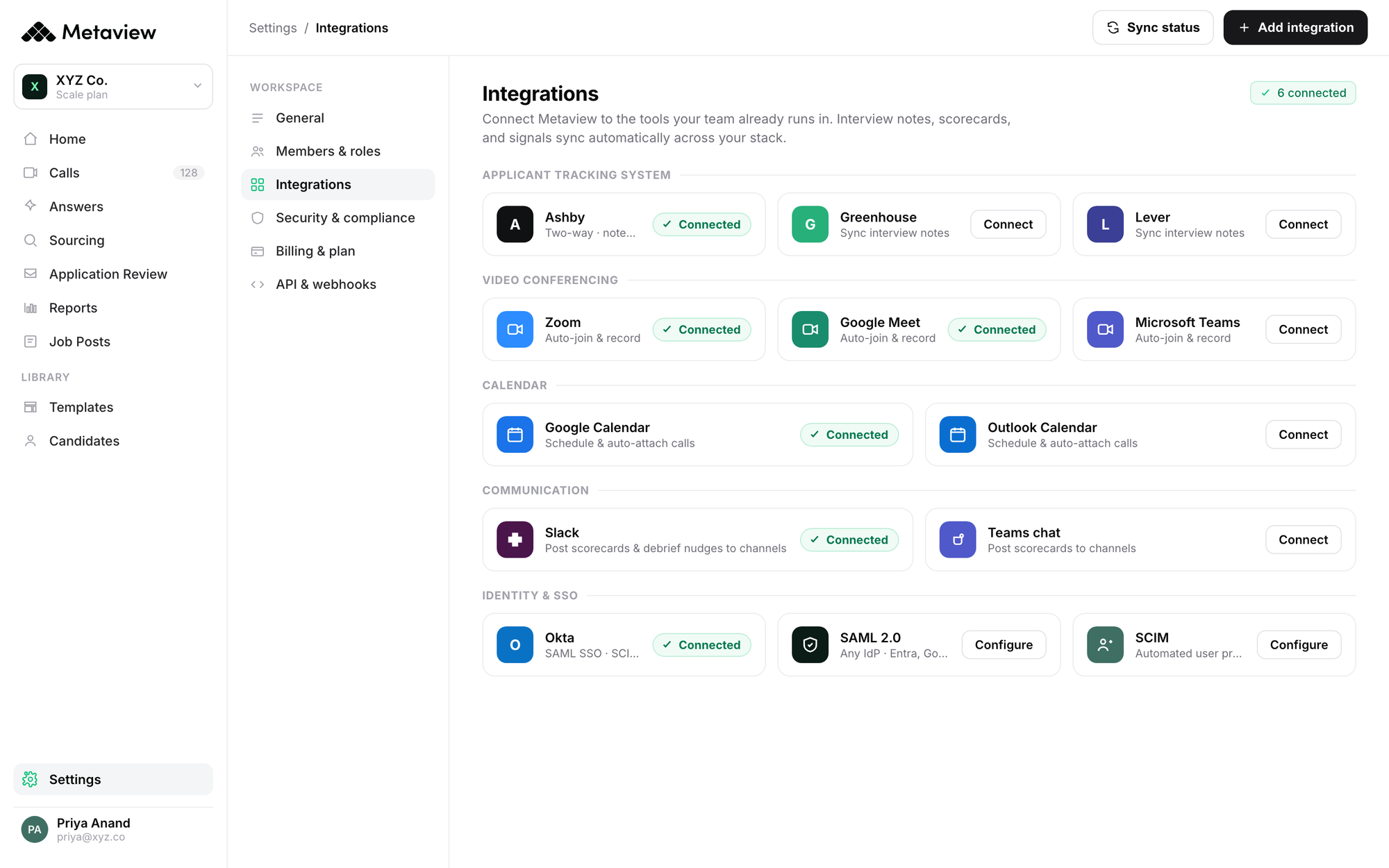
- Context flows automatically: capture once, populate scorecard, write back to ATS.
- Decision data feeds back into screening criteria for the next req.
Layers 1 to 3: get them adequate, not perfect.
Most stack-audit conversations spend 80% of the time arguing about layers 1, 2, and 3. Which ATS. Which sourcing platform. Which screening tool. That ratio is upside-down. These three layers should be stable, integrated, and boring. Then you redirect attention to where it actually matters.
What "adequate" looks like at each layer:
- Layer 1 (sourcing): two or three reliable channels that hit your weekly slate target. Stop adding tools when adding them no longer compresses time-to-slate.
- Layer 2 (screening): an AI filter that surfaces top-of-stack candidates without a recruiter manually reading every CV. Honest fraud detection on AI-generated applications.
- Layer 3 (ATS): a system that talks to the rest of your stack in both directions, with clean stage definitions and a structured-data spine you can report from.
If your layer 3 ATS can't write structured interview data back from layer 4, you don't have an integration problem. You have a decision-data problem dressed up as an integration problem.
Layer 4: the decision layer.
This is the layer where stacks either compound or stall. It is also the layer most under-tooled in the average 200 to 2,000 person company. The interview itself is still where bias creeps in, evidence gets lost, and gut-feel quietly replaces the rubric you spent two weeks writing.
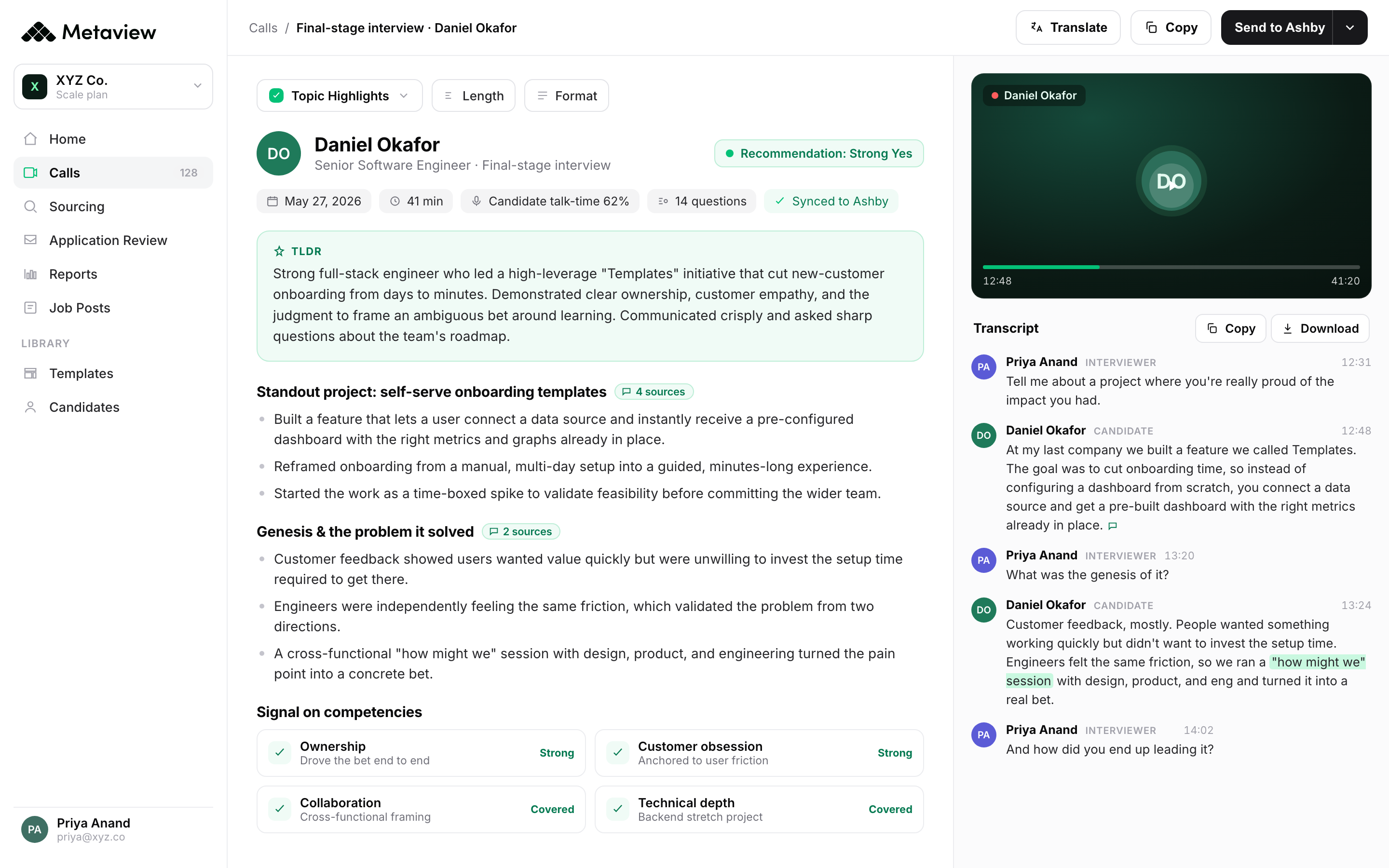
When the decision layer is wired correctly, three things change. First, the interviewer can stop typing and start listening, because the capture happens automatically. Second, the scorecard auto-fills against the competencies you set, so feedback is consistent across panel members. Third, the debrief becomes evidence-led rather than impression-led: nobody is reconstructing what was said two days later from an empty Notes app.
Layer 5: feedback loops and the data flywheel.
Without a working feedback layer, your stack is read-only. You optimize what you can measure, and most stacks measure time-to-fill, time-to-slate, source-of-hire, and offer-accept rate. Notice what's missing: quality-of-hire. The thing that actually pays for the stack.
A working layer 5 closes three loops: which interviewers produce the strongest hires at 30/90/180-day post-hire performance reviews, which competencies were under-evidenced for hires that later struggled, and which sourcing channels feed into roles that retain. When those three loops are live, the rest of the stack starts to calibrate itself.
We were making hiring decisions blind, advancing candidates without structured evaluations, risking bad hires, and losing exceptional talent along the way.”

How Metaview fits in your stack.
Metaview is purpose-built for layer 4 with structured write-back into layers 3 and 5. The simple framing: the tools you already have for sourcing, screening, and pipeline orchestration stay where they are. Metaview becomes the decision-layer instrument that gives the rest of your stack something to learn from.
Where this typically lands: a Notetaker that captures every screen and panel interview, a scorecard layer that turns conversation into evidence, a multi-source summary that consolidates every panelist's signal into one view at debrief, and ATS write-back so the structured data you generated in layer 4 finally lives where the rest of the business can see it.
The Deel case study is the cleanest version of this story to date. When their Global Head of Talent Acquisition Alan Price audited the interview layer, the pattern was familiar: 29% adoption of structured capture, 94% of recorded interviews missing core competency coverage, 42% of interviews running with excessive interviewer talk time. The stack looked complete on the org chart. The decision layer was empty. Working with Metaview, they rebuilt around a 5-metric dashboard (adoption, competency coverage, candidate talk time, interview punctuality, and individual interviewer performance), pushed adoption to 97%, and started linking interview data to 30-day post-hire performance.

Your 30-day stack audit.
If this is making you want to look at your own stack with fresh eyes, here is the version that fits inside a month and doesn't require a procurement review:
- Week 1 (map): list every tool, every license cost, and which of the 5 layers it serves. Most teams find at least one tool serving zero layers.
- Week 1 (score): for each layer, rate "adequate / weak / blind" against the leverage check in this guide. The ratings are usually unanimous within the TA team.
- Week 2 (interview the layer 4 owners): ask 5 recruiters and 5 hiring managers how interview signal moves from the conversation into the hire decision. Their answers will diverge wildly. That divergence is the gap.
- Week 3 (pick one decision): identify a single hire decision in the next 4 weeks that you can re-instrument: structured capture, scorecard autofill, debrief based on consolidated signal. Make it the proof-of-concept.
- Week 3 (instrument): wire the new layer-4 capture into ATS write-back. Don't run it parallel to your existing process; replace the panel notes outright for that role.
- Week 4 (debrief and decide): run the debrief using the new evidence. Compare to your default process: was the conversation richer? Did the decision feel better-supported? That is your signal on whether to scale.
- Month 2 onwards (close the loop): instrument layer 5. Tie interview data to 30-day post-hire performance. That feedback loop is what makes the rest of the stack worth its line item.
 Metaview
Bring Metaview into your hiring stack.
Live notes, structured scorecards, and ATS sync - set up in under 10 minutes.
How do I know if I have too many recruiting tools?
Two tests. First, can every tool name a specific hiring decision it improves? If not, it is overhead. Second, do any two tools overlap on the same metric? Pick one and retire the other. The signal that you have the right number is when removing any single tool would visibly slow down a real decision.
How often should I review or update my recruiting tech stack?
Quarterly audit, annual rebuild. The quarterly audit is the 30-day exercise in this guide, run on a tighter cadence. The annual rebuild is for layer-shifting decisions: should we change ATS, swap out our sourcing platform, add a new layer-4 instrument. Don't do layer-shifting decisions quarterly. The change cost is too high.
What's the biggest gap in most recruiting tech stacks today?
Layer 4: interview and evaluation. Most stacks are well-funded at sourcing and screening, anchored on an ATS, and then go dark at the moment the actual hire decision happens. The result is faster pipelines that don't translate to better hires. Closing the layer-4 gap is the single highest-ROI move in 2026.
Should recruiting teams prioritize deep integrations or best-in-class point tools?
Deep integrations, almost every time. A best-in-class tool that doesn't write structured data back into your ATS becomes a silo. A slightly-less-feature-rich tool with two-way integration becomes infrastructure. Optimize for the second.
How do I get adoption from recruiters and hiring managers?
Three moves. First, make the tool replace work rather than add work (live capture instead of post-interview notes, scorecard autofill instead of blank scorecards). Second, give them visibility into their own metrics. Interviewers want to improve their own quality scores when they can see them. Third, get leadership buy-in to enforce the standard, not just recommend it. Soft adoption asks fail at scale.
How do I measure the ROI of recruitment technology?
Tie spend to decision quality, not activity. The metrics that matter: quality of hire at 30/90/180 days, hiring-manager satisfaction with finalist slates, interviewer calibration drift, and stage-by-stage conversion. If a tool can't move at least one of those, it isn't earning its line item.


