The agentic talent acquisition strategy: 7 workflows and what the evidence supports

68% of searches start with the recruiter and the hiring manager aligned on what the role needs when AI is core to hiring, against 49% of searches at teams that don't use AI. That comes from Metaview's 2026 AI & Hiring Alignment Report, a survey of 505 recruiting leaders and hiring managers at companies with 200 or more employees across North America and EMEA. Roughly a 40% relative difference. It's the number most writing about agentic talent acquisition strategy leads with.
It's a softer number than it looks. The survey cross-tabulated self-reported answers at one point in time, comparing teams who say AI is core to their hiring against teams who say they don't use it. It never asked anyone about agents, it followed nobody over time, and it recorded no days-to-fill. The interview data further down hits the same wall from the other side: plenty of detail on what happens inside the hiring process, and no measure of time-to-hire at all.
Here's the one part of an agentic strategy with numbers under it: what the agent does to the written record. Whether an evaluation gets written down, and how much of it gets filled in. Speed, decision quality, and what happens after someone starts are expectations you'll have to test on your own searches. Seven workflows follow, one per stage. Each one is marked: measured evidence, or process logic that sounds more certain than it is.
What an agentic talent acquisition strategy means
An agentic talent acquisition strategy puts an AI agent at each stage of hiring, and gives every one of them the same job: produce a written record the next stage can use. The intake call becomes a brief. The interview becomes structured notes. Those notes become a scorecard mapped to the competencies in the brief. The scorecards are what the panel argues from, and the set of them is what a TA leader reports on. The agent decides nothing. It produces a record that exists and is complete enough to hand on, and the people still make every call.
You can measure whether the record exists, and usually it doesn't. Across a corpus of 5.2 million candidate interviews, 31.2% carry at least one scorecard. That's the ordinary state of written evaluation in hiring, and it's the gap a generated first draft aims at. Scorecards that began as an AI-generated draft were submitted at 50.3%, against 28.6% for scorecards written from scratch, in a capped sample of 120,000 with the same denominator on both sides. Completeness moves with it. In a separate capped sample of 80,000, drafted scorecards carried 7.85 filled competency fields on average against 2.61 for manual ones.
Two caveats, and they belong right beside those numbers. These are capped query pulls covering part of the corpus, and this is usage data, so the teams reaching for a draft may already differ from the teams who aren't. The finding is an association between a generated draft and a fuller submitted record. Whether the hiring got any better sits outside what it measures. The corpus holds no post-hire performance data, no retention and no tenure. A submitted scorecard is a judgment someone actually wrote down, and that's worth having for the same reason minutes are worth having.
The survey adds a second kind of evidence, and it's weaker. In the AI-core segment, 55% of teams rated the cross-functional relationship as excellent, against 14% of teams that don't use AI. Teams that rated the relationship excellent and started most searches aligned exceeded their business goals at 79%, against 36% for teams with fair-or-poor relationships and low alignment. And 85% of companies already exceeding their hiring goals use AI in hiring. That describes who is already winning. The data doesn't show why.
The seven workflows, and which ones have evidence
Seven stages, one agent each. Two have measured evidence behind them in the narrow sense described above. One has a documented reason no evidence can exist yet. The rest are reasonable and untested. Which is which decides what you can promise your leadership team, so it's worth spelling out.
1. Intake. The agent turns the kickoff call into a written brief: the must-have criteria, the competencies the scorecard will use, and what the recruiter and hiring manager actually agreed on. Nothing measures an intake agent on its own. The nearest thing is the survey association between AI adoption in general and kickoff alignment, and that's a different question sitting one shelf over.
2. Sourcing. The sourcing agent works from the brief, searches the web and the connected ATS, and comes back with candidates and the reasoning behind each one. Interview data can't tell you whether agent-sourced candidates fare better than manually sourced ones, because that comparison needs ATS outcome fields the interview database doesn't carry. Nobody has run it. Anyone quoting a number for it is quoting something else.
3. Screening. Application Review reads every inbound application against an ideal candidate profile a human approves, sorts candidates into fit buckets and shows the reasoning behind each call, and assesses every application for identity deception and application automation. Humans always decide, and Metaview never auto-rejects. One measured result: recruiters advanced 17.2% of candidates from the top fit bucket and 5.6% from the bottom one. That's the model and the recruiter agreeing with each other. Nothing tracks the candidates who were passed over, so neither one is shown to be right.
4. Scheduling. Calendar latency is real dead time, and it's the one stage on this list Metaview doesn't touch. Scheduling automation lives in your ATS and your calendar tooling. That's worth saying out loud. A stage map where one vendor happens to cover all seven is a product line with stage labels on it.
5. Scorecards. Metaview generates the first draft of the scorecard from what was said in the interview, mapped to the competencies in the brief. The interviewer reviews it, edits it and submits it. Direct submission works for Ashby and Lever; with Greenhouse you paste from Metaview into their interface. This is the stage the submission and completeness numbers describe, which makes it the best-evidenced workflow in the set, and it's still only evidence about paperwork.
6. Debrief. The panel works from submitted scorecards instead of memory. Across 296,555 advancing candidates, 41.9% moved to the next round with no submitted scorecard behind them. That's the ordinary state of hiring debriefs across the industry, and it long predates any one tool. Whatever those panels discussed, the next interviewer had nothing to read.
7. Reporting. A TA leader can query their own interview data: which stages produce a record, where competencies get assessed inconsistently, how long submission takes. It covers what happened inside the recruiting process and carries no post-hire dimension. Whether the process picked the right people sits outside what it can answer.
The record's first three measures, set against each other, look like this.
| What is being counted | Written from scratch | Started as a generated draft |
|---|---|---|
| Interviews with a scorecard attached | 31.2% across a corpus of 5.2 million candidate interviews, drafted and manual combined. | Not separable at corpus level. The two rows below are the comparable cuts. |
| Scorecards submitted | 28.6% submitted, n=26,498. | 50.3% submitted, n=93,502, same capped 120,000 sample. |
| Competency fields filled | 2.61 fields on average. | 7.85 fields on average, in a separate capped sample of 80,000. |
The first three figures come from Metaview's aggregate interview data. The fourth comes from the 2026 AI & Hiring Alignment Report, which measures what 505 people said about their own searches.
How to sequence it, and what you have to measure yourself
Put intake first and reporting last. That's a structural argument, and nobody has tested it: nothing downstream can inherit a brief that was never written, and reporting has nothing to roll up until the stages ahead of it have produced records. Start at note-taking and you get notes mapped to competencies nobody agreed on, because the brief that would have defined them doesn't exist yet. Nobody has run that order against another order, so it's a design argument, and you should label it as one when you present it internally.
Then measure it yourself, because no vendor can hand you the number. Take the four handoffs that carry a record: intake to brief, screen to panel, interview to scorecard, debrief to decision. Log the date each stage ended and the date the next stage had what it needed. The gap between those two dates is what an agentic strategy is supposed to move. One of the four is already instrumented, since Metaview can tell you how long a scorecard took to arrive after the interview ended. The other three live in your ATS timestamps, and nobody has published a benchmark for any of them.
The pressure that makes people skip that step is real enough. In the survey, 67% of recruiting leaders and hiring managers say they lose qualified candidates to competitors who move faster every month. That number captures how worried people are. Counting your own days is still an afternoon well spent.
The real competitive advantage is effective AI adoption vs. everyone else. The teams doing this well are building alignment at every stage. AI earns its keep when it both strips out the mechanical work and surfaces the signal that helps recruiters actually close. Alignment isn't just a kickoff, it's infrastructure.”

Gill is a practitioner giving a judgment, and his test is worth borrowing as long as you don't mistake it for a result. Run this sequence through it: if a workflow only makes one person faster on their own, the record it produces stops with that person. If it produces something the next stage reads, it's doing the job the strategy is named after. The report's own advice section puts individual copilots and bottom-up tool adoption on its list of what organizations seeing worse results do. That's the authors giving guidance. No cross-tab in the report backs it.
- Whether any of this shortens time-to-hire. Neither source carries a days-to-fill field.
- Whether a fuller record changes anything once someone starts. There is no post-hire data.
- Whether these seven workflows in this order beat any other order. That comparison has never been run.
- Scorecards that start as a generated draft are submitted more often and carry more filled fields.
- Kickoff alignment was higher in the AI-core segment of a 505-person survey, self-reported.
- Recruiters advance far more candidates from the model's top fit bucket than from its bottom one.
The product surface: Notetaker, Application Review, Sourcing and Reports
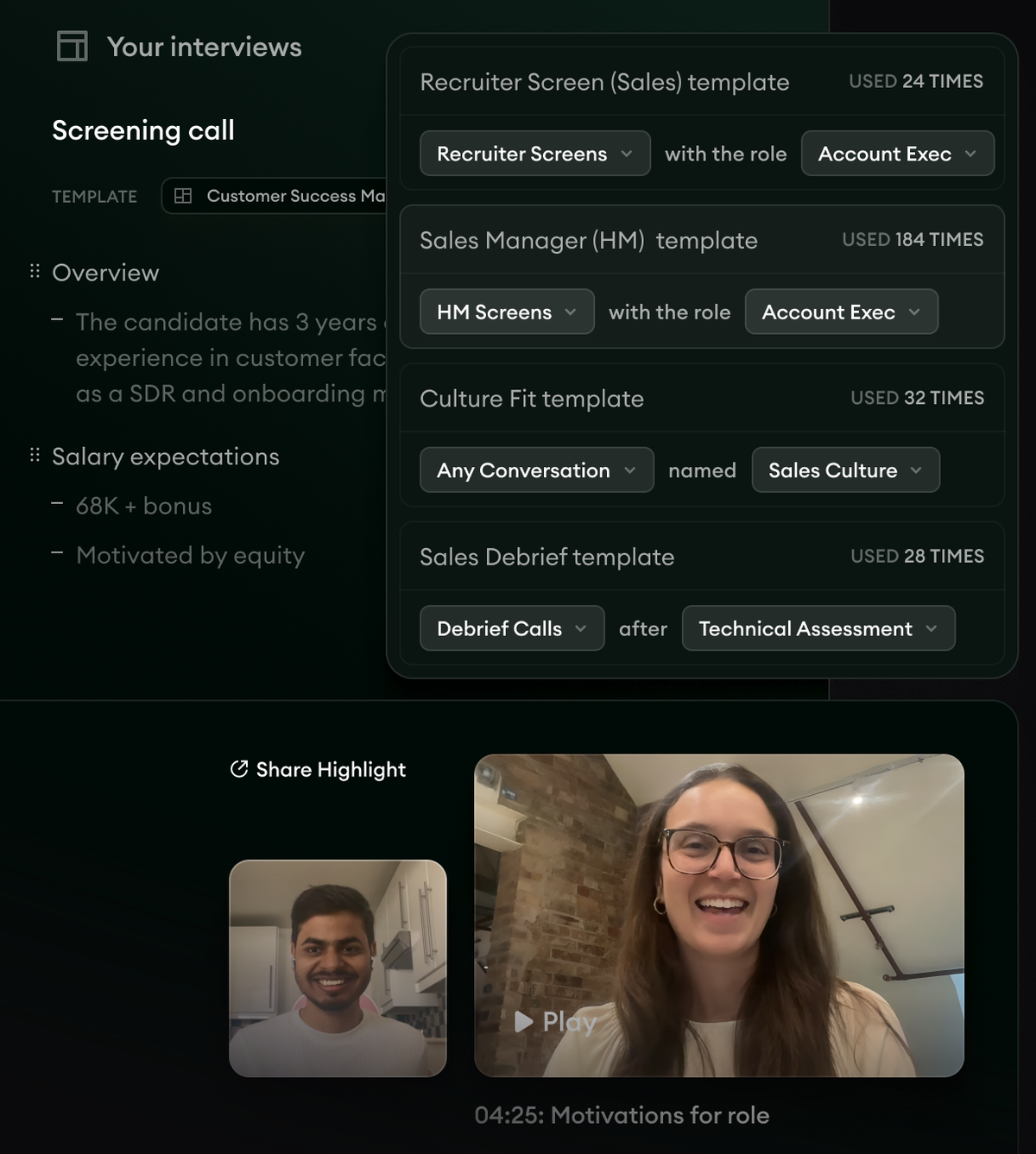
Four Metaview products sit on four of the seven stages. Notetaker joins the interview as a visible participant with consent, records the conversation and turns it into structured notes. Each section links back to the moment in the transcript it came from. Notetaker generates the first draft of the scorecard against the competencies you set, and the interviewer reviews, edits and submits it. Direct submission works for Ashby and Lever; on Greenhouse the interviewer pastes it across.
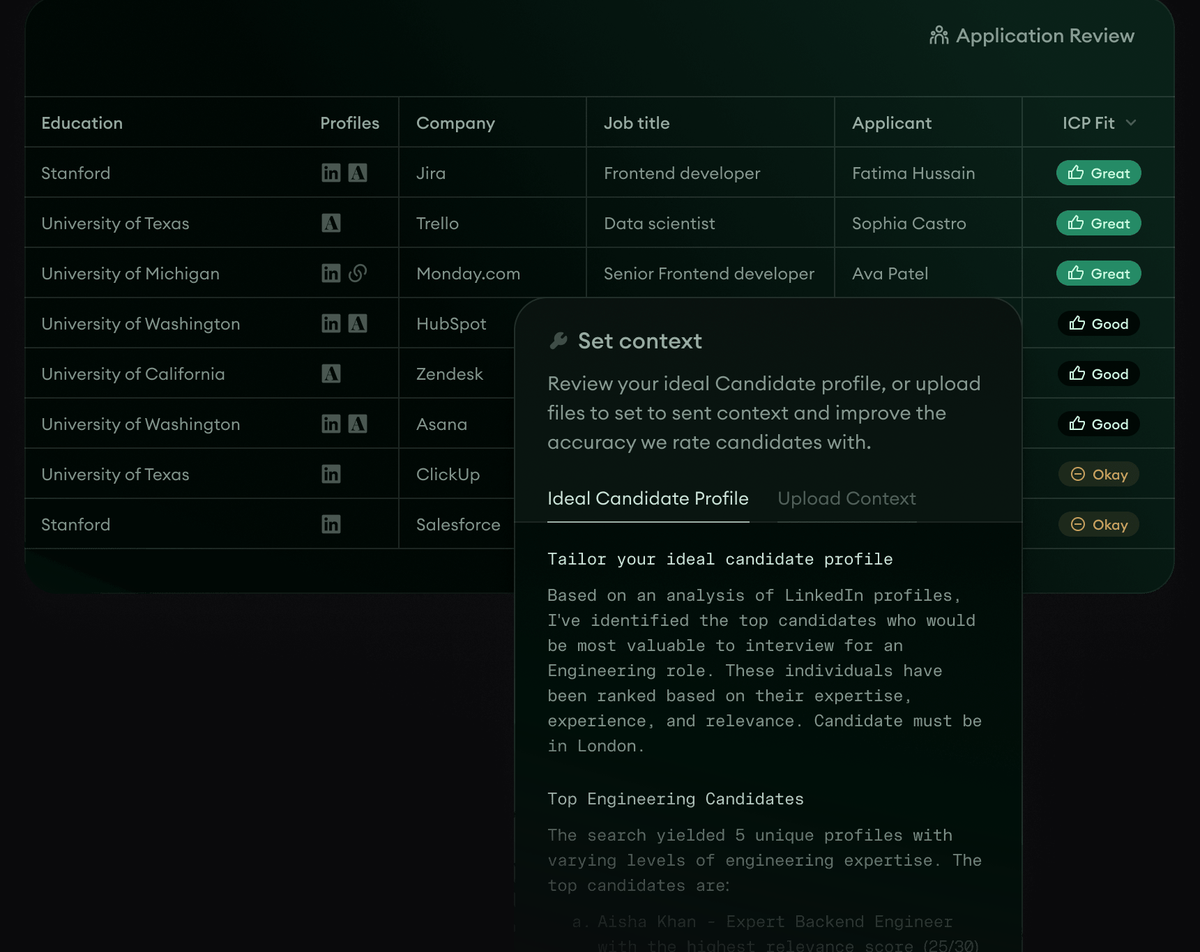
Application Review handles the screening stage on inbound volume. It reads every application against an ideal candidate profile generated from the job post and whatever context you add. You review and approve that profile before any candidate is evaluated against it. Application Review then sorts candidates into fit buckets with the reasoning attached, and assesses every application for identity deception and application automation. Candidates are synced from your ATS into Metaview, and on Ashby, Greenhouse, Lever and SmartRecruiters the accept and reject decisions made in Metaview are pushed back. Humans always decide, and Metaview never auto-rejects.
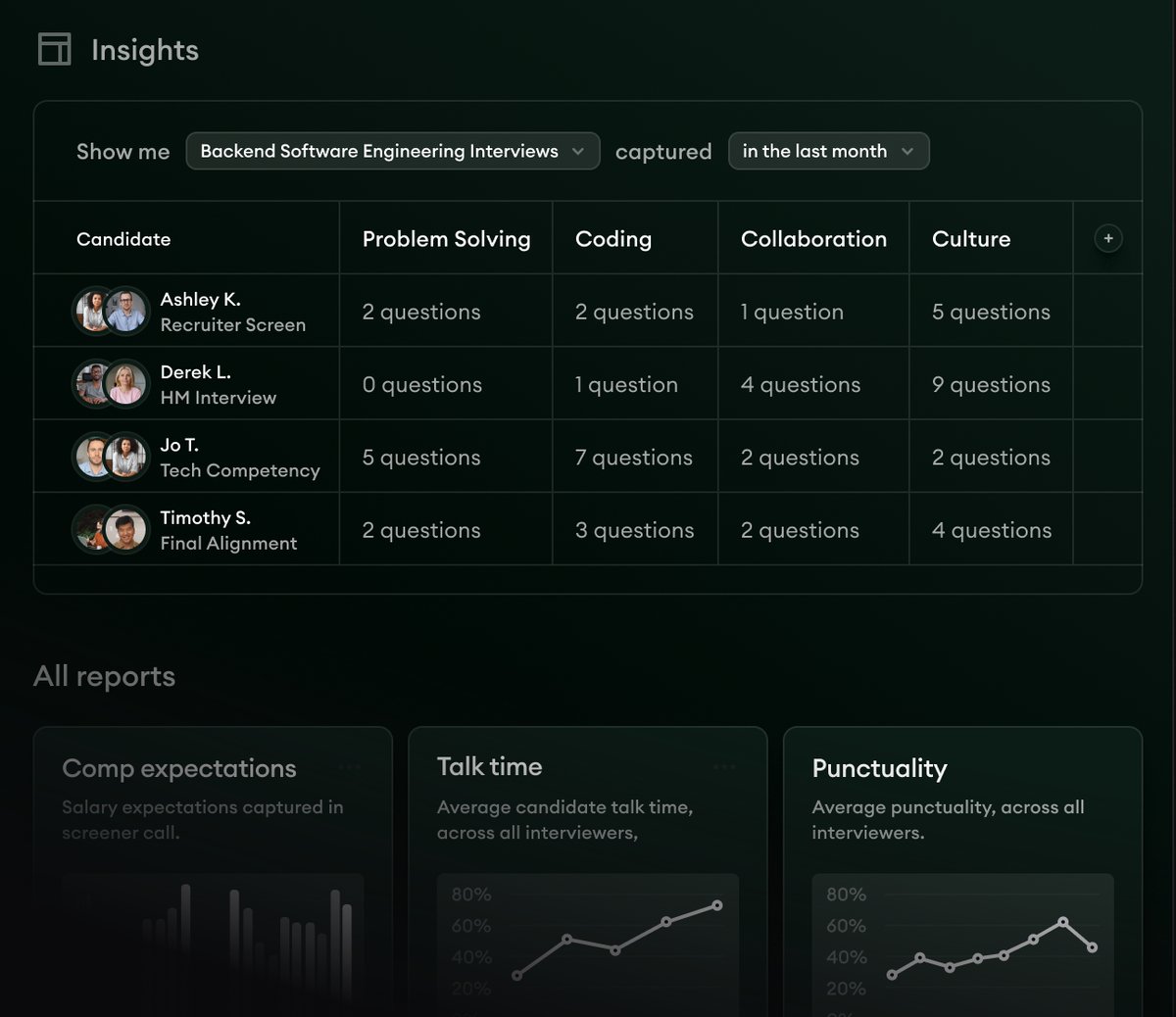
AI Sourcing covers stage two. The sourcing agent searches the web and the connected ATS from a plain-language brief and returns candidates with the reasoning for each one. It surfaces and explains them, and it doesn't contact or assess anybody on its own. Metaview Reports covers the last stage, so a TA leader can query their own interview data in the product or through the Metaview MCP. It reports on what happened inside the recruiting process and carries no post-hire dimension. That's a boundary on what the data can answer.
Worth reading next: what separates a good interviewer from a bad one, how to detect deepfake interviews and fake candidates, and how recruiters are putting Claude to work. For one customer's own account of the reporting stage, see how Deel scaled hiring with Metaview Reports.
Frequently asked
What is an agentic talent acquisition strategy?
It's a hiring process where an AI agent sits at each stage and produces a written record the next stage can use: a brief at intake, structured notes from the interview, a scorecard mapped to the competencies in the brief, and reporting across the set. The agent produces the record. The people still make every call.
Does an agentic talent acquisition strategy cut time-to-hire?
Nobody has measured that. Metaview's interview corpus carries no days-to-fill measure, and the 2026 AI and Hiring Alignment Report didn't ask about it. What is measured is the record: in a capped sample of 120,000 scorecards, 50.3% of the ones that began as an AI-generated draft were submitted, against 28.6% of the ones written from scratch. If you want the time answer, timestamp your own handoffs.
Which workflow should I roll out first?
Intake. Every later stage inherits the brief, so a written, structured intake is what makes sourcing, screening, scorecards and reporting point at the same criteria. Reporting goes last, because it has nothing to roll up until the stages before it have produced records. That order is process logic, and nobody has tested it, so run it as a plan and check it against your own numbers.
Does the agent make hiring decisions?
No. Application Review reads inbound applications against an ideal candidate profile you approve and sorts them into fit buckets with the reasoning attached. Humans always decide, and Metaview never auto-rejects. The agent prepares the record and the recruiter makes the call.
What does the 2026 AI and Hiring Alignment Report actually show?
Associations from a cross-tabulated survey of 505 recruiting leaders and hiring managers at companies with 200 or more employees. In the segment where AI is core to hiring, 68% of searches start with high alignment, against 49% in the segment that doesn't use AI. Separately, 85% of companies already exceeding their hiring goals use AI in hiring. Every answer is self-reported, there's no longitudinal component, and the survey never asked about agents, so it can't rule out that those teams differ in other ways.
Run an agentic talent acquisition strategy on one search.
Structured notes, scorecard first drafts, and reporting over your own interview data, with your team making every call.