A good Boolean string is a real skill, and the craft in it gets written off far too easily. I've watched recruiters build a string that lands on exactly the right forty people. Boolean still works, and I'd rather argue about what it costs you than pretend it's dead. It's a query technique, and techniques don't go obsolete. They carry costs, and this one's cost is specific.
To write a string that works, you have to predict vocabulary. You're guessing at the words a good candidate happened to type on their profile, which is a different job from knowing the skills you want. You can widen the guess with OR, and skilled sourcers do. A string will happily find someone who phrased it differently, as long as you thought of that phrasing first. That's the cost in one line: a keyword search only ever reaches the vocabulary you predicted.
An agent takes the prediction off you. You describe the role, and it works out who that describes. That leaves a separate question, and it's the one this piece spends most of its time on: are the people it comes back with better than the ones a good sourcer would have found? Nobody has measured that, and the honest answer stays that way for the rest of the piece.
Say the obvious thing first. This is Metaview's blog, and Metaview sells the agent side of this comparison. So here's the rule I've held myself to: every claim about the agent either carries a number you can check, or it says why there isn't one. There's more of the second kind here than a vendor comparison usually admits.
What each method asks of you
Boolean search is a way of talking to a keyword index. You combine terms with AND, OR and NOT, wrap phrases in quotes, and the index hands back every profile matching the letters you typed. That's fast and exact and hard to beat when you know what you want and the world labels it consistently.
The awkward part is what happens when it comes back thin. A string returns whatever matched, so a candidate you missed looks identical to a candidate who doesn't exist. You get the size of the result and never the shape of the gap. That's the real reason longer strings and more rejections pile up over a search. You're patching a blind spot whose edges you can't see.
An agent is blind in exactly the same place. It'll explain every candidate it returned and tell you nothing about the ones it never surfaced. Hold on to that one. The rest of this comparison reads more clearly once both sides are allowed the same weakness.
- Exact when the criteria are exact, and fast to run
- Reproducible: anyone who runs it gets the same list
- Reaches only the phrasings you thought to include
- Cannot show you the people it missed
- Takes one plain language description instead of a keyword list
- Returns each candidate with the reasoning behind it
- Two runs of one brief are not guaranteed to match
- Cannot show you the people it missed either
The workaround plenty of recruiters landed on first is to have a model write the string. Shiv Brodie runs go-to-market recruiting at Metaview, so she's not a neutral witness here, but she's describing something happening in recruiting teams that have never heard of this company. She built her own GPT that turns a job description into search terms before she opens a sourcing tab.
I think of AI as an assistant, a technical assistant, a teammate. I created my own GPT specifically for sourcing, put in a JD, get gaps, candidate questions, archetypes, Boolean strings, all in one go.”

What she's built is a better string, produced faster. The human still runs the search, still reads the list, still decides. An agent moves one step further along the same line, because it runs the search itself and comes back with candidates plus its reasoning for each. Whether that list is better is the question everything below is about.
Five briefs where predicting the vocabulary gets expensive
These five are where predicting the vocabulary starts costing you real time. The third column says what sits behind each one, because four of them are capability claims and exactly one carries a number. Those aren't the same kind of evidence, and running them together is how this genre gets slippery.
| The brief | What a keyword string needs from you | What the agent does, and what is behind it |
|---|---|---|
| Fuzzy seniority | Every title a company might use for the scope you mean, including the ones you have never seen | You describe the scope in plain language and it searches on that. A documented capability, with no head-to-head test behind it |
| The same skill, different words | Each phrasing a candidate might have used, joined with OR, and you have to think of them all | The same plain language description. Whether it recovers people a good string would miss is untested |
| Straight off the intake call | The call has to end before you can turn what was said into operators | The transcript becomes the prompt. Median 17.6 minutes to a first shortlist across 26,356 searches |
| Your own records | A second search, run separately, inside the applicant tracking system | One pass covers the open web, the connected ATS and past Metaview conversations. ATS reach is limited to candidates backfilled from the connected system |
| Checking the result | Nothing to check. A string returns what matched and no reason for any of it | Each candidate arrives with the sourcing agent's reasoning for why it was surfaced |
Two of the rows deserve a second look, for opposite reasons. The second one gets oversold. The third is the only row with an actual number behind it.
Take the infrastructure engineer who never typed the word Kubernetes and wrote instead that they ran the migration off self-managed clusters. A string listing Kubernetes finds them only if you also listed the phrase they used. You can chase that with OR, and good sourcers do, but every synonym you add is one you thought of first.
Describing the role moves that work off you. You write what the person needs to have done, and the matching happens against your description instead of your keyword list. I can't tell you how many of those people a skilled string would have found anyway, because that comparison hasn't been run, here or anywhere I can find it published.
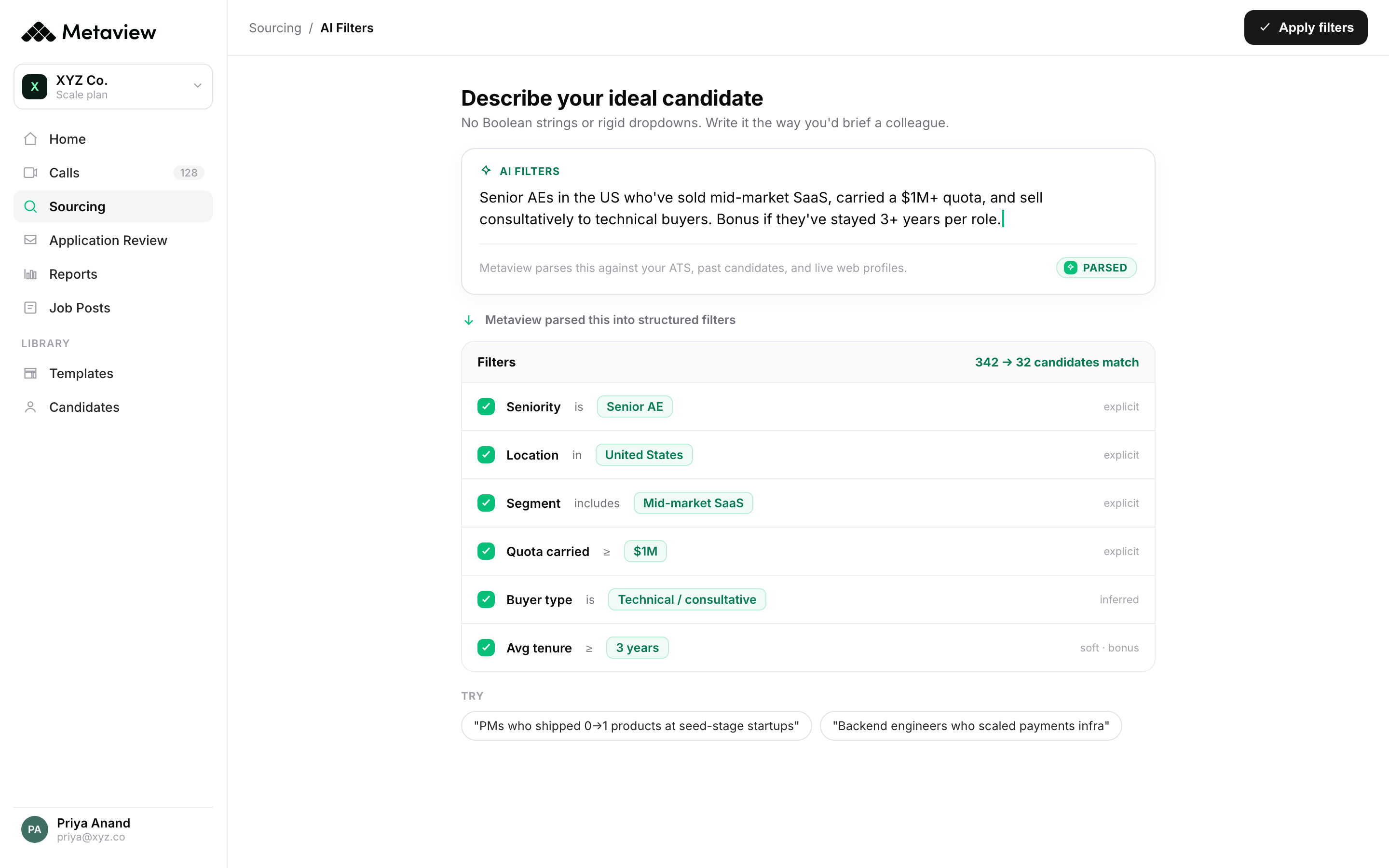
- 1You describe the role the way you would brief a colleague, instead of assembling a keyword string.
- 2Adjacent titles and different phrasing stay in scope, because the description is the query rather than a keyword list.
- 3Each result carries a reason for why it came back, which is the one part of the output a reader can audit.
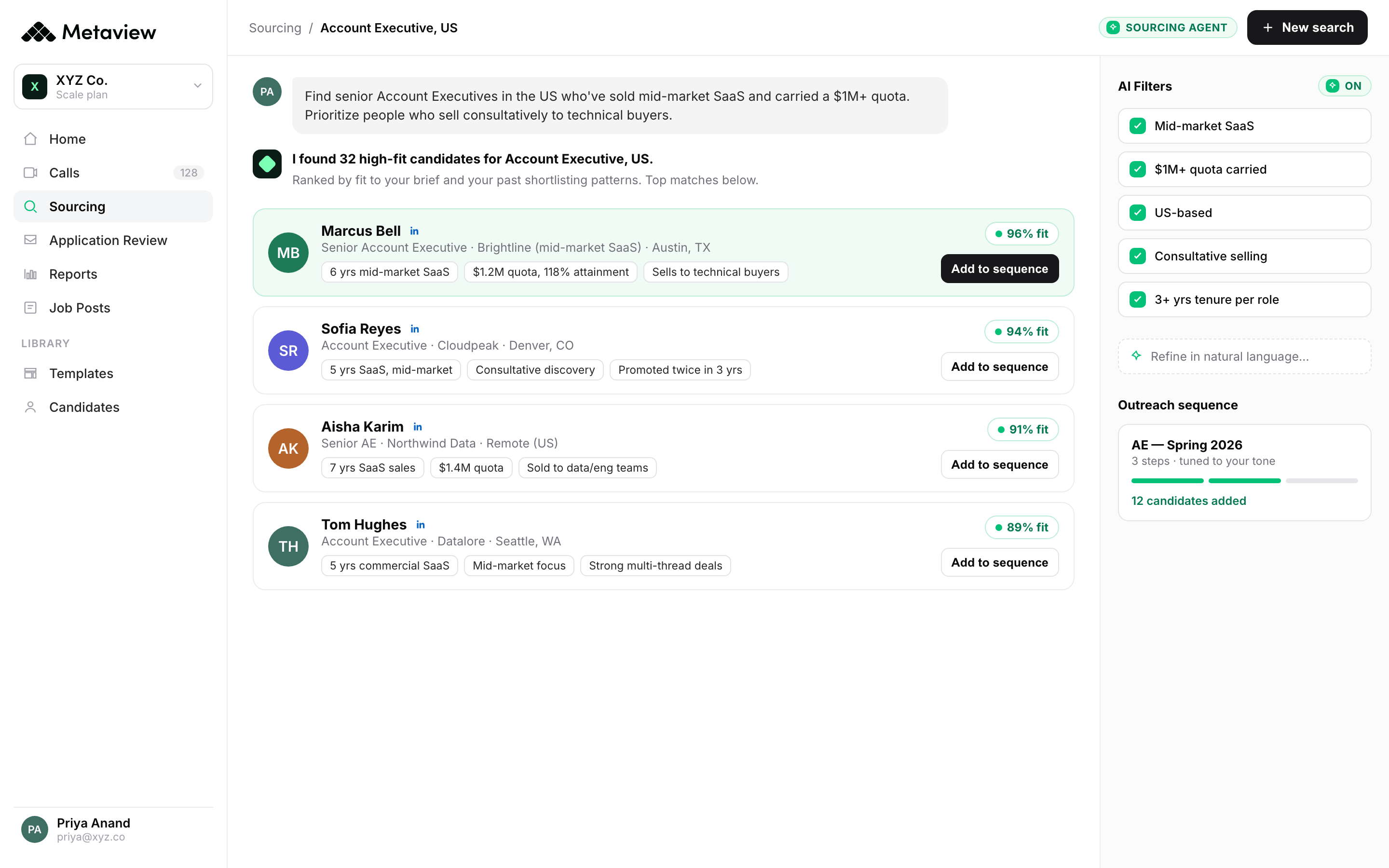
The intake-call row is the one recruiters notice first, and the only one here carrying a measurement. A Boolean search can't start until the call is over and you've turned what the hiring manager said into operators. Some of it never survives that translation: the aside about wanting someone who has held a team together through a reorg, the two companies they'd love to take from.
Metaview captures the conversation when it's on the intake call. That transcript becomes the prompt the sourcing agent searches the web and your ATS against, which saves you rebuilding a string from memory an hour later.
How fast is that in practice? Across 26,356 sourcing searches that ran off an intake call, the median gap between the call ending and the first shortlist arriving was 17.6 minutes.¹ The mean sits far above the median, so a real minority of searches take much longer, and any promise of a shortlist before lunch should be read against that tail.
One customer describes what that speed actually buys with a hiring manager. It's a testimonial on Metaview's own customers page, so weigh it as one, but it names the thing that changes.
Within 20 minutes of an intake call, I can present multiple candidate profiles to hiring managers on Slack and get immediate feedback. This isn’t just about efficiency, it’s about transforming the relationship between recruiters and hiring managers.”

What the benchmark measures, and what it does not
Sourcing accuracy used to be a matter of opinion. Exa built a public test for it, the People Search Benchmark: 1,400 real-world sourcing queries, each one scored on whether the profiles that came back actually match what was asked. Metaview's AI Sourcing agent came out of it at 93.5% precision.¹
That number needs two caveats, and the second one carries more weight. Exa designed the benchmark, which makes the test third-party. Metaview ran it and published the result, which makes the figure vendor-reported. Calling the whole exercise independent blurs those two together, and it's a distinction any recruiter evaluating vendors should insist on. The published method sets out how to run the test yourself, so you can check the figure instead of taking it on trust.
The bigger caveat is what precision means. Precision is the share of returned profiles that matched the query, and it says nothing at all about recall. The benchmark can tell you that what came back was on target, and it can't tell you how many qualified people never came back. That lands the sharpest criticism of Boolean, that a string can't tell you it failed, squarely on both sides of this comparison. We published the full benchmark write-up, including how to reproduce it.

The number nobody in sourcing has
No benchmark asks the question a recruiter actually wants answered. Do the candidates an agent finds reach an interview more often than the ones you found yourself?
Metaview ran that query against its own platform data. It came back unanswerable. Answering it needs outcome data from the applicant tracking side that isn't in the dataset, so the comparison can't be computed at all. Every vendor in this category has the same hole. No sourcing vendor publishes that number, because the evidence for it sits across systems none of them fully see.
The next question out sits further from reach again. Metaview holds no data about anything that happens once someone is hired: no performance data, no retention, no tenure. Quality of hire is therefore not a claim available to anyone writing on this blog, and a sourcing method that produced people who worked out better would be invisible to every measurement this company has.
Metaview can see one thing here that no benchmark stands in for, which is the recruiter's own verdict at calibration. Across 1,228,405 candidates rated on sourcing shortlists, 41.5% came back a decisive yes.² Read that as what a shortlist is for. A recruiter working a shortlist is there to say no to most of it, and a list coming back with a yes on every row would be a list that had learned nothing about where the bar sits.
The month by month series holds a band around that figure and never climbs. That's worth saying out loud, because “it learns from your yes and no and gets sharper” is the promise every vendor in this category makes, and an aggregate pooled across thousands of roles and thousands of different bars is the wrong instrument for showing it. The flat line is no evidence against the claim either, just the wrong measurement to settle it with, and it shouldn't be made to do work in either direction.
One more figure belongs next to the marketing. A shortlist runs to 48 candidates at the median, across 138,108 searches.³ So the pile stays the same size. Every row on it now arrives with a stated reason, which turns a bad call into something you can argue with instead of something you have to re-derive from scratch.
How context-aware sourcing works in Metaview
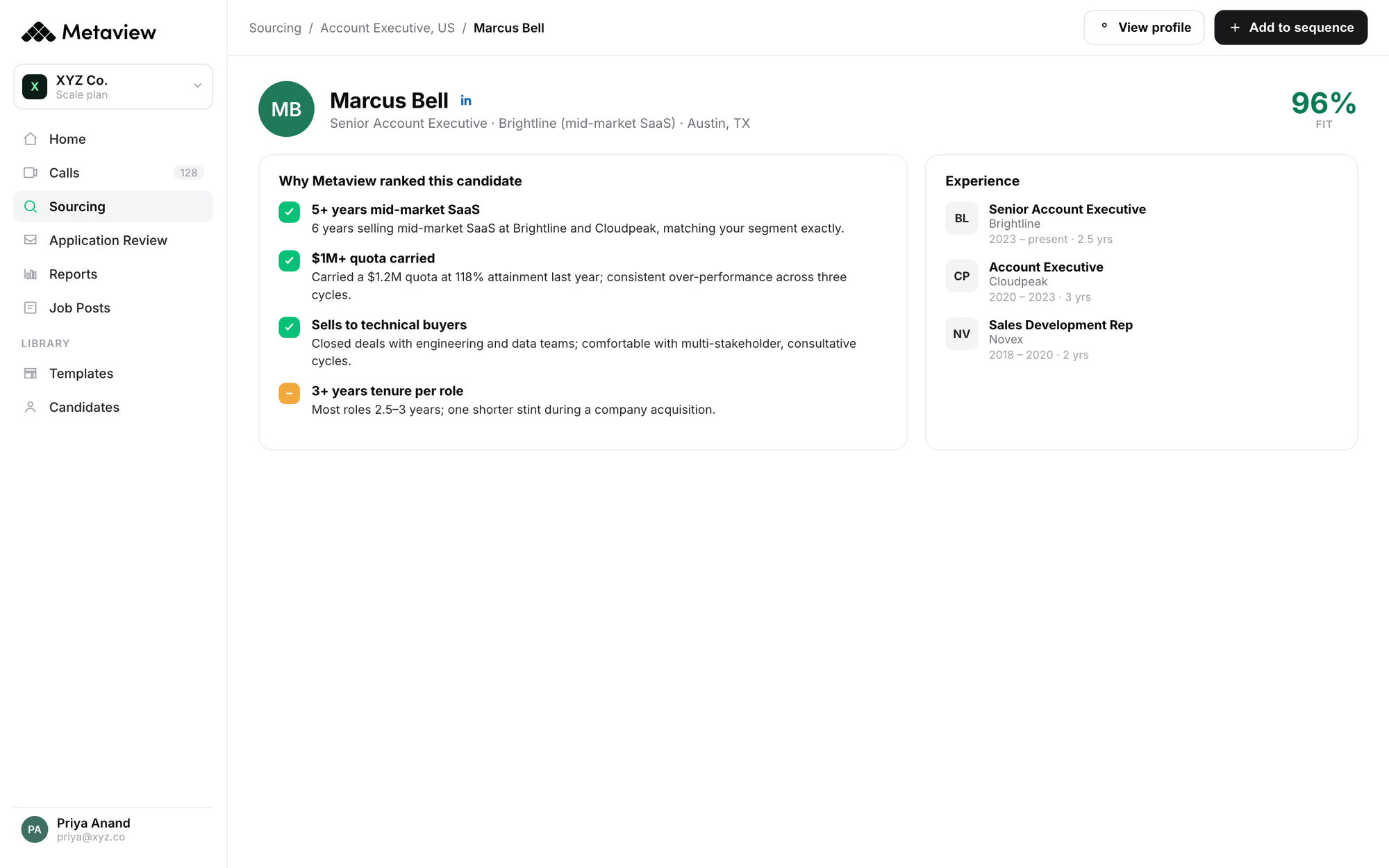
The mechanics take one paragraph. You give AI Sourcing a plain language description of the role. The sourcing agent searches the open web, the connected ATS and your org's past Metaview conversations in one pass, and each candidate comes back with the reasoning for why it was surfaced.
Two limits matter before you assume more than is there. ATS reach through your ATS integrations covers the candidates backfilled from the connected system, which is a smaller set than everyone who has ever passed through it. The agent surfaces and explains candidates, and that's where it stops. It doesn't contact them and it doesn't assess them on its own, so the outreach and the judgment both stay with you.
Those past conversations come from the rest of the product. The agent can only search later what Metaview captured on interview calls, which is why Application Review, your interview notes and Reports sit around sourcing instead of beside it as separate tools.
One search can also run a research pass alongside the candidate hunt, so a question about where a company has been hiring from stays inside the one tool. That's the extent of what's documented, and it's worth resisting the urge to read a full market map into it.
When a hand-built Boolean string is the right call
None of this retires Boolean. It keeps two properties an agent simply doesn't have.
The first is exactness. A string finds those people quickly when the criterion is a live security clearance, a named certification, or time served at a specific company, and you can hand the string itself to a compliance team as a record of what was searched for.
The second is reproducibility, and every article like this one underrates it. A string is a stated query, so anyone who runs it gets the same list, today and next quarter. An agent's shortlist is the output of a model reading a description, so two runs of one brief aren't guaranteed to return the same people. That difference stops being academic the first time you have to defend how a slate was built.
So the fair summary is narrower than the category's marketing. An agent changes what you have to specify before a search runs, and it changes when the first list arrives. Both of those are measured. Nobody has measured whether the people on that list are better than the ones a good sourcer would have surfaced. That gap belongs to Metaview and to everyone else selling into this space, and a vendor's job at that point is to say so plainly.
The list in front of you is the part you can check. Every row arrives with a reason. That's a smaller promise than the one this category usually makes, and it's one you can test on your own roles in an afternoon.
Run the sourcing agent on a role you are working now
Describe it in your own words, then read the reasoning attached to every candidate that comes back.
Frequently asked questions
What is the difference between AI sourcing and Boolean search?
Boolean search is a query technique. You combine terms with AND, OR and NOT, and the index returns the profiles matching the words you typed, so the search reaches the vocabulary you predicted. AI sourcing takes a plain language description of the role instead and searches on that, so phrasings you didn't think of are still in scope. The trade is that a string is exact and repeatable, while an agent's shortlist is the output of a model reading your description.
Is Boolean search still useful for recruiters?
Yes, and the call is per search rather than per team. Reach for a string whenever you can name what you want in words a profile will actually contain: an active clearance, a named certification, time at a specific company. A string is also inspectable, so you can hand the query itself to a compliance team as a record of what was searched for, and anyone who reruns it gets the same list. How often each kind of search comes up is not something anyone has counted.
How accurate is AI sourcing?
Ask what the number counts before you compare vendors. Precision counts only the profiles a search returned, so a tool can score well on it and still miss qualified people entirely, and no precision figure tells you anything about those misses. Exa's People Search Benchmark is public: 1,400 queries split between targeted lookups and broader role-based discovery, and its scoring code is open source, so a score claimed on it is one you can rerun yourself. When a vendor quotes an accuracy number, ask which benchmark it came from, who designed that benchmark, and who ran the test.
Can AI sourcing start from an intake call?
Yes. When Metaview is on the intake call, it captures the conversation, and that transcript becomes the prompt the sourcing agent searches the web and your ATS against. Across 26,356 searches that began this way, the median gap between the call ending and the first shortlist was 17.6 minutes, though the mean is much higher, so a minority of searches take considerably longer.
Does AI sourcing find better candidates than Boolean search?
Nobody has published data that settles it, including Metaview. The comparison that would answer it, whether agent-sourced candidates reach an interview more often than manually sourced ones, needs outcome data from the applicant tracking side that Metaview doesn't hold, and Metaview holds no data at all about what happens once someone is hired. What can be measured is narrower: the profiles returned on a benchmark, the time to a first shortlist, and the recruiter's own yes or no on each candidate, which came back a decisive yes 41.5% of the time across 1,228,405 rated candidates.
¹ Exa People Search Benchmark. Benchmark design by Exa, with the run and the write-up published by Metaview. ² Metaview platform data: a 41.5% decisive accept rate, meaning yes divided by yes plus no, across 1,228,405 candidates rated on sourcing shortlists. ³ Metaview platform data: a median shortlist of 48 candidates and a mean of 73.7, across 138,108 sourcing searches. Intake-to-shortlist timing covers 26,356 searches, with a median of 17.6 minutes and a much higher mean. All platform figures are aggregate, and none of them measure what happened to a candidate after the process ended.