On high-volume roles, arrival order often decides who gets a serious read. A role opens, applications pour in, and whoever's reviewing starts at the top and works down until the calendar's full.
Everyone under that line waits. Most of them never get reached.
Reading every application by hand at this volume and holding each one to real criteria has never been possible. So teams fall back on a blunt filter, years of experience or a title match. That filter quietly buries strong people who described their work in words it wasn't looking for.
Application Review reads every inbound application against the criteria you set, sorts candidates into fit buckets, and shows its reasoning on each one. Every applicant gets read, including the ones who applied at midnight on a Sunday.
That raises a fair question instead of settling one. Has the problem gone away if a recruiter only ever works the top of the list, or has the cutoff just moved from when you applied to where a model put you?
There's a good answer, and it comes with conditions. It holds up when the reading is genuine, when the bottom of the list stays open to inspection, and when a person still makes every call.
The shortlist arrives sorted and explained. The decision to advance or pass stays human. Here's how that works, and where it quietly falls apart.
The inbound funnel is where good candidates get lost.
Hand-reviewing hundreds of applications a day breaks down in a specific way. Someone works roughly in the order applications arrive, gets through enough to fill the calendar, and stops.
Everyone under the stopping point gets nothing. Their application never gets opened at all.
Right now, the system's not fair. When a human recruiter decides to review applications, they appear chronologically. Once they've gotten through enough and reached out to enough, they don't look at the rest. That's unfair to the people who didn't get seen.”

Being slow costs you people. Metaview's 2026 AI & Hiring Alignment Report surveyed 505 recruiting leaders and hiring managers across North America and EMEA.
In that survey, 67% of teams lose qualified candidates to faster-moving competitors every month.
The fix is obvious: read everyone, hold every application to the same bar. AI review is the first thing that makes that possible at inbound volume.
It also opens a fresh way to make the same people invisible. A sorted list still has a bottom, and if that bottom goes unread, the outcome for those candidates is what it always was. So the part to press on is what happens below the top of the list.
How Application Review reads every application.
It runs off something you already carry around in your head: what great looks like for this role. You tell Application Review your criteria once.
It drafts an Ideal Candidate Profile from the job post and whatever context you add, and you review, edit, and approve that profile before a single applicant is assessed against it. From there, every applicant gets read against the profile you approved. No keyword matching, no title filter.
Generating the profile takes about a minute. Assessing an applicant against it takes about a second, and the pool sorts into fit buckets so the strongest surface first. New applications get read the moment they land from your ATS, day or night.
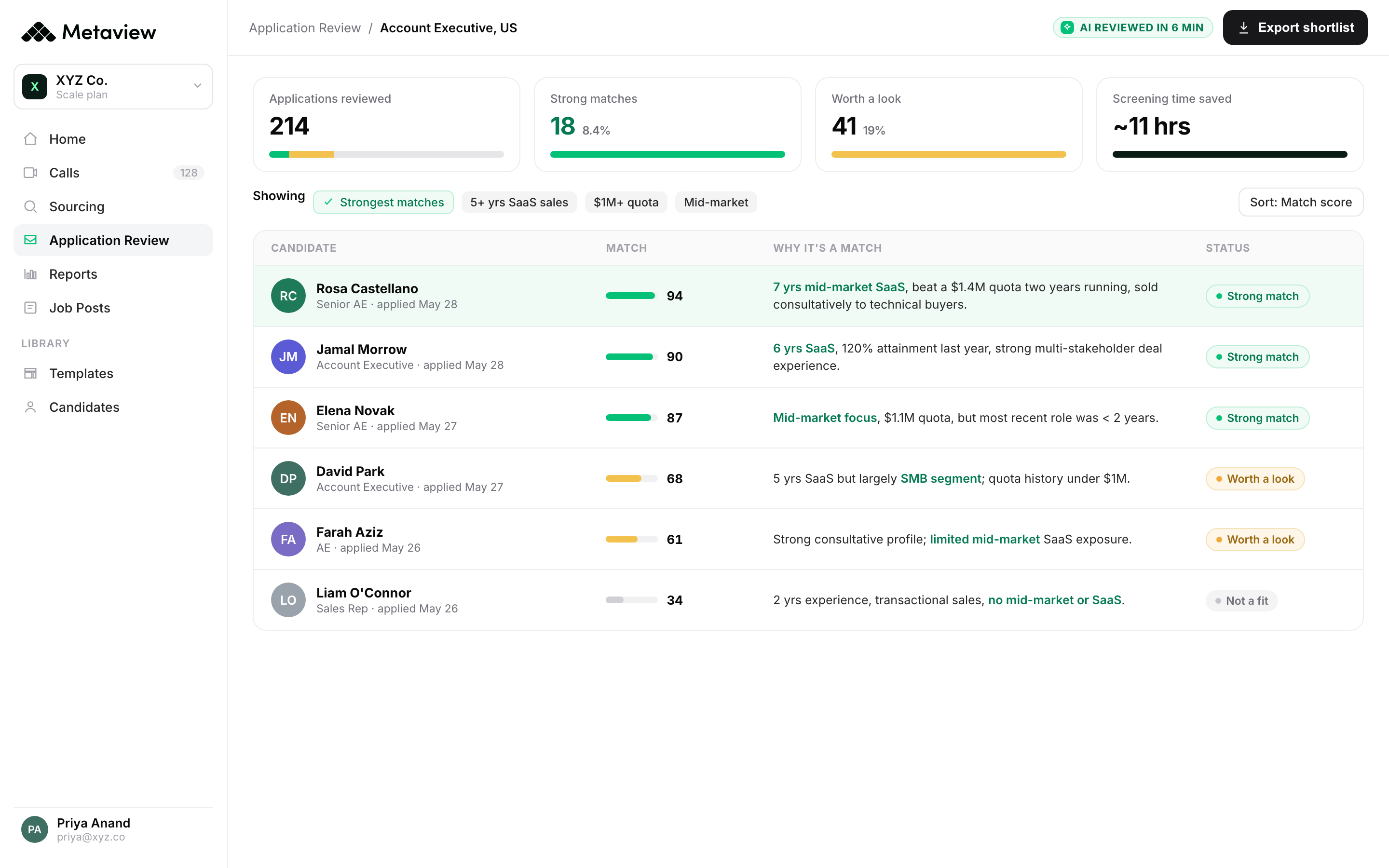
You can see why any candidate landed where they did, because the profile is doing the work in the open. Open an evaluation and the reasoning is sitting right there: which criteria the applicant met, which ones they missed, and the lines from their own application behind each call.
Here's what that looks like in practice. You open a candidate the agent placed low, read the criteria it judged unmet and the evidence it leaned on, and you fix the profile when it has misread someone. The placement is a claim with its reasons attached, and you're free to argue with it.
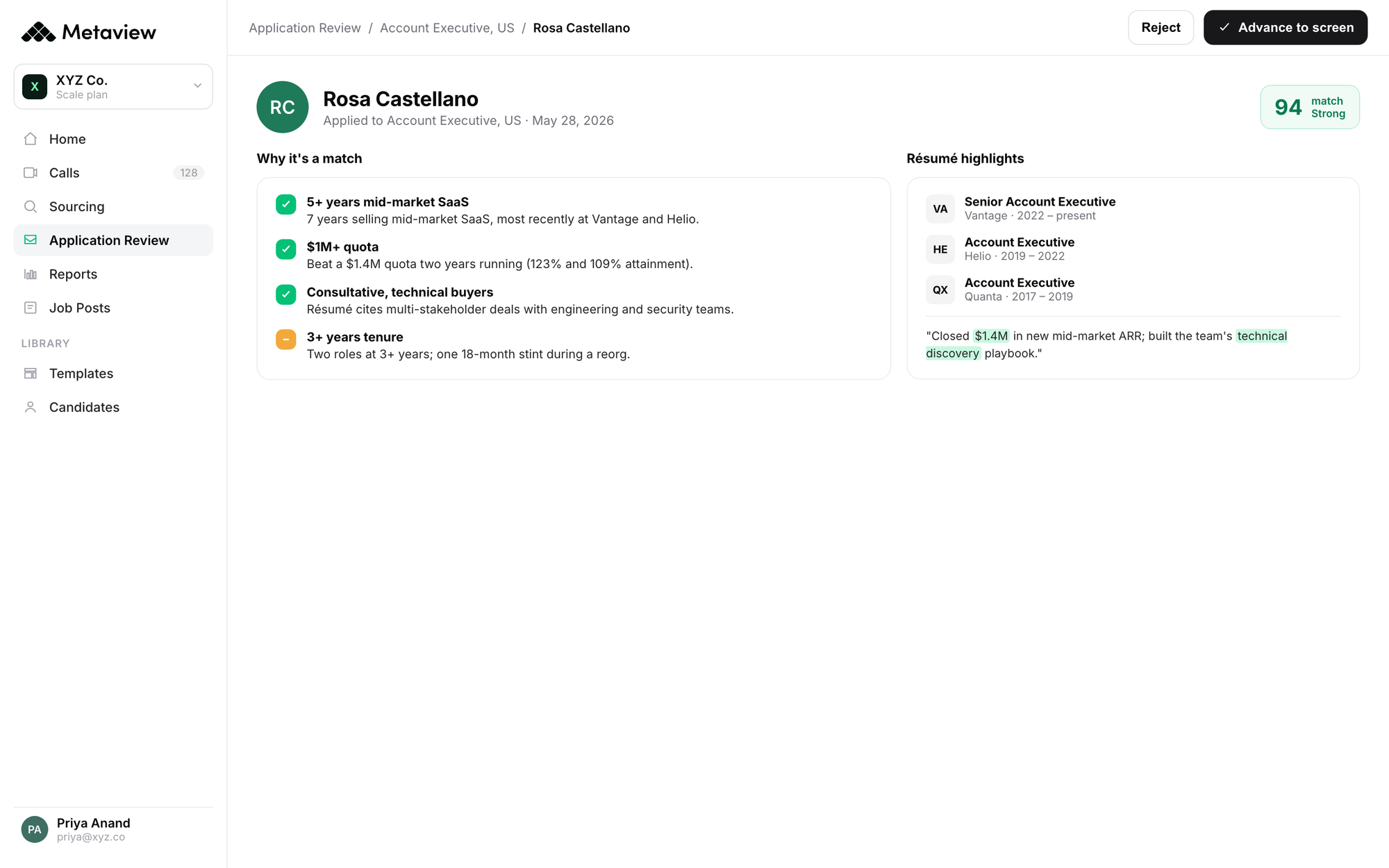
You can just ask, in plain language, for anything the profile doesn't cover. Add a custom AI column for deal-size experience or a location requirement, and the agent evaluates the whole pool on that one attribute. No rule to configure, no Boolean string to write, and the list re-sorts in seconds.
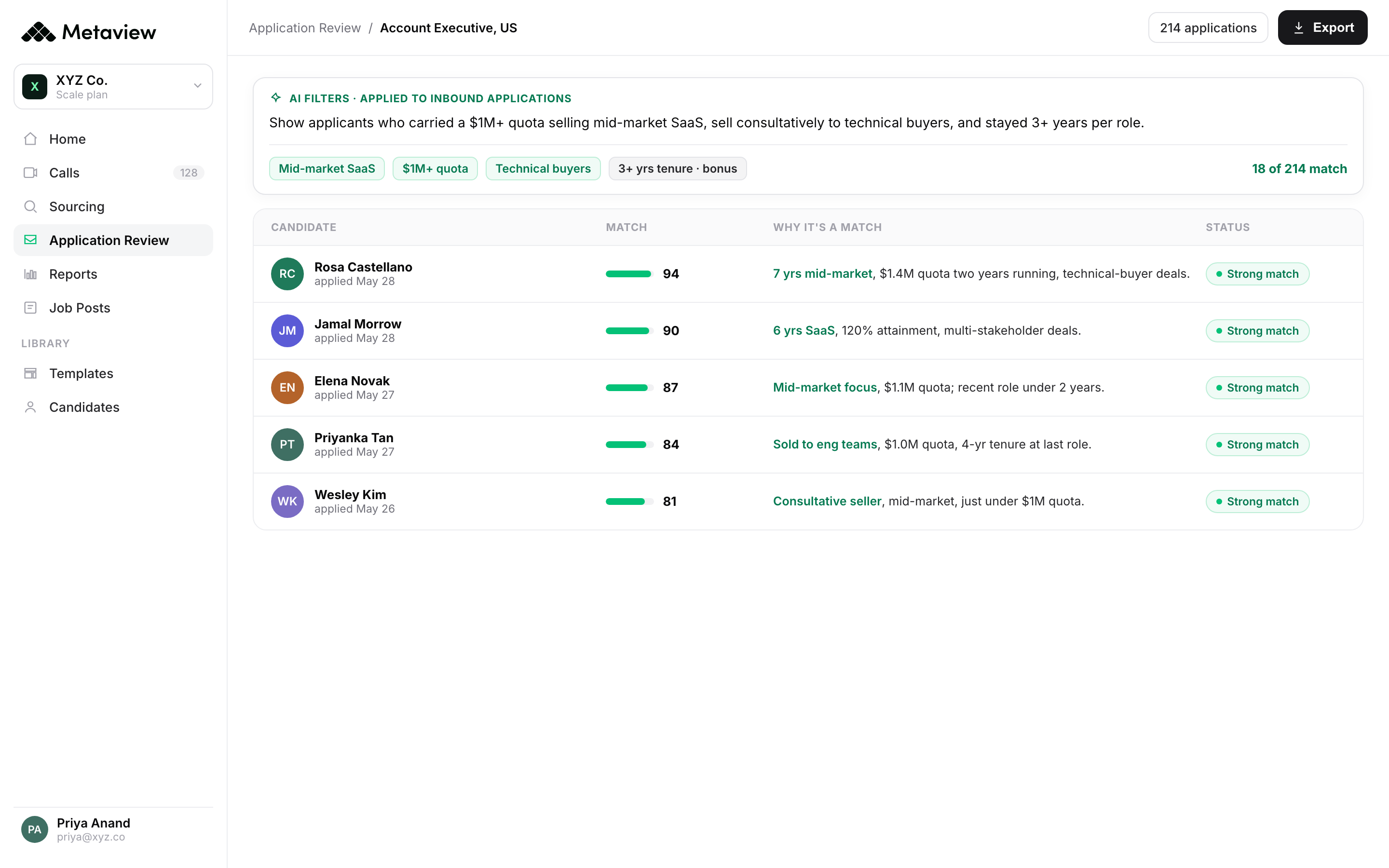
The change recruiters notice first is where their hours go. Strong and weak applications both get a real read in seconds, so the queue stops being a backlog. The time that used to disappear into skimming goes into candidates and conversations instead.
Workleap's recruiting team went through that shift, and their case study has the detail behind it.
It's reduced my screening time by up to 50%. Both strong and weak profiles are reviewed within a couple of seconds.”

This five-minute walkthrough builds an Ideal Candidate Profile and runs it across a live pipeline, if you'd sooner watch it than read about it.
Fraud, fairness, and the decision that stays yours.
Reading every application also means catching the ones that aren't real. AI-generated resumes and identity games are hard to spot at speed.
Fraud detection runs by default in Application Review, with no setup. Every application is assessed for identity deception, like an email or phone number that doesn't hold up, and for signs of automation in how it was put together.
Anything it flags carries a risk level and a plain-language reason, so you can see what triggered it and overrule it when you disagree. A flag means the model found something worth checking, and you confirm or dismiss it.
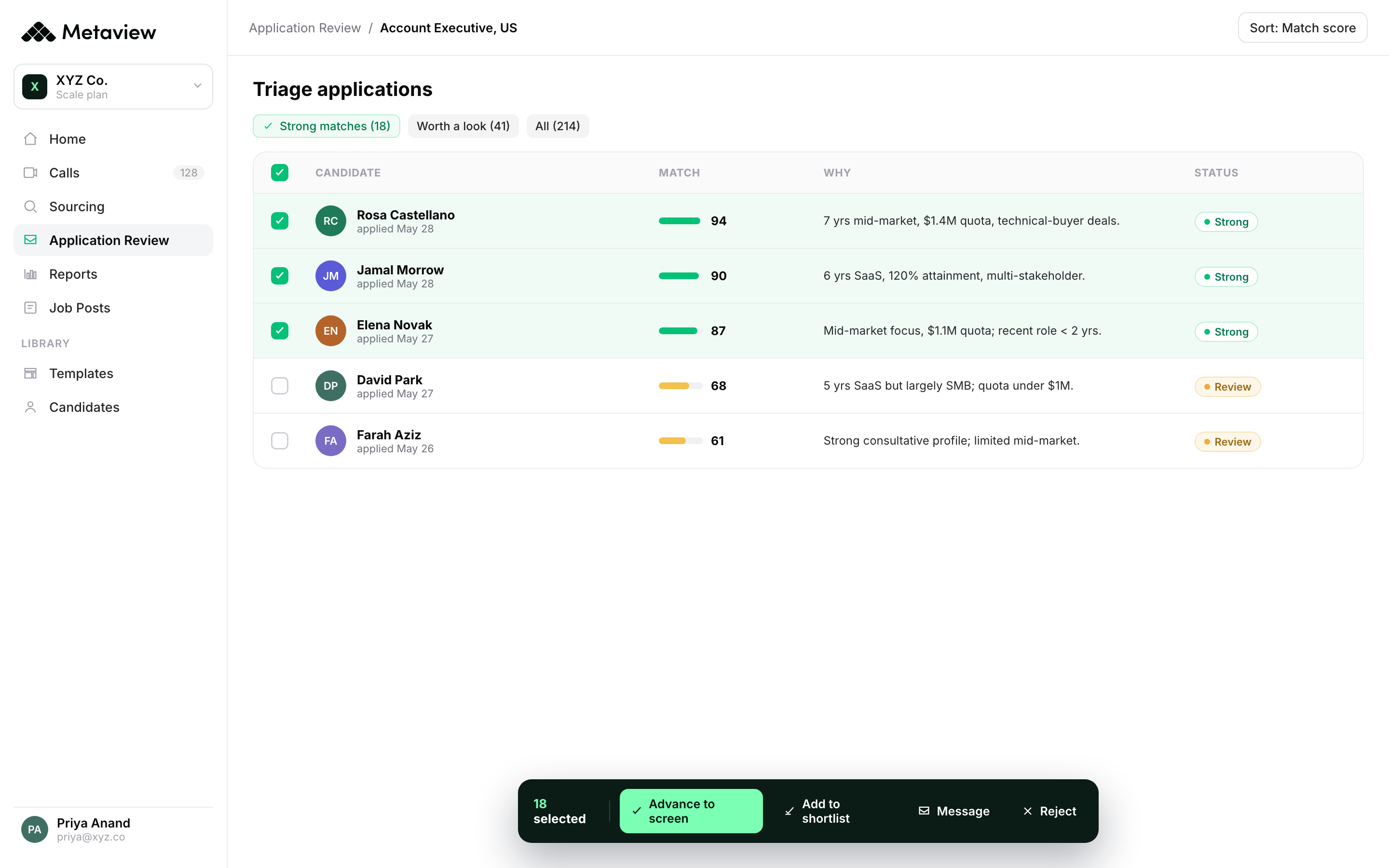
The AI never auto-rejects. It doesn't screen anyone out, it doesn't send a rejection on its own, and a human makes every accept and reject call.
That promise deserves pressure, though, because the same failure has a quieter way back in. Work the ranked list from the top down, stop when the calendar fills, and the candidates the agent placed low get passed over just as completely as the bottom of the old chronological pile.
The difference is that this time it happened without anyone deciding it should. Call it rejection by ranking. It's the thing to design against, and the product can't do that part for you.
It's tempting to call this fairer by default. Applying the same criteria to everyone is only fairer if the criteria themselves are fair, and applying biased criteria consistently just makes the bias efficient. So the claim worth making here is a narrower one.
Application Review reads every applicant against the same criteria and keeps those criteria visible and editable, so you can see exactly what it rewards. Everything else is on you:
- Review the criteria before you trust them.
- Watch where you keep overriding the placement, because that usually means the profile is wrong.
- Read a sample from the low end, where you and the machine are most likely to disagree.
- Check that the people advancing aren't skewing against a group.
Reading and explaining every application is what makes those checks possible. Not one of them happens on its own.
Where Application Review fits in the stack.
Application Review is one of a set of Metaview agents that work from the same context across a search. That is what an agentic recruiting platform buys you.
The product that reads your inbound also captures what's said in your interviews, so what you learn in later rounds can sharpen the criteria the top of the funnel gets read against.
The criteria you refine in Application Review carry into your interview notes and Reports, and what you learn there carries back, because the agents share context instead of starting cold at every step.
It connects to the rest of your stack through native ATS integrations, with accept and reject decisions syncing back to Ashby, Greenhouse, Lever, and SmartRecruiters. That same context reaches AI sourcing on the outbound side too, so the whole funnel works from one understanding of the role.
Teams already running it describe the same shift, from drowning in a queue to working a short, explained list. Here's a recruiter walking through what changed for their team.
Read every inbound application against criteria you can see.
Build an Ideal Candidate Profile, point it at an open role, and let Application Review rank the whole stack by fit. You still decide.
Frequently asked questions.
What is AI application review?
AI application review uses an agent to read every inbound application against the criteria you set for a role, sort candidates by how well they fit, and explain the reasoning behind each evaluation. In Metaview, those criteria live in an Ideal Candidate Profile, which is drafted from the job post already listed in your ATS for that role and then edited and approved by you before anything is assessed against it.
Can two roles use different Ideal Candidate Profiles?
Yes. An Application Review is set up per role, and each one carries its own Ideal Candidate Profile, drafted from that role's job post in your ATS. Editing the criteria on one role leaves every other role untouched, so a support hire and a staff engineer hire are never held to the same bar by accident.
What happens if I change the criteria halfway through a search?
The profile is versioned. When you activate an edited version, the applicants already in the review are re-ranked against the updated criteria, and you can restore an earlier version if the change made things worse. One thing does not re-run: the fraud assessment happens when a candidate first arrives from your ATS, and it is not repeated after a profile edit or after you give feedback on a candidate.
Does Application Review score candidates or rank them?
It sorts them, and the sort is expressed in buckets rather than numbers. Candidates land in Great Fit, Good Fit, Okay Fit, or Poor Fit, and opening any fit cell shows the reasoning behind that bucket. There is no published numerical score, and the buckets measure fit against the criteria you set, not future performance in the job.
Which ATS platforms does Application Review integrate with?
Application Review syncs candidates in from Ashby, Gem, Greenhouse, Lever, Pinpoint, SmartRecruiters, Teamtailor, and Workable. Decision writeback is narrower. On Ashby, Greenhouse, Lever, and SmartRecruiters, the accept and reject calls you make in Metaview are pushed back to the ATS; Gem does not currently support syncing rejections back, and Pinpoint, Teamtailor, and Workable sync candidates in only.
What happens to a candidate I reject in Metaview?
You record the decision, and on Ashby, Greenhouse, Lever, and SmartRecruiters it is pushed back to your ATS so the two systems stay in step. The AI never rejects anyone and never sends a rejection on its own, so every reject that reaches your ATS is a call a person made.