The 10 best Lever integrations to supercharge your hiring stack
For many fast-moving companies, Lever is more than an ATS—it's the operating system that runs recruiting. The combination of applicant tracking and built-in CRM capabilities means teams can manage active candidates and nurture passive pipelines in the same place, without stitching together two separate systems.
But even the best operating system needs the right applications running on top of it.
Lever integrations let recruiting teams connect specialized tools for AI-assisted interviewing, interview scheduling, sourcing, collaboration, background checks, and onboarding, without abandoning Lever as their source of truth.
When these tools sync seamlessly back into the ATS, the result is a recruiting tech stack that reduces manual work, raises the quality of hiring data, and gives teams more time to focus on what actually matters: hiring the right people.
This guide covers 10 of the most valuable Lever integrations available today, and how each one helps modern recruiting teams get more from their ATS.
Key takeaways
- Lever integrations transform your ATS into a full hiring engine. Connecting the right tools to Lever extends its core strengths—pipeline management, CRM nurturing, and structured hiring—without requiring teams to abandon the platform as their system of record.
- The highest-impact integrations improve the quality of information inside Lever. Tools that capture structured interview insights, surface stronger candidates, or automate application review ensure the data in your ATS is actually useful for making decisions.
- Strategic integrations eliminate whole categories of administrative work. The best additions to a Lever stack don't just reorganize tasks. They remove them entirely, freeing recruiters and HR leaders to spend time where it matters most.
What is Lever?
Lever is an applicant tracking system (ATS) and candidate relationship management (CRM) platform that helps recruiting teams manage the full hiring lifecycle. From the first contact with a passive candidate, to the moment an offer is signed.
Lever lets recruiting teams build and nurture relationships with passive talent over time, running multi-touch outreach campaigns, logging interactions, and maintaining a searchable database of people who may be a fit for future roles. This makes it especially useful for companies that compete for in-demand talent and can't afford to start every search from scratch.
Some of Lever's core capabilities include:
- Candidate pipeline and application management
- Built-in CRM and talent relationship management for passive candidates
- Structured interview tools, scorecards, and feedback workflows
- DEI analytics and EEO dashboards
- Workflow automation and approvals
- 400+ native integrations with the wider HR and recruiting tech ecosystem
Lever is widely used by mid-size and enterprise organizations where recruiting teams need a platform that scales without sacrificing usability or candidate experience.
Lever's built-in integration tools
Before exploring the broader ecosystem of third-party tools, it's worth understanding how Lever supports integrations natively. The platform provides several built-in capabilities that make it easier to connect with other systems while keeping recruiting data centralized.
Lever API
Engineering teams use the Lever API to build custom integrations, sync recruiting data with internal systems, or pull information into data platforms for deeper analysis. Many third-party tools also use the API to power their own Lever integrations under the hood.
Organizations with technical resources, get a flexible foundation to connect Lever with systems that aren't covered by off-the-shelf integrations.
Lever partner marketplace
Lever maintains a curated directory of approved third-party integrations spanning scheduling, background checks, HRIS, sourcing, communication, and more. Many integrations can be activated directly within the platform with minimal setup, making it accessible even for teams without dedicated technical support.
Chrome extension
Lever's Chrome lets recruiters add candidates directly from LinkedIn and other websites without switching tabs or re-entering data manually. For recruiters who spend significant time sourcing on LinkedIn, the extension removes a meaningful amount of manual work from the top of the funnel.
The 10 best Lever integrations
Lever's partner marketplace connects with hundreds of tools across the recruiting and HR ecosystem. The integrations below represent some of the most valuable options available, chosen for their ability to improve the quality of hiring data, reduce administrative work, and support workflows from sourcing through to onboarding.
1. Metaview: AI sourcing and interview intelligence
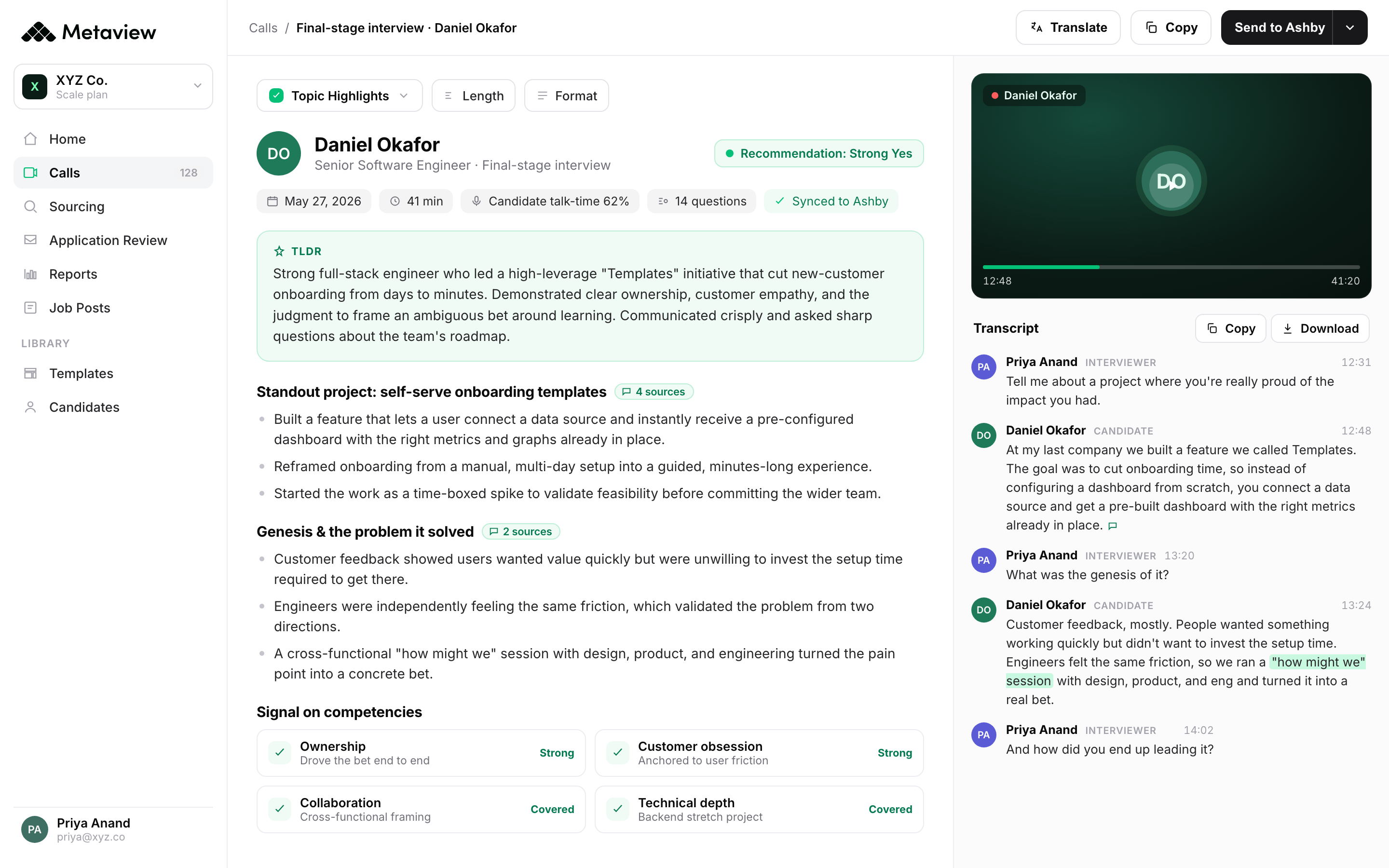
When interview notes are incomplete, feedback is inconsistent, or application review is purely manual, the data inside your ATS becomes less reliable as a basis for decisions. Metaview is the leading AI hiring platform, and its Lever integration is designed to fix exactly that problem.
During interviews, Metaview automatically captures detailed notes and structures them so they map directly to Lever feedback forms. Instead of relying on interviewers to self-report after a conversation, hiring teams get consistent, high-quality documentation that flows back into Lever without any manual effort.
Metaview also automates sourcing, helping recruiters identify and engage relevant candidates more efficiently. It rediscovers candidates already in Lever, surfacing past applicants who may be a strong fit for current roles.
And it performs instant application review, flagging poor-fit applicants before they consume recruiter time. Together, these capabilities ensure that the information flowing in and out of Lever is structured, searchable, and genuinely useful.
Key benefits
- Structured interview notes mapped automatically to Lever feedback forms
- Candidate rediscovery from existing Lever pipelines
- Instant application review to filter poor-fit applicants early
- Automated sourcing to build pipeline more efficiently
- Less administrative work for interviewers, and better signal for hiring teams

2. Slack: team collaboration and real-time hiring updates
Most recruiting teams are already living in Slack. The Lever integration brings hiring activity into those existing conversations, so recruiters, hiring managers, and interviewers stay aligned without needing to log into the ATS to check on progress.
The integration sends notifications about key recruiting activity directly into Slack channels. Stage changes, interview scheduling updates, feedback submission reminders, and offer alerts can all be routed to the right people in real time.
Recruiters can also share candidate profiles within Slack conversations and quickly loop in hiring managers when a decision needs input. It's a lightweight but meaningful way to reduce the communication overhead that tends to slow down fast-moving hiring processes.
Key benefits
- Stage-change and offer notifications delivered directly to Slack channels
- Interview feedback reminders for hiring managers
- Quick candidate profile sharing within team conversations
- Keeps distributed hiring teams aligned without constant ATS logins
3. Calendly: interview scheduling and calendar coordination
Coordinating availability across candidates, recruiters, and multiple interviewers generates a huge amount of back-and-forth for what should be a routine step. Calendly lets candidates self-schedule based on real-time calendar availability.
Recruiters send a scheduling link, and candidates select a time that works for both them and the interviewing team. The integration syncs confirmed interviews back into Lever, so candidate timelines and interview records stay accurate inside the ATS without requiring manual updates.
Removing manual scheduling from early stages gives recruiters more capacity to evaluate candidates and move strong ones forward.
Key benefits
- Candidate self-scheduling based on live interviewer availability
- Automatic calendar syncing across recruiters and interviewers
- Scheduling confirmations reflected inside Lever automatically
- Reduces back-and-forth coordination, especially at early pipeline stages
4. LinkedIn Recruiter: sourcing and pipeline building
The native LinkedIn Recruiter integration lets recruiters import candidate profiles directly into Lever without manual data entry, and keeps InMail activity synced back into candidate records so nothing falls through the cracks.
Rather than sourcing in LinkedIn and then recreating candidate information inside the ATS, recruiters can capture profiles in one click and add them directly to the right pipeline stage. Outreach history, messaging activity, and candidate status stay connected across both platforms.
Keeping LinkedIn activity anchored inside the ATS ensures that sourcing effort compounds over time rather than getting lost between tools.
Key benefits
- Import LinkedIn profiles directly into Lever with one click
- InMail activity synced back into candidate records
- Faster top-of-funnel sourcing with less manual data entry
- Supports passive candidate nurturing inside Lever's TRM
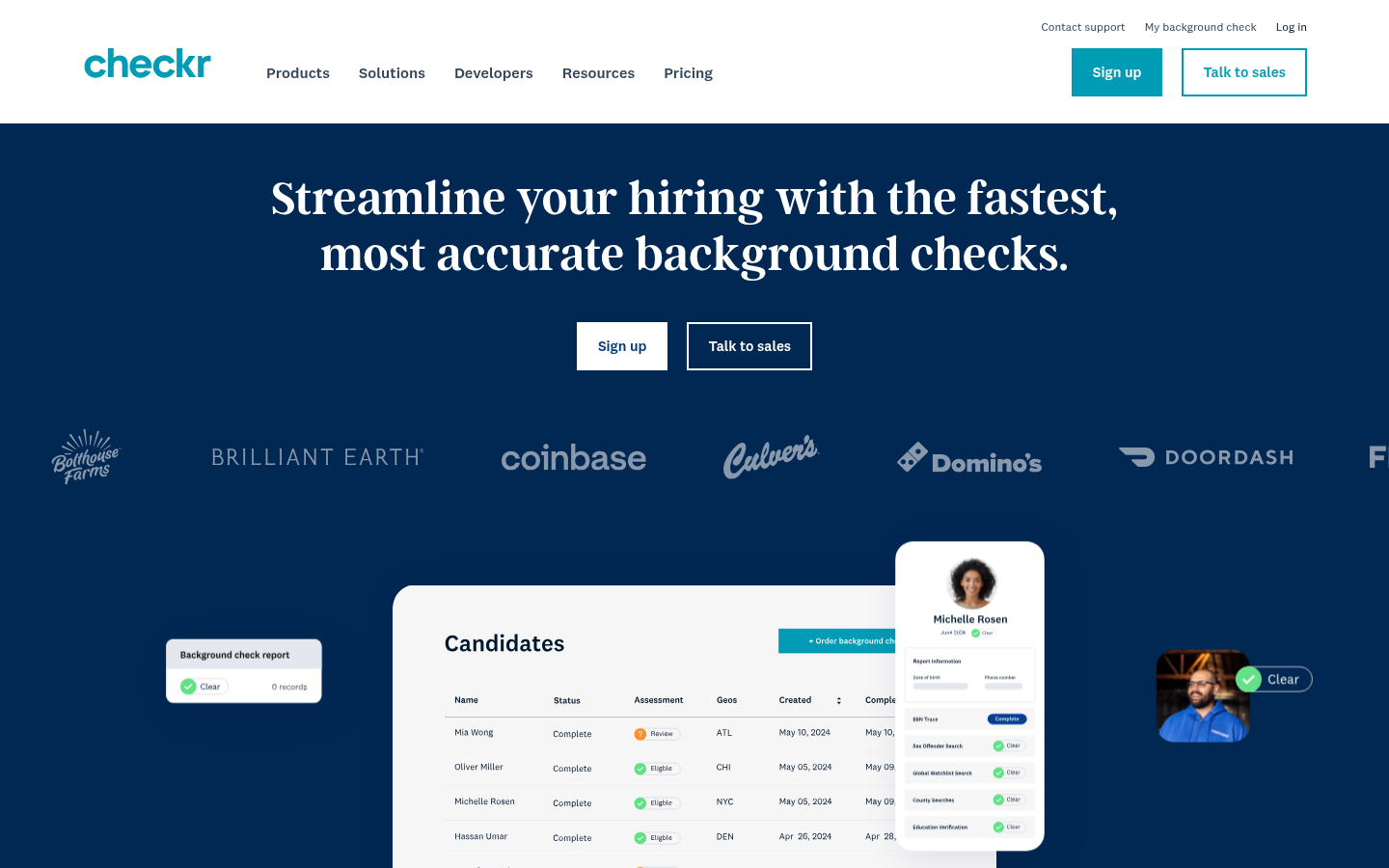
5. Checkr: background screening
Background checks are operationally straightforward in principle, but often administratively painful. Checkr's Lever integration keeps the entire screening workflow anchored inside Lever, so the final stages of the hiring process don't become a bottleneck.
Recruiters can initiate background checks directly from a candidate's record once they reach the appropriate stage. Screening status and results sync back into Lever automatically, giving recruiters and hiring managers full visibility without switching between platforms.
This means offers move faster. When screening status is visible inside the ATS alongside the rest of the candidate record, there's less chasing of updates and fewer delays between verbal offer and confirmed start date.
Key benefits
- Background checks initiated directly from within Lever
- Automatic status updates synced back to candidate records
- Faster screening turnaround for final-stage candidates
- Fewer manual steps between offer and start date
6. DocuSign: offer letters and employment contracts
Getting an offer letter out quickly matters. Candidates who have received competing offers won't wait long, and delays in the final paperwork stage can cost teams hires that were otherwise secured. DocuSign's Lever integration removes the manual work involved in generating, sending, and tracking employment documents.
Recruiters can generate and send offer letters directly from Lever workflows, with candidate and role information pulled automatically from the ATS to populate key fields in the document. That removes the risk of manual errors in offer letters while also cutting down the time between offer approval and the document landing in a candidate's inbox.
Once sent, the signing process can be tracked in real time without leaving Lever. Hiring managers and recruiting leaders get visibility into where each offer stands, and completed documents are stored against the candidate record for a clean audit trail.
Key benefits
- Offer letters generated and sent directly from Lever workflows
- Candidate and role details auto-populate document fields
- Real-time signature tracking without leaving the ATS
- Faster turnaround from offer approval to signed contract
7. Workday: enterprise HRIS and workforce management
For larger organizations, recruiting is just one part of a broader workforce management system. Workday is the central HRIS for many enterprises, and its integration with Lever ensures that hiring data feeds directly into that system without manual intervention.
Once a candidate is hired in Lever, their information can be synced into Workday to create or update employee records. This connection lets organizations maintain a single source of truth for workforce data while still benefiting from Lever’s modern recruiting workflows. It also supports downstream processes such as payroll, compliance, and headcount planning.
Beyond simple data transfer, the integration helps standardize how hiring information is captured and structured before it enters Workday. This improves reporting consistency and ensures that workforce analytics are based on clean, reliable data from the start.
Key benefits
- Seamless sync of hired candidate data into Workday
- Maintains a single source of truth for workforce information
- Reduces manual data entry and administrative errors
- Supports compliance, payroll, and workforce planning processes
- Improves consistency and quality of HR reporting data
8. CodeSignal: technical skills assessments
Evaluating technical candidates consistently is one of the hardest parts of hiring. Without structured assessments, teams often rely on subjective interview performance, which can lead to inconsistent decisions. CodeSignal’s Lever integration introduces standardized technical evaluation directly into the hiring workflow.
Recruiters can send coding assessments to candidates from within Lever, and results are automatically attached to the candidate’s profile. This gives hiring teams a clear, objective signal of technical ability before moving candidates into later-stage interviews. It also reduces the need for time-consuming manual screening calls for clearly underqualified candidates.
By bringing assessment results into Lever, teams can compare candidates more effectively and ensure that technical evaluations are part of a structured, data-driven hiring process. This is especially valuable for engineering and technical roles where skill validation is critical.
Key benefits
- Send technical assessments directly from Lever
- Automatic syncing of results to candidate profiles
- Objective evaluation of coding and technical skills
- Reduces time spent on early-stage technical screening
- Supports more consistent, data-driven hiring decisions
9. Zapier: custom workflow automation
No two recruiting teams operate in exactly the same way. While Lever offers a wide range of native integrations, there are always edge cases where teams need to connect tools that aren’t directly supported. Zapier fills that gap by enabling custom workflow automation between Lever and thousands of other applications.
Using Zapier, teams can create automated workflows (“Zaps”) that trigger actions based on events in Lever. For example, a new candidate entering a pipeline could trigger a Slack message, a Google Sheet update, or a task in a project management tool. Similarly, actions in other systems can push data back into Lever, keeping records up to date without manual effort.
This flexibility allows recruiting teams to extend Lever in ways that match their exact processes, without requiring engineering resources. For teams looking to eliminate repetitive tasks or connect niche tools into their stack, Zapier provides a lightweight but powerful solution.
Key benefits
- Connect Lever with thousands of tools without custom engineering
- Automate repetitive recruiting workflows across systems
- Trigger actions based on candidate or pipeline activity
- Keep data synced between Lever and other business tools
- Flexible customization to match unique team processes
10. Gem: recruiting analytics and pipeline intelligence
As recruiting teams scale, understanding pipeline performance becomes just as important as filling roles. Gem’s Lever integration provides deeper visibility into sourcing effectiveness, pipeline health, and recruiter productivity, helping teams make more informed decisions about where to invest their efforts.
By syncing data from Lever, Gem enables detailed analytics on candidate flow, conversion rates, and outreach performance. Recruiting leaders can identify bottlenecks in the hiring process, understand which sourcing channels produce the best candidates, and track how pipelines evolve over time.
Gem also enhances pipeline intelligence by helping teams manage and re-engage talent more effectively. Combined with Lever’s CRM capabilities, it gives recruiting organizations a clearer picture of their talent network and how to activate it.
Key benefits
- Advanced analytics on pipeline performance and conversion rates
- Visibility into sourcing channel effectiveness
- Identifies bottlenecks and inefficiencies in hiring workflows
- Enhances pipeline management and candidate re-engagement
- Supports more strategic, data-driven recruiting decisions
What to look for in Lever integrations
The most effective Lever stacks are built intentionally, adding tools that strengthen Lever’s core capabilities rather than fragmenting workflows across disconnected systems.
For recruiting leaders evaluating new tools, the goal is to extend Lever in ways that improve data quality, remove manual work, and support a faster, more consistent hiring process.
Integrations that raise the quality of data inside Lever
Lever is most powerful when the information inside it is structured, complete, and reliable. That’s what enables strong hiring decisions, meaningful reporting, and effective pipeline management.
The best integrations don’t just pull data out of Lever, they write high-quality data back into it. Tools that capture structured interview feedback, standardize candidate evaluation, or enrich candidate profiles make the ATS more valuable over time.
When evaluating integrations, ask a simple question: does this tool improve the signal inside Lever, or just add more noise? Prioritize tools that make your data more usable, not just more abundant.
Tools that eliminate administrative work, not just reorganize it
Many recruiting tools promise efficiency, but only shift work from one place to another. The highest-impact integrations remove entire categories of tasks altogether.
Scheduling tools that eliminate back-and-forth emails, AI note-taking tools that remove the need for manual interview write-ups, and automation tools that filter applications before a recruiter reviews them all fall into this category.
These are the integrations that meaningfully increase team capacity. Instead of asking recruiters to work faster, they reduce the amount of work that needs to be done in the first place.
Reliable, bi-directional data sync
Lever should remain the system of record for all candidate and hiring data. Integrations that only sync data one way—or require manual updates to stay consistent—quickly create fragmentation.
Strong integrations maintain a reliable, bi-directional flow of information. Changes in Lever are reflected in connected tools, and updates from those tools are written back into Lever automatically.
This ensures that everyone—recruiters, hiring managers, and leadership—is working from the same, up-to-date information, without needing to reconcile data across systems.
Support for the full hiring lifecycle
From sourcing and pipeline building to interviews, offers, and onboarding, each part of the recruitment process introduces different operational challenges.
The strongest Lever stacks cover the full hiring lifecycle with complementary tools at each stage. Sourcing integrations build pipeline, interview tools improve evaluation quality, scheduling and automation tools reduce coordination overhead, and HRIS integrations ensure a clean transition into onboarding.
Looking at integrations holistically—rather than evaluating them in isolation—helps ensure your stack works as a cohesive system rather than a collection of point solutions.
Security, privacy, and compliance
Recruiting systems hold some of the most sensitive data in an organization: personal candidate information, compensation details, and interview feedback.
Any integration that connects to Lever must meet the same standards for security, privacy, and compliance as the ATS itself. This includes data encryption, access controls, audit logging, and adherence to relevant regulations such as GDPR.
Beyond technical requirements, it’s also important to understand how data is stored, processed, and retained across systems. The goal is to extend your recruiting stack without introducing unnecessary risk.
Integrate Lever for a complete hiring operating system
Lever gives recruiting teams a very strong foundation. But the teams getting the most from it treat it as a platform, not just a tool.
The right integration layer transforms Lever from an ATS into a complete hiring operating system: one that sources better, interviews smarter, automates the routine, and keeps everyone aligned around a single source of truth.
For HR leaders and recruiting teams ready to maximize Lever, starting with high-impact integrations will deliver the fastest and most durable results.
Want to see how Metaview integrates with Lever? Try Metaview for free or book a demo today.

Lever integrations FAQs
How many integrations does Lever support?
Lever supports 400+ integrations through its partner marketplace and API, spanning categories from sourcing and scheduling to HRIS, background checks, assessments, and workflow automation.
Does Lever have a native integration marketplace?
Yes. Lever maintains a partner marketplace where organizations can browse and activate approved integrations. Many can be enabled directly within the platform, while more complex HRIS connections may require additional setup.
Do Lever integrations require engineering resources to set up?
It depends on the integration. Many marketplace integrations can be activated with minimal technical setup. Deeper connections to enterprise HRIS platforms like Workday may require configuration support, while tools like Zapier enable custom automations without any code.
Can Lever integrations write data back into candidate records?
Yes, many integrations support bi-directional sync, letting interview intelligence platforms, background check providers, and assessment tools push structured data back into Lever candidate records. This is one of the most important criteria when evaluating any integration.
What's the difference between a Lever ATS integration and a CRM integration?
Lever functions as both an ATS and a CRM. ATS integrations typically support active candidates moving through a hiring pipeline, while CRM integrations support passive candidate nurturing, outreach, and long-term pipeline building. The most valuable tools work across both functions.
How should recruiting teams prioritize which Lever integrations to implement first?
Start by identifying the biggest constraint in your current workflow, whether that's top-of-funnel sourcing, interview quality, scheduling overhead, or the recruiting-to-HR handoff. Implement one or two integrations that directly address that bottleneck before expanding the stack further.