Metaview scored 139,336 candidates in both an early round and a final round. The two assessments pointed the same way 54.4% of the time. Put another way: on nearly half of those candidates, the early read and the later read landed somewhere different. That doesn't mean the early interviewer got it wrong every time the two split. Later rounds test different skills, and they often bring in someone who reads the role differently. But candidate evaluations move a lot over the course of a process, and that's worth knowing before you treat a first-round call as settled.
Most candidates never get a second look. Only 20.8% of the candidate and job pairings in Metaview's corpus included a second recorded round, so for the other four in five, one early read carried most of the weight. Early assessments change often, they still decide most outcomes, and the evidence behind them is frequently thin and undocumented.
This data can't tell you how many qualified candidates were wrongly rejected. People cut in an early round rarely come back with a job-performance outcome you could check against, and, as you'll see, they barely show up in this dataset at all. Nothing follows a candidate past the offer. The data does show where the risk piles up: early decisions made against inconsistent criteria, on incomplete evidence, with nothing written down. You can measure those conditions, and you can fix them.
Early and final assessments often disagree
Metaview took 139,336 candidates who got a scorecard in an early round and another in a final round, then checked whether the two recommendations pointed the same way. They matched 54.4% of the time. Strip out the neutral, no-strong-opinion scorecards and it barely moves, to 55.2%. Either way, the same candidate gets assessed differently at the start and the end of a process close to half the time.
The figures come from Metaview's own corpus of 5.5 million captured conversations across 12,491 organizations, pulled on June 17, 2026, of which 5.2 million are candidate interviews. Everything here is aggregate only, with at least 50 interviews behind every number.
What that number does and doesn't say
This number is easy to overstate, so be precise with it. Agreement isn't accuracy. When an early and a final assessment disagree, the data stays quiet about which one was right. Maybe the later round tested different competencies. Maybe it applied a different bar, or the interviewer simply saw more of the candidate. Disagreement marks an inconsistent read, and inconsistency says nothing about which assessment was correct.
The sample has a built-in tilt. A candidate had to collect both an early and a final scorecard to show up here, which means they reached a final round. So the 139,336 lean toward people whose early read was positive, mixed, or overridden. It only includes candidates who advanced far enough to be scored twice. That's a real limit on what you can conclude, and it leads straight to the harder question underneath.
You can say early assessments are inconsistent, and outside research has been saying it for years. A classic meta-analysis by Conway and colleagues put the inter-rater reliability ceiling for unstructured interviews, still the default first-round format, at 0.34, which means two interviewers watching the same candidate often walk away with different conclusions. Structured interviews roughly double that. None of this measures Metaview's own figure directly. It describes the same pattern from a different angle: unstructured early screening produces inconsistent readings.
A first-round no isn't always the final word
Sort the outcomes by what the scorecard recommended and the early call turns out to be less binding than it looks. Candidates marked NO still advanced 6.2% of the time, against 47.4% for those marked STRONG_YES. A NO recommendation cut a candidate's odds hard. It didn't always end the process.
Be careful what you read into that 6.2%. Advancing isn't the same as being hired or performing well, and some of those candidates were surely turned down in the next round. The data also won't tell you why any single override happened. Two interviewers may have genuinely disagreed. A later stage may have turned up something new, or nobody treated the recommendation as decisive in the first place. The line between a first-round yes and no is softer in practice than a clean sequence of gates would suggest, and that's about as far as the figure goes.
Four in ten advances have no scorecard
Among the candidates who advanced, 41.9% had no submitted scorecard on file when the decision was made. That's a real operational gap, and it's worth being exact about it: the basis for the decision isn't visible in this dataset. It doesn't mean no evidence existed. A scorecard might have been filed later, the feedback might live somewhere else, or a recruiter might have moved someone forward before the written feedback caught up.
In multi-interviewer loops, 56.3% of the candidates who advanced did so with at least one dissenting no on record. On its own that isn't alarming. Panels exist partly to surface independent and sometimes conflicting views, so one no among several yeses can be a panel working exactly as designed. To tell the difference you'd want to know how many interviewers were in the loop, whether the dissent landed on a core competency, and whether anyone resolved it in the debrief. One strong opinion, for or against, is rarely the whole story.
These gaps point at a pattern hiring research keeps flagging. Google's structured interviewing guidance describes how a snap first impression pulls interviewers toward confirming whatever they already decided. Harvard Business School's Hidden Workers study found that 88% of employers believe qualified candidates get filtered out of their process for not matching the exact criteria in a job description. Neither study measures Metaview's numbers, and neither one has to. Between them they describe the mechanism: qualified people fall out quietly during inconsistent, under-documented early screening.
Where the risk is highest
This data can't count how many qualified candidates were wrongly rejected, and it never will, because nothing follows a candidate past the offer. It can still point at the conditions where that risk concentrates: early decisions made against inconsistent criteria, on incomplete evidence, with no written record. A rejection made under those conditions is the one most likely to be a mistake and the least likely to get caught, since there's nothing to go back and review. That's a narrower claim than a headline false-negative rate, and it's the one the numbers actually support.
The most reliable fix here is also the dullest one. Structured interviews are a more consistent and more valid instrument than unstructured ones, 0.51 against 0.38 in the validity coefficients Schmidt and Hunter established and the U.S. government still cites. They work because every candidate faces the same questions and the same bar. An improvised early round hands each candidate a slightly different test, then asks you to compare the results.
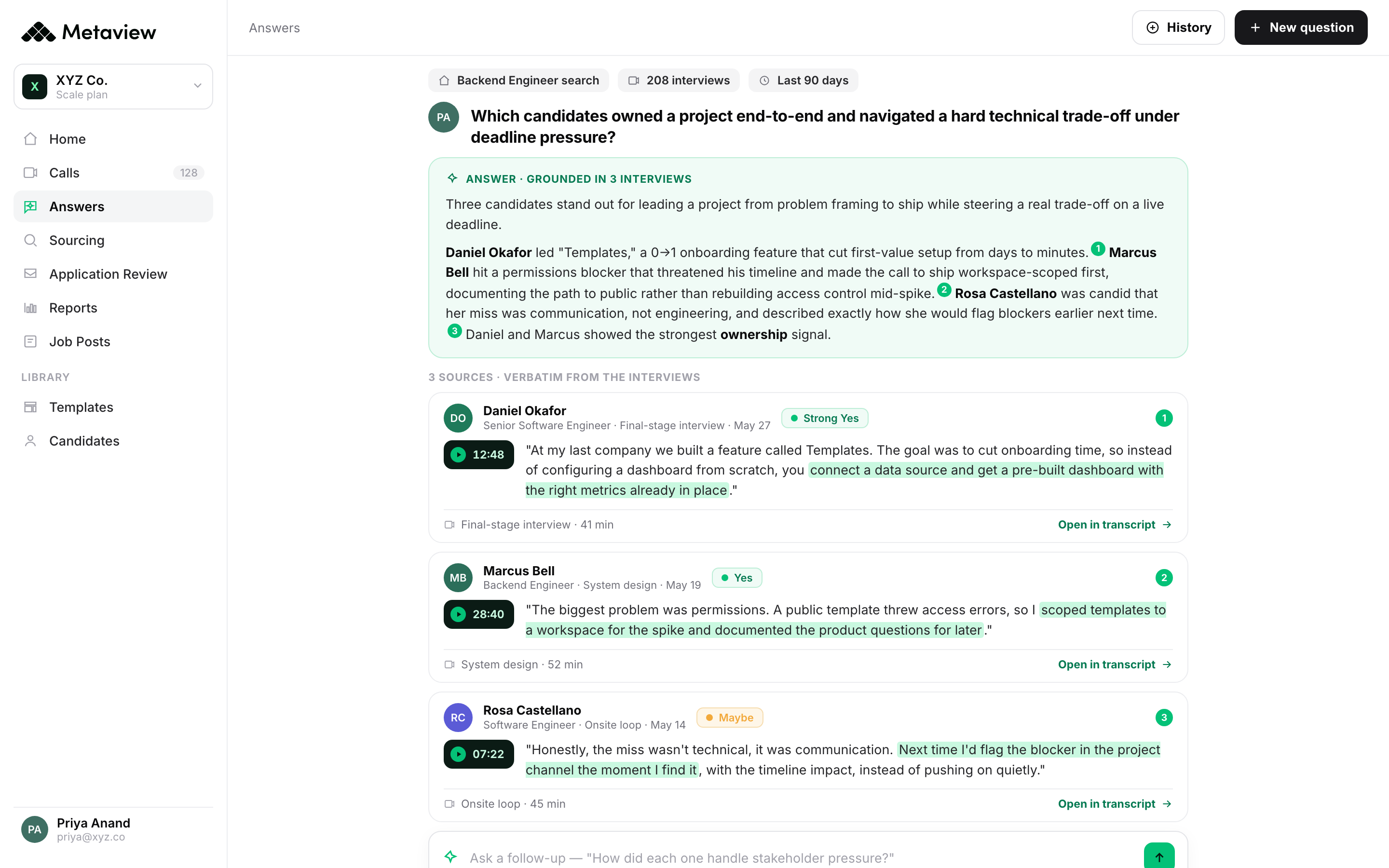
Structure only helps if the reasoning survives the conversation, and most of it doesn't. The interview ends, someone types up a few lines, and by the debrief the detail has evaporated. That's the gap Metaview was built to close. Its Notetaker captures every spoken word of an interview, so the basis for a decision sits in a record you can reopen weeks later.
How to make the first round more consistent
You can't fully measure false negatives, but you can shrink the conditions that create them. Three moves, heaviest first.
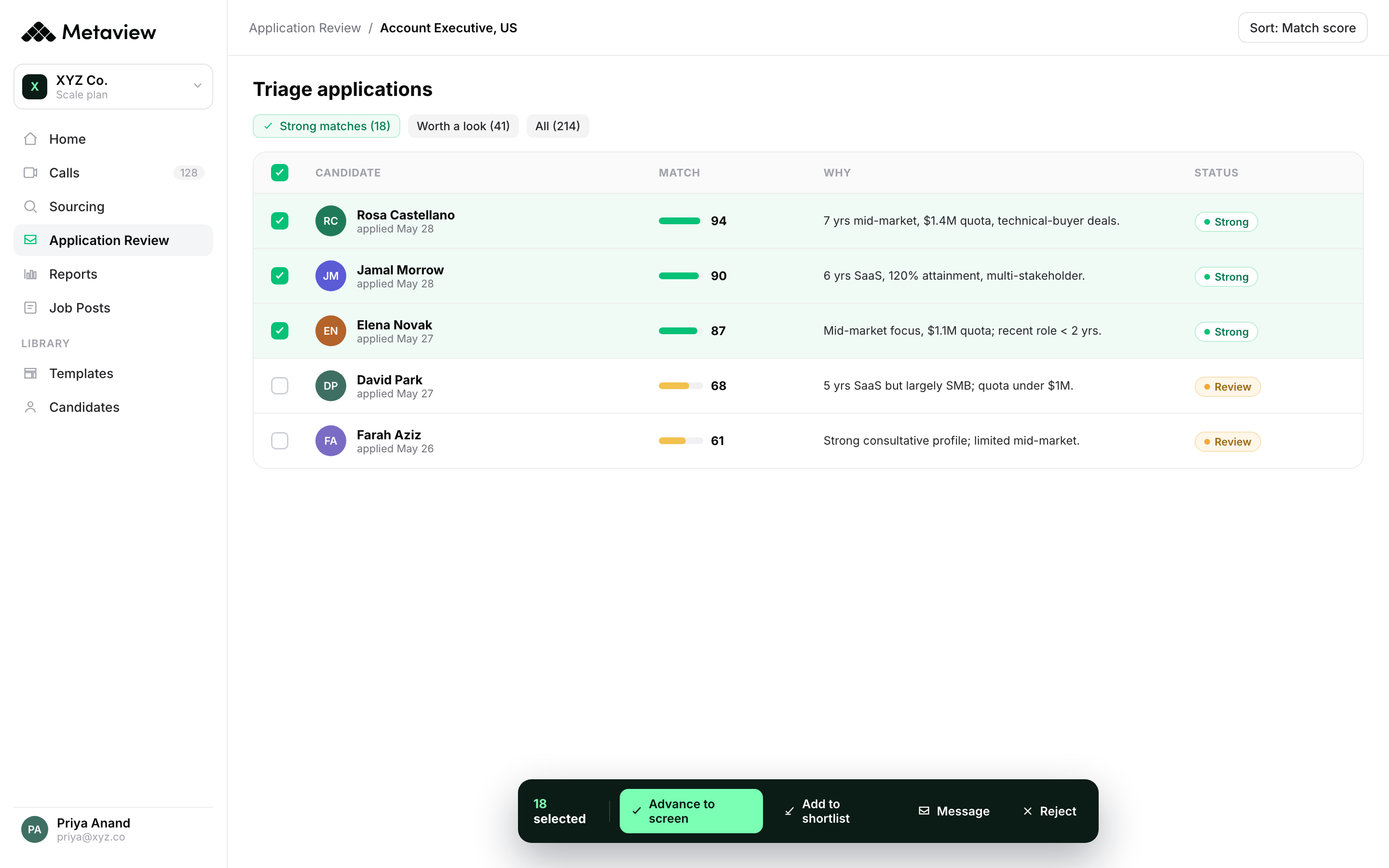
First, make sure everyone gets a real review. Plenty of strong candidates fall out early because nobody ever made a decision about them at all. A human starts at the top of the stack, works down until the calendar runs out, and the rest go unread. Metaview's Application Review reads every inbound application against the ideal candidate profile you define, sorts them by fit, and shows its reasoning on each one, so a candidate sitting deep in the pile gets the same read as the person who applied first. Our guide to inbound screening covers the mechanics. The guardrail is the part worth repeating: it never auto-rejects and never sends a rejection on its own. It reads, ranks, and explains. A human decides who moves forward.
Second, make the first round leave a record. A rubric turns a vague impression into criteria you can actually score, and a captured interview means the score is anchored to what the candidate said. A tight structured scorecard and a shared bar, the kind a bar raiser program sets, turn an early no into a reason someone else can review and compare. One talent team put the change like this.
Hiring managers can be less experienced or newer to hiring, so being able to structure their questions and give them guidance on the questions to ask, which are then represented in the scorecard and their notes, makes it more consistent. People are following the same line of questioning, and we can compare and contrast.”

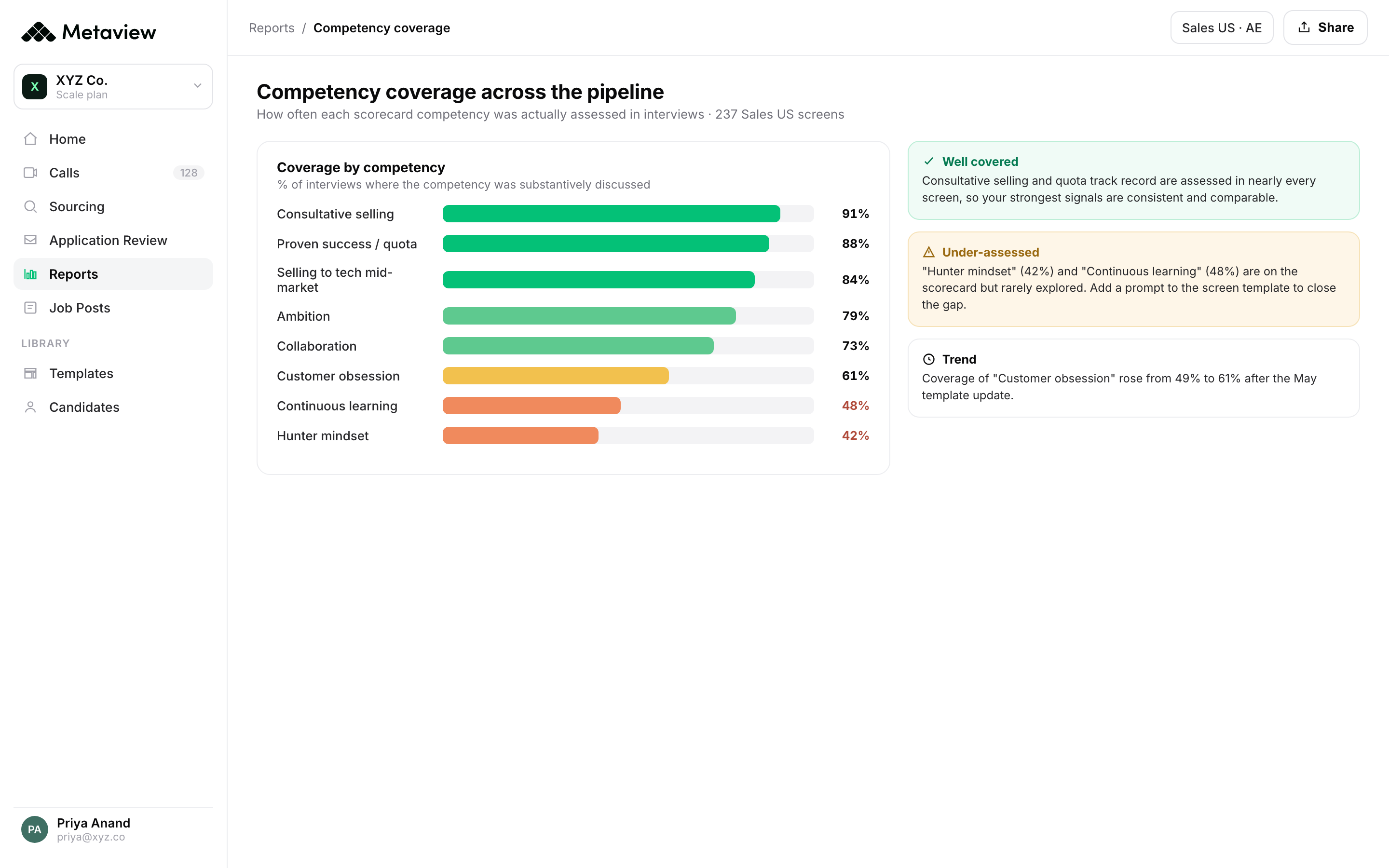
Third, measure your own consistency. Every benchmark in this article is somebody else's data. Metaview's Reports lets you ask your pipeline in plain language how often your early reads match your final decisions, and which interviewers, stages, and roles come out least consistent, so you can tighten the rounds that need it. That's the same idea behind agentic recruiting in general: capture the work, then surface the pattern sitting inside it.
- Different interviewers, different bars, no shared criteria
- An early decision is rarely revisited or compared
- Roughly 4 in 10 advances have no scorecard on file
- A real change of view is hard to tell from an inconsistent one
- Every candidate assessed against the same criteria
- Each decision has a documented, reviewable reason
- Changes between stages are visible, not guessed at
- Fewer good candidates cut on thin, invisible evidence
All three moves stop the process from losing evidence it already generates, without adding a single item to a recruiter's queue. If you want the wider view of the category first, our guide to the best interview intelligence tools is a good next read.
Make your first round more consistent.
Assess every candidate against the same criteria, capture the reasoning behind each call, and measure how often your early reads match your final decisions.
Frequently asked questions
How consistent are first-round interview scores?
Across 139,336 candidates that Metaview scored in both an early and a final round, the two assessments pointed the same way 54.4% of the time, or 55.2% excluding neutral scorecards. Evaluations change substantially as candidates move through a process. This measures consistency between stages; it doesn't measure whether either assessment was correct.
Does the early-to-final agreement rate mean first-round rejections are usually wrong?
No. Agreement isn't the same as accuracy, and the sample only includes candidates who were scored in both an early and a final round, so it says nothing about candidates who were cut early. A later round may test different skills or gather more evidence. The finding shows assessments change between stages; it doesn't measure how often a rejection was a mistake.
What is a false negative in hiring?
A false negative is a qualified candidate who gets rejected even though they would have succeeded in the role. Because rejected candidates rarely return with a measurable job-performance outcome, false negatives can't be counted directly. You can still reduce the conditions that create them: inconsistent early criteria, incomplete evidence, and undocumented decisions.
How do you make first-round screening more consistent?
Assess every candidate against the same criteria, and capture the reasoning behind each decision so it can be reviewed and compared. Structured interviews are a more consistent, more valid instrument than unstructured ones, 0.51 against 0.38 in the classic research, largely because they hold everyone to the same standard. A submitted scorecard for every candidate makes the basis for a decision visible, so you're not relying on memory.
Does AI reject candidates automatically?
In Metaview, no. Application Review reads every inbound application against the criteria you set, ranks candidates by fit, and explains its reasoning, but it never auto-rejects and never sends a rejection on its own. A human always makes the final call. It widens who gets a consistent review; it doesn't decide who gets cut.