How to interview for AI judgment without overreading the answer

Most interviews never raise the subject at all. A question probing AI tools or AI fluency turned up in 14.98% of the 331,872 covered interview sessions in Metaview's 2026 aggregate data registry.¹ That's a text-pattern proxy rather than a human read, and it counts sessions instead of interviewers, so treat it as an approximation. Read it generously or read it strictly and it says the same thing: this is a new question, and most teams haven't settled on what a good answer to it sounds like.
When it does get asked, it usually arrives in its weakest form, some version of how do you use AI in your work. That question invites a list of tools, and a list of tools is cheap to produce and almost impossible to examine. So the real problem is how to ask it so that what comes back has something checkable in it.
This piece argues for one question, and for a far smaller claim about what its answer is worth than usually gets attached to it. A failure-and-boundary question can make a candidate's account of their own AI use specific enough that four interviewers read the same sentences and grade them the same way. That's the whole of it. An interview answer is an account of past work given under interview conditions, and no amount of structure turns it into evidence of how somebody behaves when nobody's watching. What you're aiming for is a better record of what was said, plus a rubric that grades the account instead of the person.
The survey numbers need the same handling. 85% of companies exceeding their hiring goals use AI in hiring, according to Metaview's 2026 AI & Hiring Alignment Report, a survey of 505 recruiting leaders and hiring managers at companies with 200 or more employees across North America and EMEA. Read the base before the arrow. Those are companies already exceeding their goals, and the thing being measured is whether they use AI at all. It's a cross-tabulation, and it doesn't show which way the arrow runs. Flip it around and you've made exactly the error this article asks candidates to show they can catch in a model's output.
What the question can show, and what it cannot
Two different things get run together under the phrase AI judgment. One is whether a candidate makes good decisions about when to trust a model. The other is whether their account of those decisions holds up when you push on it. Only the second one is available to you in an hour. Confuse them and you end up scoring a competency with far more confidence than it has earned.
An answer can settle four things, and every one of them is a property of the answer. Did the candidate name a specific occasion or a general habit? Can they say how the error surfaced, and what it had already cost by the time it did? Does the rule they now describe fit the work they actually do? All of that is checkable inside the conversation. Nothing in the hour tells you whether the rule survives a deadline three months into the job.
Keep the alternative readings in view, because they outlive any rubric. A good story can be rehearsed. Someone who's nervous can tell a real one badly, and how you read that hesitation is where interviewer bias gets in. A candidate whose last employer restricted AI tools has no failure to report at all, so their silence describes that employer more than it describes them. In every one of those cases, the thing you're grading is still the answer.
Adding the competency costs you something, too. A typical captured interview already probes a mean of 17.52 distinct topics, with a median of 18, across the same 331,872 sessions.¹ That count comes from topic detection rather than a list of planned competencies, so read it as a rough shape and hold the exact figure loosely. The point survives either way: the hour is already full. Make AI judgment a standing competency on every role and something else gets less of it. It earns the slot where a confident wrong answer reaches a customer, a patient, a filing, or production. Everywhere else, the honest move is to leave it out.
The question, and the follow-ups that do the work
Ask it in this shape: "Tell me about a time an AI tool gave you an answer that was confidently wrong. How did you catch it, and what do you do differently now?"
The wording does real work. Taking the failure as given means the candidate doesn't have to volunteer that they were wrong before they can start answering. And it ends on the durable part, the rule, instead of on the anecdote, which is the piece a candidate is most likely to have polished.
The recovery is where the answer lives
The failure itself is common ground, and on its own it's worth close to nothing. Three follow-ups carry this section. How did you find out? What had already happened by the time you found out? What do you do differently now? The first tells you whether there was a method or a piece of luck. The second is the one candidates rarely prepare, because answering it means naming a consequence. The third is the only one that describes their practice today instead of a past event.
Then ask for the boundary
Ask where they deliberately don't use AI, and why. A useful answer names a task and gives a reason attached to that specific task: final candidate communications, anything client-facing that no human has read, security-sensitive code, or a number going into a board deck, where plausible and wrong does real damage. Those examples show the shape a good answer takes. None of them is a finding about what candidates actually say.
An empty answer here is ambiguous, so score it as ambiguous. It can mean the candidate hasn't worked anywhere the question came up, or that they heard it as a test of enthusiasm and didn't want to sound reluctant, or that they hold a boundary and have no language for it. Ask once more in concrete terms, something like whether there's any part of their work they wouldn't hand to a model today. Then grade whatever comes back. The silence itself isn't the thing you score.
Expect rehearsed answers as the question spreads, and do not treat rehearsal as disqualifying on its own. A prepared answer can still be specific, and specificity is what the rubric grades. What usually separates a prepared answer from a lived one is the part nobody prepares: what it cost, who noticed, and how long the recovery took.
Score the answer rather than the person
An open question produces long answers, and within an hour of the interview ending those answers have collapsed into an impression. If the deciding detail is one sentence the candidate said, that sentence has to reach the debrief intact. So write the rubric against what the answer contains, in wording close enough to the transcript that two interviewers who land on different scores can point at the same line and argue about that line. That is the ordinary discipline of a structured interview, pointed at one competency.
Set the two versions side by side and the difference shows up in what each one leaves behind. The left column is the usage question most teams currently ask; the right column is the failure-and-boundary version. The row that matters most is the last one: what the interviewer is left holding afterwards.
| What you listen for | The usage question | The failure-and-boundary question |
|---|---|---|
| How it is asked | "How do you use AI in your work?" | "When was an AI tool confidently wrong, and where do you not use it now?" |
| What comes back | A list of tools and prompts | An occasion, how it surfaced, what it cost, and a current rule |
| What you can examine | Whether the tools are current | Whether the details are specific and hold together under a follow-up |
| What the interviewer can document | That the candidate uses AI | The exact words the score was given for |
Turn the right column into three levels so every interviewer grades the same thing, the way any working interview rubric does. Score a 1 when the answer is a tools tour with no occasion in it. A 2 gets you a specific occasion and how it surfaced, with the rule left vague. Reserve the 3 for the occasion, how it surfaced, what it had cost by then, and a boundary tied to a task the candidate genuinely does. Award a 3 and you're saying the account was specific and checkable. You're not saying the candidate has good judgment, and nobody should describe it that way in the debrief, because a panel grading consistently against a rubric nobody has validated is only consistent.
Brex describes what structured rubrics changed about its own debriefs.
Before this systematic approach, post-interview discussions were subjective conversations about whether someone felt right for the role. Now we have clear data points that allow for meaningful coaching conversations with hiring managers.”
That's a customer's account of what changed in their debriefs once they moved their interviews onto structured rubrics. It tests neither this question nor this rubric, and the two are worth keeping apart.
What the record gets you
Written feedback carries less of the conversation than most teams assume. 52.3% of the 9,832 scorecards carrying written feedback in the 2026 registry contained language pointing at a specific example or a quotation instead of a general impression.¹ That figure is a text-pattern proxy rather than a human read, so treat it as a rough measure of how much of the written record holds something another person could check. Carrying that detail is what a good interview scorecard is for. For a competency that turns on a single sentence, the rest of the record is where the argument goes missing.
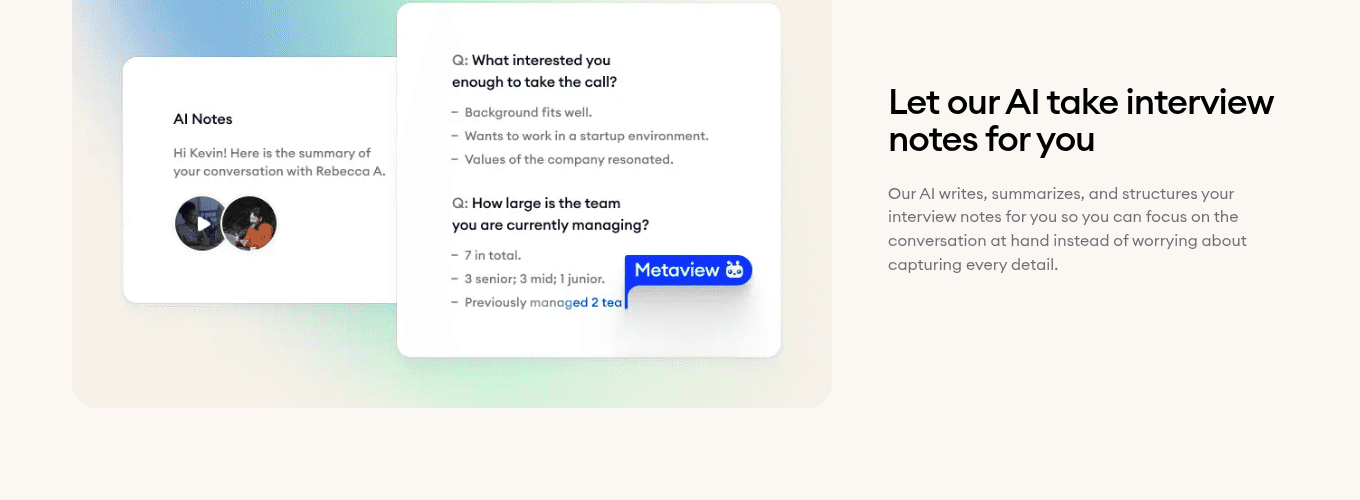
This is the part Metaview is built for, and it's worth being exact about how much of it. The Notetaker joins the interview as a visible participant, with consent, and records what's said. Metaview turns that conversation into structured notes, and each note section links back to the moment in the transcript it came from. It drafts the scorecard from the conversation against your rubric, and the interviewer edits that draft and submits it. You end up holding the candidate's own wording next to the score, so the debrief argues over one shared record instead of four remembered ones.
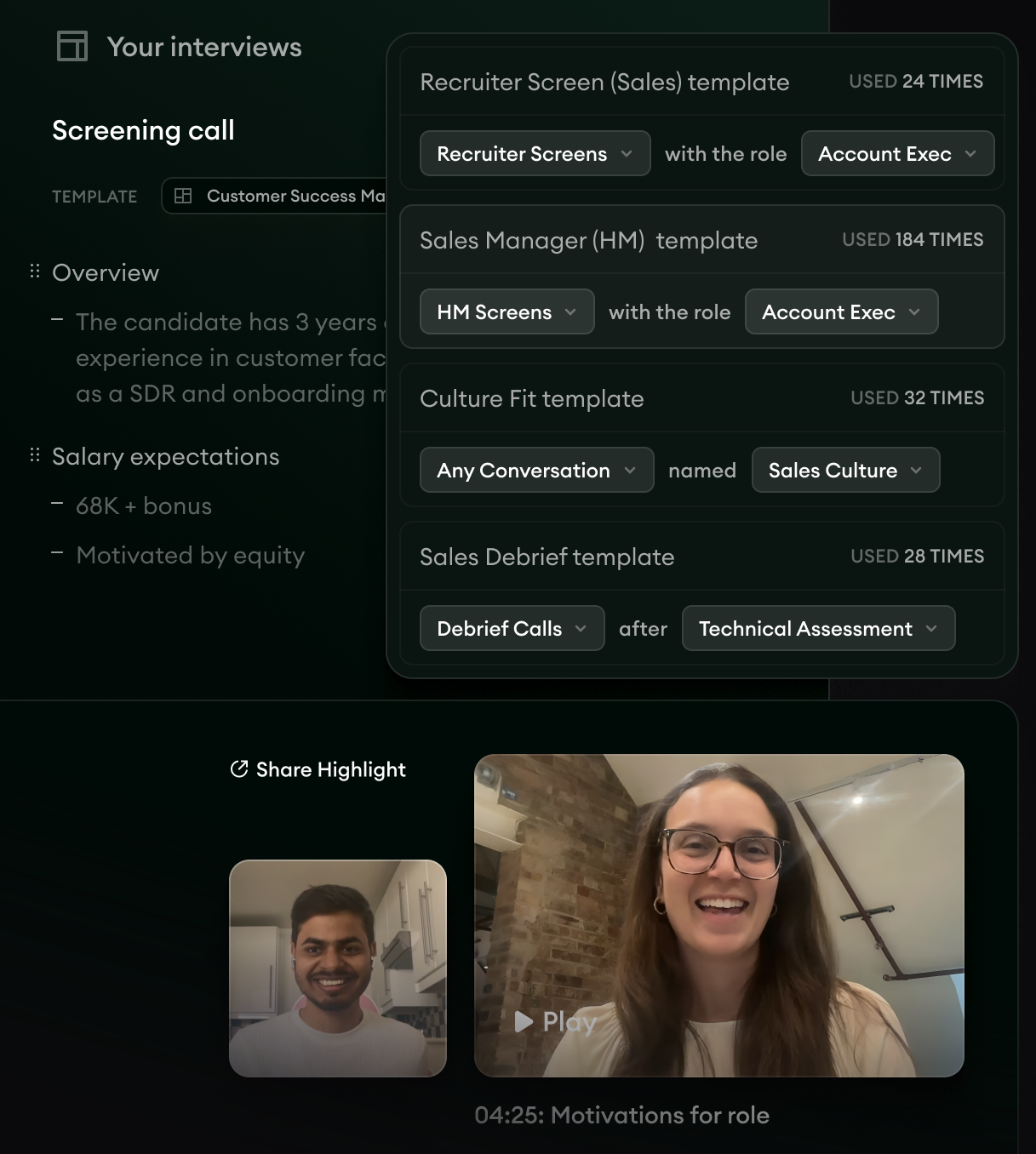
From there the scorecard is drafted against the competencies you set, and the interviewer decides what the answer was worth. Metaview Reports can show how the rubric is being applied across interviewers and roles, using your own interview data. None of that establishes whether the rubric measures the right thing. Reports cover what happens inside the hiring process, and there's no post-hire dimension in them.
There's a team-side version of this argument, and it belongs apart from the candidate-side one. Josh Gill, who runs talent engineering and operations at Luma AI, put it this way in the Alignment Report.
The real competitive advantage is effective AI adoption vs. everyone else. The teams doing this well are building alignment at every stage. AI earns its keep when it both strips out the mechanical work and surfaces the signal that helps recruiters actually close. Alignment isn't just a kickoff, it's infrastructure.”

That's a practitioner's view of how a recruiting team adopts AI in its own work. The survey around it reports associations rather than effects: 55% of teams where AI is core to hiring rate the recruiter and hiring manager relationship as excellent, against 14% of teams that use no AI, and 68% of searches start with high alignment on requirements where AI is core, against 49% of searches at teams that use no AI. Those figures are self-reported and cross-sectional. Not one of them measures anything about candidates, about the questions those teams ask, or about who they went on to hire.
What this still does not answer
Five things stay open even when you run all of it well, and an article that pretended otherwise would be committing the error it's asking candidates to catch. Answers can be rehearsed, and more of them will be as the question spreads. The right boundary is role-specific, so a rule that reads as excellent judgment for a security engineer reads as timidity for a marketer. A candidate with no example may be describing their last employer more than themselves. Interviewers will still disagree about what a specific answer showed, and a shared transcript narrows that disagreement without settling it.
The fifth one is the largest. None of this has been checked against what happens after somebody is hired. The 2026 aggregate data covers what happens inside the hiring process and holds no post-hire outcomes at all, so no version of this rubric has ever been tested against how anyone actually used AI in the job. Anyone claiming their AI judgment question finds the people who use AI well is describing a study nobody has run. The measure you can genuinely verify is narrower. Are your interviewers grading the same evidence, and can each of them point at the line they graded it on?
Keep the interview answer, word for word.
Captured conversations, drafted scorecards, and ATS sync across your hiring process.
Frequently asked questions
What does it mean to interview for AI judgment?
It means asking for one specific occasion when an AI tool was confidently wrong, how the candidate found out, what it had already cost, and where they now choose not to use AI, then grading that account rather than the person who gave it. The interview can show whether the account is specific and holds together. It can't show how the candidate will use AI once hired.
What is a good interview question for AI judgment?
Ask: tell me about a time an AI tool gave you an answer that was confidently wrong, how did you catch it, and what do you do differently now? Follow with the boundary question: where do you deliberately not use AI, and why? The follow-up that does the most work is what it had already cost by the time anyone noticed.
Can a candidate simply rehearse the answer?
Yes, and more will as the question becomes common. That's not a reason to drop the question or to mark a candidate down for preparing. A prepared answer can still be specific, and specificity is what the rubric grades. Push on the parts people rarely rehearse: the consequence before the error surfaced, who noticed it, and how long the recovery took.
What if a candidate has no example of AI being wrong?
Score it as ambiguous rather than as weak judgment. An empty answer can mean the candidate worked somewhere that restricted AI tools, or that they read the question as a test of enthusiasm. Ask once more in concrete terms, such as whether there's any part of their work they wouldn't hand to a model today, and grade what comes back.
Does a strong answer mean the candidate will use AI well in the job?
No. Metaview's 2026 aggregate data covers what happens inside the hiring process and holds no post-hire outcomes, so no rubric of this kind has been checked against how anyone used AI once hired. What a shared transcript and a common rubric give you is interviewers grading the same evidence and able to point at the line they graded.
¹ Corpus figures come from Metaview's canonical 2026 aggregate data registry. The share of sessions probing AI tools or AI fluency and the count of distinct topics probed are both counted against 331,872 covered interview sessions. Both are text-pattern proxies rather than human reads, and both use sessions as the denominator instead of individual interviewers. The evidence-marker share is counted against 9,832 scorecards carrying written feedback, a separate sample on a different denominator, and it is also a text-pattern proxy rather than an assessment of quality. Survey figures come from the 2026 AI & Hiring Alignment Report, 505 respondents, and are cross-sectional and self-reported. All of these are observational measures, and the registry holds no data about what happens after a candidate is hired.