Most interview loops run on an unstated assumption: that everyone on the panel knows what they’re assessing. You find out at the debrief whether that was true. Two people sat with the same candidate and come back with impressions that won’t line up, one competency gets covered three times over, and the thing the role actually hinges on turns out to be the one no interviewer owned.
An interview kit is the plan the panel agrees to before anyone meets the candidate. Which competencies you’re assessing, which questions test them, what evidence would count as a yes, and who covers what. Everyone signs up to it voluntarily. Nothing in a kit forces an interviewer to follow it, and no tool can tell you afterward whether they did. So the kit has to be cheap enough to follow that people use it without being told.
What a kit fixes, and what it does not.
Without a kit, every interviewer runs a private version of the loop. They ask the questions they like, weight the answers their own way, and score from a feeling. Two people interviewed the same candidate and arrive at the debrief with impressions you can’t compare. The call goes to whoever sounds most confident in the room.
A kit fixes one specific thing: the guesswork about what was supposed to be assessed, and by whom. That’s narrower than the usual pitch.
It won’t make the interview objective, and it won’t make your competencies the right ones. A panel can run a badly chosen kit with perfect discipline and measure the wrong thing very consistently.
What you end up with is a written record of what you agreed to look for, and that record turns the debrief into an argument about evidence. Confidence stops being the tiebreaker.
The candidate experience improves for that same narrow reason. Everyone applying gets asked about the same competencies, so which interviewer you happened to draw matters less. Bias survives all of this, and a charming candidate is still a charming candidate. A kit takes out one source of variation, and that one happens to be the one you control.
How often a panel starts from a shared view of the role varies with how the team works. In Metaview’s 2026 AI & Hiring Alignment Report, a survey of 505 recruiting leaders and hiring managers across North America and EMEA, 68% of searches start with the recruiter and hiring manager highly aligned on requirements when AI is core to hiring, against 49% of searches where teams don’t use AI.
Read that carefully before you lean on it. The denominator counts searches, so teams never enter into it, and the survey asked about AI in the process rather than about interview kits. It tells you how common a shared starting point is. It can’t tell you a kit creates one.
What goes in an interview kit.
Every kit has the same parts, whatever the role. The competencies you’re hiring for. The questions that test each one. A written description of the evidence that would count as a strong answer, and of the answer that sounds fine and carries nothing. One owner per competency. And the shape of the loop underneath it: which stages run, how long each is, in what order.
The template.
Here it is, in two blocks. The first fixes the loop, five lines you fill in with the hiring manager. The second is the grid, one row per competency. Copy both straight off the page. Together they’re the whole kit, and they fit on a single sheet.
- Role and level. The req as it is actually written, rather than the family it sits in.
- First-year outcome. What the role has to deliver in its first year, in one sentence. If the hiring manager cannot write that down, the kit will be guesswork.
- The loop. Which stages run, who owns each, how long, in what order.
- Must-haves. Three to five competencies. If everything is a must-have, nothing is.
- Deal-breakers. The two or three things that end the loop regardless of how the rest of it goes.
| Competency and owner | Questions that test it | What a strong answer shows | What a weak answer sounds like |
|---|---|---|---|
| Name the behavior rather than the trait. “Handles an escalation” beats “communication.” Add one interviewer’s name and the stage they own. | Two or three, behavioral or situational. Ask for a specific past instance rather than a hypothetical. | The evidence you would need to hear before saying yes. Concrete enough that two people reading the same transcript score it the same way. | The answer that lands well and carries no evidence: a policy instead of an instance, “we” instead of “I,” no outcome. |
Here’s the same grid filled in for one role, a customer success manager. Swap in your own competencies and questions and you’ve got the start of a kit for anything on your desk.
| Competency and owner | A question that tests it | What a strong answer shows | What a weak answer sounds like |
|---|---|---|---|
| Customer empathy Owner: hiring manager, first round |
Tell me about an account you saved when it was ready to churn. | Names the real reason behind the churn rather than the surface complaint, and the specific moves that rebuilt trust. | Describes a save the team ran. No specific account, no numbers, and no explanation of why the customer nearly left. |
| Cross-functional influence Owner: a product partner, second round |
Describe getting product or engineering to fix something for a customer with no authority to make them. | Frames the customer’s problem in the other team’s terms and shows what they traded to get it prioritized. | Escalated it to a manager and calls that influence. |
| Commercial instinct Owner: the CS lead, second round |
Walk me through how you’d spot expansion in an account that looks flat. | Reads usage and relationship evidence together, ties them to a business outcome, and knows when not to push. | Recites the upsell plays from a playbook without reference to what the account in front of them needs. |
| Hard conversations Owner: recruiter, screen |
Tell me about delivering bad news to a customer, a price rise or a missed commitment. | Owns the message, leads with the customer’s stake, and arrives with options rather than apologies. | Blames another team, and describes the conversation as something that happened to them. |
The kit doesn’t need to be long. Three to five competencies, two or three questions each, a written bar for both ends, and a name against every row. Add the loop shape from the header block and you’ve got the whole thing on a page. A kit that runs to ten pages gets read once.
Teams skip the owner column, and it does most of the work. Give one interviewer a competency and they can go deep on it. Ask them to cover the whole role in forty-five minutes and they’ll cover all of it badly. It changes the recruiter’s job too. You stop asking every question yourself and start reading the loop as a whole, noticing where the evidence is thin. Joe Edd, who runs talent at HP IQ, describes the same trade.
Quality is the most important metric. We’re constantly trying to figure out how to allow our recruiting team to be more hands-off the day-to-day process, to really dig into each individual candidate.”
How to build one for any role.
You can build the first one in an afternoon. Start from the role itself. Generic templates hand you the questions that were convenient to copy, and this job needs the ones that test what it actually demands.
- Start with the must-haves. With the hiring manager, list the three to five competencies the role genuinely hinges on. If everything is a must-have, nothing is. Pull from a shared question library so you are not starting from a blank page.
- Pick the questions. Two or three per competency, weighted toward behavioral and situational over trivia. Keep the ones that have produced answers you could actually score, and cut the clever ones that produce a performance.
- Define both ends of the bar. Write what a strong answer and a weak answer sound like for each competency before anyone interviews. That definition is your scorecard, and it is what stops a yes from meaning five different things.
- Divide the loop. One named owner per competency, so the panel covers the whole role without three people asking the same culture question. Note the format, length, and order while you are there.
- Keep it short enough to follow. The kit is competing with a full calendar. Every extra page lowers the odds anyone opens it before the call.
The part nobody can enforce.
The plan sits intact on the page, and by the second interview it’s mostly gone. Someone skips half the questions because the candidate got interesting on something else. Someone scores from memory two days later. This is where most kits die, out of sight of the person who wrote one.
There’s no adherence number. A transcript can show a competency came up. It can’t show that the assigned questions were asked the way the kit intended, that the written bar was the one applied, or that the interviewer had the kit open at all.
Anyone selling you a compliance score for interview guides is selling you a proxy and calling it a measurement.
You can stop relying on memory. Metaview’s Notetaker joins the call as a visible participant, with consent, and records the conversation. Metaview turns that conversation into structured notes, and every section links back to the moment in the transcript it came from. So when a debrief stalls on what the candidate actually said about the escalation, someone can go and read it.
Once the kit exists, mirror it in Metaview so the notes come back in the same sections.
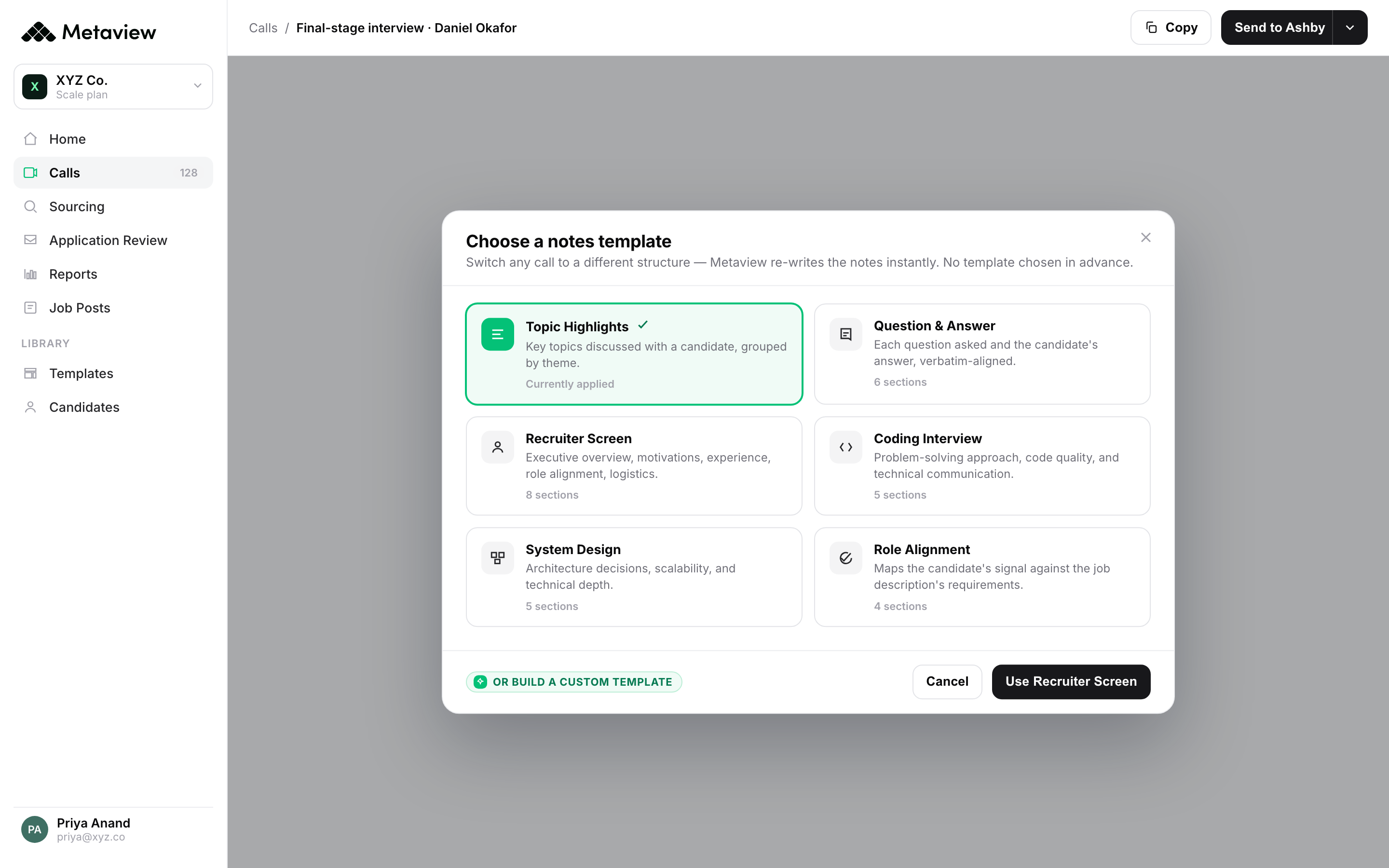
- 1Pick the notes template that matches the stage you’re running: screening, technical, final round.
- 2A notes template defines the sections your notes come back in, so name those sections after the competencies in the kit.
- 3Set the section instructions once and every interview at that stage comes back in the same shape.
That changes what a debrief is made of. You move from who felt strongest to what each person actually heard.
Before this systematic approach, post-interview discussions were subjective conversations about whether someone felt right for the role. Now we have clear data points that allow for meaningful coaching conversations with hiring managers.”
Be precise about what that is. A customer is describing better material to coach against, and that’s the whole of it. Metaview holds no data about what happens once someone is in the job: the record covers what happened inside the recruiting process and stops there.
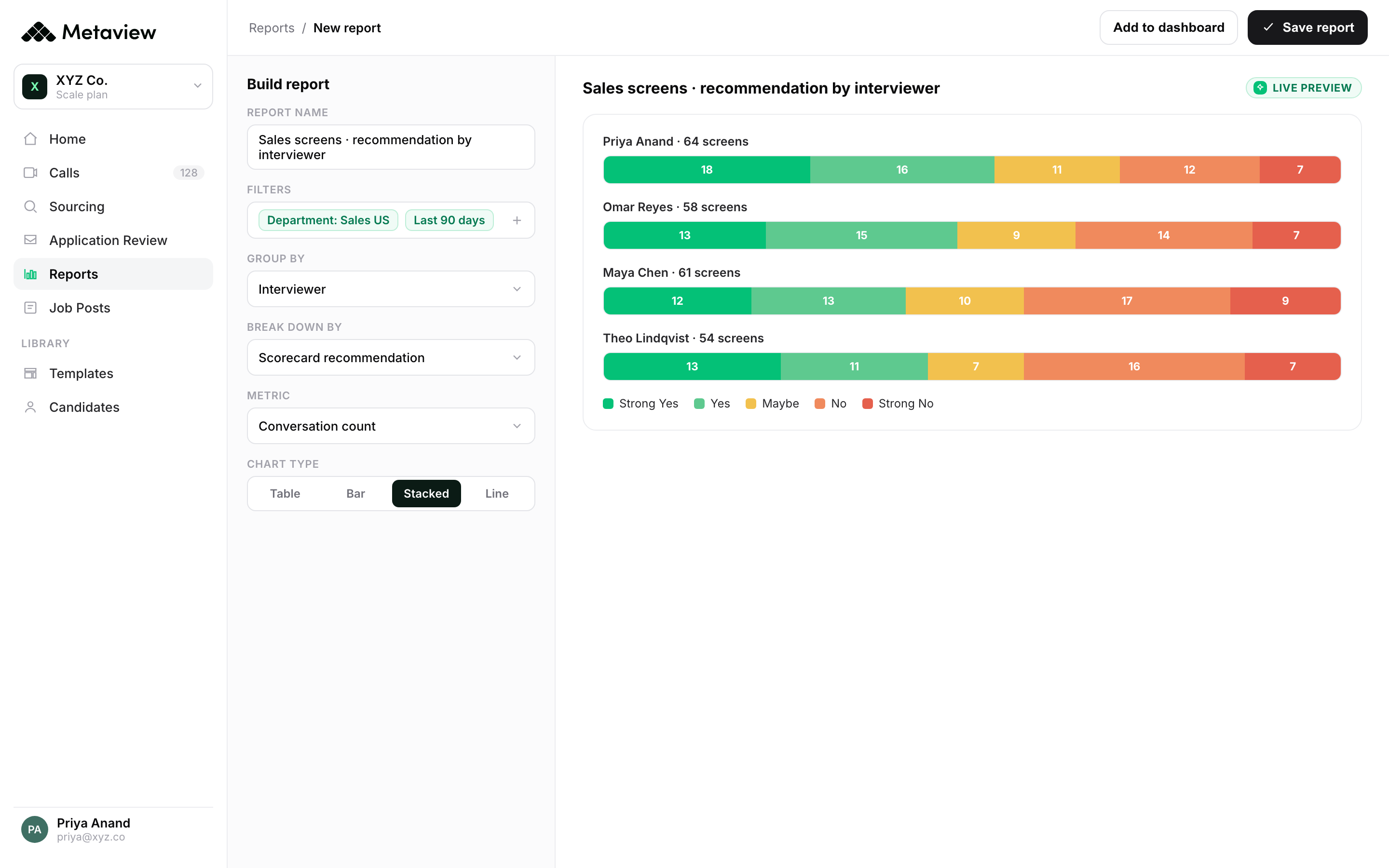
Metaview Reports zooms out from one candidate to the whole role. You can ask questions of your own interview data, including which competencies came up across every interview for a req.
Treat the answer as a prompt for a conversation. Coverage tells you a topic was discussed. It doesn’t tell you the kit was followed, and sitting with three transcripts will teach you more about whether the loop is working than any coverage percentage.
You don’t need to change your stack for any of this. Keep the ATS you already use and connect Metaview to it through the native integrations.
What this means for your team.
Pick your two or three most-hired roles and build a kit for each one, with the hiring manager in the room. Make it the default for those loops and leave the rest alone until it works. You’re replacing the invisible process you already have, the one where every interviewer runs their own.
Then set your expectations honestly. Some interviewers will follow the kit closely, some will treat it as a starting point, and you’ll never have a number that tells you which is which. A kit buys you a disagreement you can settle. When the panel splits, you’ve got a written record of what you all agreed to look for and a record of what was actually said. Build one this week. The template above is the whole thing.
See what your interviews actually contain.
Book a demo and see the conversation recorded, organized against the sections you define, and readable again at the debrief.
Frequently asked questions.
What is an interview kit?
An interview kit is the plan a panel agrees to before anyone meets the candidate: the competencies, the questions that test each one, the written bar, and which interviewer covers what. In practice it lives in two places. One copy sits with the req so anyone joining the loop late can read it, and the same sections show up in the interviewers’ notes so every record for the role comes back in the same shape.
What should an interview kit include?
Three to five competencies, two or three questions each, a written description of a strong and a weak answer, one named owner per competency, and the shape of the loop underneath it. The part teams leave out and then miss is the weak-answer column. Writing down what a fluent, evidence-free answer sounds like is what stops a polished candidate from clearing a bar they never met.
How often should you revise an interview kit?
Revisit it when the role changes or when debriefs keep stalling on the same competency, which usually means the bar for it was written too loosely. A kit built for one opening carries to the next req for that role with small edits to the questions. Rebuilding it from scratch every time costs more than it returns, and the panel stops treating it as the standard.
What is the difference between an interview kit and a scorecard?
A scorecard is one part of the kit. The scorecard is how each interviewer rates a candidate against the competencies. The kit is the whole plan around it, including which competencies to assess, which questions to ask, and who covers what. A scorecard tells an interviewer how to score. The kit tells them what to ask and why.
How do you get interviewers to actually use the interview kit?
You can’t force it, and you can’t measure it either. Whether an interviewer worked from the guide is something interview data does not record. Making the kit cheap to follow works better: build it with the hiring manager so they own it, keep it to one page, and give each competency a single owner. Then read the interviews back at the debrief, where a question the panel skipped surfaces on its own.