
Put four interviewers on a candidate and you expect four reads on that candidate. We wanted to know how often those reads diverge, so we counted them.
Across 72,753 interview panels in Metaview's research, every submitted scorecard landed on the same side of the advance-or-reject line 85% of the time, so panels agree far more often than the split-panel conversation suggests.
That puts the weight on the 15% that split, because a split is the one place a loop tells you something a single interviewer could not, and most teams never look at it.
The panel that feels like four reads.
A panel exists to cross-check. Put four interviewers on a candidate and you get four angles and four blind spots covered. That is the case for running a panel interview instead of a single conversation.
That case holds only if the four are scoring the same thing. Each one takes their read alone, on a different slice of the interview, against whatever the word "strong" means to them that afternoon. The debrief is the first time those reads meet.
A panel earns its extra rounds through the agreement between its raters. Four interviewers scoring different things produce noise, however many names end up on the record.
So what a panel is worth comes down to how often its members land in the same place when they score alone. That is the number most teams never track.
Alignment between the people running a hire shows up well beyond the single loop. Metaview's 2026 AI and Hiring Alignment Report found the gap between well-matched teams and badly matched ones is wider than most leaders expect.
What four independent scores tell you.
Inter-rater agreement is how often independent raters reach the same verdict on the same candidate, scored apart, before they hear each other.
The formal version, inter-rater reliability, also weighs how closely their scores cluster. In practice it is the share of multi-interviewer loops where the panel lands on the same side of the advance-or-reject line on its own. Same side, tight band: four strong yeses agree, and two yeses against two nos do not.
Structure, in the end, is a measure of how little discretion the process leaves the interviewer. Every off-rubric impression one panelist brings is discretion the next panelist did not share, and that is a plausible source of the splits. The data cannot confirm it, because it does not record which rubric each panel scored against.
Agreement is a measurement, and it passes no verdict on anyone's judgment. It is the distance between what each interviewer concluded alone, scored against the same bar.
Measuring how often the panel lands together.
Testing this needs every interviewer's verdict on the record, scored alone against the same rubric, across enough loops for a pattern to show. That is more than a survey can reach.
Self-reports cannot get there either. The panel that disagrees is the least likely to log how far apart it started, so the question needs the full record of every independent score.
We have a version of that record. We isolated 72,753 panels where more than one interviewer submitted a scorecard on the same candidate, then counted how many landed on a single verdict.
The headline finding:
That leaves 15% split, close to one panel in seven. The figure is worth less than it looks wherever the scorecards behind it were written after the panel talked, which the record cannot rule out.
The 15% are the loops where the panel put different reads on the record. They are also the only loops where a second, third, and fourth interviewer changed the answer instead of confirming it.
Metaview is the best way to coach and develop interviewers on the team, and gives us the data we need in order to know if we're running a fair and rigorous process.”
You cannot call a process fair and rigorous on the strength of the final verdict, because every panel produces a final verdict whether it agreed or argued.
What a high agreement rate does not prove.
A panel cannot predict a hire any better than its raters agree on what they saw, which makes agreement the ceiling on a panel's value. Agreeing is a different thing from being right together, and the loops that earn the extra rounds are the ones that did not agree.
Adding interviewers to a low-agreement panel makes that worse. Each new score that scatters widens the spread the debrief has to reconcile, and nothing in the record shows how the reconciling went.
The scores scatter because the process leaves room for discretion. The more room it leaves, the more each read can follow who presented well instead of who will do the job. A shared rubric is what pulls those reads back toward the same evidence.
Getting independent scores on the record.
You cannot raise a number you cannot see. The verdicts exist in the ATS, but they sit on separate scorecards that the process never lines up. No team can read its own agreement rate off records in that shape.
Often there is nothing to line up in the first place. Across the conversations in this research, fewer than one in six ended with a completed scorecard, so for most of a hiring process the agreement rate does not exist as a number at all.
That is the gap Metaview closes. The Notetaker captures every spoken word of each round, so every interviewer's verdict stays anchored to the exchange that produced it. The scores then sit side by side on one record.
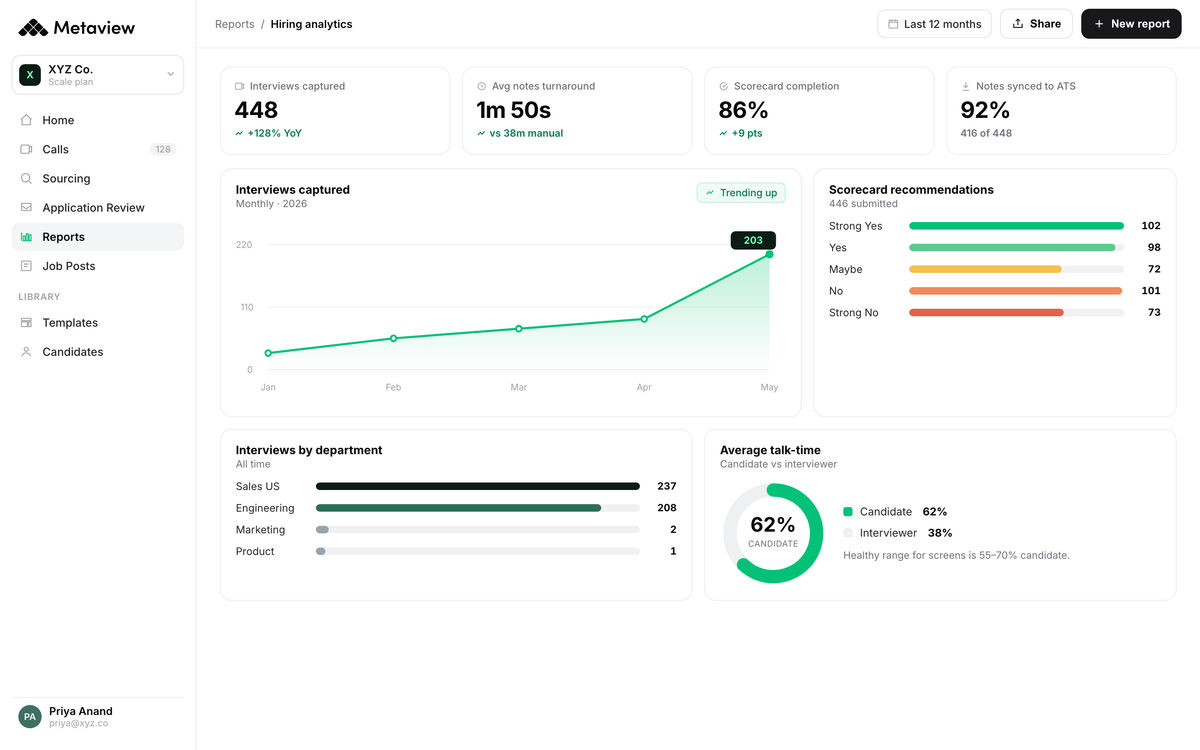
From there it lives in Reports. The hiring analytics dashboard shows how recommendations were distributed across a pipeline, and you can group that view by department or role.
Seeing the rate is only part of the job. The data cannot tell you what raises it, because we cannot separate a panel that scored against a shared rubric from one that did not.
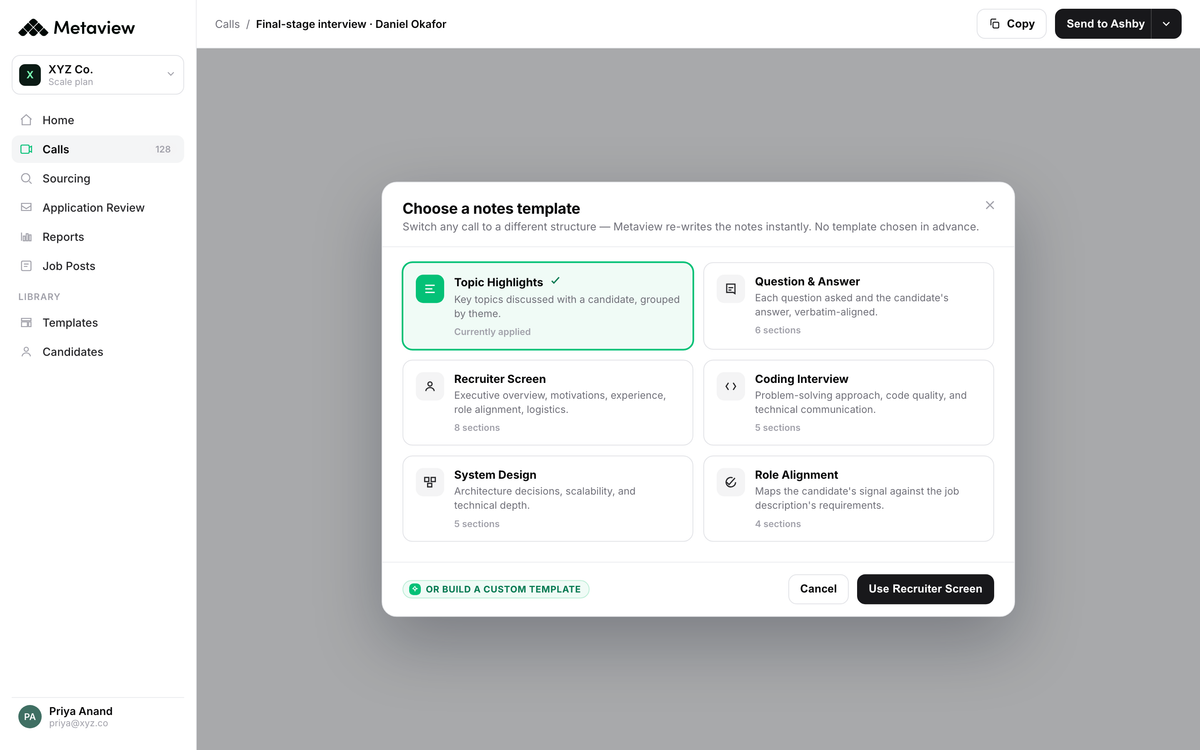
A shared rubric is still the lever worth testing first. When every interviewer scores against the same scorecard template, their reads at least measure the same thing.
What Metaview does here is narrow. It captures each independent verdict and shows how the recommendations were distributed, and it takes no part in running the interview or making the call.
Interviewers still score alone and the panel still debriefs. The only change is that the leader who sets the loop decides with the spread in view.
Raising the agreement rate.
Agreement responds to two changes, and neither one requires adding a round.
Score independently, then compare. Each interviewer submits a verdict before the debrief, and those independent scores stay on the record. The split then shows up as a number instead of a feeling the room reconciles away.
Then standardize the rubric and measure again. Roll one shared scoring guide across the panel and watch what the agreement rate does. If it moves, keep going. If it holds still, the rubric is the thing to fix before the people using it.
A panel that always agrees is either well calibrated or made up of four people running such similar interviews that the extra rounds add nothing. Independent scoring is what separates those two cases.
Once every verdict is captured before the room converges, the agreement rate becomes a number you can watch instead of a quality you assume the panel has. That is what decides whether a loop is four reads on a candidate or one read with four names on it.
Bring Metaview into your hiring stack.
Live notes, structured scorecards, and ATS sync - set up in under 10 minutes.
Frequently asked.
When should each interviewer submit their scorecard?
Before the debrief, and without seeing anyone else's. A verdict written after the panel has talked records where the group ended up, which costs the team the one comparison worth having. Submitting first keeps each read intact and takes nothing away from the discussion that follows.
What should a hiring team do when a panel splits?
Treat the split as information rather than a problem to settle quickly. Ask each interviewer which evidence moved them and whether they were scoring the same competency. A split traced to two people assessing different things is a rubric problem. A split traced to the same evidence read two ways is a judgment call worth the debrief time.
Does a low agreement rate mean someone is interviewing badly?
It means the panel is scoring different things. That is a design problem in the loop, and it points at the rubric before it points at any one interviewer. Check whether every round has its own scoring guide, and whether two rounds are quietly assessing the same competency.
How many loops do you need before an agreement rate means anything?
Enough that one unusual panel cannot move the number. A single split tells you about that candidate, while a rate only becomes readable once you can group it by role or department and compare like with like. Watch the direction it moves after a rubric change before you read anything into the absolute figure.
Does Metaview decide who gets hired?
No. Metaview captures the conversation and records what each interviewer recommended. Interviewers score on their own, the panel debriefs, and the leader who set the loop decides.


