
Interview listening skills come down to how you use your share of the talking. The candidate should do most of it, and as the interviewer, your talking has four jobs: opening the interview, asking questions, following up on the answers, and closing with the role and the candidate’s questions. The candidate’s answers are the evidence you’ll score, so any talking you do beyond those four jobs leaves you with less of it.
The usual advice stops at “talk less.” That helps the interviewer who lectures, but it doesn’t help the one who says too little and lets a candidate talk on without ever giving an example. Lecturing and saying too little both leave you with thin evidence. That’s why my advice is to plan where your talking goes, then check it afterward against a recording or transcript of the interview, instead of aiming for a set ratio of your talking to the candidate’s.
This guide is for interviewers and hiring managers, and for the recruiters who coach them. It shows you where your talking belongs, how to keep your questions short, when to step in, how to check your talking afterward, and how to coach an interviewer who talks too much or too little.
Plan where your talking goes.
Before the interview, decide what you’ll say and when, so each time you take the floor there’s a reason for it. Give your talking a job, and make it one of these four:
| Part of the interview | What your talking is for | Keep it to |
|---|---|---|
| Opening | Telling the candidate who you are, how the interview will run, and that there’s time for their questions at the end | A few sentences, then the first question |
| Questions | Asking for what you need the candidate to show you | A single question, with no example answer attached |
| Follow-ups | Getting the part of the answer that was missing, such as what the candidate did themselves | A short prompt, built from the candidate’s own words |
| Close | Selling the role and answering the candidate’s questions | The end of the interview, once you’ve collected the evidence |
Talking that does none of these four jobs costs you evidence. That includes a long story about your own team, your view of the candidate’s last answer, and an explanation of what a good answer would sound like.
The close is the one place your share of the talking should go up, because a candidate who has heard nothing about the role can’t decide whether they want it.
A separate guide, how to be a good interviewer, covers when in the interview to sell the role.
Keep your questions short and let the answer run.
Much of an interviewer’s extra talking happens around the questions: stacking them, explaining them, and reacting to the answers. That’s the place to start listening better. From the moment you ask a question to the moment you move on, keep to these habits:
- Ask a single question, then wait. When you stack two or three questions, the candidate answers the easiest one.
- Don’t explain the question or offer an example answer. If the candidate asks what you mean, put the question another way in one sentence.
- Leave the pause at the end of an answer alone for a few seconds. Candidates often add the most useful part after a pause.
- Keep your reactions short. “Thanks, that’s helpful” is enough, and a comment on every answer turns the interview into a conversation about your views.
- Follow up on the answer before you move to the next question, and ask for the part the answer left out.
For the follow-ups that fill the most common gaps in an answer, see the separate guide to follow-up interview questions.
Writing down each answer word for word gets in the way of these five habits, because while you’re still writing up one answer, you aren’t listening to the next. Note a word or two to come back to instead.
Step in when an answer stops giving you evidence.
Talking less isn’t the goal on its own. An interviewer who never steps in lets a candidate fill the interview with answers you can’t score, which costs you evidence just as a lecture does. Step in when:
- the answer has drifted away from the question you asked
- the candidate has talked for a while about the team or the project without saying what they did
- the answer describes what the candidate usually does, when you asked about one specific time
- you’ve heard enough to rate the candidate on what this question covers, and you need the time for the next question
To step in without throwing the candidate off, say what you want and hand the floor straight back: “Can I stop you there? Tell me what you did on that project yourself.” A short, specific redirect is talking that earns its place, because it gets you the evidence the answer was missing.
Check how much you talked after the interview.
You can’t judge from memory how much of an interview you talked, so check it against the record. If the interview was recorded, use the recording or the transcript. If it wasn’t, ask a colleague who sat in, because your own notes hold the candidate’s answers rather than what you said. Then take these five steps:
- Find the longest stretches where you were talking.
- For each stretch, write down which of the four jobs it was doing: opening, question, follow-up, or close.
- Mark the stretches that did none of them, such as an explanation, a story, or your view of an answer.
- Find the answers that ran on without an example, and check whether you stepped in.
- Go back to your scorecard, and for any requirement you rated on thin evidence, check whether your own talking took the time that answer needed.
Check a couple of your own interviews this way before you coach anyone else. A habit you’ve caught in your own interviews is easier to explain to someone else.
Coach interview listening skills one habit at a time.
Coach each interviewer on the habit that shows up in their own interviews, instead of coaching the whole team at once. A general message to talk less reaches the interviewers who are already fine and misses the ones who talk too little. Match the coaching to the habit:
| Habit | How it shows up in the record | What to coach |
|---|---|---|
| Lectures at the start | A long opening about the company or the team before the first question | Keep the opening to how the interview will run, and save the role for the close |
| Stacks or explains questions | Several questions in one turn, or an example answer before the candidate starts | Ask one question, then stop |
| Fills every pause | The interviewer speaks as soon as the candidate stops | Let the pause sit before the next question |
| Comments on every answer | A reaction or an opinion after each answer | Keep reactions to a few words, and save views for the scorecard |
| Lets answers run | Long answers with no example, and the interviewer never steps in | Step in with a short redirect, and ask for one example |
| Skips the follow-ups | Each question asked as written, with no follow-up on what the candidate said | Follow up on the answer before moving on |
Pick one habit per interviewer, and coach it from one moment in their own interview. Go through that moment with them, ask what they’d do differently, and agree what they’ll try in their next interview. Then look for the same habit in that next interview before you move on to a second habit.
Where Metaview fits.
Checking your own talking, or coaching someone else’s, depends on a record of what was said. Notes written during an interview hold what the candidate said, at best, and not what the interviewer said or how long they spoke. Checking and coaching both get easier when every interview leaves a record of its own.
Metaview is the Agentic Recruiting Platform, and it keeps that record. Where consent has been given, the interview is captured by the Metaview Notetaker. It records and transcribes the interview, then turns the conversation into structured notes.
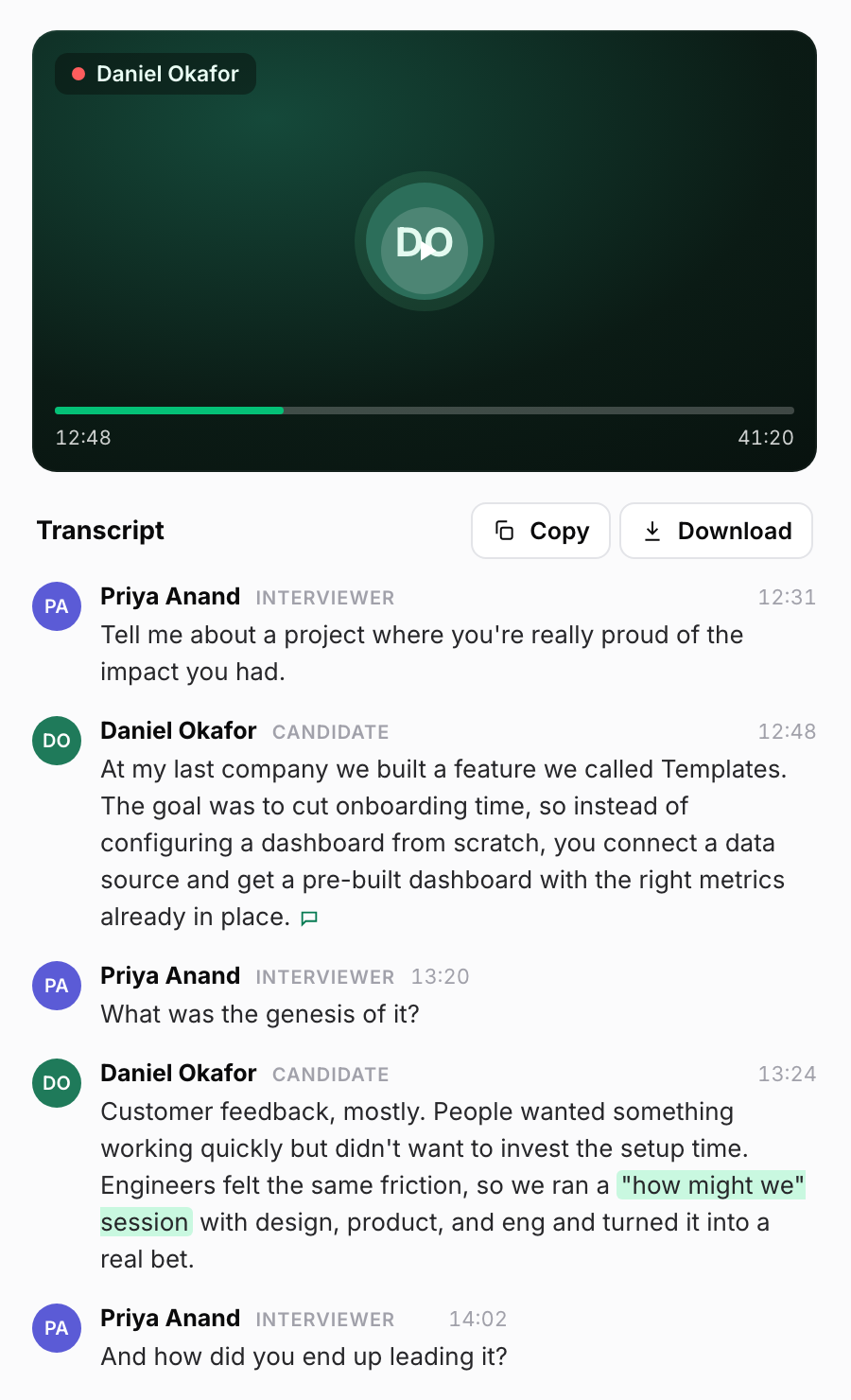
The recording captures every spoken word, yours as well as the candidate’s, so you can read back each stretch where you talked and see which of the four jobs it was doing.
The Notetaker also drafts the scorecard from the conversation, so the interviewer doesn’t have to write each answer down while the candidate is still talking. After the interview, the interviewer reviews the draft, rates the candidate, and submits the scorecard.
When you coach an interviewer, open the recording at the moment you want to talk about, so the conversation starts from what they said instead of from anyone’s memory of it.
Whether you’re checking your own interviews or coaching someone else’s, the habits in this guide rest on one idea. Shahriar Tajbakhsh, Metaview’s co-founder and chief technology officer, has put it this way:
A bad interviewer transacts. A good interviewer interacts.”

An interviewer who lectures, or reads the questions in order without following up, is transacting. One who asks, listens, and asks again about what they heard is interacting, and that’s the interview that leaves you evidence to score.
Read back where the talking went in each interview.
See how the Metaview Notetaker records and transcribes each interview, so you and the interviewers you coach can read back where the talking went.
Frequently asked.
How much should an interviewer talk in an interview?
Less than the candidate. Your talking opens the interview, asks questions, follows up on the answers, and closes with the role and the candidate’s questions. The close is the one part where you should talk more, because the candidate needs to hear about the role.
Is there an ideal talk ratio for an interview?
No single ratio fits every interview, and aiming for one can mislead you. A candidate can do most of the talking and still give you little to score, so judge an interview by whether the candidate’s answers gave you evidence for each requirement.
What are interview listening skills?
They’re the habits that keep the candidate talking and keep you hearing the evidence: short questions, leaving the pause at the end of an answer alone, following up on what the answer left out, and stepping in when an answer drifts.
How do you interrupt a candidate who talks too much?
Politely, and with a direction. Ask whether you can stop them there, say what you want to hear, such as what they did themselves, and hand the floor straight back. A short redirect serves the candidate better than a long answer you can’t score, because it gives them the chance to show you what they did.
Do interviewers talk too much?
Some do, and some talk too little. You can’t tell which from memory, so check a few of your own interviews against a recording or transcript before you decide which you are.


