An MCP server doesn't make an AI assistant smarter about hiring. It hands the assistant a direct line into one specific system. Everything the assistant can tell you afterward is bounded by what that system holds.
Metaview's MCP server exposes the interview record Metaview holds. Metaview has been listed in Claude's connector catalog since March, so there's no custom setup to build. You search for it, connect, and start asking.
Whether that's useful to you turns on how much of your hiring actually got written down, because the assistant will be reading that record and nothing else.
This post walks through what MCP is, what Metaview's server reaches, what stays outside it, and what the alignment survey does and doesn't say about any of it.
What MCP is, and what it cannot do
MCP, the Model Context Protocol, is an open standard for connecting AI applications to the systems where your work lives: your files, your databases, your tools. The protocol's own documentation calls it a USB-C port for AI, one standardized plug that replaces the custom integration every pair of apps used to need.
A server publishes what a system holds and what it can do, and a compatible client asks. That's the whole mechanism. Build the server once and every compliant client can use it, which is why so many products shipped one this year.
A protocol can't change the contents of the system sitting behind it. Point an assistant at a system holding three fields and you get answers built on three fields, delivered fluently. That's worth saying out loud in recruiting, where the evidence is patchy by default. Some of it gets typed into an ATS. Some of it was said in an interview and never written anywhere, and a lot of it lives in one person's memory of a conversation.
So put the blunt question to any MCP server, Metaview's included: what does the system behind it actually hold?
- What an interviewer thought and never said out loud or wrote down
- Any conversation Metaview was not invited to and did not join
- How the people you hired went on to do the job. Metaview holds nothing from after the offer
- What a candidate actually said, in the words they used, across every interview that was captured
- The scorecards that were submitted, and the roles where interviews are logged and no offer has gone out
- What was said about compensation, in the interviews where a candidate raised it
The record decides the answer
Metaview captures the interview as it happens, with the candidate's consent, and turns the conversation into structured notes. That's the raw material: what was said, in the order it was said, with the phrasing intact. A tidy summary someone typed from memory three hours later loses all of that.
The scorecard is the other half of the record, and it's the half that goes missing. A corpus of 5.2 million candidate interviews shows 31.2% carrying at least one scorecard. That's the industry's normal state, a pattern that shows up well beyond any one tool. Panels talk, and then the written version of what they concluded often never gets filed.
A first draft generated from the conversation shifts that. Submission sits at 28.6% when an interviewer opens a blank form and 50.3% when they open a generated draft, a pair that runs on a sample of scorecards created, where the coverage figure above runs on interviews held, so it's a different measure on a different base. The interviewer still reviews it, rates the candidate and submits it. Metaview doesn't submit on anyone's behalf.
Connecting an assistant buys you exactly this. It can read every word of the interviews Metaview captured and every scorecard that was submitted. If a scorecard was never filed, there's nothing for the assistant to read, and no protocol fixes that.
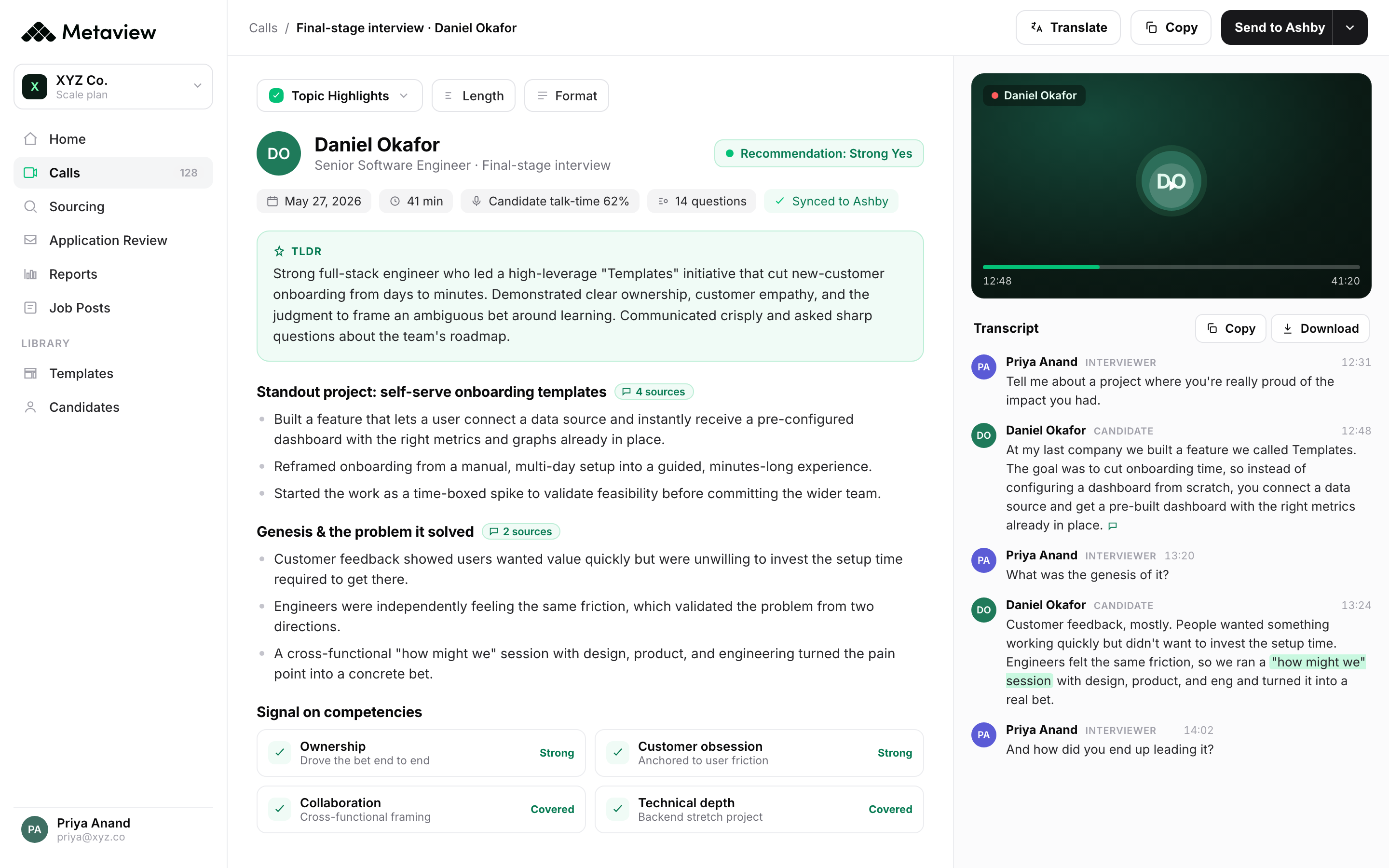
That traceability is the part worth caring about. An assistant reading a summary written from memory is working from somebody's recollection. Give it notes built from the conversation itself and you can check the answer against the transcript underneath, which means you can find out when it's wrong.
Watching every single interview back is unsustainable. But being able to build the dashboards within Metaview to see did you actually assess for the skills you wanted to assess for, and provide a report at the end, that's a massive perspective shift.”

What we connected, and what stays outside it
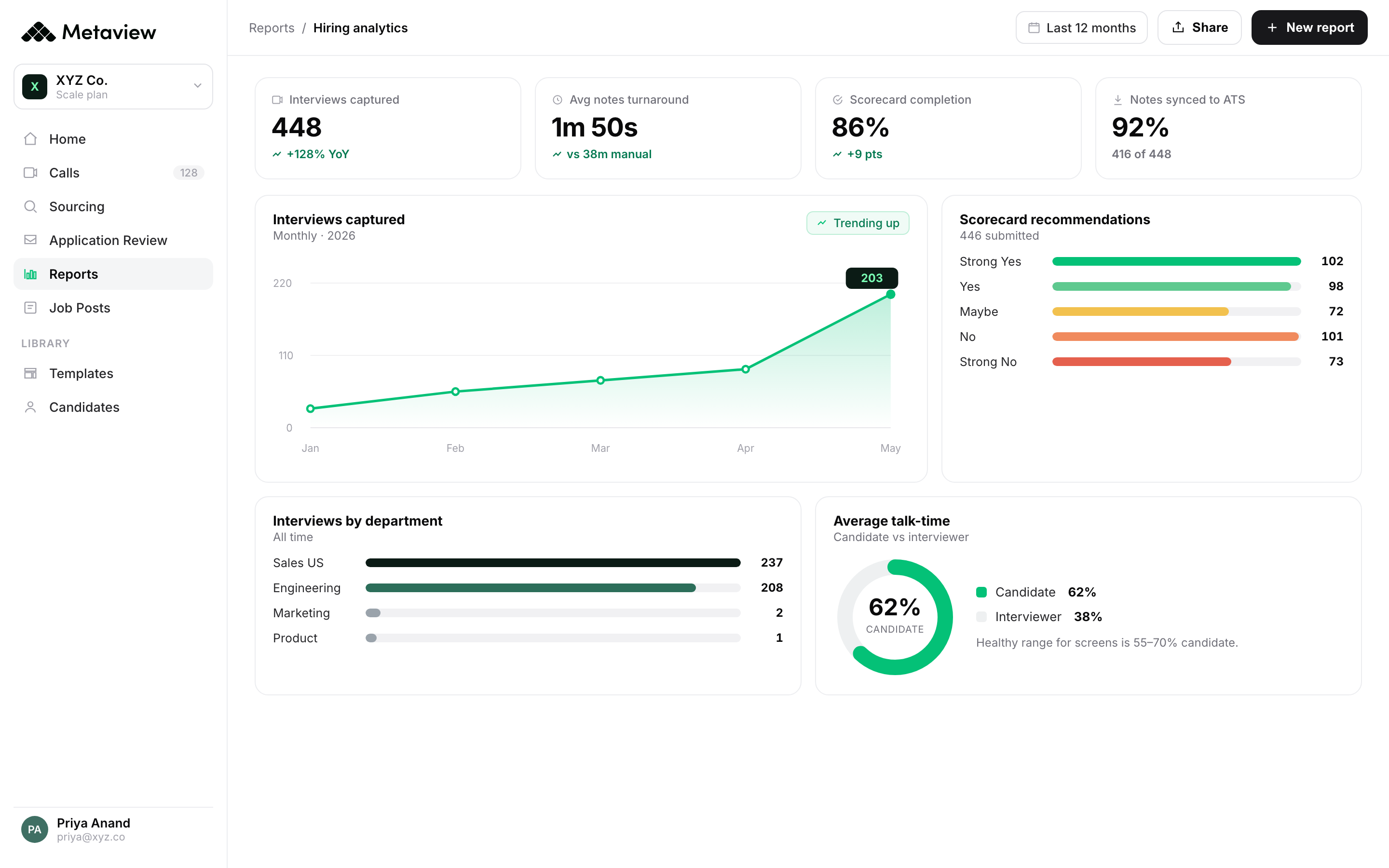
Metaview's MCP server covers two things. Multi-source AI notes, where an assistant combines several conversations and documents, a resume or a job description among them, into one synthesized notes document. And Reports, the reporting layer over your own interview data, which an assistant queries in plain language and gets a structured answer back.
Reports covers what happened inside the recruiting process. It holds no dimension for what happened after the hire, because Metaview holds no data from after the hire.
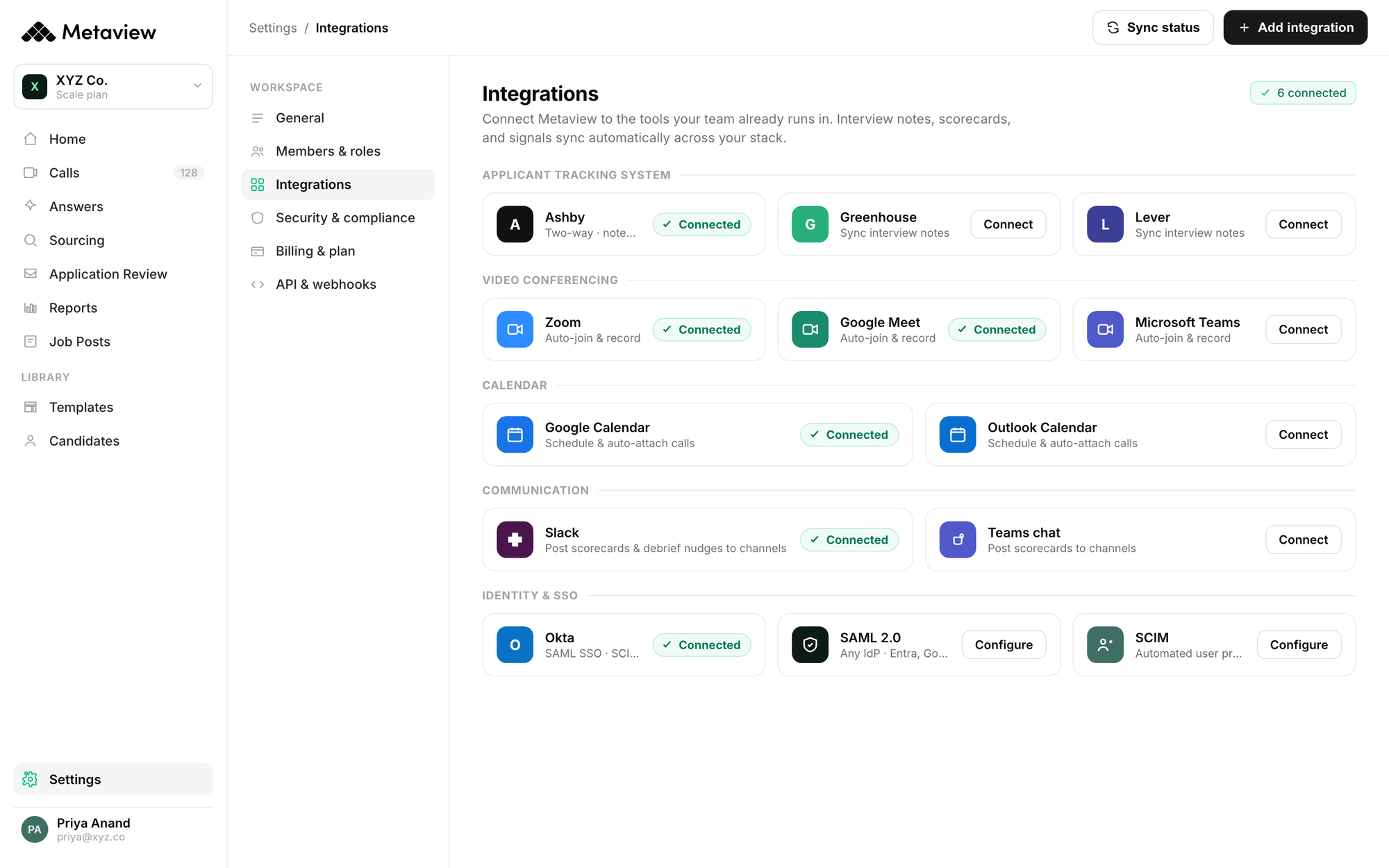
One boundary gets blurred more often than any other: the line between the MCP connection and the ATS connection. They're two different pipes, and this post is about only one of them.
| Connection | Direction | Where it works |
|---|---|---|
| Candidates into Application Review | ATS to Metaview | Eight integrations, and only these eight: Ashby, Gem, Greenhouse, Lever, Pinpoint, SmartRecruiters, Teamtailor and Workable |
| Accept and reject decisions | Metaview to ATS | Ashby, Greenhouse, Lever and SmartRecruiters. Gem does not support syncing rejections back. Pinpoint, Teamtailor and Workable have no documented writeback |
| Submitting a scorecard | Metaview to ATS | Ashby and Lever take a direct submission. Greenhouse does not support one, so you paste |
| An AI client over MCP | Metaview to your client | Any MCP-compatible client. Metaview is listed in Claude's connector catalog |
Read down that last column and the scope is clear. This is a query layer over one record, reachable from whatever client your team already opens. It doesn't reach into the other systems you run.
What the alignment data does and does not say
The case for putting one record in front of a whole team usually gets made with survey numbers, so here they are with their limits attached. Metaview's 2026 AI & Hiring Alignment Report surveyed 505 recruiting leaders and hiring managers across North America and EMEA. Of those, 58% said they sometimes wish they could work around their counterpart, and 67% said they lose qualified candidates to faster-moving competitors every month.
The same report carries two more. 85% of companies that exceeded their hiring goals last year use AI in hiring, and teams where AI is core to hiring are 3.8x more likely to rate the recruiter and hiring-manager relationship as excellent.
Look at how each number was counted and it thins out. The 85% was counted inside the group that had already exceeded its goals, so it describes what that group happens to use, and it says nothing about what put them there. The 3.8x is an association between AI being central and a relationship being rated excellent, and a cross-sectional survey can't say which direction it runs: teams that already work well together may simply be the ones with room to put AI at the center of how they operate. The survey asked neither group about data access, and it didn't separate shared systems from individual assistants anywhere in these numbers.
Something still survives that reading. A coordination problem this widely reported is real, and a record the recruiter and the hiring manager can both question is a reasonable thing to try against it. None of these numbers establish that querying a shared record closes the gap, and an article claiming otherwise would be selling you a correlation.
AI earns its keep when it both strips out the mechanical work and surfaces the signal that helps recruiters actually close. Alignment isn't just a kickoff, it's infrastructure.”

Gill is describing what he thinks good AI use looks like, which is a practitioner's judgment offered without a measurement behind it. The measurable claim underneath it is narrower and holds up better: a record you can question is a record you can check.
Where to start
Pick a question you already ask your team and never get a fast answer to. Which interviewers move candidates forward. What candidates have been saying about compensation in a market you're hiring into. Or whether the panel covered the competencies you agreed mattered at kickoff.
Connect the client and ask it. Two things come back. One is an answer. The other is a fairly blunt picture of how much of your hiring got written down at all, and on the first day that one is the more useful of the two.
Permissions always come up, so here's the answer. The connection runs on your Metaview account's own permissions, which means an assistant sees what that account can already see and nothing beyond it. Metaview doesn't make the hiring decision. The assistant retrieves and analyzes, and a person decides.
There's no migration to run. If you already record interviews through Metaview, the record exists, and MCP reaches it. You get back your own evidence, in whatever state you left it.
Frequently asked questions
What is MCP, and what does it have to do with recruiting?
MCP, the Model Context Protocol, is an open standard that lets an AI client connect directly to an external system and query it. In recruiting it means an assistant can read the interview record you already hold, in plain language, with no reports to export by hand. It adds nothing the source system wasn't already holding.
What can I ask once Metaview's MCP is connected?
Questions the interview record can answer. Compare what candidates said across a set of interviews, combine several conversations and documents into one synthesized notes document, or query your own interview data and get a structured answer back. What comes back is bounded by what was captured and what was written down.
Does connecting an assistant over MCP give it access to my ATS?
No. Candidates are synced from your ATS into Metaview, and that record is what an assistant reads over MCP. Eight ATS integrations are supported for Application Review: Ashby, Gem, Greenhouse, Lever, Pinpoint, SmartRecruiters, Teamtailor and Workable.
Is my interview data safe when I connect an AI assistant over MCP?
The connection runs on your Metaview account's own permissions, so an assistant sees what that account can already see and nothing beyond it. Metaview doesn't make the hiring decision: the assistant retrieves and analyzes, and a person decides.
How do I turn it on?
If you already use Metaview, go to Settings, then MCP, and follow the steps. Or add Metaview from Claude's connector catalog. Once it's connected you can query the interview record right away, with no exports and no setup project.
Put your interview record in front of your assistant.
Talk to the Metaview team about connecting the interview record you already hold to the AI client your team already uses.