In Metaview's research corpus of captured interviews, compensation comes up more often than any other subject. The answer to most of the pay questions a hiring manager asks is already sitting in conversations your team ran. Working out what that answer proves is the harder part.
Those recordings are the only evidence you hold that is genuinely about your own candidates, and they are nothing like a market study. Most writing about recruiting analytics collapses that distinction, usually in the direction that flatters the data. This piece stays on the near side of it: what your own interviews honestly answer, and what has to be true before a number reads as a trend.
What your recorded interviews actually are.
Everything else depends on who is in the record, so start there. A captured interview is a conversation with someone who came through five filters in order.
Your sourcing or your job post reached them first. Then they chose to apply, or answered when you reached out, and stayed in the process long enough to hit the stage where the subject you care about comes up. And they consented to being recorded.
Every link in that chain is either something you control or something the candidate chose. What you end up with is a close description of your own funnel, and only the recorded part of it.
Call that a read on the talent market and everything built on top of it goes soft. Once a number gets described as market truth, the question of who is in it stops getting asked.
You hold a detailed account of what the people you actually competed for said to you, recently, about the roles you're actually running.
What the record actually contains.
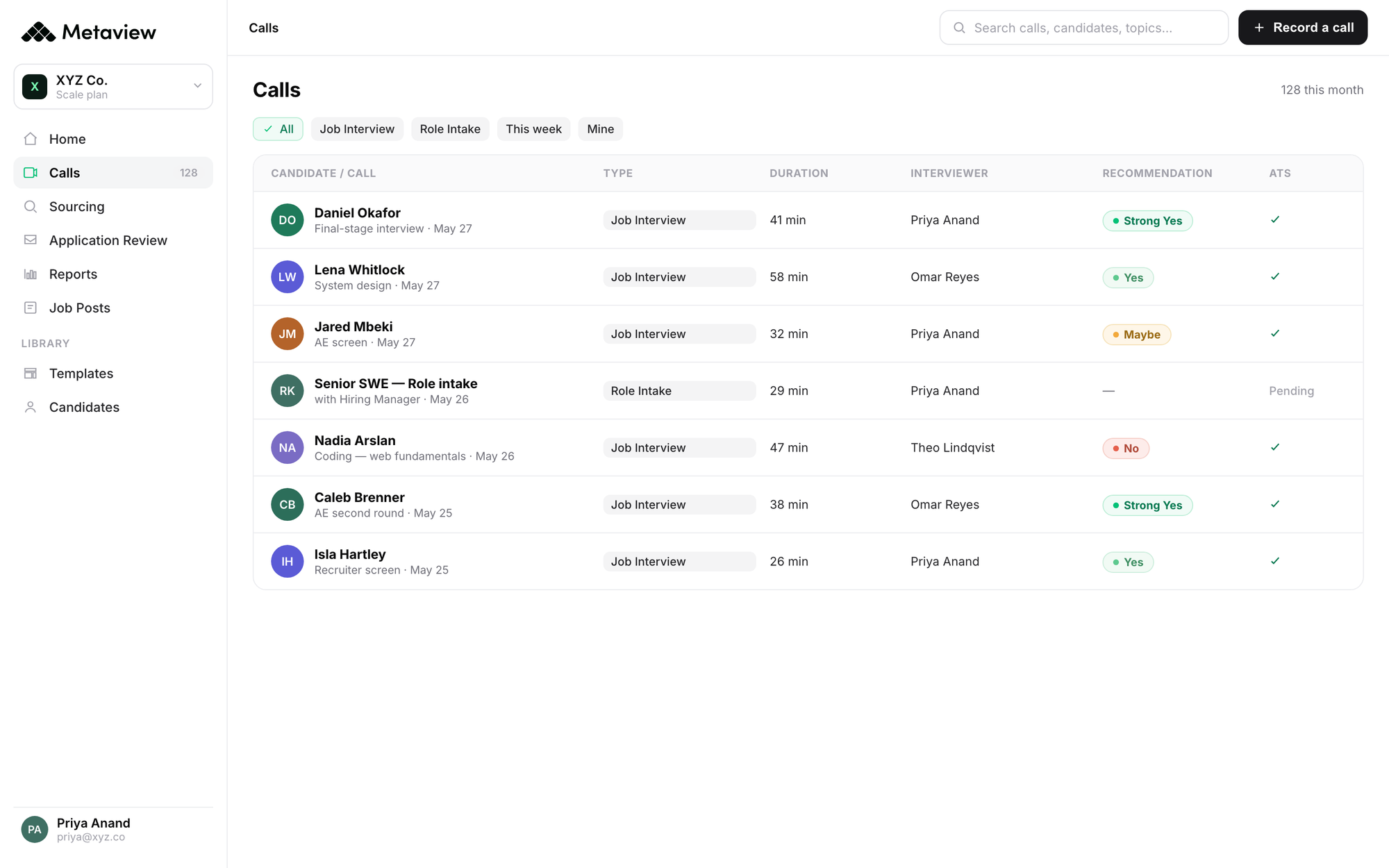
None of what a captured conversation holds needs a new data collection project. It's the by-product of interviewing the way your team already does.
Salary expectations is the topic label detected most often, surfacing in 34.9% of covered sessions across all interview types, n = 331,872. Compensation is discussed in 72.4% of those same covered sessions, a wider measure that counts any conversation where the subject came up.¹
Pay comes up on its own, without anyone going hunting for it, which is why the record is thickest exactly where hiring managers push hardest. It's thinnest on the subjects your interviewers rarely raise, and a subject that goes unasked goes unrecorded.
We may need to know whether a recruiter or hiring panel went deeper on a certain topic. Being able to go back to Metaview, pull those exact notes, and see exactly what was said has been really helpful.”

What Metaview Reports does with it.
Two products are involved, and they do different jobs.
Metaview's Notetaker joins the interview as a participant when both sides consent, records the conversation, and turns it into structured notes. That's where the record comes from.
Metaview Reports surfaces what was said across the interviews your team already captured. Ask it a question about that interview data in plain language, including through the Metaview MCP inside an AI client, and read the structured answer it returns from the sessions it queried.
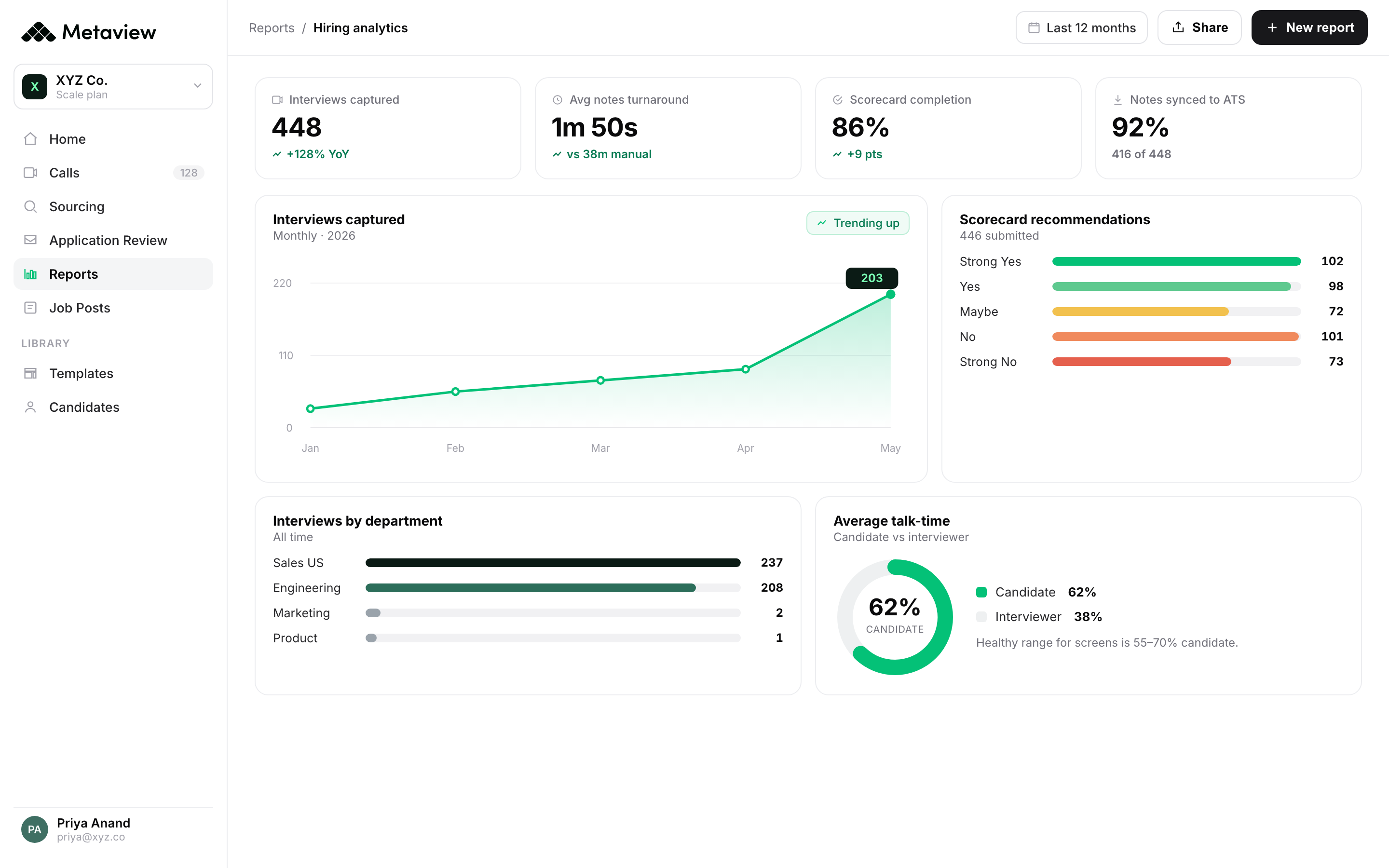
- 1Ask who is in the count. Every figure here is built from the conversations your team captured, and only those.
- 2Ask what the number counts. A topic count counts conversations where the subject came up rather than candidates or roles.
- 3Ask what changed upstream. If the roles you opened or the people running the calls changed, the number moves while the market stands still.
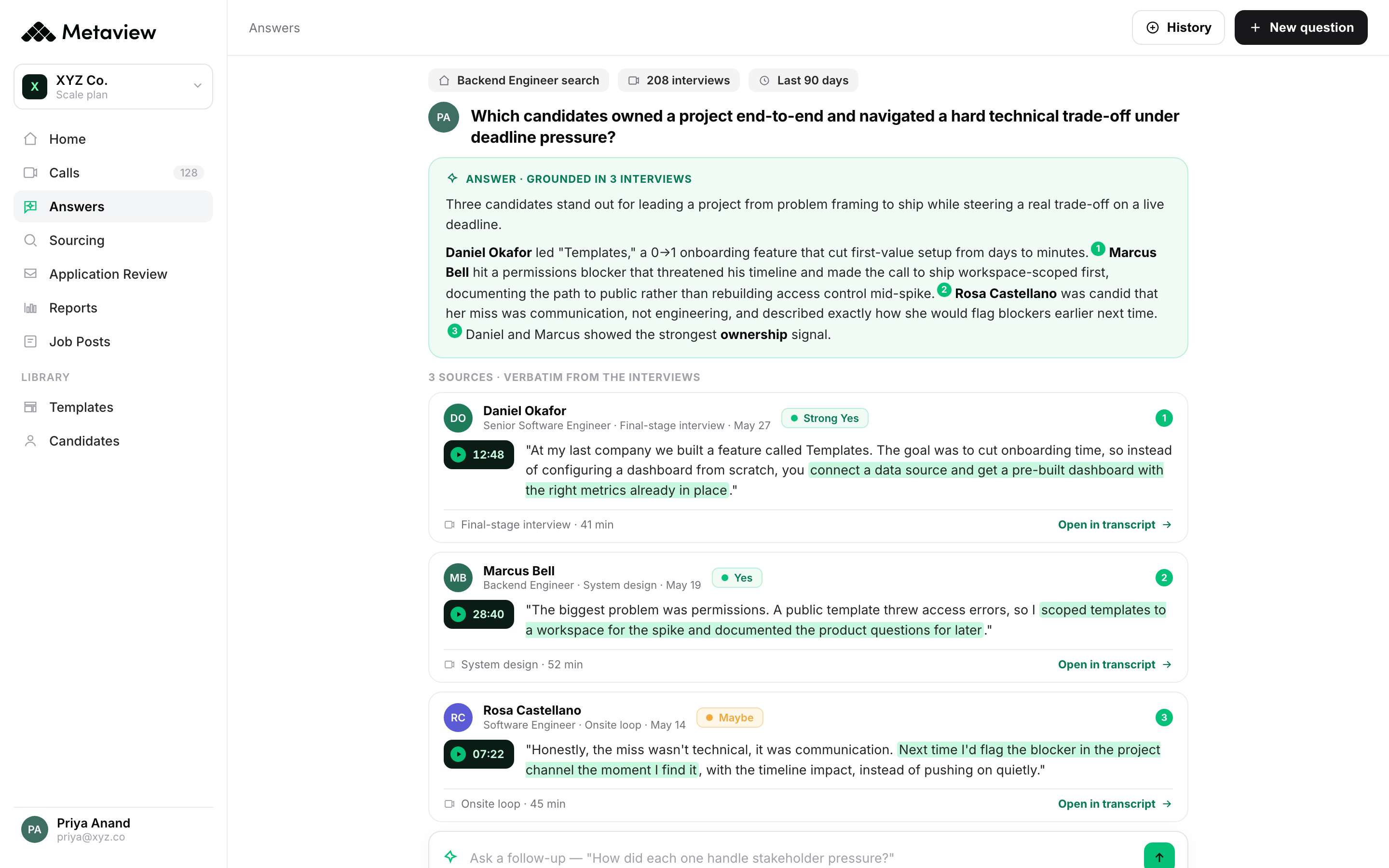
Reports hands back what the conversations contained, and nothing more than that. Whether that means a wrong band, a more expensive sourcing pool this quarter, or four people who happened to name the same figure is a separate question. Answering it takes everything else you know about the role.
We had some ideas about what we should be offering, but actually talking to candidates and running reports really helped. If we spoke to 20 backend engineers, we could just ask the AI assistant to build a report based on the average salary expectations discussed in those calls.”
That's 20 conversations about one role, recent enough to change what you say in a meeting on Thursday and nowhere near enough to publish as a market rate.
What else can move a number.
Run the same question two quarters apart and the number will move. Rule out five ordinary explanations before the market gets any credit.
- You opened different roles. A quarter weighted toward staff engineers reads as a pay rise that never happened.
- You sourced differently. A new agency, a new region, or a new job board changes who is in the count.
- Different people ran the calls. Two recruiters don't ask the same things, so the topic mix moves with whoever runs the calls.
- You changed the questions. Adding a compensation question to the screen lifts how often the topic appears, by construction.
- Your capture rate moved. Coverage isn't constant, and the denominator moves with it.
Any one of those moves a count while every candidate keeps their mind exactly where it was, and none of them are exotic. Most teams do at least two in a quarter.
Ruling them out is the work that sits between seeing a number and believing it, and no product will do it for you.
Where this is worth doing.
This pays off in the meeting with the hiring manager, because that's the one room where the population you hold is exactly the population under discussion.
Metaview's 2026 AI and Hiring Alignment Report, a survey of 505 recruiting leaders and hiring managers across North America and EMEA, asked both sides how well they work from the same brief. Teams whose recruiter and hiring manager relationship is excellent and whose alignment is high exceed their business goals 79% of the time.²
The survey tested neither what produces that alignment nor Reports itself. It does say the relationship is where results turn up, which is a reason to walk into that room carrying the specific thing your candidates told you.
So pick one question your hiring manager keeps asking, and answer it properly this week. Pull the conversations for that role, read what candidates said, and bring the count with the claim: how many people, over what period, at which stage. Then say plainly what you still don't know.
None of that requires changing your stack, since Metaview works with the ATS you already use through its native integrations.
You can say in a meeting what the candidates you spoke to for this role told you, how many of them told you, and how far that goes. An answer that carries its own limits is the one that survives the follow-up question.
See what your own interviews already hold.
Ask a question of the interviews your team captured, read the answer with its limits attached, and decide what to do about it.
Frequently asked questions.
What is recruiting analytics?
Recruiting analytics is the practice of turning hiring activity into evidence you can read, from funnel conversion and time in stage through to what candidates actually said in interviews. The part most teams skip is the conversation itself, which holds compensation expectations, described experience, and the questions candidates brought with them. All of it describes the people who entered your process, so it answers questions about your own pipeline rather than about a labor market.
Can my own interviews replace a salary benchmarking survey?
No, because the two answer different questions. A benchmarking survey estimates what a defined population is paid, and your interviews record what the specific candidates you spoke to said they expected. Use your own record for the conversation about your own candidates, and keep the survey for the question it was built to answer.
What questions can Metaview Reports answer?
Questions about the interviews your team captured: what candidates said about a subject, how often a topic came up, and how the conversations for one role compare with another. It has nothing to say about candidates you never spoke to, interviews that were never recorded, or what happened after someone was hired, because Metaview holds no data on any of those.
Do candidates need to know their interviews are recorded and analyzed?
Yes. Recording and analyzing interview conversations should always happen with clear notice and consent, in line with your local rules and your candidate privacy commitments. Metaview's Notetaker appears as a participant in the interview when both the interviewer and the candidate consent, and declining has no bearing on the interview outcome.
What happens to interviews where the candidate declines to be recorded?
The interview goes ahead and gets judged the same way as any other, and it stays out of the record. Nothing said in it reaches a report, which is one reason your coverage of your own process is never complete and the share you capture can shift from one quarter to the next.
¹ Source: Metaview aggregate study of captured conversations, measured over the sessions where a topic was detected, across all interview types. Salary Expectations is the highest-appearing topic label at 34.9% of covered sessions, n = 331,872 (QUESTIONS-1 and MARKET-1). Compensation carries the highest topic discussion rate over the same covered sessions, at 72.4% (MARKET-7).
Both are proxy measures over Metaview's customer base, and neither is a labor-market estimate. The study publishes no distribution of expected pay, because the underlying records carry no usable pay-amount field.
² Source: Metaview 2026 AI and Hiring Alignment Report, a survey of 505 recruiting leaders and hiring managers across North America and EMEA. The 79% needs both halves of its condition, an excellent recruiter and hiring manager relationship together with high alignment.
The outcome that figure measures is business goals rather than hiring goals specifically. Survey responses are self-reported and observational, and the report tests no product.