Structure buys comparability. Two candidates answer the same core questions against the same written criteria. Their answers can be set side by side at the end of the loop, and the comparison holds.
The case gets stretched from there. Structure is sold as a way to pick the right person and as a way to run a faster process. It is also sold as a way to prove afterward that everyone stuck to the plan.
Only the first has real evidence behind it, and that evidence comes from academic selection research. No hiring team can check that research against its own numbers.
The second claim runs backwards. Interviews that follow a written guide run longer than the ones that don’t. The third rests on a measurement that does not exist yet.
This guide sticks to what holds up. It covers what structure is, what it buys, and what it costs in minutes. It closes on what the record of an interview can tell you afterward.
What a structured interview is.
Every candidate for the role gets the same core questions, in the same competency areas, and each answer is scored against one agreed rubric.
The unstructured version is the open conversation. It feels productive while it’s happening, and it leaves you with nothing you can line up against the next candidate.
Plenty of unstructured interviews are run by careful people asking hard questions. Rigor is not what separates the two.
Only one produces evidence that two colleagues can argue over. When every interviewer picks their own questions, the debrief has no common ground. It ends up comparing impressions of the candidate instead of answers from the candidate.
- The questions change with whoever is asking them
- A score has no written standard behind it
- Two candidates cannot be lined up against each other
- Every candidate gets the same core questions
- Every score points at one agreed rubric
- The comparison at the end rests on the same evidence
What structure buys you.
Put two scorecards side by side and you are reading answers to the same question, judged against the same written standard. The gap is in their answers, and how the two conversations went does not come into it.
Defensibility comes from the same property, seen from outside. When a rejected candidate asks why, you have something specific to point at. The same holds when an executive asks why you picked the other one.
That benefit is real and it should not be oversold. Being able to explain a decision is a different thing from the decision being right.
There is a larger claim available, and it belongs to somebody else’s data. In academic selection research, structured interviews come out with higher predictive validity than unstructured ones. That finding has held for a long time.
That research measures how people did once they were doing the job. A record of the hiring process stops at the offer, so it cannot speak to any of it.
The validity case is a good outside reason to run structured interviews, and it stays outside. Your own interview data will not confirm it, and anyone blending the two is selling you borrowed evidence.
The agreement that has to happen first.
A structured interview sits downstream of an agreement. Somebody has to decide what the role requires and what a good answer to that requirement sounds like.
That somebody is a recruiter and a hiring manager, working it out together. Agree the requirement first, or the loop inherits the disagreement.
Five interviewers can read the same questions off the same page. That will not rescue a panel that never settled what it was looking for.
Metaview’s 2026 AI & Hiring Alignment Report surveyed 505 recruiting leaders and hiring managers. The survey measured that upstream agreement, so it says nothing about the interviews themselves.
Teams whose recruiter and hiring manager relationship was excellent, and whose alignment was high, reported exceeding their business goals 79% of the time. At the other end, where the relationship was fair or poor and alignment was low, the figure was 36%.
Where AI is core to hiring, 68% of searches started with both sides already aligned on requirements. Where teams don’t use AI, that figure was 49%.
Among the companies that exceeded their hiring goals, 85% use AI in hiring at all. And 67% of teams said they lose qualified candidates to faster-moving competitors, every month.
Source: 2026 AI & Hiring Alignment Report, 505 recruiting leaders and hiring managers
The survey asked about working relationships, about alignment on requirements, about AI use, and about losing candidates on speed. It never asked whether anyone runs structured interviews.
So none of it is evidence that structure works. These are self-reported answers, cross-tabulated, with no causal design behind them. The associations may run in either direction, or come from something neither question touched.
What’s left is narrower and still worth having. The teams reporting the best outcomes are the same teams that started aligned. The recruiter and the hiring manager had agreed on the requirement before the search opened.
That agreement is the input to step one.
How to build a structured interview, step by step.
For interviewing purposes, a role is a weighting of a few competencies. Decide which ones matter, then write questions for each and split them across the panel. The loop then covers the role without three people going over the same ground.
- Define the competencies. Start from the work the role involves, and pick the four or five capabilities it turns on instead of a generic list. An account executive loop might weight discovery, negotiation, resilience, and ownership. An engineering manager loop leans on people management, technical depth, and cross-functional work.
- Write the questions. Two or three behavioral questions per competency, each asking for a specific past example. Add the follow-ups that get past the rehearsed answer. Pull from a shared question library so you’re not rewriting them every search.
- Set the rubric. Write down what a weak, a solid, and a strong answer sounds like for each competency, before anyone interviews. Teams skip this step, and it’s the one that makes a score mean something to the person reading it.
- Assign the panel. Give each interviewer one or two competencies to own and go deep on.
- Run and score. Each interviewer asks their set and scores against the rubric while it’s fresh, writing down the evidence behind the score. The debrief then has evidence to compare.
Step four changes the shape of a loop more than the others do. Ask five people to form a view of the whole candidate and you get five overlapping shallow reads.
Split the role into owned areas and the coverage adds up instead of stacking.
The minute you deputize interviewers to think that their job is to assess the totality of a candidate, all of them start behaving in this way that creates a lot of risk that every single interview process won't actually surface all the details that you need to make an informed judgment.”

Mazer built the interviewing culture at a16z speedrun on that split. Each interviewer owns a defined area, and those areas feed one shared decision. He walks through how it holds together in the first episode of our podcast.
What to look for in an answer.
A question is half the tool. The other half is a written account of what a strong answer sounds like, agreed before anyone interviews.
Four things separate a real answer from a rehearsed one, across almost every competency:
- Specifics instead of generalities
- The candidate’s own actions instead of the team’s
- The reasoning behind a decision instead of the decision alone
- An honest account of what didn’t work
Write those into the scorecard and rate every candidate against them.
A shared rubric does not calibrate two interviewers by itself. Two people can read the same words in different ways, and nothing in the format stops them.
What a shared rubric does is give the disagreement somewhere to happen. Two colleagues who both rated an answer against a written standard can find the exact sentence where they parted company. That is impossible when each of them is working from a private scale.
For the mechanics, our guide to interview scorecards covers the format.
What structure costs.
The tidy version of this guide would say a structured interview is a tighter interview, and therefore a shorter one. The evidence points the other way.
The comparison covers interviews that carried both a recorded duration and a loaded guide. Among those, the guided ones averaged 39.5 minutes, against 34.7 minutes for the rest.¹
More than one reading fits those numbers, and the data does not choose between them. A guide may add questions an open conversation would have skipped.
Guided interviews may also cluster in the later, longer stages of a loop, where there is more to assess. Both readings fit the same figures, and the corpus does not show which one is doing the work.
What the figures rule out is the pitch that structure saves time. Whatever discipline a written guide adds to a conversation, it does not arrive as a shorter conversation.
If you’re adding structure to a loop, budget the extra minutes. A calendar slot that suited an open conversation is a different proposition once four competencies and a rubric are in it. A loop that keeps the old slot is deciding by default which competencies get the time.
What you can check afterward, and what you cannot.
A transcript holds what was said. It carries no record of the questions the guide contained, so adherence cannot be computed from it.¹
The same goes for the overlap between two interviewers working the same role. That comparison needs the questions each of them was meant to ask, and the record does not hold them.
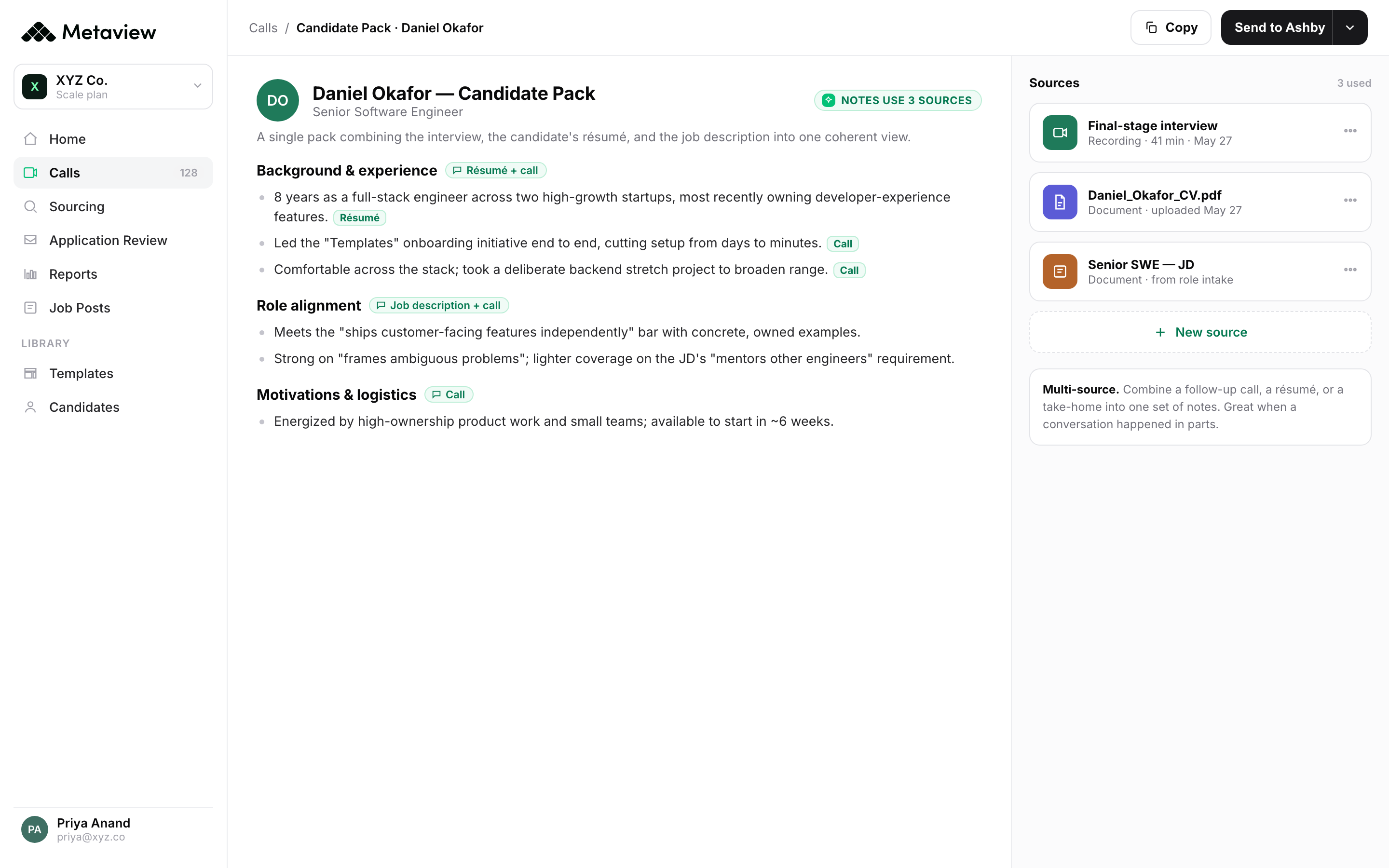
What you can read is smaller and real. Metaview’s Notetaker sits in the interview as a participant, with consent, and turns what was said into structured notes. Each part of those notes traces back to the moment in the transcript it came from.
So a single interview can be read after the fact. You can see which questions were asked and what the candidate said in reply, instead of what somebody reconstructed two days later.
It does not tell you whether the interview was any good. That judgment stays with a person, and reading the interview is how they make it.
Metaview Reports shows the same thing across a team instead of one interview at a time. You can see how many conversations were captured and how recommendations came out by department.
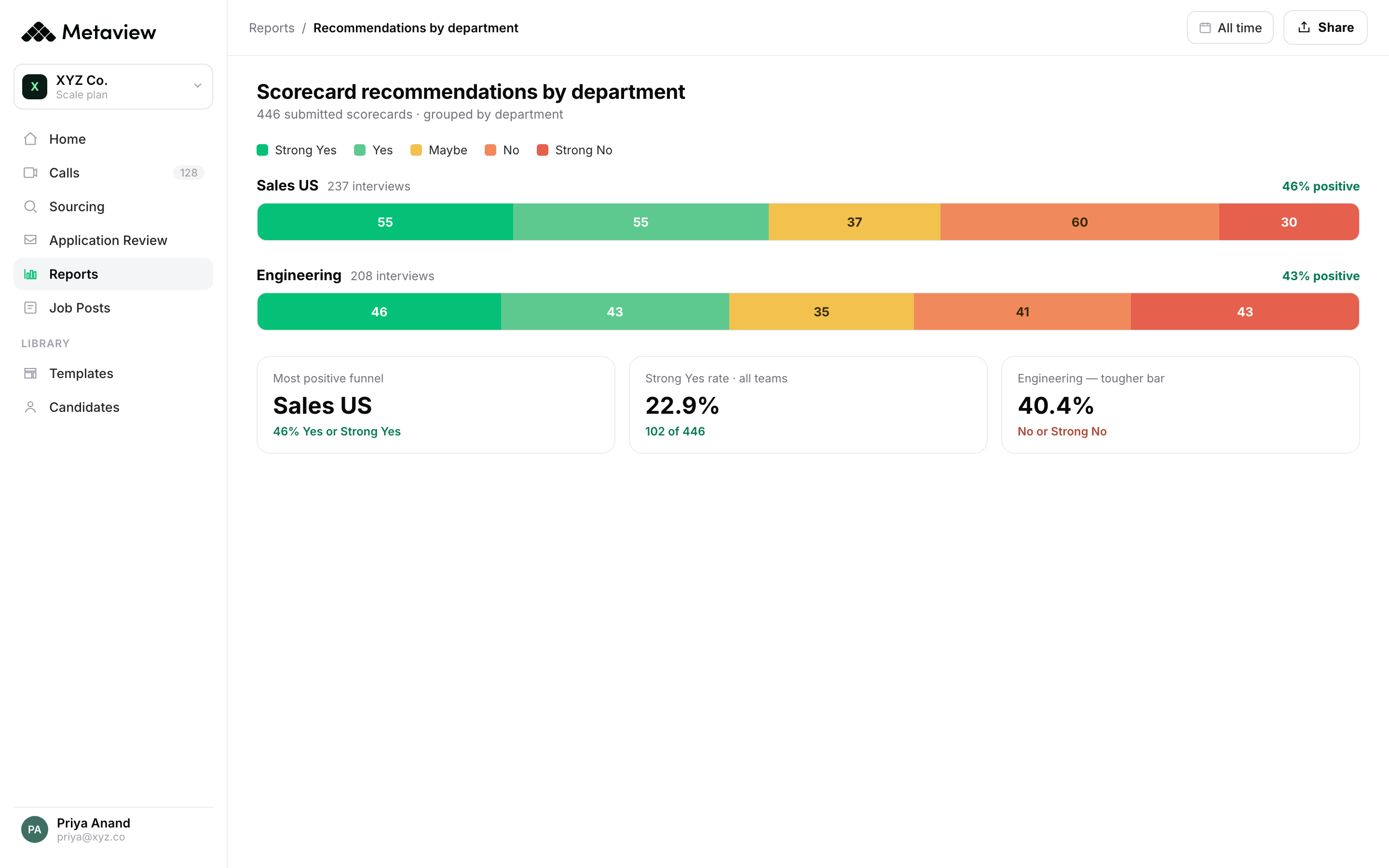
Read that as a list of questions to take into a review. Reports covers what happened inside the recruiting process and stops there.
It can show you that one department’s recommendations look unlike everyone else’s. It cannot tell you which department is right.
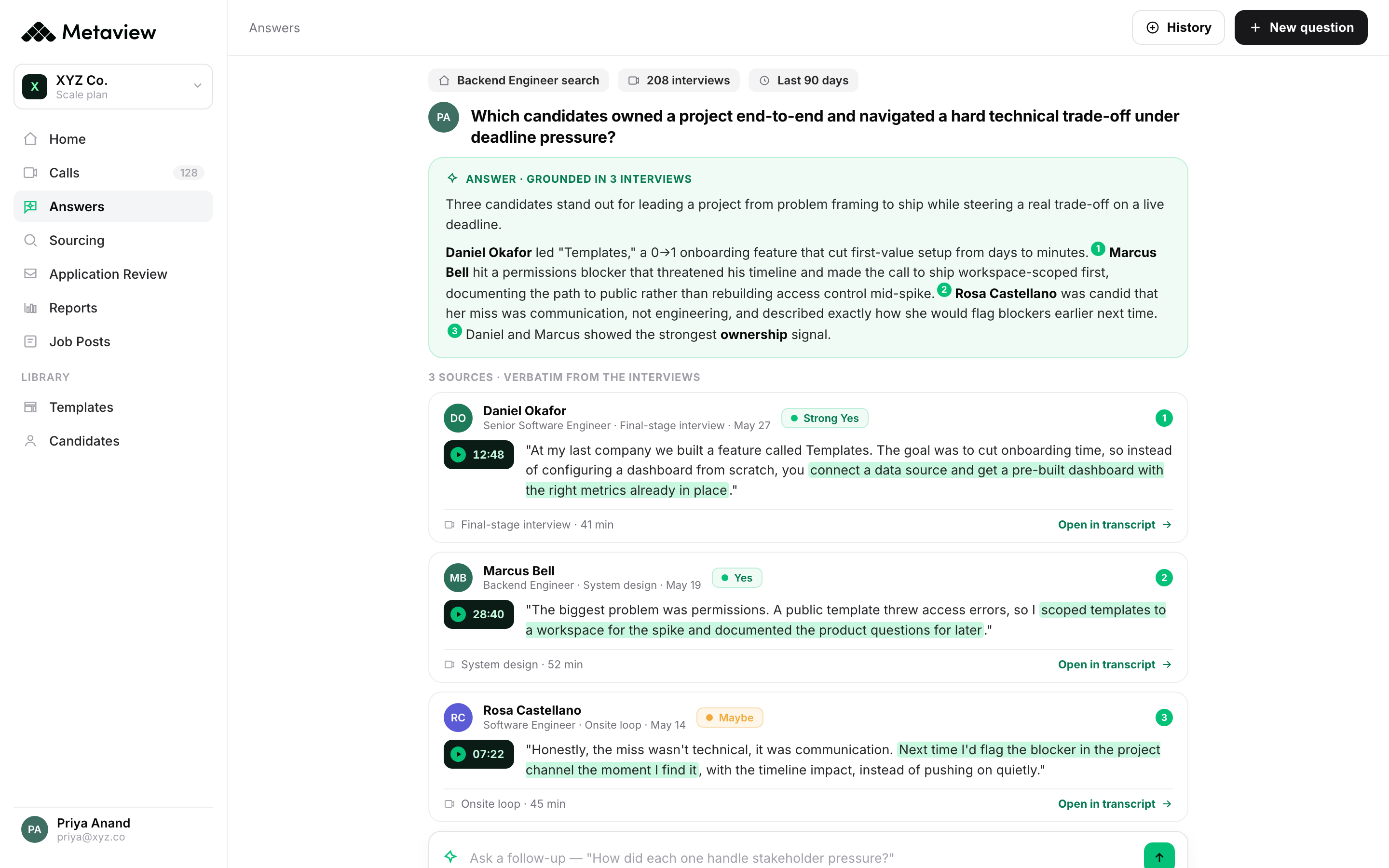
- 1Ask in plain language where a competency came up across the interviews for one candidate.
- 2The answer comes back with the moments it was raised, and which interview each one came from.
- 3Read what the candidate said, in their own words, instead of a summary of it.
The change worth paying for is what a recruiter carries into a debrief. The evidence is on the table, and the argument is about the evidence. The alternative is a recollection and a strong opinion.
When recruiting partners come to the table with data and insights rather than just candidates, the entire hiring process transforms.”

None of this needs a new stack. Keep your ATS and build the loop out of the competencies and questions above. Metaview integrates with the ATS, video, and scheduling tools most teams already run.
Give a structured loop the extra minutes it needs, and plan on reading the interviews instead of measuring adherence to the guide.
Run a structured interview, then read it back.
Book a demo and see what the record of a loop looks like. Metaview does not score your candidates and it does not decide anything. It keeps the conversation so that you can.
Common questions.
What is a structured interview?
Every candidate for the role gets the same core questions, in the same competency areas, and every answer is scored against one agreed rubric. That consistency is what makes two candidates comparable at the end of the loop. It is also what lets you explain the decision to the person you turned down.
Are structured interviews better than unstructured ones?
For comparing candidates, yes, and that is the part you can check on your own process. The claim about higher predictive validity comes from academic selection research, and a hiring team's own interview data cannot confirm it. That research follows people into the job, which is past the point where a record of the hiring process can see anything.
How do I build a structured interview for a role?
Start from the work the role involves. Pick the four or five competencies it turns on, then write two or three behavioral questions for each. Agree what a weak, a solid, and a strong answer sounds like before anyone interviews, and give each interviewer one or two competencies to own.
What should I look for in a candidate's answer?
Specifics, the candidate's own actions, the reasoning behind a decision, and an honest account of what didn't work. An answer missing all four is the rehearsed version, and a follow-up question fixes it faster than a lower score.
Do structured interviews take longer than unstructured ones?
Longer, on the evidence available. Interviews that ran against a loaded guide averaged more minutes than the ones without one. Whatever discipline a written guide adds to a conversation, it does not arrive as a shorter conversation, so budget the extra time.
Can I prove that my interviewers followed the structure?
Not in the sense the word prove implies. A record of what was said carries no record of what the guide contained, so adherence cannot be computed from it. What you can do is read the interview and coach from the questions that were asked.
¹ Interview length figures come from Metaview’s corpus of 5.5 million captured conversations, 2026. The length comparison covers interviews that carried both a recorded duration and a loaded guide. The corpus records what was said in an interview. It holds no record of the questions a guide contained, so guide adherence and cross-interviewer question overlap cannot be computed from it. Survey figures come from the 2026 AI & Hiring Alignment Report, based on 505 recruiting leaders and hiring managers at companies of 200 or more employees in North America and EMEA.