It's the second interview of the day, and the candidate is describing a migration they led. The answer comes back clean: a big platform move, delivered on time.
You write it down and move to the next question on your guide. The sentence worth chasing was in there somewhere. It went past while you were typing.
Catching it means holding the answer in your head and working out which part has no evidence behind it. Then you build a question about that part, while the candidate is still talking and you're still writing.
Guides to follow-up questions hand you the questions. The harder half is spotting the gap that earns one, and that competes with taking notes. This post covers both. Four gaps tell you which question to ask, and the rest is about getting your attention back in time to ask it.
Why the follow-up is the first thing to go.
Reading the next scripted question off a guide costs you almost nothing. Building a follow-up costs you judgment. You have to apply it to something you heard nine seconds ago and haven't finished writing down. When the two compete, judgment is what gives.
When you're short of room, the scripted question survives and the probe drops. The interview ends on time and the notes look complete. Nothing on the scorecard shows that the loop never tested anything.
Jen Brown, Director of Recruiting at Omada Search, described the change after the typing stopped.
I am better at catching small nuances in conversation and going back to dig deeper without losing my train of thought while typing.”
The phrase doing the work is "without losing my train of thought." That train of thought is the diagnosis. Miguel Delgado Alonso, People and Talent Senior Director at Perk, names the same trade: removing the load of note-taking lets recruiters get back to building rapport and asking follow-up questions.
4 gaps, and the probe that closes each one.
You pick one of these four, and the gap in the answer makes the choice. More gaps exist than four; these are the ones that come up most. The skill is diagnosis. The question is just what you say once you've made the call.
The answer with no owner.
You hear "we". "We rebuilt the pipeline, we got the error rate down." Every noun is a team, and the candidate hasn't appeared in their own story yet.
A strong reply gets concrete and smaller. They name a decision they made, or an argument they won. A weak reply restates the team's work in the singular. That tells you the candidate may have watched the outcome happen instead of driving it.
The answer with no constraint.
The story runs clean. Resources were adequate and the plan held. Few real projects sound like this, so either they left the constraint out or the problem was easy.
Listen for a real trade-off: what they'd protect and what they'd drop. If they can't rank the work, you don't yet have evidence that they made the prioritization calls. Treat that as a gap in this answer. It tells you where to look next, and it settles nothing about the candidate.
The answer with no opposition.
Everyone agreed. The proposal landed and the team got behind it. Sometimes that's true. More often, someone edited the disagreement out of the retelling.
Listen for whether they can state the objection the way its author would recognize it, and for what the objection changed. A caricature tells you this answer hasn't shown you how they handle disagreement. Go looking for that elsewhere in the loop.
The answer with no cost.
The result lands well and nothing goes wrong in the telling. No overrun, and no decision they'd take back.
This one rewards patience. The first answer often names a flattering weakness, such as moving too fast or caring too much, and never describes a cost. Wait, then ask what it cost.
Candidates who review their own work have a specific answer ready. They've already had this conversation with themselves.
Hearing the gap while it is still open.
The gap is obvious while the answer is still in the air. Two questions later it's much harder to reconstruct. So the practical move is to buy back the seconds you spend writing.
AI Notes captures the conversation as it happens. That leaves you one decision in the moment: what to ask.
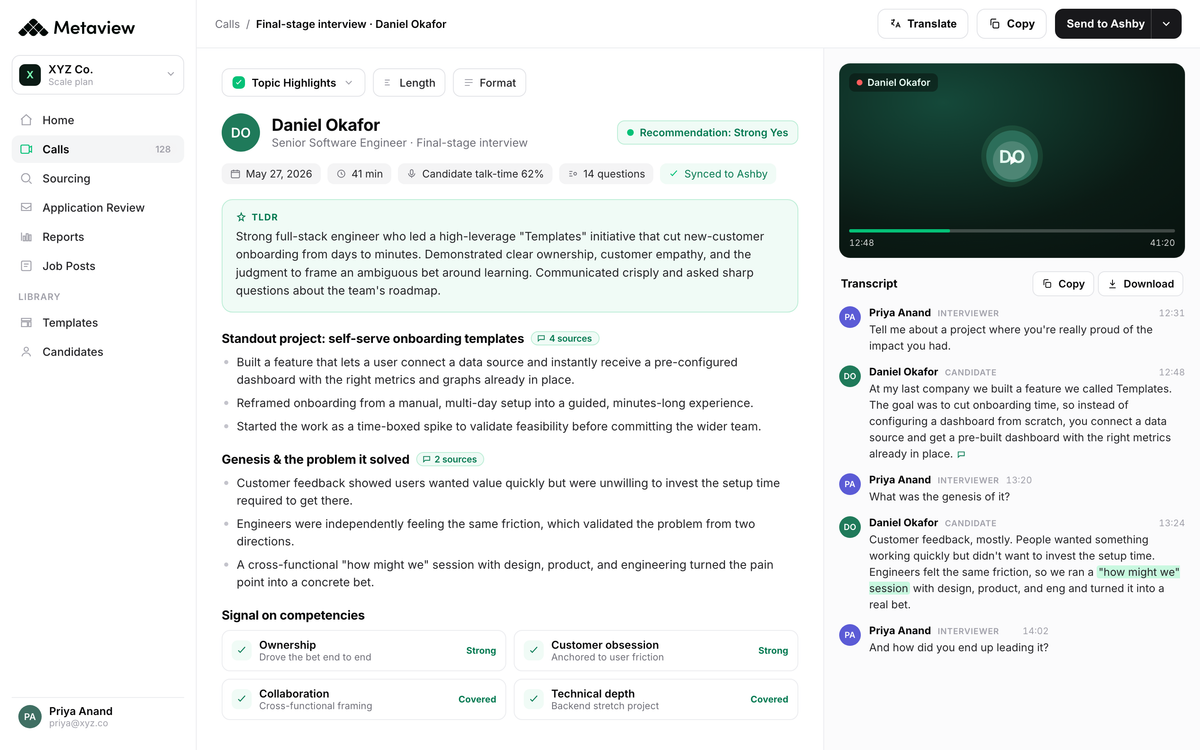
- 1The structured notes build as the call runs, so nothing depends on you typing.
- 2The transcript stays alongside it, for the phrase you want to quote back.
One habit survives the change: keep a pen for gaps only. Write the two or three words that mark where you want to come back. "No owner, Q2 project." The record already holds what the candidate said. Your note is a diagnosis, and it's worth the attention it costs.
Checking the probe after the call.
Attention buys you a second thing: a record worth reviewing. Few interviewers get to find out whether they probe well. The evidence disappears when the call ends, and memory rewrites it in your favor.
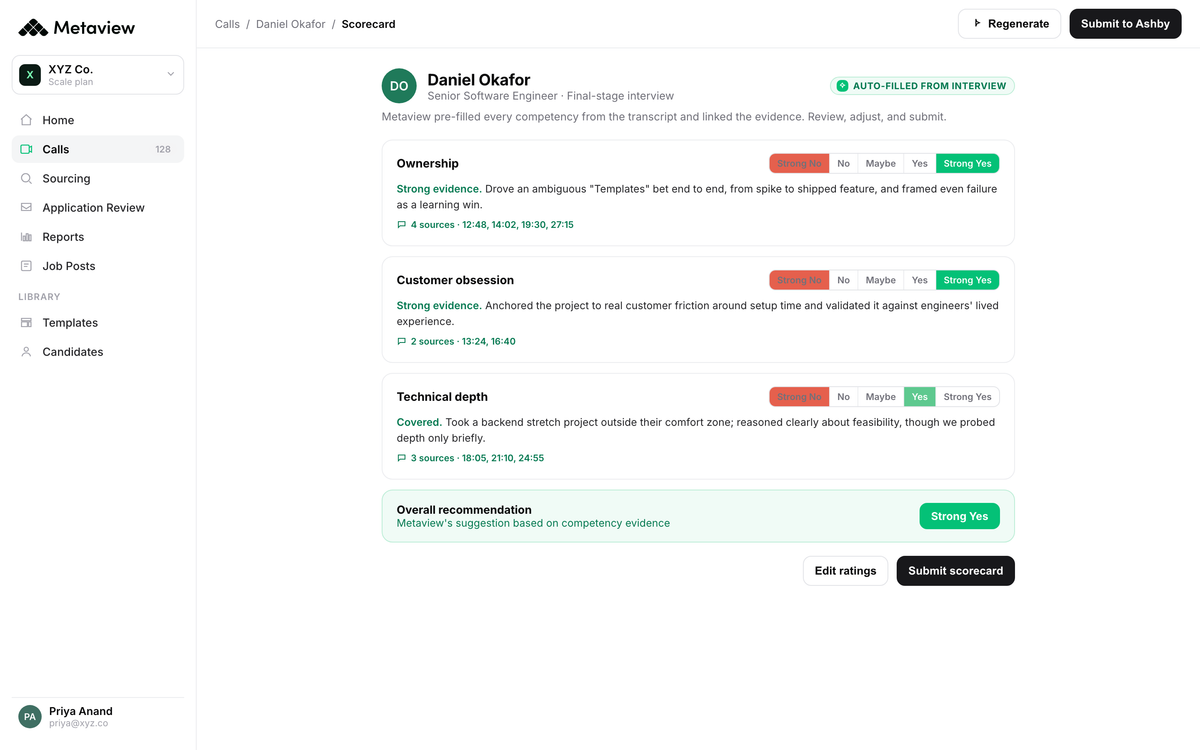
- 1Each competency links back to the moments it came from, so you can hear the answer again.
- 2"We probed depth only briefly" is the record telling you where the follow-up stopped.
Do it on your own calls first. Take one interview and check what you said after its three weakest answers. Most people find at least one place where they accepted a "we" without asking who. Seeing that in writing is often what changes the behavior.
It works across a panel too. Lydia An, a Business Recruiter at Brex, uses the record to settle this question after the fact.
We may need to know whether a recruiter or hiring panel went deeper on a certain topic. Being able to go back to Metaview, pull those exact notes, and see exactly what was said has been really helpful.”
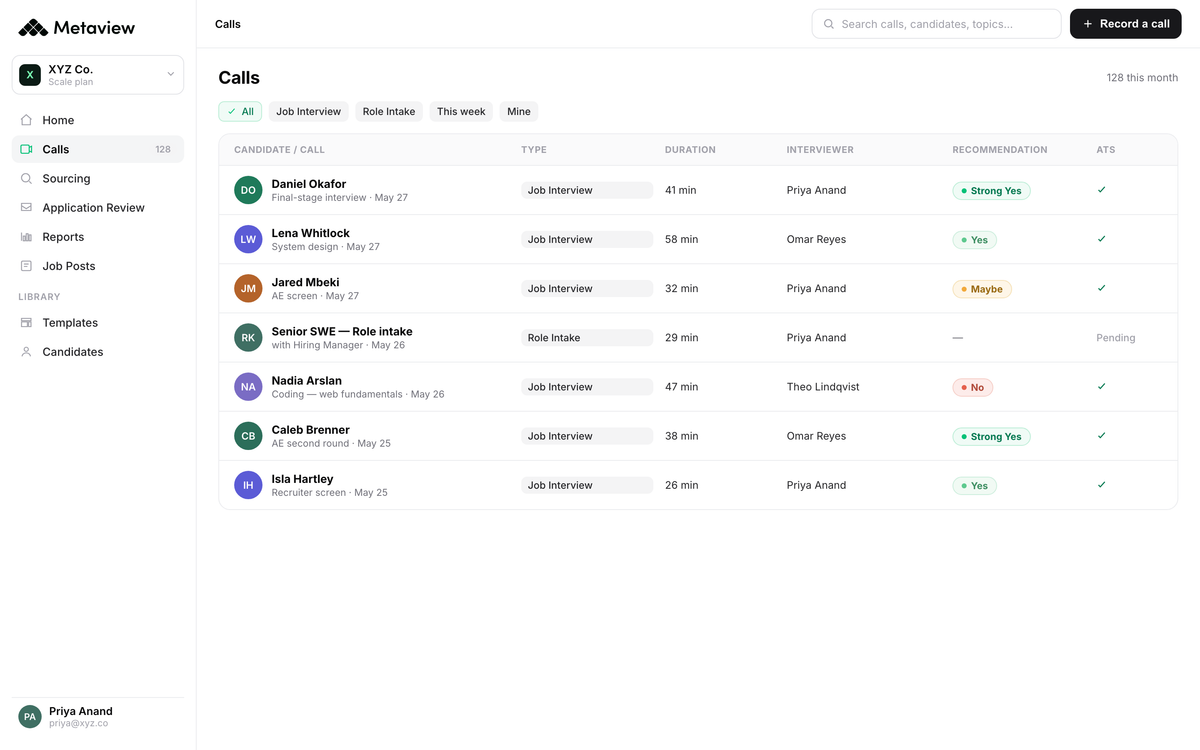
- 1Every call in one place, so the review stays a five-minute habit.
- 2Search across them when you want the same moment in several interviews.
What this does not fix.
Attention gives you room to use technique you already have. That's a real gain, and a narrower one than the pitch you'll hear for tools like this.
An interviewer who has never learned to hear a missing owner will run the same shallow interview with better eye contact. Diagnosis is what separates a good interview from a weak one, and you train it by reviewing your own calls and hearing what you missed.
Attention is not the only reason probing fails. An interviewer who doesn't know the domain can't spot what's missing in the first place. A guide that's too long for the slot leaves no room for the question you wanted to ask. And plenty of interviewers would rather be liked than be accurate.
Each of those needs a different fix, and reaching for the same one every time is how teams stay stuck.
The four gaps are the part you can practice. Listen for the missing owner, the missing constraint, the missing opposition, the missing cost. Then ask the one question that closes the gap you found. Getting your attention back is what lets you do it while the answer is still in the air.
Bring Metaview into your hiring stack.
Live notes, structured scorecards, and ATS sync - set up in under 10 minutes.
Frequently asked.
How many follow-ups should one answer get?
No correct number exists. Any figure you have seen quoted is one interviewer's habit, and it travels because it sounds concrete. The useful test is whether you could now describe what the candidate did themselves and what it cost them. Keep going until you can.
Does probing hard hurt the candidate experience?
Specific interest reads as respect, as long as you're asking about their work and not quizzing them. What damages the experience is the interrogation pattern: the same four questions fired at every answer, whatever the answer contained.
How do I probe in a structured interview without breaking the structure?
Structure holds the competencies and the scoring criteria constant. It does not require identical wording. When a follow-up gets a candidate to the evidence the competency asks for, that is the structure doing its job.
What if the candidate has rehearsed an answer to the follow-up too?
Go one level further down, because rehearsal has a floor. Prepared material covers the story and the lesson. Few candidates have prepared the decision they'd now make another way, or the colleague who disagreed at the time.
How do I probe an answer in a domain I don't know well?
Ask about the shape of the work instead of the content. You can hear a missing owner, a missing constraint and a missing cost without knowing the stack. Then hand the technical depth to the interviewer who has it, and tell them which claim you could not test.