Nobody is short of interview questions. The typical interview touched a median of 18 distinct topics, across 331,872 captured sessions where question topics were detected. That's one slice of a 5.5 million conversation corpus rather than the whole of it, and topic detection is a proxy for what was asked. Read it loosely and it still says the obvious thing: the questions get asked. What a library changes is which of them got picked before the call instead of reached for during it.
So treat the 300 questions below as an inventory. The work is cutting. Pick the three to five competencies the role actually runs on, pull two or three questions for each, and split them across the panel. A whole loop lands at around a dozen core questions. The breadth on this page is here so the set you take off it can be small.
One limit belongs up front, because the rest of this guide sits inside it. A shared question set makes two candidates comparable: they answered the same things, so you can set the answers beside each other and argue about them. It won't tell you which questions find the people who go on to do the job well. Metaview's corpus holds no record of what happened after a candidate was hired, so that's a question this data can't settle, and a list can't settle it either. Comparability is checkable after the fact. Predictive power stays out of reach.
What a question library is for.
A library is a shared inventory, so everyone interviewing for one role asks about the same things. Its job is coverage and repeatability. Cutting down on variety is the whole point.
You already know the version without one. One interviewer digs into past projects, another runs a puzzle, a third spends thirty minutes describing the team. Nobody's holding the same evidence at the debrief, so the conversation turns on who argues hardest. That's a real problem, and a shared set is a real fix for it. Be precise about what gets fixed, though: the panel becomes comparable. Whether the competencies you picked are the right ones for this job is a separate judgment, and this page can't make it for you.
The corpus offers one check on intuition here. The most frequently detected topic across those same 331,872 sessions was salary expectations, showing up in 34.9% of them, ahead of anything about how a person works. That describes what gets asked and recommends nothing, which is exactly the point a library exists to make: how often a question comes up says nothing about how much it's worth. A library is where the habit gets replaced with a decision.
Take the sets below as that inventory. Agree the list before anyone interviews, then put it where every panelist will see it, which usually means a shared interview template or a reusable interview kit.
Behavioral questions, and why they lead.
A behavioral question asks a candidate to walk through something they've actually done. The reason to lead with them is the evidence they produce: a specific past episode with decisions and consequences you can push on, in place of a statement about how someone would handle a hypothetical. That's an argument about evidence quality, and it deserves to stay separate from the stronger claim people usually attach to it. Whether behavioral answers identify the people who go on to do the job well is something this corpus can't test.
The corpus can describe the mix, though. Of all question topics detected across the sample, 22.5% classify as behavioral and 0.06% as situational. Most of the rest fall into neither bucket cleanly, so the pair works as a ratio between those two buckets, and it says nothing about the share of every question asked. Interviewers lead with past experience by a wide margin. That's what teams do, which is a different thing from evidence that it works, and the two are easy to blur.
These travel across almost every role, which is why they open the library. Here's a starter set you can ask anyone.
- Tell me about a time you owned a project end to end. What was your specific role in it?
- Describe a goal you missed. What happened, and what did you change afterward?
- Walk me through a hard decision you made without enough information.
- Tell me about a time you disagreed with your manager. How did you handle it?
- Describe the most difficult piece of feedback you have received. What did you do with it?
- Tell me about a time you had to learn something quickly to get a job done.
- Describe a time you had to say no to a stakeholder. How did you make the call?
- Walk me through a project that did not go to plan. Where did it go wrong?
- Tell me about a time you changed your mind based on new information.
- Describe a time you carried more than your share. How did you keep it sustainable?
- Tell me about a conflict on your team. What was your part in resolving it?
- Describe something you shipped that you are proud of. What made it hard?
Listen for a real situation with specifics, the candidate's own actions inside it, the reasoning behind the call, and an honest account of the outcome. When those pieces are missing, ask one more follow-up before you decide anything. An answer with no "I" in it can mean a rehearsed story. It can just as easily mean genuinely shared work, or a candidate trained never to claim credit. The follow-up is how you find out which.
The library by competency.
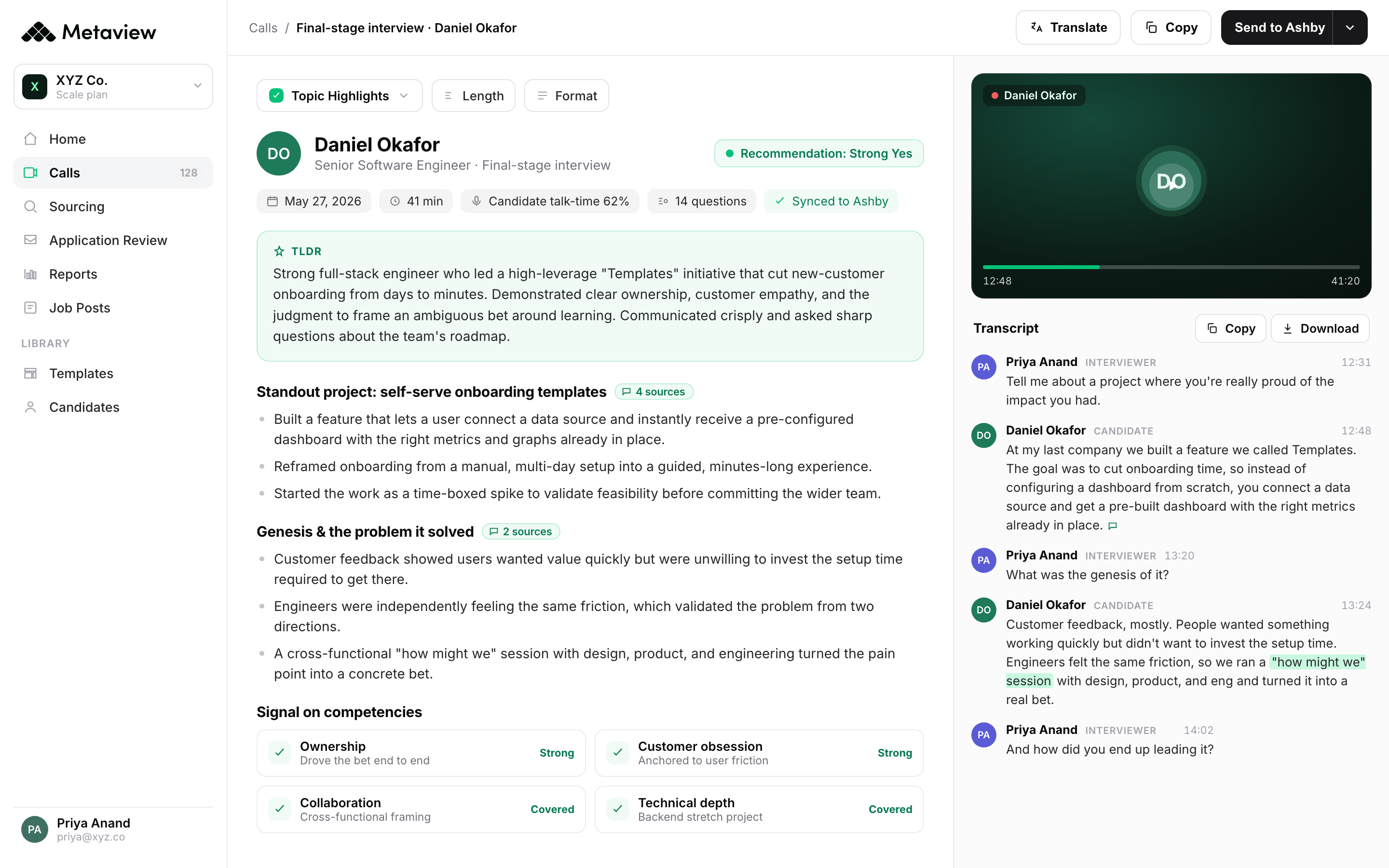
Most loops assess competencies, and a job title is shorthand for a bundle of them, so the inventory below is grouped by the competency itself. Each entry links to the full bank behind it, with what to listen for in answers. Together they run well past 300 questions, and a good loop uses about a dozen of them.
- Communication skills: can they make a complex idea simple and read the room. Try: walk me through a technical concept as if I am not in your field; tell me about a time you had to deliver bad news; describe a moment you realized you had been misunderstood.
- Problem-solving: how they break down an unfamiliar problem. Try: tell me about the hardest problem you solved last year; walk me through how you approached something with no obvious answer; describe a time your first solution was wrong.
- Leadership: how they set direction and bring people with them. Try: tell me about a time you led without authority; describe a call you made that was unpopular; how have you handled an underperformer.
- People management: how they grow and support a team. Try: tell me about someone you helped level up; describe a difficult performance conversation; how do you give feedback that sticks.
- Ownership and accountability: whether they run toward problems. Try: tell me about something that broke on your watch; describe a time you fixed a problem that was not yours; what is a commitment you missed, and what did you do.
- Adaptability and resilience: how they handle change and setbacks. Try: tell me about a time priorities shifted under you; describe your hardest stretch at work and how you got through it; what did you do when a plan fell apart.
- Cross-functional collaboration and teamwork: how they work across lines. Try: tell me about a project that needed another team; describe a time you smoothed a fight between functions; when did you put the wider goal ahead of your own.
- Prioritization and decision-making: how they choose under pressure. Try: tell me about a week with more work than time; how do you decide what not to do; describe a fast decision you would make the same way again.
- Conflict resolution and negotiation: how they handle tension and tradeoffs. Try: tell me about a disagreement that got heated; describe a time you found a middle ground; when did you hold your line and why.
- Culture and values: how they actually operate, beyond the slogans. Try: what kind of environment brings out your best work; tell me about a time your values were tested at work; describe a team norm you would fight to keep.
The question hub collects every bank in one place if you'd rather build from the master set.
Subscribe to Metaview Builds
New interview question sets, hiring playbooks, and product updates, straight to your inbox.
Unsubscribe with one click.
Building a set by role.
A role is a weighting of competencies, and that weighting is a judgment your team makes about the job. Neither this page nor the data behind it can make it for you. What a library does is stop the weighting happening by accident, one interviewer at a time, in the room.
A team hiring an account executive might weight communication, negotiation, resilience, and ownership, with each interviewer going deep on one. An engineering manager loop usually leans on people management, problem-solving, and cross-functional collaboration. A first product hire needs prioritization, decision-making, and communication. Those are common choices. None of them are validated. Write yours down with a line on why, and you've got something to revisit when a loop keeps producing arguments where a decision should be.
Agreeing what a good answer looks like.
The question is only half of it. The other half is agreeing what a strong answer contains before the interview, so two people rating the same answer are at least arguing about the same thing.
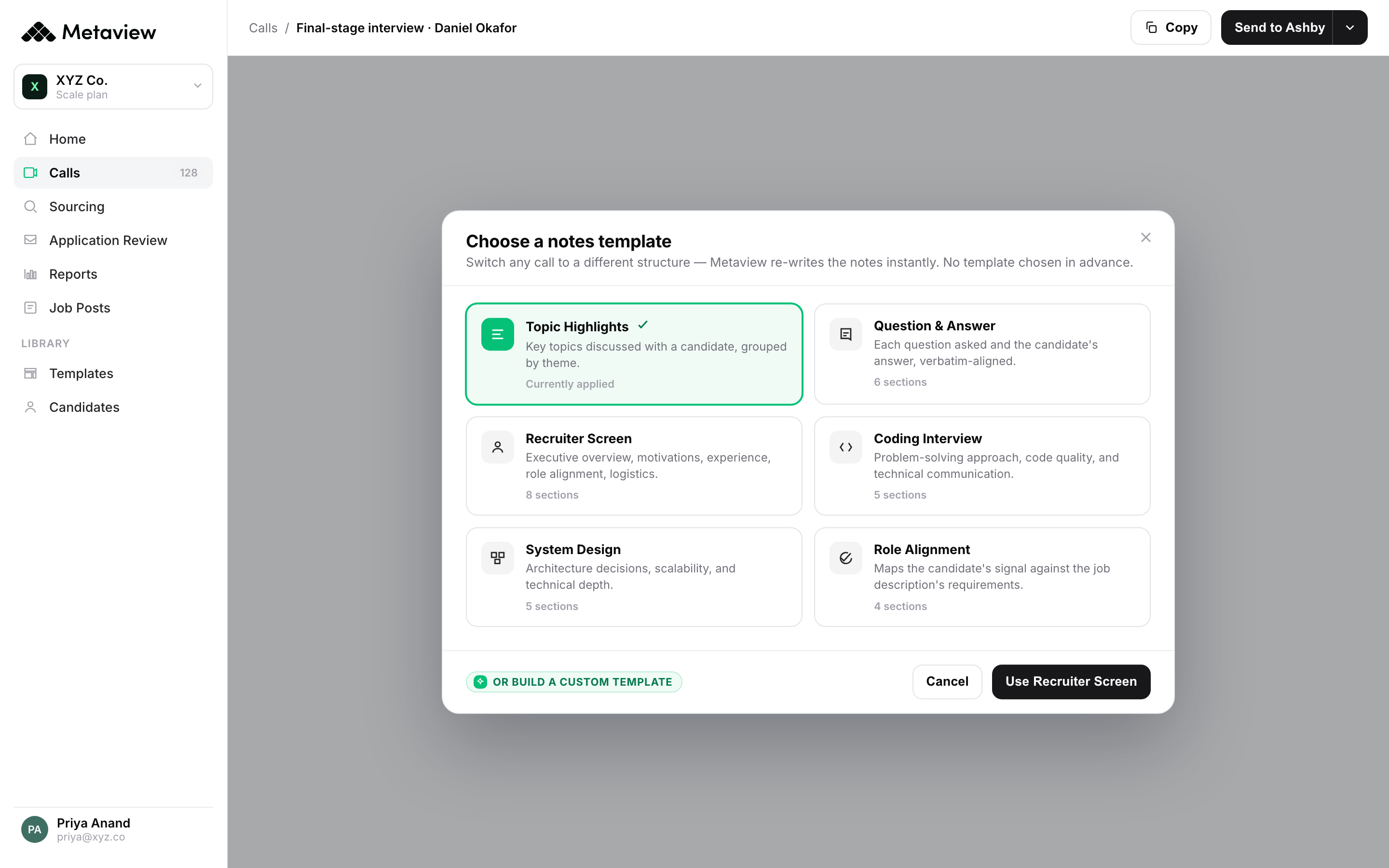
A workable default across most competencies: specifics over generalities, the candidate's own actions over the team's, the reasoning behind a decision as well as the decision, and an honest account of what didn't work. Write those into your scorecard criteria and rate every candidate against them. Then be clear about what that buys you. A shared rubric fixes what the words on the scale mean. It won't make two interviewers apply them identically, and it doesn't make the resulting rating correct. What it does is turn a clash of impressions into an argument about evidence, which is the kind a debrief can actually resolve.
Making the same interview happen twice.
An agreed set only counts if it survives contact with a calendar. Most of the drift comes down to where the document lives, which is somewhere nobody opens at ten in the morning with a candidate already on the call. So put the set where the interview happens.
How often does that happen today? 30.5% of captured interviews in the last twelve months ran against a loaded guide. Two caveats matter more than the number itself. It's a proxy: it counts whether a guide was attached to the interview, which is a different question from whether the interviewer worked from it. And the aggregate data can't close that gap, because it can't tell you whether the planned questions were asked. So read it as a rough floor on how many interviews get planned in advance, and as a reminder that "we have a library" and "we ran the library" are two different claims.
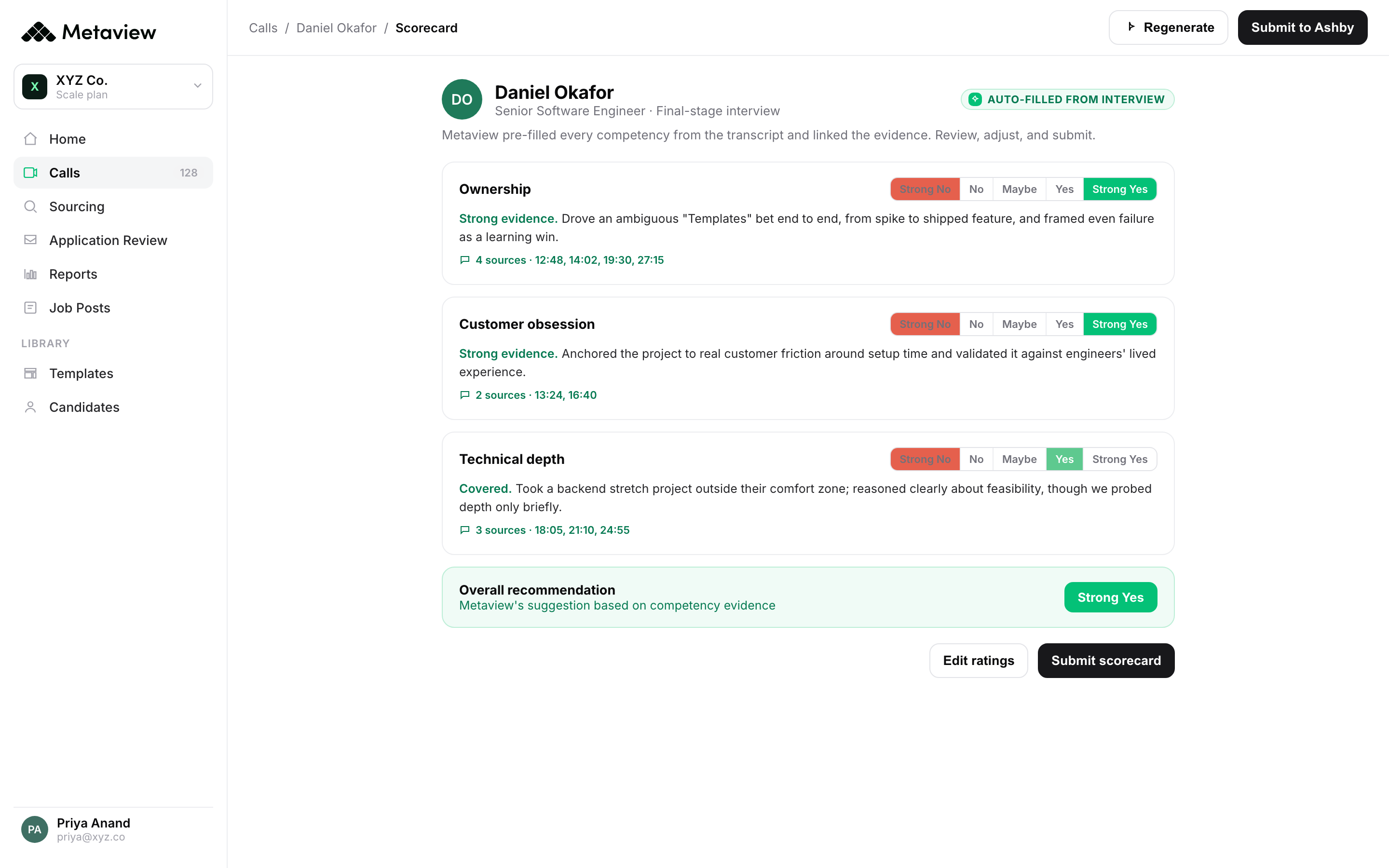
In practice the questions live in the template, so a new interviewer opens the same structure a senior one uses. That's no guarantee they follow it. It does kill the excuse that nobody knew what the set was.
The same problem sits one step upstream, in whether the recruiter and the hiring manager agreed what the role needs before anyone wrote a question. That agreement gets made or missed on the intake call. Metaview's 2026 AI & Hiring Alignment Report, a survey of 505 recruiting leaders and hiring managers across North America and EMEA, found 68% of searches start with high alignment when AI is core to hiring, against 49% when teams don't use it. Be exact about what that is: a self-reported association from a survey of searches, which says nothing about templates or question sets and nothing about what produced the gap. It works as a reminder that consistency has an upstream half this page doesn't cover, and it does no work as evidence for a question library.
One recruiter put the downstream half this way.
Being able to structure their questions and give them guidance on what they should be asking, which is then represented in the scorecard and their notes, makes that more consistent.”

What a question library cannot tell you.
The obvious next thing to ask is which of these questions is any good. It's the right question. This page can't answer it, and neither can Metaview.
Start with the hard boundary. Judging a question by whether it found someone who went on to do the job well needs a record of how that hire turned out, and Metaview's corpus holds no such record: no performance reviews, no retention, no tenure. Nobody's run that measurement. A claim that a specific question predicts strong performance on the job has no study behind it, weak or otherwise. Any list that claims otherwise is reaching past what anyone has measured.
Then the softer boundary, which bites more often in practice. The aggregate data can't tell you whether an interviewer asked the questions on their guide, even inside the interview itself, or how much two panelists on one loop overlapped. Those are the two things you'd most want to know about interview consistency, and neither is currently measurable across the corpus.
One tempting shortcut deserves naming. You could rank your questions by how often they show up in interviews that ended in a strong yes. That ranks how closely a question agrees with the process you already run, which is the thing you were trying to check in the first place. The circle closes on itself, and a process that's consistently wrong produces beautifully stable patterns.
What you can check is narrower and still worth having: coverage. Metaview Reports shows which question topics a loop actually covered, read across a whole pipeline. That's a fact about the interview, with no claim attached about the candidate, which is precisely why the data can carry it. It answers "did we assess what we said we would" and leaves "was this person any good" with the people in the room.
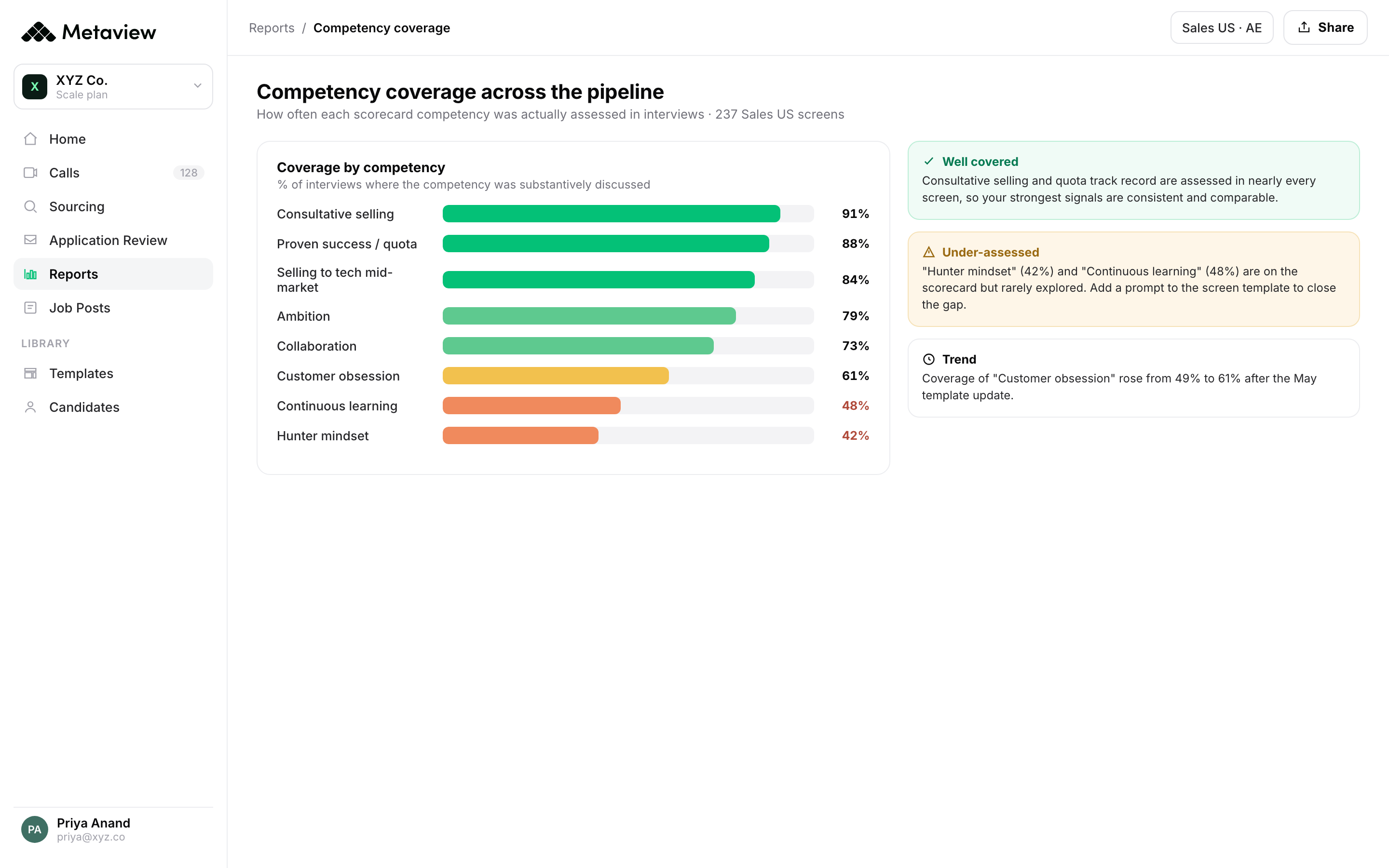
A recruiter using it that way arrives at the debrief able to say what the interview covered and what it missed. That's a smaller thing to bring than a firmer opinion about the candidate, and a more checkable one. The VP of People quoted below sets her own standard for good hiring, and she opens the interview record when the funnel numbers look wrong.
Quality of hire starts with quality of interview. If funnel conversions don't make sense or aren't where we want them to be, my next step is to look at Metaview and see what's happening with these interviews to try to get to the root cause.”

Set the two ways of running a library side by side and the honest scoreboard still has a blank row in it.
| Running the library | By hand | Metaview |
|---|---|---|
| The questions asked | Vary by interviewer | Set once in a shared template every panelist opens |
| Scoring the answers | Free-text notes, hard to compare | Drafted against one rubric, then edited and submitted |
| What the loop covered | Nobody checks after the fact | Question topic coverage visible across the pipeline |
| Whether an interviewer stuck to the set | Nobody knows | The record exists, so a person can read it back |
| Which questions find a good hire | Unknown | Also unknown. No product on the market can tell you this, and one that says it can is selling you a study nobody ran. |
You don't have to replace anything to start. Build a loop from the sets above, keep the ATS you've got, and let the structure live where the interview happens through Metaview's integrations. How other teams run it is on the customers page, and what it costs is on pricing.
Cut the library down to a dozen questions.
Put the set into a shared template, keep the panel on it, and see which question topics each loop actually covered.
Frequently asked questions.
What are behavioral interview questions?
Behavioral interview questions ask a candidate to describe something they've actually done rather than something they might do. They usually open with a prompt like "tell me about a time" and depend on your follow-ups to get past the rehearsed version to what the candidate specifically did, decided, and learned. The reason to lead with them is the evidence they produce: a specific past episode you can push on instead of a statement of intent.
How many questions should I ask in one interview?
Fewer than you think, asked deeply. A single interviewer can cover one or two competencies well in 45 minutes, with two or three core questions plus follow-ups. Across a four-person panel that comes to about a dozen core questions, with each interviewer going deep on their slice, so nobody has to skim all of it.
How do I choose interview questions for a specific role?
Start from competencies and work back to the title. Decide which three to five the role runs on, pull a question set for each, and assign them across the panel so no two interviewers cover the same ground by accident. That weighting is a judgment your team makes about the job, and no question library can make it for you.
What is the difference between behavioral and situational questions?
Behavioral questions ask about a real past experience (tell me about a time you missed a deadline). Situational questions ask how someone would handle a hypothetical (what would you do if a project slipped). Behavioral answers are harder to give without real detail, so most loops lead with them and keep situational questions for cases where a candidate hasn't got much relevant history to draw on.
How do I keep interviews consistent across a panel?
Agree the question set and the rubric before anyone interviews, put the questions into a shared template so every panelist opens the same interview, and rate every candidate against the same criteria. Tools like Metaview hold that structure in the interview itself and draft the scorecard from what was said, so a disagreement in the debrief is about the evidence, with the meaning of the rating already agreed.
Can you tell which interview questions actually work?
Not in the sense most people mean it. Judging a question by whether it found someone who went on to do the job well needs a record of how that hire turned out, and Metaview's corpus doesn't contain one. Ranking questions by how often they appear before a strong yes only measures how closely they agree with the process you already run. What you can check is coverage: which question topics a loop actually assessed, and where a loop had a gap.