
A hiring manager doesn't describe their ideal hire in keywords or job titles. They describe a person:
"We're looking for someone who's built products in a fast-moving startup, can work directly with customers, and isn't afraid of ambiguity. Someone who's technical enough to earn engineers' trust but commercial enough to influence product strategy."
Sounds good. But how do you feed that into your sourcing tool? All that nuance has to be translated into job titles, keywords, years’ experience, and Boolean filters a database can understand.
It’s a paradox: the richer your understanding of the role, the more frustrating this translation becomes.
Recruiting has never really been about matching keywords. It's about recognizing potential, understanding career trajectories, and spotting candidates who fit the intent behind a hiring brief.
For years, recruiters have adapted their thinking to fit search tools. But today, AI reverses that relationship.
Instead of translating nuanced hiring requirements into rigid searches, you can simply describe who you’re looking for, refine that understanding through conversation, and let AI do the work of finding the right people.
That's the promise of conversational recruiting. And we’re about to see just how easy and powerful it can be.
What is conversational recruiting?
Traditionally, conversational recruiting has referred to candidate-facing tools like chatbots, automated interview scheduling, SMS outreach, and AI-powered screening. These technologies make it easier for candidates to ask questions, schedule interviews, and move through the hiring process with less friction.
But a new generation of AI is changing how recruiters themselves work.
Instead of navigating complex workflows or constructing increasingly elaborate Boolean searches, recruiters interact with AI the same way they'd collaborate with an experienced teammate. You describe the outcome you want, refining your thinking through discussion, and delegate execution.
Conversation becomes the primary interface for recruiting work.
Conversational AI in sourcing: an example.
You’ve just left an intake call with a hiring manager. You helped them define and refine their ideal candidate profile (ICP), and can now essentially feed that directly to your AI colleague:
I'm looking for the second product marketer at a Series A startup. They'll have built positioning from scratch, worked closely with founders, and be excited by ambiguity. Where should we look?
The AI asks follow-up questions, challenges assumptions, suggests adjacent talent pools, and gradually builds a much richer understanding of the ideal candidate than a list of keywords ever could.
And then it begins sourcing directly across a range of job boards, LinkedIn Recruiter (or alternatives), and any other relevant sources. It’ll even launch outreach campaigns and schedule interviews.
All based on a deeper, more nuanced understanding of the role than any Boolean filters allow.
The result isn't just faster sourcing. It's sourcing built on understanding rather than approximation.
Why is conversation a better interface for recruiting?
It’s not just that Slack chats are easier than Boolean strings. (Although who would argue?) It's that conversation helps you think more clearly about the person you’re trying to hire.
Even experienced recruiters rarely identify the ideal candidate immediately. They refine their understanding as they learn more about the role, challenge assumptions with hiring managers, and uncover what really matters.
A typical person-to-person conversation usually includes:
- "Actually, startup experience is more important than industry experience."
- "Let's avoid candidates who've only worked at very large companies."
- "I think someone from fintech could transfer really well into this role."
- "Maybe we should prioritise people who've built teams, even if they don't have the exact title."
These aren't search queries. They're hypotheses. Sourcing is an iterative process of exploring possibilities, testing assumptions, and gradually sharpening the ideal candidate profile. And conversational AI lets you stay in that flow.
Instead of asking recruiters to think like database administrators, you get a partner to bounce ideas off. The AI asks clarifying questions, surfaces adjacent talent pools, points out potential blind spots, and helps recruiters build a much richer picture of the candidate they're looking for.
By the time sourcing begins, you’re working from a refined understanding of the ideal candidate.
Why conversational AI creates better shortlists.
Traditional sourcing typically cast the net wide, then narrows it down. Run a search, review hundreds of profiles, tweak the filters, repeat. Eventually you'll arrive at a shortlist.
The downside is that recruiters spend hours separating genuinely strong candidates from people who merely happen to match the search criteria. Either that, or they speed through profiles without paying any real attention.
People flip into zombie mode and look for certain things in the profile, without looking at them in detail. They literally tell us they spent three to five seconds looking at these applications.”

Conversational recruiting does the opposite. Instead of investing most of the effort after the search, recruiters invest more effort before it.
The conversation captures context that rarely fits neatly into a Boolean query:
- What kind of environments has this person thrived in?
- Which career paths tend to produce strong performers in this role?
- Which experiences are essential, and which are simply proxies?
- What adjacent backgrounds might the hiring manager not have considered?
Only once those questions have been explored does the AI begin sourcing. And the result is a smaller, but far more qualitative candidate pool.
Less time is spent refining searches and reviewing false positives. More time is spent evaluating strong candidates, building relationships, and partnering with hiring managers.
Agentic AI brings nuanced, critical thinking.
If conversational recruiting were only about replacing Boolean searches with natural language, it would be a welcome improvement. But that's not the real transformation.
Conversational AI both understands and can act on what recruiters are looking for. Once it understands the outcome you're trying to achieve, it can take ownership of the work required to get there.
Which has a few significant advantages:
1. It works from your brief, but isn’t limited by it.
Perhaps you asked for three years’ experience in product management, among six or seven other key considerations. With classic filters, you’ll never see anyone with two years and nine months.
An agentic AI approach recognizes that if enough other boxes are ticked, and the person looks like a true rising star, a few months’ less experience shouldn’t rule them out.
The AI agent has the context to understand when we're already hitting 95% of the requirements. It’ll still include this candidate because it has the context to understand that they’re actually really aligned to the role.”
2. It works pragmatically, not dogmatically.
Don’t confuse artificial intelligence with process automation. Automation tends to work sequentially, completing the exact same tasks in exactly the same way, every time. Which is great in its own way.
But recruiting is inherently human. And humans don’t always follow the same path.
Instead of asking AI to complete individual tasks, recruiters can delegate an objective. It isn't automating a workflow. It’s working towards an outcome.
Conversation becomes the mechanism for communicating intent. The AI handles the execution.
And you’re free to focus on the parts of hiring where human judgment matters most: partnering with hiring managers, assessing candidates, and building relationships.
fillmore: conversational recruiting as your unfair advantage.
We’ve been talking about conversational AI as a nameless, faceless entity. But your colleagues aren’t nameless or faceless. And you need AI coworkers you can trust.
That’s fillmore: a recruiting teammate you can brief in natural language.
fillmore lives in your daily work tools like Slack, spaces built for quick conversations with colleagues.
You don't feed it filters or keywords. You simply describe the person you're trying to hire.
As the conversation unfolds, fillmore helps refine the ideal candidate profile. It can challenge assumptions, suggest adjacent backgrounds, and ask follow-up questions until there's a shared understanding of what success looks like.
Then fillmore gets to work. Instead of producing a broad list of possible matches, it researches candidates, builds a highly qualified shortlist, writes personalized outreach, manages follow-ups, and books meetings with interested candidates.
fillmore reaches candidates through email, InMail, job boards, and wherever they’re most active. And can do so on behalf of the hiring manager or lead recruiter:
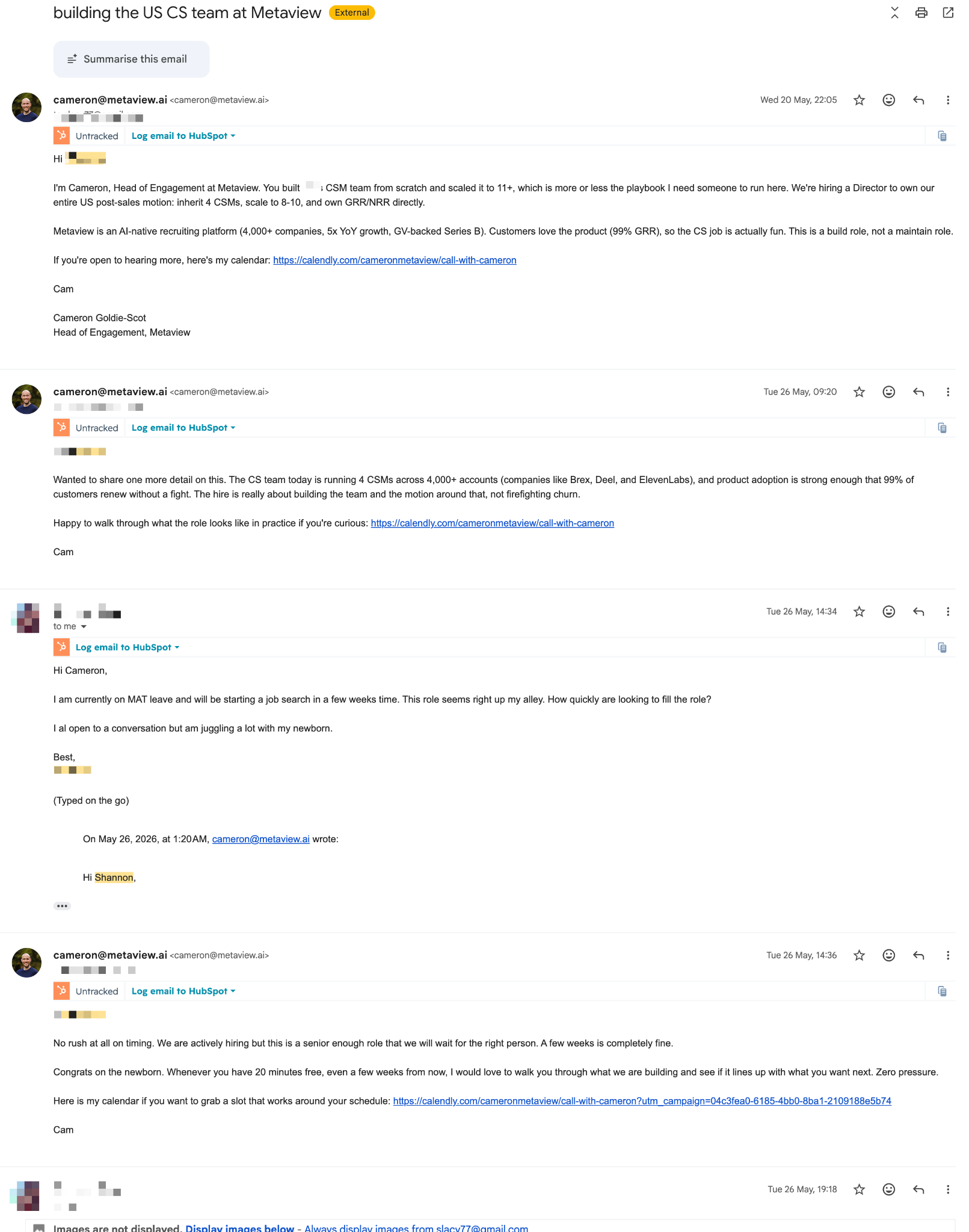
You stay in control throughout, and can make suggestions, tweaks, or stop the search at any point. But you’re no longer responsible for orchestrating every step of the sourcing process.
The result is that recruiters spend less time operating software and more time doing the work they're uniquely good at: advising hiring managers, evaluating talent, and creating exceptional candidate experiences.
Outbound recruiting that runs itself.
Fillmore is the AI coworker that finds candidates, runs personalized outreach, and books screening calls. Autonomously.
The end of search-first recruiting.
For more than two decades, recruiting technology has been built for step-by-step search.
- Need candidates? Write a query.
- Not happy with the results? Adjust the filters.
- Still not finding the right people? Rewrite the search and try again.
Conversational recruiting flips the model. Instead of translating hiring requirements into keywords and Boolean logic, you communicate what they're trying to achieve in natural language, refine that thinking through dialogue, and let AI execute the work.
The AI can take the understanding developed through conversation and turn it into a qualified pipeline. Driven by outcomes, not assumptions.
The best recruiters are successful because they understand people. They know how to challenge assumptions, uncover hidden talent, advise hiring managers, and build trust with candidates.
The next generation of recruiting technology should amplify those strengths. That's why conversational recruiting isn't simply a new interface, it's a new operating model.
One where recruiters spend less time searching, more time hiring, and partner with AI to build exceptional candidate pipelines faster than ever before.
Conversational recruiting FAQs.
How is conversational recruiting different from traditional recruiting?
Traditional recruiting relies on structured searches, filters, and manual candidate review. Conversational recruiting replaces rigid search syntax with natural dialogue, where recruiters communicate intent directly, and AI generates more precise shortlists with less manual effort.
Does conversational recruiting replace Boolean search?
Not entirely. Or at least, not yet. Boolean search and filters still have their place for highly specific or niche searches. But conversational recruiting offers a more intuitive way to define hiring intent, making it easier to discover strong candidates without spending hours refining search queries.
How does conversational recruiting improve candidate quality?
Rather than casting a wide net and filtering hundreds of profiles, conversational recruiting helps recruiters clarify what success looks like before sourcing begins. This richer understanding lets AI identify candidates who align more closely with the hiring brief, for more relevant shortlists and less time spent reviewing weak matches.
How does fillmore support conversational recruiting?
fillmore is a conversational AI colleague. Recruiters describe the ideal candidate in natural language, refine their thinking through conversation, and delegate pipeline creation to fillmore. From sourcing and research to personalized outreach, follow-ups, and meeting scheduling, fillmore handles the repetitive execution so recruiters can focus on evaluating talent, partnering with hiring managers, and building meaningful candidate relationships.


