Interview questions that predict performance: 7 to ask, and how to score them

Search "interview questions that predict performance" and you will get a hundred lists. Almost all of them are opinion dressed up as science.
The questions that actually predict how someone does the job are not secret, and they are not clever. They share one trait. They force the candidate to show evidence instead of talk well.
I have watched a lot of interviews. The most reliable tell is not which question you ask. It is whether you capture the answer and score it the same way for everyone. Get that wrong and the best question in the world predicts nothing.
So here are seven questions worth asking, what good looks like for each, and the part most teams skip that makes any of them work.
Why most "best questions" lists are useless
Most question lists rank on how interesting the question sounds, not on whether the answer tells you anything about the job. "If you were a tree, what kind would you be" is memorable and predicts nothing.
The research has been settled for a long time. Structured, evidence-based interviewing, where everyone is asked comparable questions and scored against a rubric, is one of the most predictive hiring methods we have, and it leaves unstructured "let's just chat" interviews far behind.
So the bar for a good question is simple: does the way candidates answer it reliably track how they later do the work? The ones that clear it all do the same thing. They make the candidate produce evidence.
The 7 interview questions that predict performance
Treat these as patterns, not a script. The exact wording matters less than the follow-ups, which are where the evidence actually shows up. Pull from our interview questions library for role-specific versions.
1. Walk me through a project you owned end to end. What did you personally do?
This separates the people who did the work from the people who were standing nearby. What good looks like: specific decisions and actions in the first person, not "we."
2. Tell me about a decision you made without enough information.
Judgment under uncertainty is most of real work. What good looks like: a clear reasoning process and the tradeoff they accepted, not a lucky outcome.
3. Describe a time your work failed or fell short. What did you change after?
Ownership and learning predict growth better than a flawless track record. What good looks like: they name their own part and a concrete change, not blame.
4. How would you approach this specific problem from the role in your first 90 days?
A situational question tied to the actual job, not a generic puzzle. What good looks like: they ask clarifying questions and reason about your context, not a textbook answer.
5. Show me how you would actually do the core task.
A short work sample is the single most predictive thing you can do in an interview. What good looks like: they think out loud and handle the edge case, not just the happy path.
6. Teach me something you know well that I probably don't.
Depth and communication at once, and very hard to fake. What good looks like: they pitch the explanation to your level and check that you followed.
7. What would you need from us to do your best work here?
Self-awareness and fit, and it makes the interview two-way. What good looks like: a specific, honest answer about how they work, not "a good culture."
The part that makes any question predictive
Here is the uncomfortable truth about every list like this one. The question is only half of it, and it is the easy half.
The same great question predicts nothing if one interviewer scores a "3" generously, another scores it harshly, and a third fills the scorecard from memory two days later. The signal you worked to get is lost the moment the answers are remembered instead of recorded.
When you understand what you're looking for in a candidate, it's actually quite fuzzy in your head. Being able to articulate it is almost half the problem.
This is the work Metaview does. It captures every answer, writes the notes against the competency each question is testing, and drafts the scorecard from what the candidate actually said. The same question gets scored the same way, candidate after candidate.
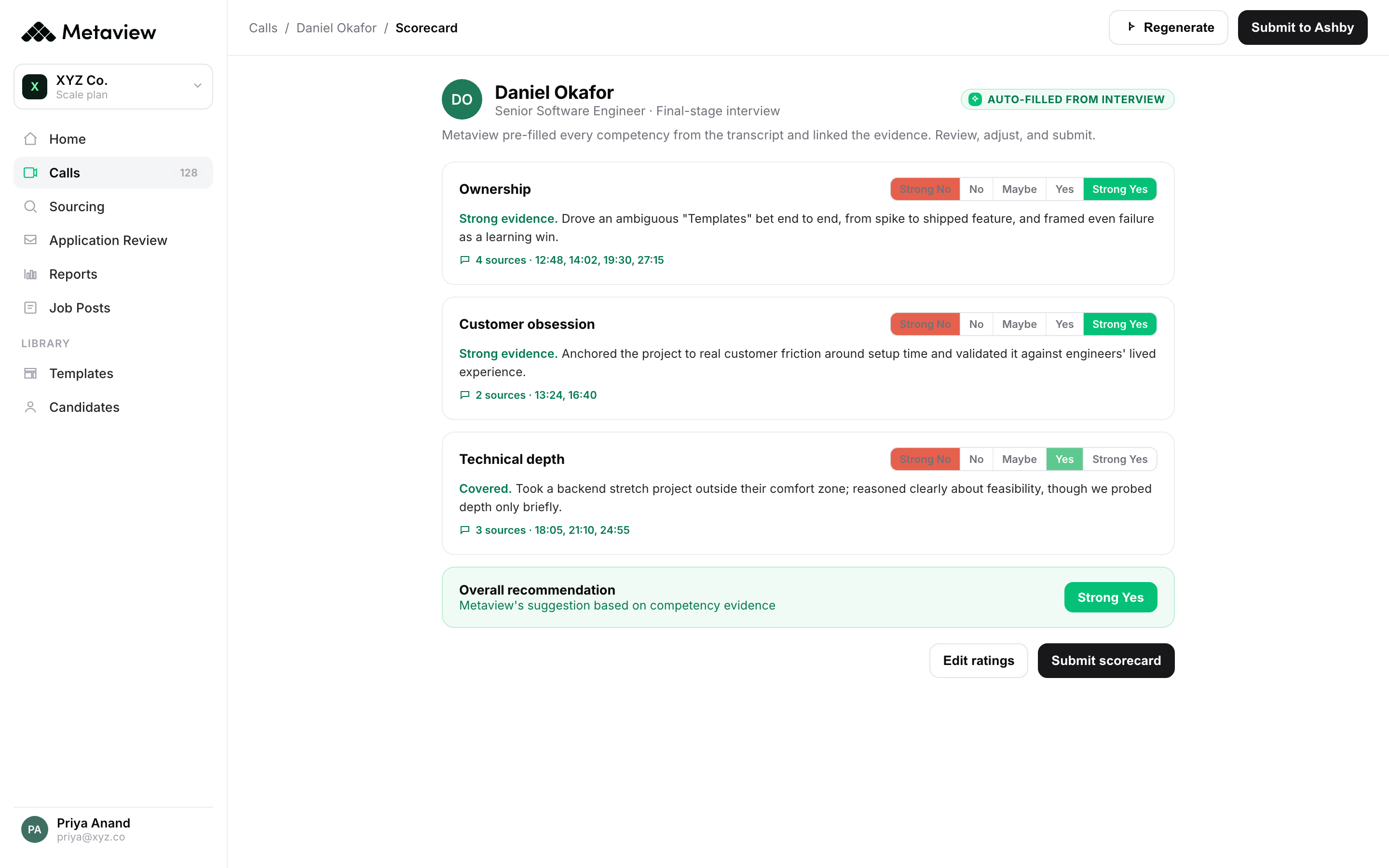
It is also why the questions and the method have to match. A great question scored against a vague rubric is back to gut feel with extra steps.
How to put it to work
You do not need all seven in one interview. Pick the four to six that map to the competencies the role actually needs, ideally set in the intake call, and spread them across the loop.
- Give each interviewer one or two competencies to own, so they go deep instead of trading broad impressions
- Score against the same rubric, during or right after the interview, never from memory
- Recalibrate the bar now and then with regular calibration, and pair the questions with competency-based interviewing
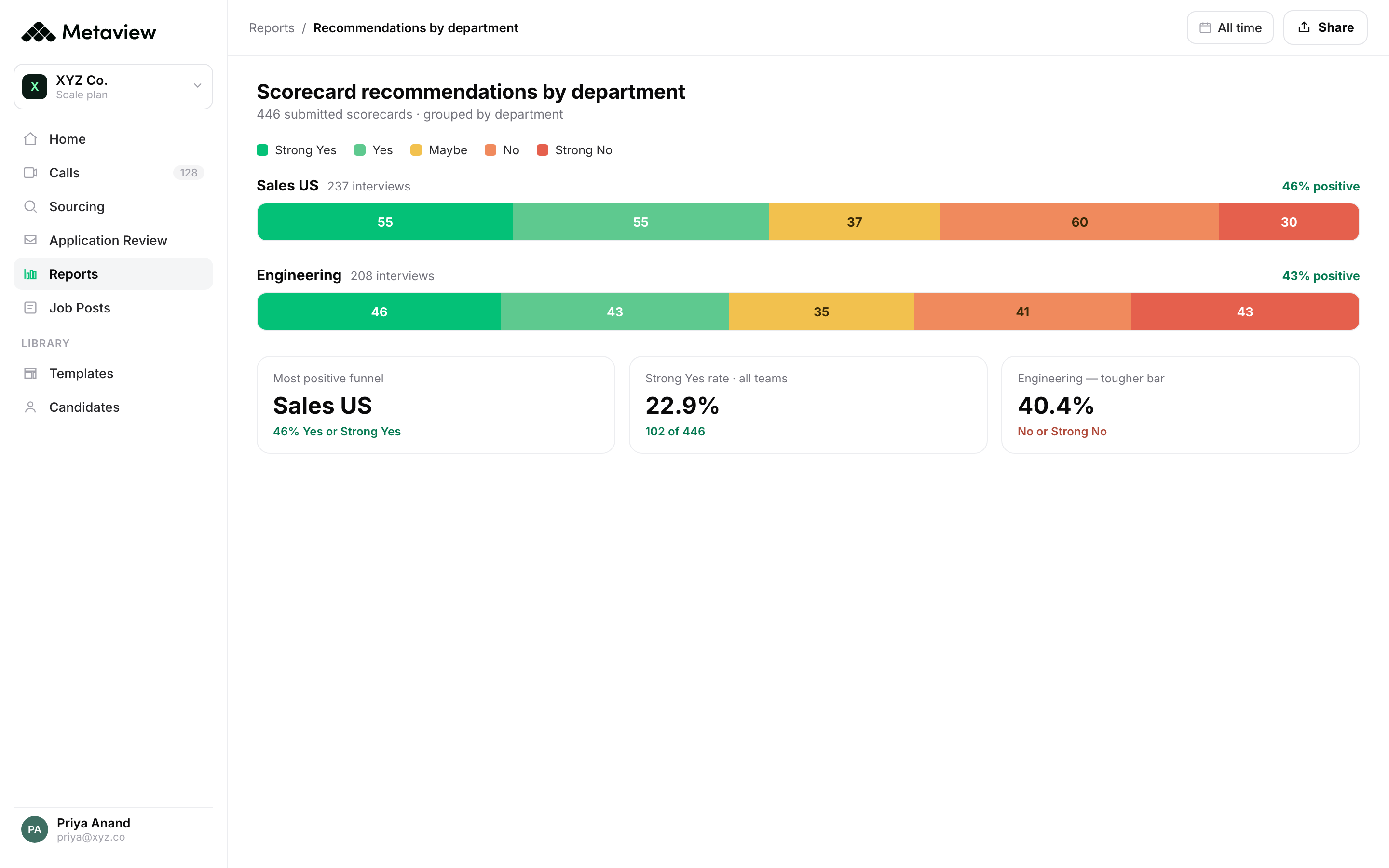
- Review how each question is scoring across the team in Reports, and cut the ones that never separate candidates
The best interviewers have always worked this way. They ask for evidence and they score it the same way every time. The questions on this list just give you a place to start, and capturing the answers is what makes them predict anything at all.
Bring Metaview into your hiring stack.
Live notes, structured scorecards, and ATS sync - set up in under 10 minutes.
Frequently asked
What interview questions actually predict job performance?
The ones that force evidence: a real project the candidate owned with what they personally did, a decision made under uncertainty, a job-relevant situational question, and a short work sample. The pattern matters more than the exact wording.
Do structured interviews predict performance better than unstructured ones?
Yes. Structured, evidence-based interviewing, where candidates are asked comparable questions and scored against a rubric, is one of the most predictive hiring methods and consistently outperforms gut-feel conversations.
How many questions should you ask to assess a candidate?
Enough to cover the four to six competencies the role needs, usually split across the loop so each interviewer owns two or three and can go deep with follow-ups rather than skimming everything.
Why don't good questions guarantee a good hire?
Because the question is only half of it. If answers are not captured and scored the same way for every candidate, the signal is lost to memory and bias, and even the best question predicts nothing.
How does Metaview help interview questions predict performance?
It captures every answer, writes structured notes against the competency each question is testing, and drafts the scorecard from what the candidate said, so the same question is scored the same way for every candidate.