
A candidate your team turned down has applied again. Now you have to decide whether to consider them, and how to assess them without holding the first rejection against them or waving them through because they came back.
Rejected candidates who reapply deserve a second look. To make it fair, give the new interviews one question to answer: has the candidate closed the gap, the specific thing they couldn’t show when the team turned them down?
I’d judge a returning candidate on what they show now, with the old rating kept away from the new interviewers, so the first rejection doesn’t follow them into the new loop.
The steps below follow the order you’ll need them in, starting with a policy you write before anyone reapplies and ending with what you tell the candidate. They work even when the record from the candidate’s first application says little more than “not a fit.”
Should you consider rejected candidates who reapply?
Yes, under a policy you’ve written down. People can close a gap in the months after a rejection, and a returning candidate who reached interviews last time gives you something no new applicant does: a gap to retest, if the first interviewers named one.
Reapplying shows, at most, that the candidate is still interested. Whether they’ve closed the gap is for the new interviews to find out.
Not every returning candidate was turned down for a gap. A finalist who lost out to a stronger candidate, or someone whose role the company paused, had nothing to fix, and I’d invite them back for the next opening with no wait.
Others apply to every opening you post with nothing new since last time, and I’d set their applications aside until enough time has passed for something to change.
How long each of them waits depends on why the team turned them down. The next section sets a window for each reason, so the team doesn’t have to argue each case from scratch.
Write the reapplication policy before you need it.
A reapplication policy says who can apply again and when. Write it before any particular candidate comes back, so the rule doesn’t bend to how the team feels about one person. Write it once and apply one policy to everyone.
Set each waiting window by how long a candidate would need to fix what they were turned down for. The window only decides when you look again, and the new interviews decide whether anything changed.
A skill that takes years to build earns a longer window than a credential the candidate could earn in a month. The table below covers five reasons a team might turn someone down, with what each window depends on and what to look for next time.
| Why your team turned them down | Waiting window | What to look for next time |
|---|---|---|
| A stronger finalist got the offer, or the company paused the role | None: invite them to the next opening | Nothing has to change |
| A specific skill was missing, one they can build | Long enough to build the skill and use it | Work that uses the skill, in a job or outside one |
| The role needed more scope than they had handled | Long enough to take on more scope | The scope they now own, in a job or outside one |
| A required credential was missing | As soon as they hold it | The credential |
| The application never reached an interview, or the first record gives only a conclusion such as “not a fit” | Whenever a new opening fits them | A closer match to that opening’s requirements |
Put a length on the two “long enough” rows before you publish the policy, so any recruiter can quote it and give a candidate a date.
The policy covers the candidates the team liked, too. If you waive a window for one favorite, every returning candidate after them waits out a window that someone else skipped.
Exceptions will still come up, so name one person who can approve them, such as the head of recruiting, and have that person write down the reason each time.
Check your retention policy before you set the windows. How long you may keep a rejected candidate’s interview records depends on where the candidate lives and what they agreed to, and a window that outlasts those records leaves nothing to read when the candidate comes back.
Find the gap in the first record.
With the policy set, the first job when a rejected candidate applies again is reading their first record. Do it before anyone books a new screen, because the gap you find there decides what the new interviews test.
Collect the scorecards and interview notes from the first loop, along with the rejection reason in your applicant tracking system (ATS). If the candidate was turned down before any interview, that reason is the whole record.
Then separate verdicts from gaps. A verdict is the team’s conclusion, such as “not senior enough” or “weak technically.” A gap is what the candidate couldn’t show, written specifically enough that a new interviewer could test it: “couldn’t explain how they’d prioritize a backlog with two projects competing for the same engineers.”
Where the first record holds only a verdict, go back to the interview notes for what was asked and how the candidate answered, and write the gap from those answers if the notes support one. Where they don’t, write “no testable gap on file.”
A rejection with no testable gap on file gives the new panel nothing specific to retest, and I wouldn’t count that rejection against the candidate.
Turn the gap into something the new interviews can test.
A gap helps only once somebody tests it, so turn it into a question or an exercise and give it one owner on the new loop.
Write the gap as one thing the candidate will be asked to do or explain. If the gap was prioritizing competing work, hand them a backlog with two projects on it and ask what they’d cut. If it was managing people, ask about a time since they last applied when they handled a struggling team member.
Use a fresh interviewer for that question: one person who has never met the candidate, so the answer is judged by someone with no earlier view of them.
Add a field for the question to that interviewer’s scorecard, where they record what the candidate said and how well it shows the skill. If your scorecard has no room for an extra field, add one. For a layout to adapt, use our “interview scorecard template.”
Run the rest of the loop at full length. A shorter loop assumes the first interviews covered everything else, and the role may have moved on since they ran.
Keep the old rating out of the new interviews.
Decide who sees what before the new interviews start. I’d keep the old rating away from the new panel, because knowing how the last panel scored someone can tilt what a new interviewer listens for.
Tell the interviewer who asks the gap question which skill to probe, in the same words you’d use for any other part of the interview plan: “test how they prioritize competing work.” Don’t mention the earlier gap: to that interviewer, it’s one more skill to test.
Where you can, fill the new loop with people who didn’t meet the candidate last time. If someone from the first loop has to take part, keep them off the gap question, since their view of this candidate formed the first time around.
Keep the old scores and the old verdict with you. If your ATS shows interviewers a candidate’s earlier applications, check who can see them before the new loop starts.
Have the panel score only what it hears now, and when their scorecards come in, line them up against the first record yourself.
Decide on the new evidence, and record whether the gap closed.
Make the hiring decision on the full new loop, and record whether the gap closed in one line, with the answer or exercise that shows it.
An open gap counts the way it would for a first-time applicant: where the role needs that skill, it’s a reason to decline again. A closed gap removes the old reason for the “no,” and the rest of the loop decides.
That line is also for whoever looks at this candidate next. Without it, a third application would arrive with a decision on file and no reason attached.
Two situations change what goes in that line: the role has changed since the first application, or the first loop left no testable gap.
If the role has changed, assess the candidate against the current requirements. Note which of the old gaps still apply to the current role and which no longer do, so anyone reading the record later can tell whether the role changed or the candidate improved.
If the first loop left no testable gap, decide on the new interviews alone, and write “no testable gap on file” in that line.
Tell the candidate what the new interviews showed.
A returning candidate has been through your process twice, so they’ve earned a specific answer whichever way it went.
If you move them forward or make an offer, tell them what they showed this time, in terms of the role’s requirements. It shows the candidate the second look was real.
If the gap is still open, name what’s still missing in terms of the role’s requirements, and say what the team would look for next time, without promising that another application would get further.
Whichever way it went, leave other candidates’ details and the interviewers’ private notes out of what you send.
Invite them to apply again only if the policy allows it and the team means it. If you do invite them, point them back to what’s still missing, so they know what to work on before they apply again.
If you want help with the wording, read up on writing rejection emails.
Where Metaview fits.
The hardest step above is reading the record of interviews that ran months ago, and we help with that from your next round of interviews onward.
Metaview is the Agentic Recruiting Platform. Our Notetaker records and transcribes an interview, then turns it into notes grouped by topic, so if a candidate applies again, their answers are on record.
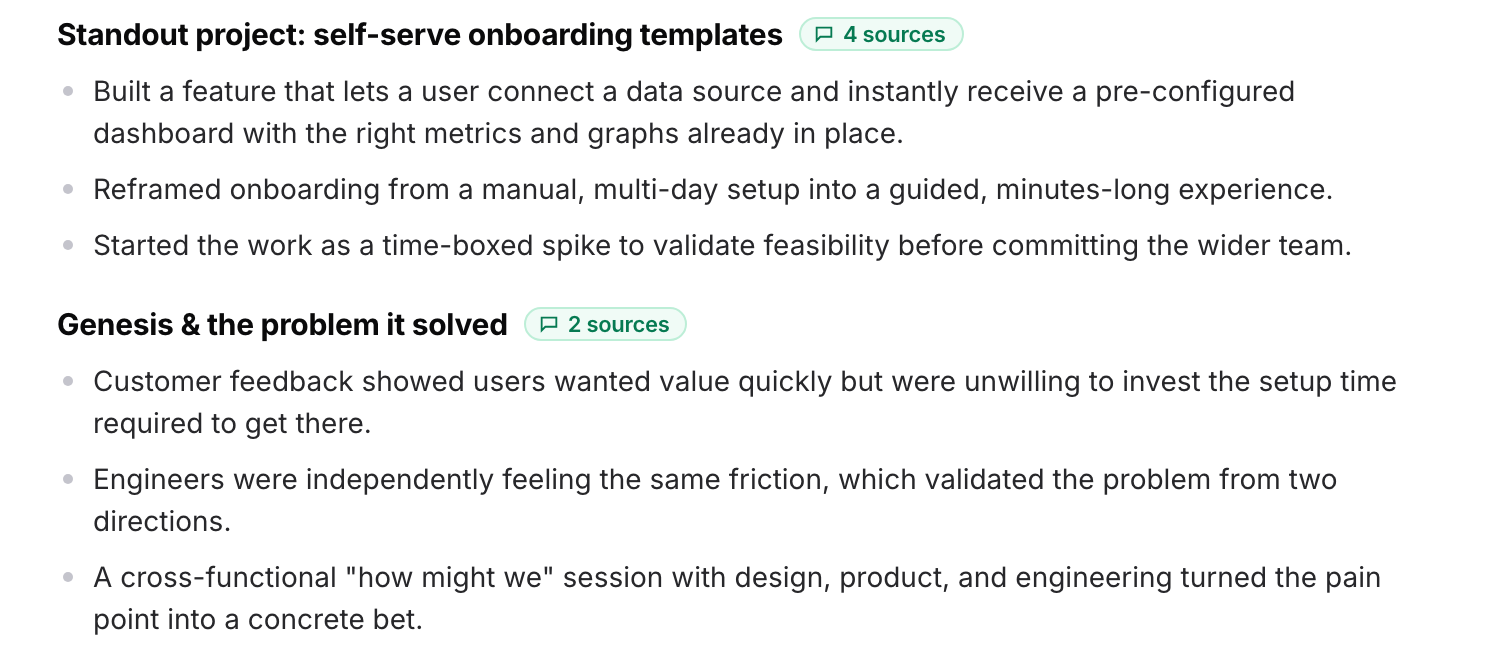
The Notetaker captures every spoken word. When the candidate applies again, you can find the question they struggled with and the answer they gave, and write the gap from that.
You can go back to a recording only if one was made, and that depends on consent. The candidate-facing copy reads: “If both you and the interviewer consent, you will see a ‘Metaview Notetaker’ appear as a participant during the interview.”
If a recording was made, how long it stays available follows your company’s own data settings, so check them against your longest waiting window.
Scorecards are the other part of the first record you read when a candidate returns. Metaview drafts one from each recorded conversation, and the interviewer edits the draft and submits it with their own rating, so the scorecard starts from what the candidate said.
The video below is about how interviews run when interviewers don’t have to take their own notes. For a returning candidate, the recording also leaves you a transcript of the first interviews to read.
For a candidate who reapplies, the Notetaker’s multi-source notes can combine the first interviews with the new resume into one notes document, so you read the old evidence beside the new application. The document covers only what you attach to it, and like the rest of the first record, it stays with you rather than going to the new panel.
Our Reports runs on your own interview data, so you can also see which competencies the interviewers in the first loop asked about. The view below counts the questions under each competency for every interview.
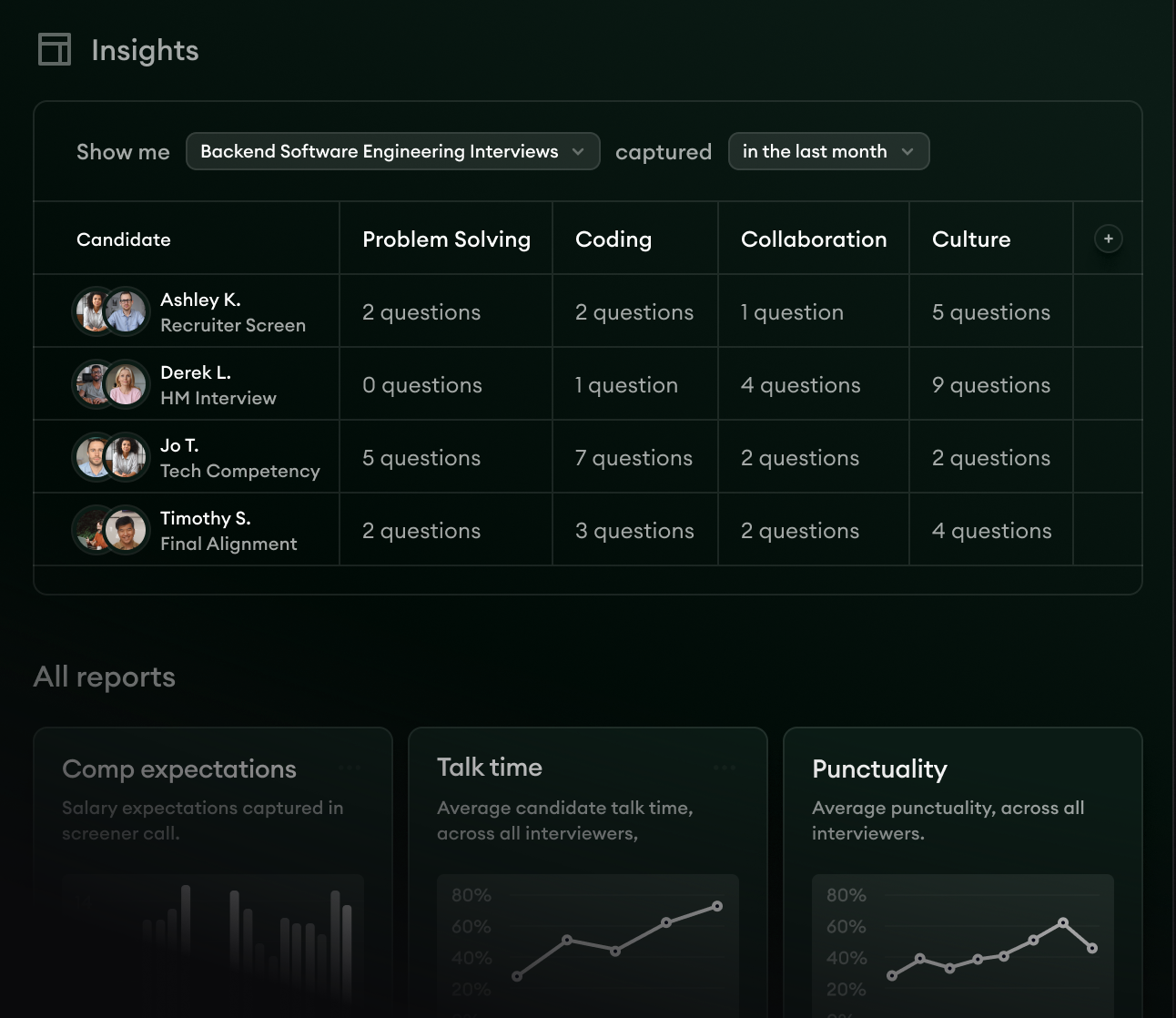
In that sample, the view counts no questions under “Problem Solving” in the hiring manager interview. If a rejection for weak problem solving leaned on that interview, read its transcript before anyone holds that reason against the candidate.
Recordings and reports show only what was said in the room. A doubt the interviewer never voiced reaches the file only if they write it down. Shahriar Tajbakhsh, our Co-Founder, made the case for writing those doubts down in a post on scorecards.
Interviewers shouldn’t be afraid to include hypotheses they didn’t get a chance to verify or falsify.”

A doubt the first panel wrote down but couldn’t test gives the next panel a gap to start from.
Your interviewers still rate the candidate, and your hiring team still decides.
Check how your last few returning candidates were assessed.
Pull the last few files for candidates who applied again, and look for four things, each with what to fix when it’s missing.
- A window you could quote. For each returning candidate, could you name the waiting period the policy set for their reason? If not, put lengths on the policy before the next application.
- A gap someone could test. Does each first record name one? If most hold only verdicts, change how interviewers write rejection reasons.
- A blind panel. Did any new interviewer see the old rating before scoring? If so, keep the first record with you from now on.
- A decision line. Does each decision say whether the gap closed? If not, add that line to whatever your hiring team writes down when it makes the decision.
Of the four, start with the testable gap, because interviewers write it at the moment of rejection, and it’s the hardest to add later. Ask interviewers to write a testable gap on every “no” from now on. When one of those candidates applies again, the next panel can judge them fairly, on what they show at that point and against a gap the first panel wrote down.
Find the gap to retest when a candidate reapplies.
See how the Metaview Notetaker records your interviews, and how Metaview Reports counts the questions each one asked per competency.
Frequently asked.
Should we consider a rejected candidate for a different role?
Yes, when their background fits that role. Assess them against the new role’s scorecard, and check whether the gap from their first application counts for that job, since a gap that sank them for one role can be irrelevant to another.
Are silver medalists the same as rejected candidates who reapply?
They overlap. A silver medalist reached the final round and lost to another finalist, while a reapplicant is anyone who applies again after a rejection at any stage. When your team goes back to past finalists on its own initiative, that’s candidate rediscovery. For that side of it, read about how to rediscover past candidates from earlier interviews and ATS records.
What if the candidate reapplies before the waiting window ends?
Reply with the date they can apply again and what would strengthen the next application. Interview them early only if the person who approves exceptions signs off and writes down why.
How should we handle a candidate who keeps reapplying?
If each application arrives inside the waiting window with nothing new, send one short reply naming the date and the gap, then set later applications for that role aside until the date passes.
What if the first rejection named more than one gap?
Write each gap as its own question and give each one an owner on the new loop. Record each as closed or still open, since closing one gap leaves the others standing. Weigh any that stay open against the role’s requirements.


