
Put the job spec for a role you hire for again and again next to its interview plan, and you can find the same criterion checked twice. It comes up once in the recruiter screen and again in the hiring manager interview, so the second stage spends interview time on evidence you already have.
The same spec can also hold a criterion that no stage checks at all. A phrase like “resilient self-starter” can stay on the spec for as long as the role is open, with no question written to test it. The scorecard still asks someone to rate it.
Both problems come from one decision that never got written down: what to screen for and what to leave to the interview. If you’re the recruiter or talent acquisition lead setting up the screen for a role like this, you lead that decision with the hiring manager. I’d make it one criterion at a time. Go down the job spec line by line and pick where each one gets checked, instead of starting from what a screen usually covers.
The tool for that is a criteria map. It’s a table with one row for each line of the job spec, saying how that line’s evidence is gathered and what the evidence can’t show. Below is one filled in for a sales development role with both faults visible, followed by four checks to run on your own map before the next requisition opens.
What to screen for and what to interview for.
Screen for the criteria a candidate can show by answering questions you plan in advance, such as why they want the role or how they’d handle a common price objection. Score each answer against a written rubric that’s the same for every candidate, because that shared rubric is what makes their answers comparable.
Leave reactions to the interview: the criteria where the interviewer’s own reaction is part of the test. For example, the interviewer gives feedback on a role-play and watches the candidate try again. That’s different from a follow-up question in a screen, which asks the candidate to say more about the same answer. Feedback gives them something new to respond to, and what they do with it is the evidence.
Some criteria need neither stage. If a “yes” or a “no” settles a requirement, such as whether the candidate can work the required schedule, ask it on the application. Check a hands-on task, like logging an activity in a sales database, with a practical test.
For questions and follow-ups to use in the screen, start with our list of screening interview questions.
Build a criteria map for the role.
Here’s how to fill in a criteria map for one role, one column at a time. The rows follow the job spec line by line, and that’s what catches both faults: a plan built stage by stage lets a criterion land in two stages or in none.
Start from the job spec for a role you fill often. Copy every line into the first column as written, vague phrases included, since those are the lines interviewers end up rating on instinct.
At the intake meeting, agree with the hiring manager on what behavior each phrase means, and rewrite the line as that behavior. Leave any phrase the two of you can’t define as it is for now, so the map shows it as a criterion no stage checks. The questions and agenda for that meeting are in our recruiter intake meeting template.
Next, give each criterion one instrument, which is where its evidence comes from:
- Application materials, meaning the resume and the application questions
- A short structured conversation, such as the recruiter screen
- A standalone work sample
- An interview with the hiring manager or a panel
- A practical or physical test
The map records the instrument rather than the stage, because one stage can hold two kinds of check, such as a short conversation and a written task sent afterward.
I’d pick the cheapest instrument that still gives you evidence you can compare across candidates and trust enough to decide on. Cost here means the recruiter’s and the interviewers’ time, plus the candidate’s effort.
Beside the instrument, record the format, which is how the candidate hands the evidence over, such as a spoken answer or a written one.
A written answer doesn’t always mean a separate instrument. If the candidate drafts an email during the call, that’s written work inside the conversation. An account plan they research and send afterward is a separate piece of work, so it counts as a work sample.
Use the last two columns for what you learn and what the evidence can’t tell you. In the sales example below, one answer to one price objection shows how the candidate handled that objection. Whether the approach holds up on real prospect calls is a separate question.
Write down each answer’s limit in the “what it can’t tell you” column, so the debrief doesn’t read one narrow answer as proof of more than it shows.
A criteria map for a sales development role.
Here’s the map for a sales development representative (SDR) role, which uses every instrument. Each line that began as a vague phrase is written as the behavior the team agreed at intake, except one that was never defined. Two rows are wrong on purpose, to show the two faults this article opened with: a criterion checked twice, and one no stage checks.
| Criterion | Instrument | Format | What you learn | What it can’t tell you |
|---|---|---|---|---|
| Authorized to work in the role’s location | Application materials | Declaration | Their answer to a clear eligibility question | Whether their documents are valid |
| Available for the required schedule | Application materials | Declaration | Their stated availability | Whether it changes later |
| Prior outbound sales experience | Application materials | Declaration | What they say about the scope of that experience | Whether they can sell, or what their results were |
| Explain why they want this SDR role | Short structured conversation | Spoken answer | Whether their reasons are specific to the work | Whether that motivation lasts through repeated rejection |
| Explain an unfamiliar product clearly | Short structured conversation | Spoken or video answer | How they organize an explanation of the same product every candidate is given | How they’ll handle a live prospect call |
| Handle a common price objection | Short structured conversation | Spoken answer to a scenario | Their approach and wording in one defined situation | Whether it holds up on real prospect calls |
| Write a short prospecting email | Short structured conversation | Written answer | Their written judgment and editing choices | How they communicate aloud or follow up |
| Respond to a rejected outreach attempt | Short structured conversation | Spoken answer to a scenario, with a follow-up question | How they handle a defined setback and pick a next step | How they respond to rejection over several weeks |
| Explain a recent sales challenge | Short structured conversation, and again in the hiring manager interview | Spoken answer | How clearly they tell a story about their own work | Whether the story is accurate |
| Apply feedback in a second role-play | Hiring manager interview | Live role-play | How they use feedback on the next attempt | How they behave outside the role-play |
| Log an activity in the sales team’s customer database | Practical test | Live task | Whether they complete a defined task in a test account | Their speed or accuracy under a real workload |
| Research an account and send an outreach plan | Standalone work sample | Written plan, sent afterward | How they turn account details into a written plan | How they’d explain the plan in a live conversation |
| “Resilient self-starter” | None, as written | None | Nothing comparable | Anything, until the team defines the behavior |
In the sales-challenge row, the recruiter screen and the hiring manager interview both ask for a story about a recent sales challenge and score how it’s told. That’s the first fault, one criterion checked twice.
The second fault is “resilient self-starter,” a criterion no stage checks, because the team never said what behavior it means.
Give each repeated criterion one owner.
Fix the first fault by giving the criterion one owner. In the map, the owner is the single instrument that gathers its evidence, so the recruiter screen and the hiring manager interview can’t both own it.
The repeat is easy to fall into, because each question is reasonable on its own. The recruiter asks for a recent sales challenge to hear how clearly the candidate tells a story. Later, the hiring manager asks the candidate for another sales challenge and ends up testing the same skill again.
I think hiring managers ask again for two reasons: they want to hear the candidate firsthand, and they worry the recruiter missed something. A written rubric makes a miss less likely, because it tells the recruiter what to listen for. The hiring manager can read the recruiter’s notes on the answer, and they’ll still hear the candidate firsthand on the criteria only the interview can test.
So where two stages ask for the same behavior, keep the cheaper instrument, as long as its evidence is still comparable, and cut the other question.
Sometimes the hiring manager asks a similar question to test a different behavior. Asking what the candidate would do differently in the sales challenge they just described, for example, shows how they learn from it. Give that behavior its own row and its own line in the interview’s rubric. For examples of rubric lines, use the step-by-step walkthrough of interview rubrics on our blog.
Define or delete the criteria no stage checks.
The opposite fault is harder to spot, because nothing on the scorecard looks missing. Look for scorecard lines with no instrument behind them, since each one still gets a rating in the debrief.
“Resilient self-starter” has no planned question and no shared evidence, so two interviewers’ ratings of it can’t be compared. I’d define it or delete it.
Defining it can be quick. If the team means responding to a rejected outreach attempt and picking a sensible next step, the map already has that row. Swap the phrase for that behavior in the spec, and fold its scorecard line into the rejected-outreach line. If the team can’t say what behavior it means, take the phrase off the spec and the scorecard.
The walkthrough of skills-based hiring on our blog shows how to turn a trait like “resilient self-starter” into a skill you can check.
Look again for scorecard lines with no instrument whenever the criteria change, and keep a new criterion off the scorecard until its row is complete.
What to leave to the interview.
Once you’ve given the earlier stages every criterion they can check, the interview keeps only the ones that need the interviewer’s reaction. In the SDR map, that’s only the second role-play, because the evidence is what the candidate does with feedback from someone who just watched their first attempt.
Other roles add criteria like that. Leading a discussion with an executive about an ambiguous decision belongs in the interview, because the evidence is how the candidate responds when a senior person pushes back. I’d give those criteria to an interviewer who knows the work well enough to react the way a real counterpart would.
The interview can also pick up where the earlier stages stopped. Before it starts, hand the interviewer the limits from the map’s “what it can’t tell you” column, choosing the ones a live conversation could answer. The outreach plan arrived in writing before the interview, for example, so the interviewer can ask the candidate to walk through it and push back on one choice.
No interview can settle the rest, such as whether the price-objection approach would work with real prospects, so carry those into the debrief as stated limits.
The interview has one more job besides the criteria: leave room in it for the candidate’s own questions. By this stage a strong candidate is weighing whether to join, and I’d want them to hear from the hiring manager they’d work for.
Where Metaview fits.
Two of the instruments on your map, the short structured conversation and the hiring manager interview, line up with products we build at Metaview, the Agentic Recruiting Platform. Our Screening runs the conversation rows, and our Notetaker records the interviews.
Screening isn’t built for executive search or for highly bespoke assessment loops, so for those roles the conversation rows stay with a recruiter.
Screening holds a voice-led screening conversation with each candidate your team chooses to assess. It generates an assessment plan for the role, built from the role’s job post or an existing screening call, with questions that each carry their own written rubric. Your team can edit the rubrics and preview the whole call before anything goes out, which is the moment to check the plan against your map’s conversation rows.
During the call, Screening tailors the plan’s questions to the candidate’s resume and follows up when an answer is thin, and the candidate can ask questions back. Screening scores every answer against its question’s rubric, which keeps the evidence comparable across candidates.
The plan’s questions can take a spoken or a written answer, and video is optional unless your team requires it. That lets the spoken and written rows in the SDR map sit in the same call.
After each completed call, the recruiter gets an assessed fit with the reasoning behind it, the recording, and a transcript mapped question by question. For every completed call, a recruiter decides who moves forward, and Metaview does not make that decision.
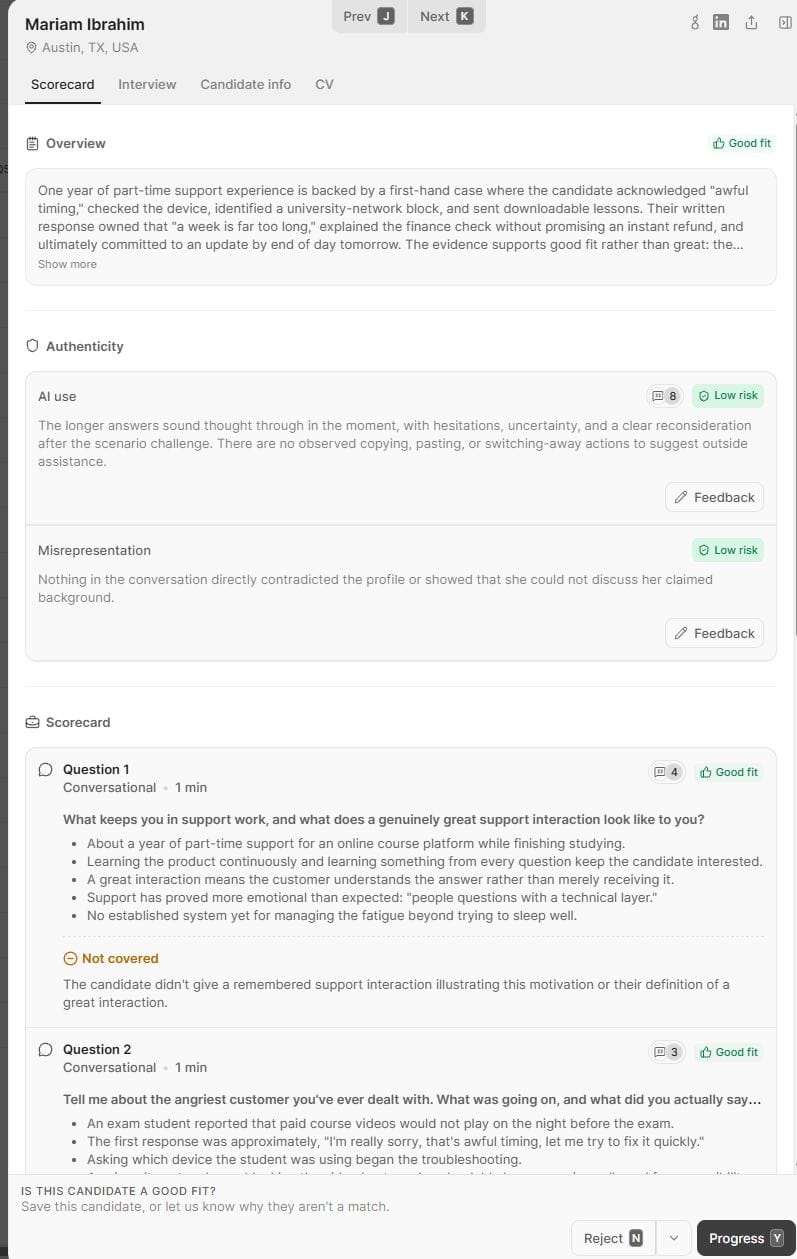
In this example, the first question is rated “Good fit” and still carries a “Not covered” note for one thing the answer left out. The recruiter can see what that answer didn’t cover before deciding.
Screening covers the conversation rows, but the hiring decision draws on every row of the map, the interviews included. Our Co-Founder and Chief Technology Officer, Shahriar Tajbakhsh, has written about what the loop as a whole has to provide:
One interview can’t get all of the signal needed to make a hiring decision, but the collection of all interviews for any given candidate must provide the necessary information.”

Each interview adds to that collection through its notes. For the interview rows, our Notetaker joins the video interview as a visible participant, and where your team’s consent process allows, it records and transcribes the interview.
Because our Notetaker captures every spoken word, the interviewer can stay in the role-play instead of taking notes. The scorecard draft our Notetaker prepares starts from what the candidate said, and the interviewer reviews it before submitting.
Four checks before the next requisition.
Before the next requisition for this role opens, read your map against the scorecard and the interview plan:
- Does every scorecard line have a row with an instrument? If not, define the behavior or delete the line.
- Does any behavior have two owners? Keep the cheaper instrument, if its evidence is still comparable, and cut the other question.
- Is the “what it can’t tell you” column filled in for every row? If not, fill it in now, so the debrief doesn’t read one narrow answer as proof of more than it shows.
- Does the interview plan cover the “what it can’t tell you” entries a live conversation could answer? If not, add them, so the interviewer has something new to ask instead of the screen’s questions.
If your map fails more than one check, I’d start with the unchecked criteria, since defining or deleting a line takes one conversation with the hiring manager.
Once every row has one owner, and that owner is the cheapest instrument that works, the interview is left with the criteria that need an interviewer’s reaction.
Run the screen your criteria map calls for.
Screening runs the conversation rows of your map, and a recruiter reviews the assessed fit and its reasoning from every completed call.
Frequently asked.
What’s the difference between a phone screen and an interview?
A phone screen is the short first conversation a recruiter uses to decide who goes further. An interview comes later, with the hiring manager or a panel, and suits the criteria where the interviewer’s reaction is part of the test, such as how a candidate handles pushback. It also lets the candidate meet the people they’d work with.
Can knockout questions replace a screening call?
No, because they cover a different kind of requirement. A knockout question settles something with a “yes” or a “no,” like work authorization, and that answer carries no evidence about how a candidate explains a product or handles an objection. Knockouts belong on the application form, and the call is for criteria that need a fuller answer, spoken or written, scored against a rubric.
Should you screen for culture fit?
Only if the team can name a behavior that a planned question can draw out. “Culture fit” with no definition gives interviewers something to rate and no evidence to rate it on. If the behavior the team means depends on an interviewer’s reaction, such as how someone takes feedback, it belongs in the interview instead.
Who should decide what gets screened and what gets interviewed?
The recruiter decides and keeps the criteria map, after agreeing each row with the hiring manager at the intake meeting. When the spec or the scorecard changes, the recruiter updates the map and checks the change with the hiring manager, so everyone hiring for the role works from the same version.
Can you reuse screening criteria across roles?
Only where two roles ask for the same behaviors, and even then, check each criterion against the new role’s job spec at its intake meeting. The ways you check carry over more easily, since a short structured conversation or a work sample works for many roles.


