
Modern outbound recruiting seems like it’s getting easier. Recruiters have access to enormous professional networks, talent databases, previous applicants, referrals, and increasingly powerful AI search tools.
Type in what you're looking for and you can have hundreds (or thousands) of plausible profiles in seconds.
But a list of 500 potential matches still leaves you with 500 people to evaluate. Which means you’re still a long way from finding the right people to reach out to.
The better AI candidate discovery tools now do more of the narrowing. They read the role, research the people behind the profiles, learn what a hiring team considers good, and cut the list to the people worth your time.
This guide compares 10 AI candidate discovery platforms, from AI-native search tools to systems that can autonomously find and engage candidates.
In brief: the 10 best AI candidate discovery tools.
| Tool | Best for | Discovery approach | Recruiter effort |
|---|---|---|---|
| Metaview | Complete AI candidate discovery | Context-aware sourcing, application review, and screening | Low |
| fillmore | Autonomous candidate discovery | Autonomous sourcing, research, outreach, and scheduling | Very low |
| Juicebox | Natural-language candidate search | AI-powered conversational search | Medium |
| SeekOut | Deep talent search | AI search and talent intelligence | Medium |
| Findem | Data-driven discovery | Attribute-based candidate search | Medium |
| hireEZ | Discovery and outreach | AI sourcing and candidate matching | Medium |
| LinkedIn Recruiter | Professional network data | AI-assisted search and recommendations | High |
| Eightfold AI | Skills-based matching | AI talent intelligence and skills matching | Medium |
| Gem | Candidate rediscovery | CRM data, search, and outreach | Medium |
| AmazingHiring | Technical candidate discovery | Specialized technical talent search | High |
What is AI candidate discovery?
AI candidate discovery uses artificial intelligence to find, evaluate, and prioritize potential candidates based on what your hiring team cares about most.
Traditional sourcing relies heavily on keywords, filters, job titles, and Boolean searches. These are useful ways to narrow a database, but they put most of the interpretation on the recruiter. You define the search, review the results, work out why each person might fit, and continually adjust your criteria.
AI candidate discovery platforms can interpret natural-language requirements, search across large candidate datasets, research individual profiles, identify less obvious matches, and prioritize candidates based on relevance.
They can also discover passive candidates before they apply, and identify promising people already sitting in your applicant pool. That's increasingly important as application volumes rise and strong candidates become harder to spot among hundreds of superficially similar resumes.
What makes a good AI candidate discovery platform?
Candidate discovery tools have traditionally competed on reach: bigger databases, more profiles, more filters.
Those things still matter. But when virtually every platform can surface a large pool of plausible candidates, precision becomes much more valuable than volume.
When comparing AI candidate discovery platforms, look at:
- Understanding your hiring bar: Strong tools should know company context, hiring manager preferences, and key criteria behind who your team actually progresses. And ideally, they should improve that understanding with time.
- Candidate relevance: Look at how much narrowing the platform does for you. Twenty well-researched candidates can be far more useful than 2,000 loose matches.
- Search depth: AI should be able to uncover candidates who don't fit an obvious title-keyword combination, particularly for unusual or hard-to-fill roles.
- Candidate intelligence: A useful result should tell you more than where someone works. Look for research and context explaining why a candidate could be relevant.
- Learning from feedback: Your first search shouldn't be your best search. The platform should get sharper as recruiters and hiring managers approve, reject, and discuss candidates.
- Inbound and outbound coverage: Great candidates can be people you've proactively found, previous prospects, or applicants already waiting in your ATS.
- What happens next: Some platforms stop at a profile. Others can help with outreach, application review, screening, or moving promising candidates into the hiring process.
Ultimately, the best AI candidate discovery tool isn't necessarily the one that finds the most people. It's the one that leaves you with the fewest irrelevant ones.
10 best AI candidate discovery tools and platforms.
Different tools take very different approaches to finding the right people. Some give recruiters smarter ways to search huge talent pools, while others take over the research, evaluation, and narrowing, or even run the discovery process autonomously.
Here's how the 10 platforms in this guide compare:
1. Metaview: complete AI recruiting platform.
Metaview approaches candidate discovery differently from a traditional sourcing platform. Instead of starting with the biggest possible database and leaving recruiters to narrow it down, its AI agents use the context behind the role to identify who is actually worth considering.
That happens on both sides of the funnel.
For outbound hiring, Metaview Sourcing agents take the role criteria, company context, and hiring manager preferences into account when looking for potential candidates. They research prospects in depth and build focused shortlists, rather than handing recruiters another enormous collection of profiles to work through.
The sourcing agent works from one plain-language prompt and searches the web, your connected ATS, and your own past Metaview conversations, so people already in your ATS or interviewed before come up alongside new prospects. Across Metaview sourcing searches, the median shortlist is 48 candidates, and the first shortlist lands a median of 17.6 minutes after the intake call ends.
Metaview's Application Review agent reviews every inbound application against the specific criteria for the role, helping you surface strong applicants who might otherwise get buried in the queue. AI Screening adds another layer when the resume doesn't tell you enough. Candidates can have a structured, conversational screen where the agent asks relevant follow-ups and gathers signals around areas such as motivations, communication, and situational or behavioral questions.
The advantage is shared context. Metaview connects sourcing, application review, screening, human interviews, and reporting, and every agent works from the same hiring context.
Learning from feedback has a concrete form here. As recruiters accept and reject applicants in Application Review, the agent learns from those decisions and suggests refinements to the role's Ideal Candidate Profile, and a recruiter approves each change before it applies to the list.
Key features
- Context-aware AI sourcing: Finds and prioritizes candidates based on role criteria, company context, and hiring manager preferences.
- Targeted candidate shortlists: Focuses recruiter attention on highly relevant prospects rather than producing another huge talent pool to review.
- AI Application Review: Reviews every inbound application against the hiring criteria and surfaces promising candidates who could otherwise get buried.
- Conversational AI Screening: Gives candidates an opportunity to demonstrate qualities beyond their CV through structured, adaptive screening conversations.
- Candidate fraud detection: Flags likely fraudulent applications so recruiters can spend more time evaluating genuine candidates.
- Connected hiring intelligence: Carries context across sourcing, screening, interviews, and hiring decisions so candidate discovery gets smarter throughout the process.
Pricing: Per agent, with a free tier for each agent and paid plans priced by agent rather than one platform fee. Current plans are on metaview.ai/pricing.
2. fillmore: autonomous candidate discovery and outreach.
fillmore takes the idea of targeted candidate discovery a step further: the recruiter doesn't need to run the search at all.
Give fillmore a job description, notes, or a plain-language description of the role. The agent maps the market, researches each prospective candidate's professional background, career history, and fit against your brief, and builds the target list for the search.
The research comes before any message goes out. fillmore reads each person's background and career history against the brief first, which is the work a recruiter would otherwise do by hand before deciding whom to contact.
And it doesn't stop at discovery. fillmore creates individualized outreach for each person, follows up across channels, and books interested candidates directly onto your calendar.
Recruiters run it from Slack, with no separate dashboard. They refine the search, adjust the outreach, review the pipeline or pause a campaign there, approve or decline a booking in one tap when a candidate wants to talk, and set rules for what the agent can and can't do.
Which makes candidate discovery as hands-on or hands-off as you want.
Key features
- Autonomous sourcing: Maps the market and finds prospective candidates from a job description, notes, or a plain-language brief, without a recruiter building and running searches.
- Deep candidate research: Reads each prospective candidate's professional background, career history, and fit against your brief before any outreach goes out.
- Target lists: Builds the list of people to contact for the search, which recruiters review in Slack.
- Personalized outreach: Writes each message from scratch for one person, across email, LinkedIn, and WhatsApp.
- Follow-up and scheduling: Manages the follow-up conversations over time and books screening calls with interested candidates onto your calendar.
- Slack-native control: Recruiters refine searches, adjust outreach, review the pipeline, pause campaigns, and set rules for what the agent can and can't do, all in Slack.
Pricing: Talk to the team for details.
3. Juicebox: natural-language candidate search.
Juicebox is an AI platform best known for PeopleGPT, its conversational approach to candidate search. Instead of building Boolean strings or stacking filters, recruiters describe the person they're looking for in natural language and use AI to find relevant candidates.
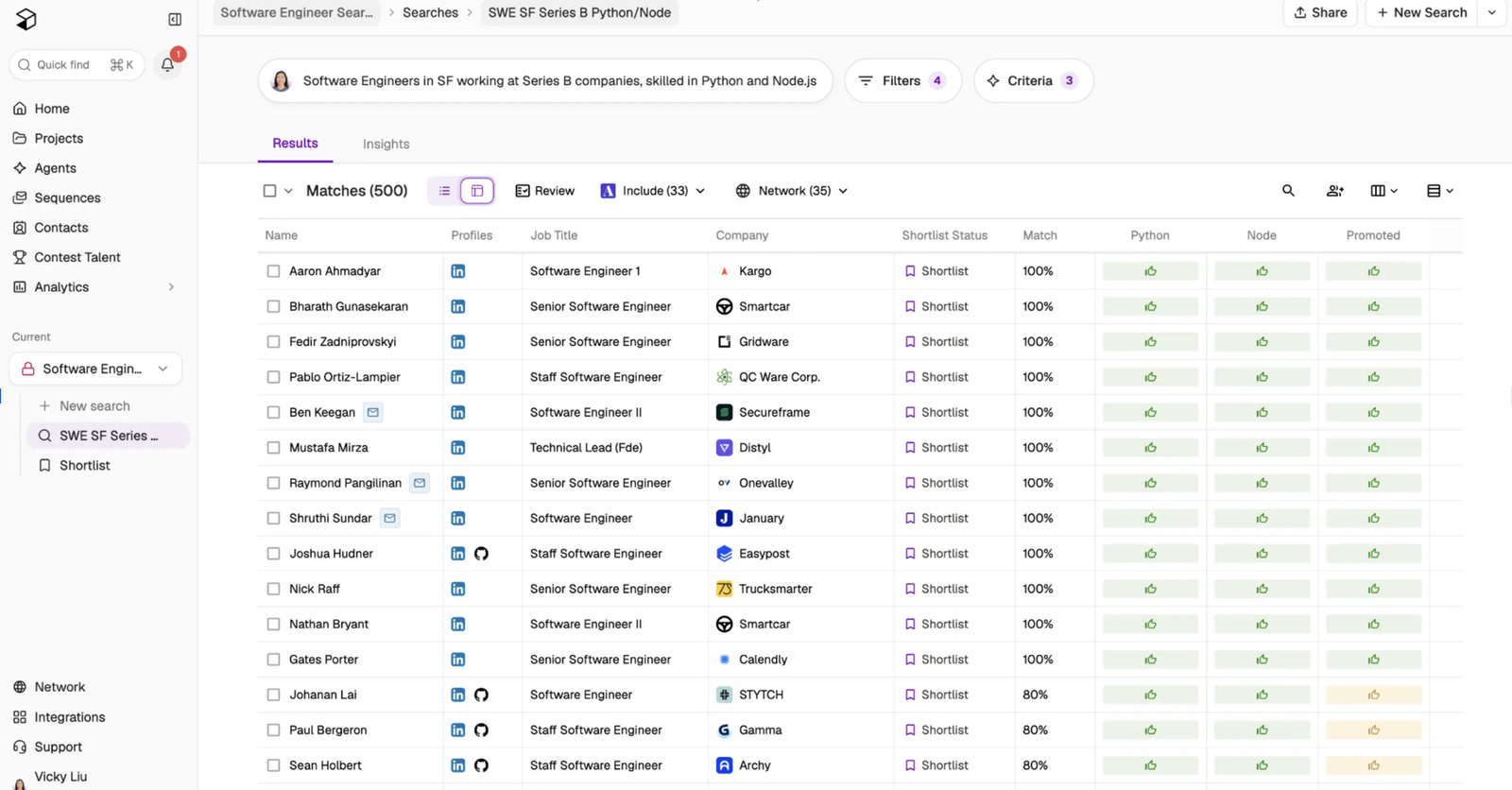
That makes Juicebox useful for searches that are difficult to reduce to a few job titles, companies, or keywords. Recruiters can describe more nuanced requirements, refine searches conversationally, and use AI to research and understand the resulting candidates.
Juicebox also extends beyond discovery with enrichment and outreach capabilities, so recruiters can move from finding someone to engaging them without starting again in another tool.
Key features
- Natural-language search: Lets recruiters describe the candidates they want without constructing complex Boolean queries.
- PeopleGPT: Uses conversational AI to interpret hiring requirements and discover relevant talent.
- Candidate research: Provides additional context to help recruiters understand potential matches.
- Search refinement: Allows teams to iteratively adjust candidate criteria through conversational inputs.
- Profile enrichment: Adds candidate information to give recruiters a more complete view of prospects.
- Outbound engagement: Helps teams move from discovering candidates to contacting them.
Pricing: Free trial available; Starter from $99/user per month; Growth from $179/user per month.
4. SeekOut: deep talent search.
SeekOut is a talent sourcing and intelligence platform to search across large candidate datasets and uncover people who can otherwise be difficult to find. Its AI-powered search lets you describe the talent you’re looking for and explore candidate pools based on search criteria and talent data.
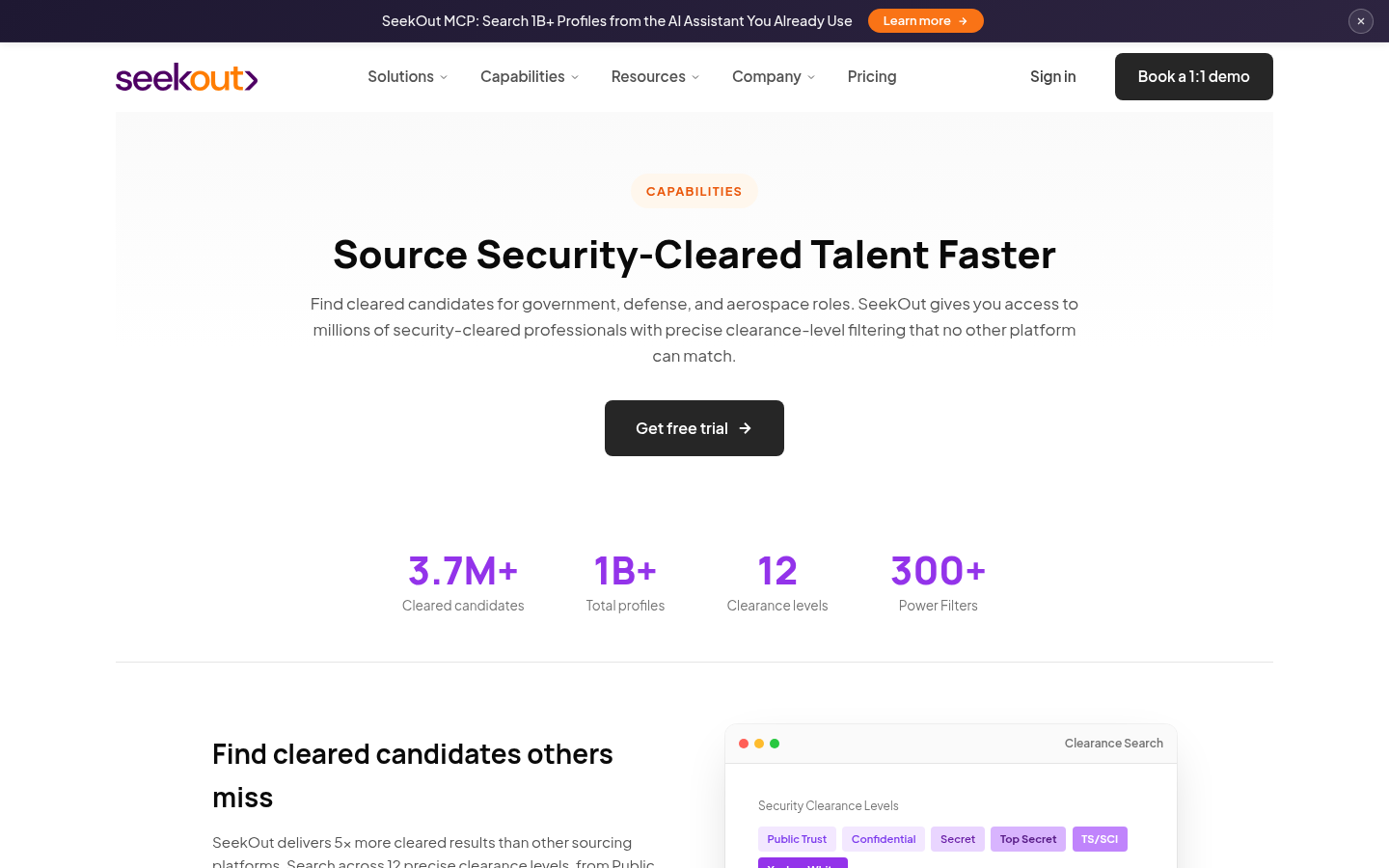
SeekOut also brings additional talent intelligence to candidate discovery. Teams use its data to understand talent pools, skills, and workforce availability.
The core strengths here are depth and reach. SeekOut gives recruiters powerful ways to explore a large universe of potential candidates. But the recruiter still has to direct the search, assess the resulting profiles, and decide where to invest their time.
Key features
- AI-assisted talent search: Helps recruiters discover candidates using AI alongside advanced search functionality.
- Deep candidate data: Gives teams access to extensive professional information for researching potential hires.
- Specialized talent discovery: Supports searches for difficult-to-find and specialized candidates.
- Talent intelligence: Provides insights into talent pools, skills, and workforce availability.
- Advanced filtering: Lets recruiters narrow broad candidate populations using detailed search criteria.
- Candidate engagement: Supports moving selected prospects from discovery into outbound engagement.
Pricing: SeekOut Recruit Core starts at $149/month. Custom plans are available by request.
5. Findem: attribute-based candidate discovery.
Findem takes a data-driven approach to candidate discovery, using “attributes” to help teams search beyond basic job titles and keywords. These attributes combine signals about a person's experience, skills, career history, and other professional characteristics.

That lets recruiters describe more complex candidate requirements and build talent pools around combinations of qualities that can be difficult to express through conventional filters.
Findem combines this approach with AI search, enriched candidate profiles, talent intelligence, and engagement capabilities. It can also help you explore both external talent and rediscover existing candidates, often more efficient than running a whole new outbound search.
Key features
- Attribute-based search: Finds candidates using combinations of professional characteristics rather than keywords alone.
- AI candidate discovery: Helps recruiters translate complex hiring requirements into relevant talent pools.
- Enriched talent data: Combines multiple data signals to build more detailed candidate profiles.
- Talent intelligence: Helps organizations analyze talent populations alongside individual candidate searches.
- Internal and external discovery: Supports finding talent both outside the organization and within existing candidate or employee populations.
- Candidate engagement: Connects talent discovery with downstream engagement workflows.
Pricing: Book a demo for details.
6. hireEZ: candidate discovery and engagement.
hireEZ combines AI-powered candidate sourcing with contact data and engagement tools. Recruiters move from discovering potential candidates to reaching out without stitching together several separate platforms.
Describe who you’re looking for, search across a broad talent pool, and use AI matching to identify relevant prospects. Once you’ve found the right people, you’ll find contact information and be able to move candidates into engagement workflows.
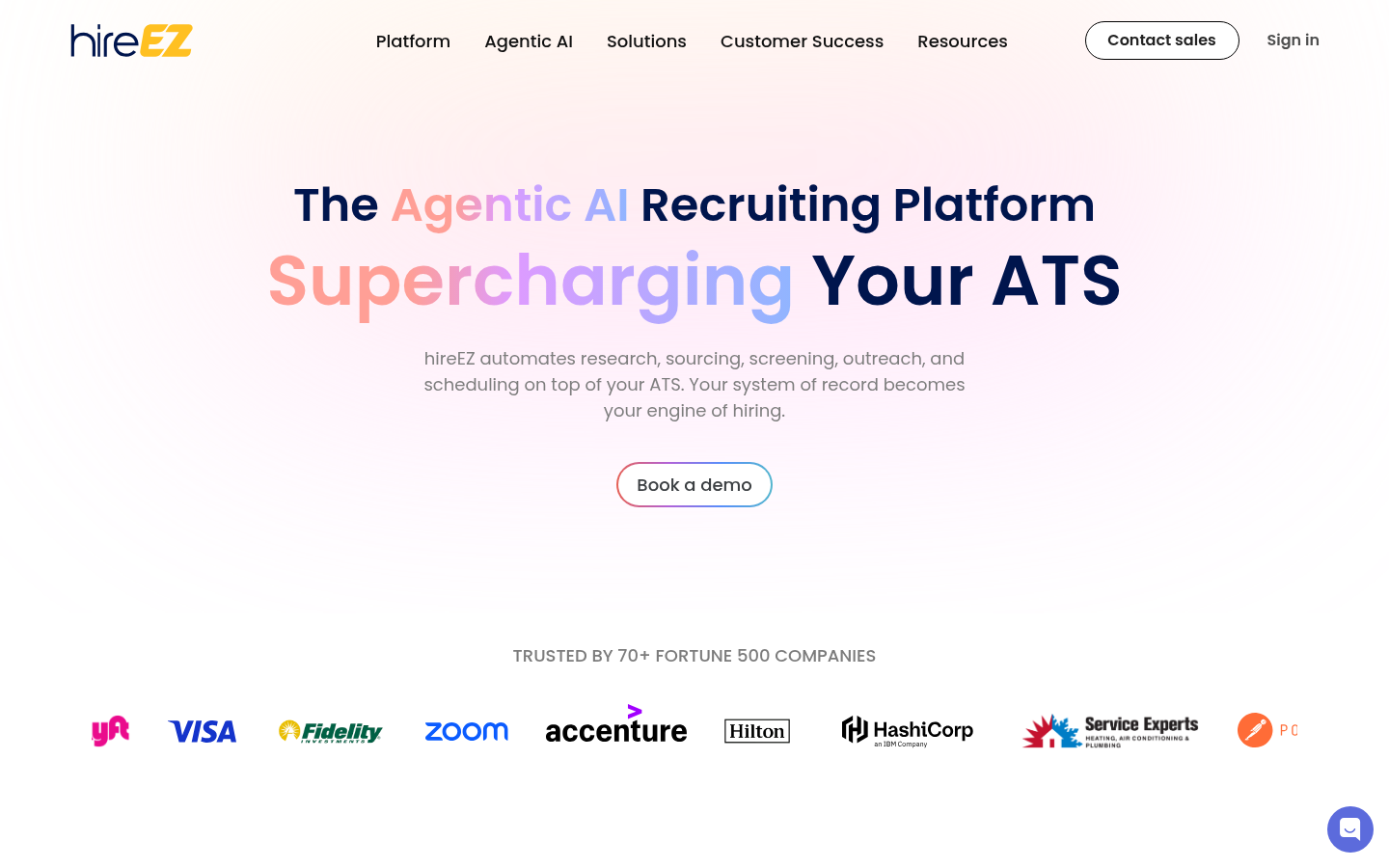
That makes hireEZ particularly useful when the goal is to make the entire sourcing-to-outreach process more efficient, rather than improving search alone.
There's still a meaningful amount of recruiter involvement. hireEZ helps teams search, match, and engage candidates faster, but recruiters remain responsible for directing the process and deciding which results deserve attention.
Key features
- AI candidate sourcing: Uses AI to identify potential matches across a broad talent pool.
- Candidate matching: Helps prioritize prospects based on the requirements of an open role.
- Profile enrichment: Brings together candidate information from multiple sources for easier evaluation.
- Contact information: Helps recruiters find the details needed to reach promising prospects.
- Candidate engagement: Lets teams move discovered candidates directly into outreach workflows.
- Recruiting integrations: Connects sourcing and engagement activity with the wider recruiting technology stack.
Pricing: Request a demo for full details.
7. LinkedIn Recruiter: professional network data.
LinkedIn Recruiter is difficult to leave out of any candidate discovery comparison, because it’s so ubiquitous. Recruiters can search an enormous pool of professionals using career history, skills, location, employers, and other information that candidates largely maintain themselves.
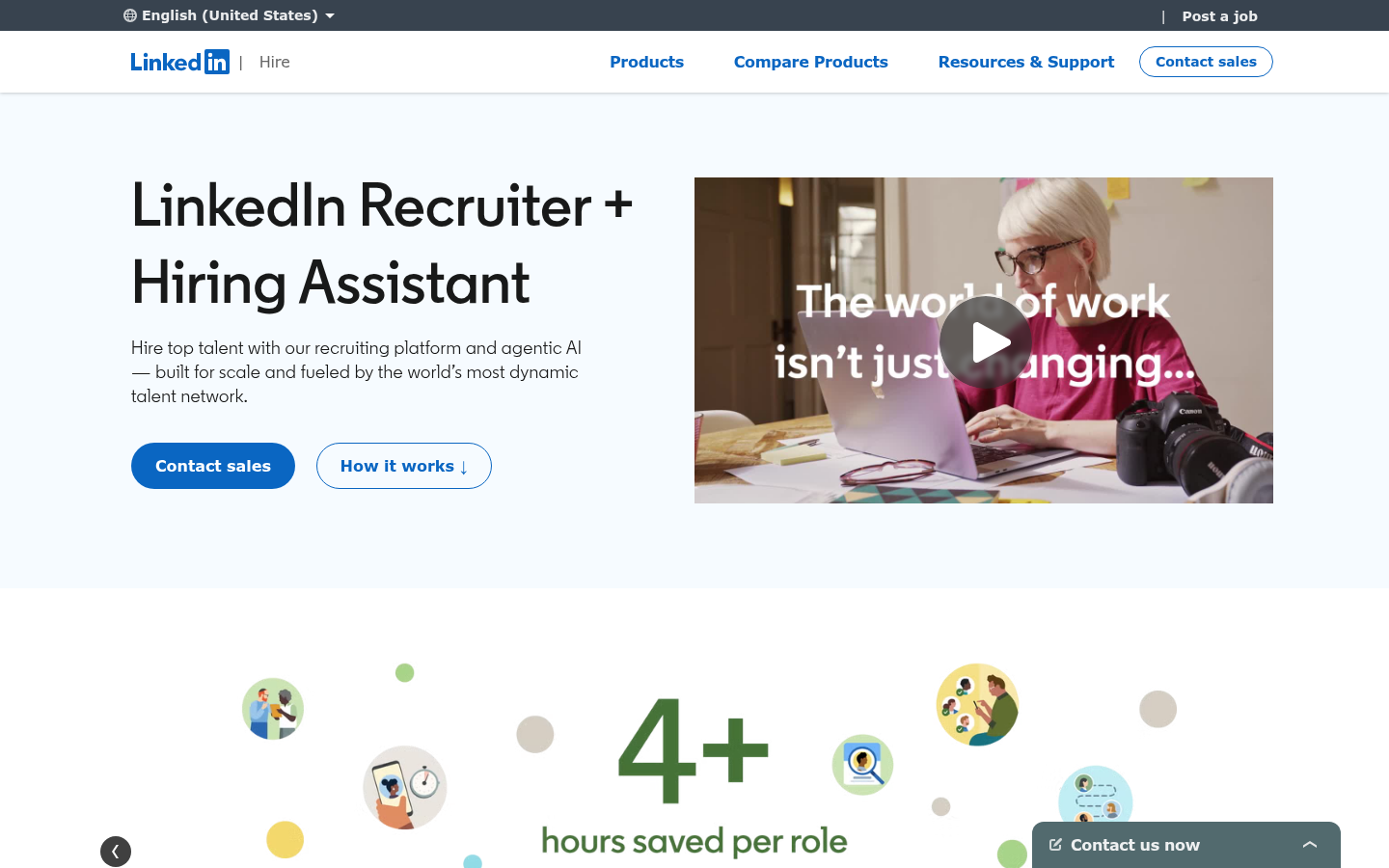
AI is increasingly part of that discovery experience, alongside LinkedIn Recruiter's established filters, recommendations, and search capabilities. Recruiters can use more natural search inputs to identify potential matches while drawing on the depth of LinkedIn's professional data.
LinkedIn Recruiter gives you exceptional access to a huge talent market. But recruiters still need to determine which profiles genuinely fit the less obvious requirements of the role and hiring team.
More context-driven platforms differentiate themselves by doing more of the work to decide who within that market is actually worth your time.
Key features
- Large professional network: Gives recruiters access to LinkedIn's extensive pool of candidate-maintained professional profiles.
- AI-assisted search: Uses AI to help recruiters translate hiring requirements into candidate searches.
- Advanced search filters: Narrows candidates by criteria such as skills, experience, location, and employer.
- Candidate recommendations: Suggests additional prospects based on searches and recruiting activity.
- InMail: Lets recruiters contact potential candidates directly through LinkedIn.
- Projects and pipeline organization: Helps sourcing teams save, organize, and collaborate around promising candidates.
Pricing: LinkedIn Recruiter Lite typically costs $170-270 per month, but most teams will need custom pricing.
8. Eightfold AI: skills-based talent matching.
Eightfold AI approaches candidate discovery through talent intelligence and skills. Rather than focusing primarily on whether someone's previous job title matches an open role, its AI uses skills, experience, and inferred potential to identify relevant people.
A strong candidate doesn't always have the obvious title or career path. AI can help surface adjacent experience that traditional keyword searches overlook.
Eightfold's broader talent intelligence platform can also help you identify existing employees for opportunities, adding internal mobility to the usual sourcing and applicant-discovery use cases.
This makes it a considerably heavier platform than a standalone AI sourcing tool. For large enterprises looking to understand skills and talent across their entire workforce, that breadth can be an advantage. Smaller recruiting teams simply looking for an easier way to find candidates may not need it.
Key features
- Skills-based matching: Identifies candidates based on skills and potential rather than relying solely on previous job titles.
- AI talent intelligence: Uses AI to understand talent and match people with relevant opportunities.
- Inferred skills: Identifies capabilities that may not be explicitly stated in a candidate's profile.
- External candidate discovery: Helps enterprises identify talent for open positions across external candidate populations.
- Internal mobility: Matches existing employees with opportunities based on their skills and potential.
- Talent insights: Gives organizations a broader view of skills and talent availability to support workforce decisions.
Pricing: Book a demo for full pricing.
9. Gem: rediscover candidates already in your network.
Gem combines recruiting CRM capabilities with AI-powered search, sourcing, and talent engagement, making your existing network much easier to use. Instead of starting every search from scratch, recruiters can rediscover people who already have some history with the company and identify previous candidates who could fit a new opportunity.
That can be particularly valuable as your organization grows. Someone who wasn't quite right for one role two years ago might be an excellent match today, and existing recruiting data can contain strong candidates who would stay buried in the ATS or CRM.
Gem also supports outbound sourcing and engagement, so teams aren't limited to people they already know. But its ability to bring existing candidate relationships back into consideration gives it a useful angle in a category often focused almost entirely on finding new profiles.
Key features
- Candidate rediscovery: Surface previous applicants and prospects who may fit newly opened roles.
- Recruiting CRM: Maintain candidate relationships and historical recruiting context in a centralized talent network.
- AI-powered search: Find relevant people across existing candidate data and external talent.
- Talent pools: Organize promising candidates for current and future hiring needs.
- Candidate engagement: Personalize outreach and ongoing nurture campaigns.
- Recruiting analytics: Get visibility into sourcing, engagement, and pipeline performance.
Pricing: Talk to sales for details.
10. AmazingHiring: discover technical candidates.
Technical candidates don't always fit neatly into standard sourcing filters. Relevant experience can show up through projects, technical communities, skills, and other signals beyond someone's current title.
AmazingHiring is designed specifically for technical recruiting. It brings together candidate information and signals from multiple professional and technical sources. You get a broader picture of someone's technical background than they'd necessarily get from a conventional resume or professional profile alone.
The specialization is both AmazingHiring's strength and its limitation. If most of your candidate discovery is focused on engineering and technical roles, that added context can be valuable. If you're hiring across sales, marketing, finance, operations, and other functions too, a broader platform is likely to make more sense.
Key features
- Technical talent search: Specializes in discovering developers, engineers, data professionals, and other technical candidates.
- Multi-source profiles: Aggregates professional information from multiple sources into consolidated candidate profiles.
- Technical candidate signals: Surfaces information beyond standard job titles and resume keywords to help assess technical relevance.
- Advanced search: Lets technical recruiters narrow candidates using role-specific criteria.
- Contact information: Helps recruiters find ways to reach promising technical candidates.
- Candidate outreach: Supports moving technical prospects from discovery into engagement workflows.
Pricing: Request a demo for pricing details.
Discover candidates worth talking to.
Candidate discovery used to start with the biggest possible talent pool. Recruiters would apply filters, scan profiles, build lists, and gradually narrow hundreds or thousands of people down to the handful they actually wanted to meet.
AI lets us reverse that model. Start by understanding what good looks like. Use the role requirements, company context, hiring manager preferences, and feedback from the search. Then find the people who fit.
If that sounds good, try Metaview. Sourcing agents find highly relevant prospects before they apply. Application Review surfaces strong candidates already in your inbound pipeline. AI Screening creates another layer of evidence when a CV isn't enough. And that context carries through into the human interviews and decisions that follow.
To hand off more of the work, fillmore takes your brief, researches the prospects, runs personalized outreach across email, LinkedIn, and WhatsApp, and books screening calls with interested candidates onto your calendar.
The goal of candidate discovery is to move the right people into your process. Judge each tool in this list on how much of the narrowing it does for you, and on whether the recruiter still has to work through a long list afterward.
Bring Metaview into your hiring stack.
Live notes, structured scorecards, and ATS sync - set up in under 10 minutes.
Candidate rediscovery FAQs
What is AI candidate discovery?
AI candidate discovery uses artificial intelligence to find, evaluate, and prioritize quality candidates based on your company's hiring requirements. Unlike traditional sourcing, which relies heavily on keywords and filters, AI tools can interpret natural-language criteria, research candidates, identify less obvious matches, and prioritize the people most likely to fit.
Candidate discovery can include both outbound recruiting and inbound hiring: finding passive candidates who haven't applied and identifying the strongest people already within an applicant pool.
What are the best AI tools for candidate discovery?
The best platform depends on what you're trying to achieve. Metaview is a strong choice for candidate discovery across both inbound and outbound hiring, while fillmore is designed for teams that want to automate outbound discovery and engagement.
Juicebox is strong for natural-language candidate search, SeekOut for deep talent search, Findem for attribute-based discovery, Eightfold AI for skills-based matching, Gem for rediscovering existing candidates, and AmazingHiring for technical sourcing.
How does AI improve candidate discovery?
AI can understand more nuanced hiring criteria than conventional keyword searches, research candidates across multiple signals, and prioritize people based on their relevance to a specific role.
It can also learn from recruiter and hiring manager feedback. That means candidate recommendations can become more closely calibrated to the team's actual hiring bar as the search progresses.
What's the difference between AI candidate discovery and AI sourcing?
AI sourcing typically refers to proactively finding potential candidates who haven't applied for a role. AI candidate discovery is broader.
It can include outbound sourcing, reviewing inbound applications, rediscovering candidates already in your ATS or CRM, and gathering additional information through screening. The common goal is identifying which people in a much larger talent pool are worth progressing.
Can AI find passive candidates?
Yes. AI sourcing tools can search large external talent pools and identify people whose experience, skills, and career history suggest they could fit an open role, even if they're not actively applying.
Some platforms can also research and prioritize those candidates before recruiters reach out. fillmore goes further by handling the subsequent outreach and follow ups as well.
Can AI candidate discovery replace LinkedIn Recruiter?
It depends on what you use LinkedIn Recruiter for. LinkedIn's enormous professional network and self-maintained profile data make it an extremely valuable source for candidate discovery.
AI-native platforms can complement or replace parts of the workflow by searching across different data sources, understanding more nuanced requirements, doing deeper research, or narrowing results more aggressively.
How can AI produce better candidate shortlists?
The strongest AI candidate discovery tools go beyond matching resumes against a job description. They can incorporate company context, hiring manager preferences, deeper candidate research, and feedback about whom the team progresses or rejects.
That helps move candidate discovery away from broad "potential match" lists and toward smaller groups of people with a clearer reason to be there.


