
Recruiter screening doesn't scale easily. A 20-minute screening call is manageable when you have 20 promising applicants. When hundreds apply, you either fill recruiter calendars with calls, or decide who gets heard based entirely on their resume.
AI interview screening tools offer another option: have real 1:1 candidate interactions without requiring a recruiter on every call. The best AI agents ask relevant questions, follow up on interesting answers, and give recruiters richer evidence to review.
But there's a big difference between a good AI screening conversation and a questionnaire with an AI label. For this list, we've identified the best mix of conversation quality and candidate experience, in the form of six excellent AI platforms.
The best AI interview screening tools at a glance.
| Tool | Best for | Interview format | Standout strength |
|---|---|---|---|
| Metaview | Best overall screening tool | Conversational AI agent | Adaptive screening + candidate experience |
| HireVue | Large enterprises | Voice/video + assessments | Enterprise assessment infrastructure |
| Sapia.ai | Chat-first screening | Text/chat | Structured conversational interviews |
| Humanly | High-volume TA teams | Chat, voice + video | Screening workflow automation |
| FloCareer | Technical + enterprise hiring | Voice/video | Screening + proctoring |
| Paradox | Frontline + hourly hiring | Text/chat | Mobile-first screening + scheduling |
There isn't one ideal approach to AI screening. A retailer with global talent acquisition needs is very different from a technology company trying to understand an engineer's experience.
The right choice depends on more than how many interviews the software can conduct. Conversation quality, candidate experience, recruiter visibility, and the kind of hiring you're doing all matter.
What is an AI interview screening tool?
An AI interview screening tool conducts or supports early-stage candidate interviews using artificial intelligence. Candidates typically answer questions through voice, video, or text, and the system captures and structures their responses for the hiring team.
More advanced tools can adjust and respond to what candidates actually say. Instead of moving through the same fixed questionnaire, they ask for examples, clarify unclear answers, and explore relevant experience in more depth.
That's different from many tools often grouped under "AI screening." Resume screening tools evaluate applications without interviewing candidates. One-way video platforms typically ask candidates to record answers to predetermined questions. And interview intelligence tools capture and analyze interviews conducted by humans.
AI interview screening specifically uses AI to conduct or facilitate the screening conversation itself.
How we chose the best AI interview screening tools.
We haven't ranked these tools based on which one can automate the most decisions. Faster rejection isn't necessarily better screening.
Instead, we focused on six areas:
- Conversation quality: Does the interview feel responsive, and can the AI ask useful follow-up questions?
- Candidate experience: Is it transparent, flexible, and straightforward for candidates to complete?
- Signal quality: Does the interview uncover useful evidence beyond what's already on the resume?
- Consistency: Can candidates have natural conversations while still being evaluated against common criteria?
- Recruiter control: Can recruiters inspect the evidence and understand how evaluations were reached?
- Use case: Is the product designed for the roles, candidate volumes, and hiring model it's being used for?
The candidate experience is arguably most important. First-generation automated screening often solved the capacity problem with rigid scripts or one-way interviews that offered little genuine dialogue.
The best AI screening tools should give more candidates a meaningful chance to demonstrate what they can do, and still give recruiters deeper information without consuming more of their time.
The 6 best AI interview screening platforms.
1. Metaview: Best overall AI interview screening tool.
Metaview Screening is a voice-first AI agent that conducts personalized screening interviews and gives recruiters the evidence to decide who moves forward.
Unlike one-way interviews, Metaview has an actual conversation. The agent adapts to the candidate and role, asks relevant follow-up questions, and can run behavioral and situational scenarios.
There's no avatar pretending to be a human; the experience is transparent about being AI.
Every interview is reviewed against the hiring team’s precise criteria, and recruiters can see an overview, dig into individual responses, generate custom summaries, or review the full interview.
Candidate experience is a major part of the design too. Candidates can interview from their phone or computer, at a time when they're ready to perform at their best.
At launch, candidates rated the Metaview Screening experience 4.7/5 CSAT.
Most importantly, screening is part of a complete recruiting process. Metaview’s AI agents combine sourcing, outreach, application review, interview notes, and reporting for full-funnel hiring efficiency.
Key features
- Adaptive AI interviews: Questions and follow ups respond to each candidate's actual answers.
- Behavioral and situational screening: Explore real examples and scenarios rather than only basic qualification questions.
- Consistent evaluation: Assess every conversation against the same role-specific rubric.
- 18 languages supported: Conduct screening conversations across global candidate pools.
- Flexible candidate experience: Candidates choose when to interview and can join from phone or computer.
- Detailed recruiter review: See overviews, individual answers, custom summaries, or the complete interview.
- Human decision making: Recruiters retain control over who progresses.
Best for: Recruiting teams that want to increase screening capacity without compromising candidate experience or handing hiring decisions over to AI.
Pricing: Free plans available; Pro plans from $100/user per month; unlimited Max plan from $300/user per month.
2. HireVue: Best for large enterprise hiring.
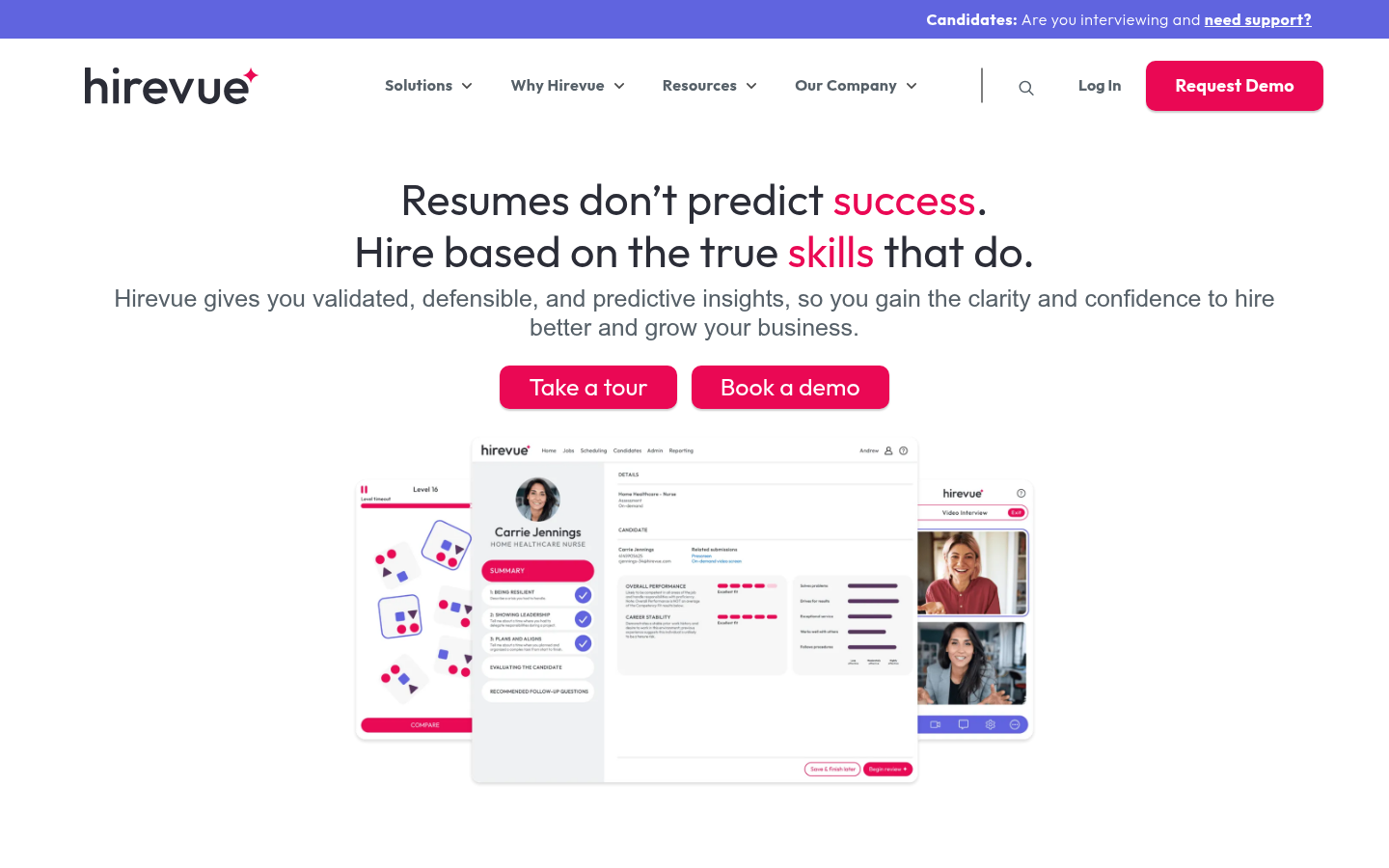
HireVue is an established name in digital interviewing and assessment. Its platform combines video interviewing, scheduling, and AI-powered interviewing. It’s particularly suited to large organizations that want screening within a broader enterprise hiring system.
Its newer AI capabilities bring more dynamic conversations to that stack. Rather than relying only on prerecorded video questions, AI agents conduct structured interviews designed around job-relevant skills and competencies.
HireVue's biggest differentiator is breadth. For companies that want assessments, interviewing, structured evaluation, and enterprise hiring infrastructure from one established vendor, there's a lot here.
But the breadth that makes HireVue attractive to large enterprises may be more than smaller or faster-moving recruiting teams need. If conversational screening and candidate experience are your main priorities, compare the interview quality itself first.
Key features
- AI-powered interviews: Conduct structured early-stage candidate interviews.
- Video interviewing: Supports HireVue's established on-demand and live video workflows.
- Skills assessments: Evaluate candidates beyond their resumes.
- Structured evaluation: Standardize how candidates are assessed.
- Interview scheduling: Reduce coordination around later human interviews.
- Enterprise integrations: Connect interviewing and assessment workflows with existing HR systems.
Best for: Large enterprises that want AI screening as part of a broader interviewing and assessment suite.
Pricing: Request a demo for details.
3. Sapia.ai: Best for chat-first AI screening.
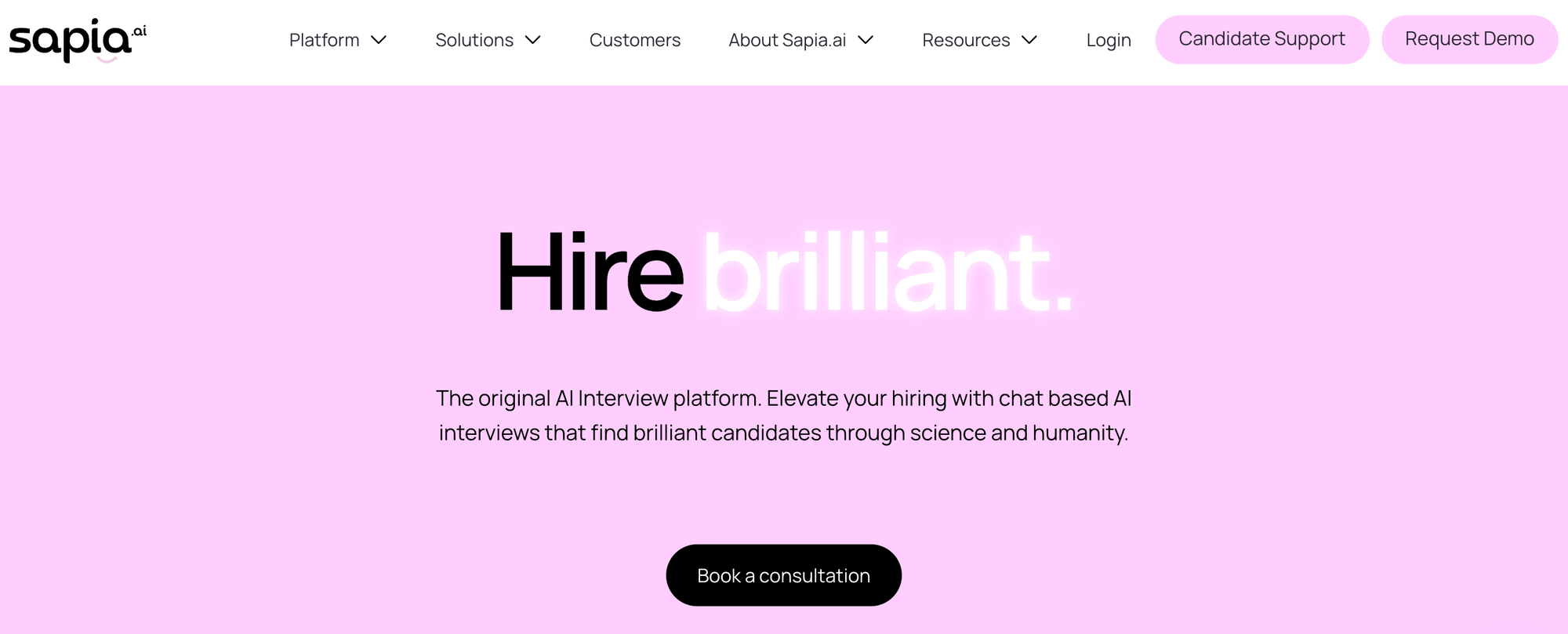
With Sapia.ai, candidates primarily interview through text-based chat rather than a voice or video conversation.
Candidates answer structured questions in their own time, and Sapia uses responses to generate insights for the hiring team. This removes scheduling entirely and can create a lower-pressure experience for candidates who prefer writing to speaking on camera.
The format is also the main trade-off. Chat can work well for scalable, asynchronous screening, but it doesn't recreate the spoken conversation of a traditional recruiter screen. So decide whether written responses give you the signals you're actually looking for. If the purpose of screening is partly to hear candidates explain their experience naturally, voice may be a better fit.
Key features
- Chat-based AI interviews: Candidates complete interviews through written conversation.
- Asynchronous screening: Candidates participate without booking an interview slot.
- Structured questions: Gather comparable information across applicants.
- Candidate evaluation: Turn interview responses into structured hiring insights.
- Explainable results: Give hiring teams context behind candidate evaluations.
- High-volume screening: Process large applicant pools without adding recruiter calls.
Best for: High-volume recruiting teams that want an asynchronous, text-first alternative to traditional screening interviews.
Pricing: Book a demo for specifics.
4. Humanly: Best for very high-volume hiring.
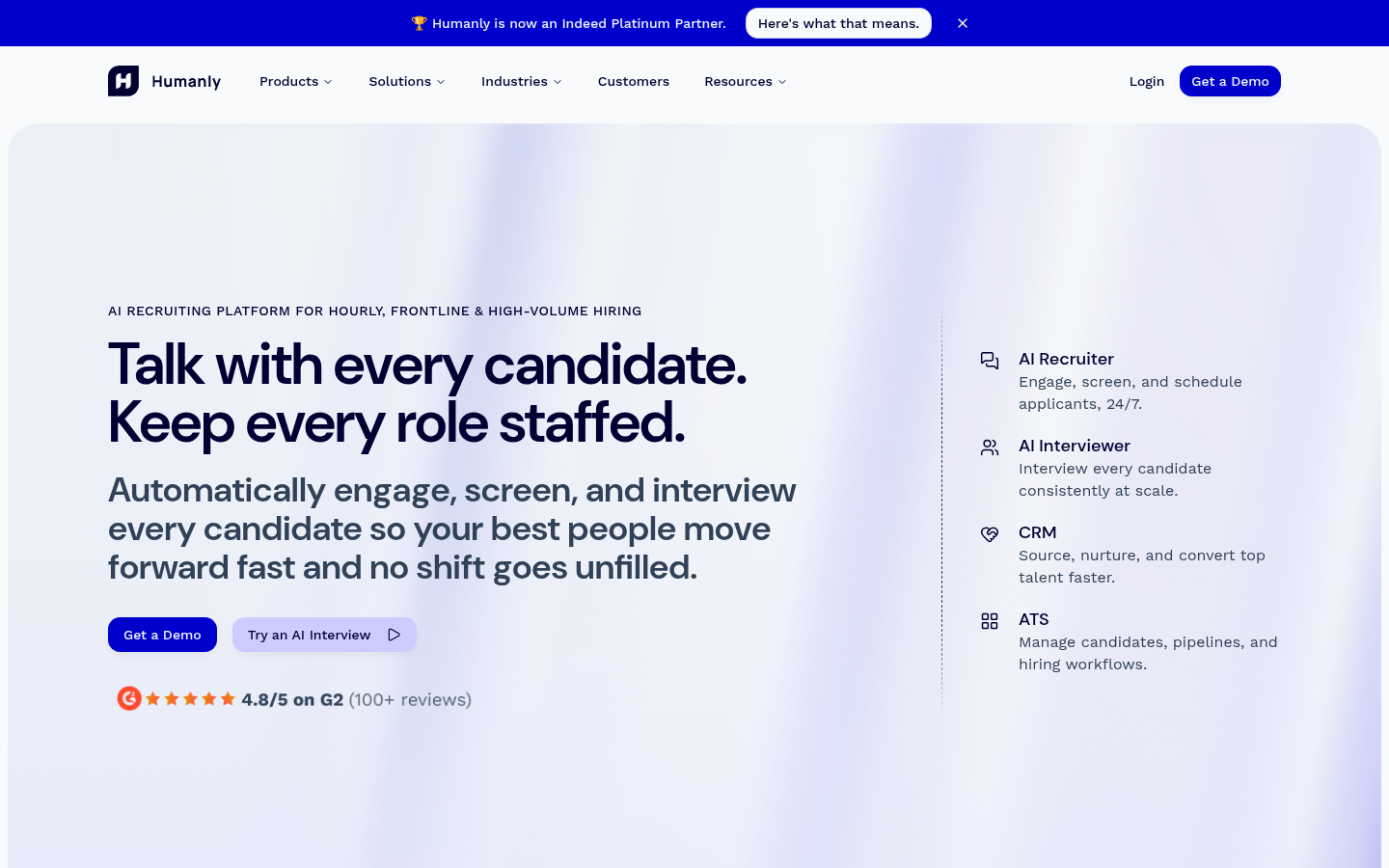
Humanly is an AI recruiting platform built primarily for hourly, frontline, and high-volume hiring. Its AI interviewer conducts structured interviews across chat, voice, and video, while the wider platform also handles candidate engagement, screening, scheduling, and ATS workflows.
That breadth is the main appeal. Humanly can engage candidates as soon as they apply, conduct the initial screening, score their responses, and automatically move qualified candidates forward. It's a good fit for teams where keeping large candidate pipelines moving is the priority.
Humanly leans further into end-to-end automation than some tools on this list, including automatically advancing qualified candidates. Teams that want recruiters to personally review the evidence before every advance/reject decision may prefer a more human-in-the-loop approach.
Key features
- Chat, voice, and video interviews: Choose the format that fits the role and candidate population.
- Structured interviewing: Ask candidates consistent questions tied to role requirements.
- Automated scoring: Evaluate responses using configurable scoring models.
- 24/7 screening: Let candidates interview without waiting for recruiter availability.
- ATS integration: Embed screening and interview results into existing recruiting workflows.
- Automated progression: Move qualified candidates to the next stage without manual recruiter intervention.
Best for: Hourly, frontline, and other high-volume recruiting teams that want screening, interviewing, and scheduling automation in one workflow.
Pricing: Public pricing not available. Book a demo.
5. FloCareer: Best for technical screening and proctoring.
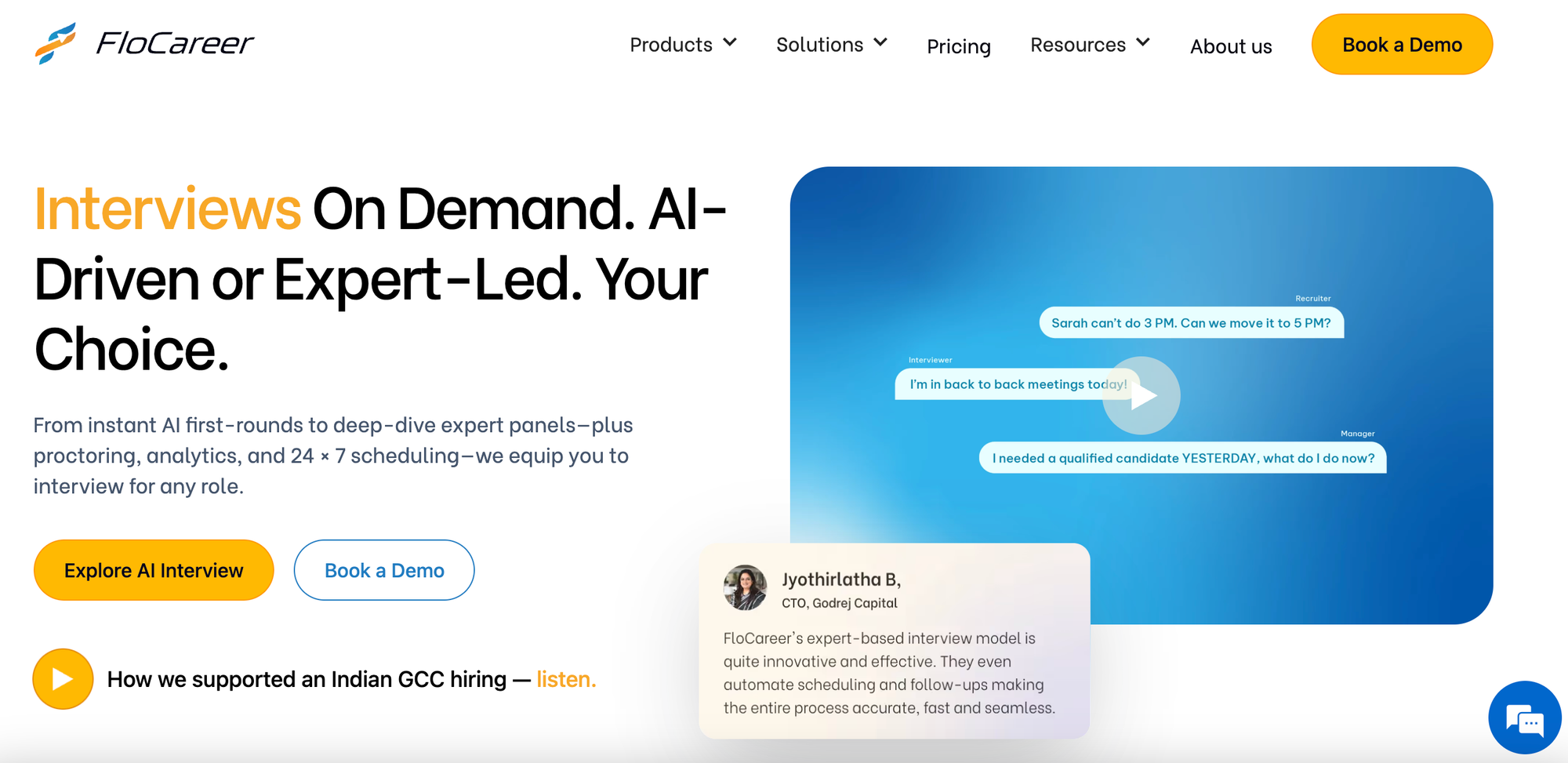
FloCareer combines conversational recruiting with candidate verification and proctoring, making it particularly interesting for technical and skills-heavy hiring.
Its NIVO AI Interviewer conducts real-time, voice-led conversations and adapts questions to the role, candidate, and their answers. For technical hiring, FloCareer can also add coding exercises and multiple-face or voice-detection integrity checks, plus other proctoring signals.
The result is closer to an automated assessment environment than a simple recruiter intro call. That's useful when you need to establish both whether someone has the required skills and whether the assessment itself is trustworthy.
Proctoring is valuable for some assessments, but it also changes the candidate experience. If you're primarily replacing a friendly introductory recruiter screen, consider whether that level of monitoring is necessary.
Key features
- Conversational AI interviews: Run responsive, voice-led interviews with dynamic follow-up questions.
- Technical and coding interviews: Assess coding and problem-solving within the interview flow.
- Advanced proctoring: Surface integrity signals alongside candidate performance.
- Structured evaluation: Score candidates against configurable skills and competencies.
- 24/7 availability: Let candidates complete interviews without waiting for an interviewer.
- Detailed reports: Review recordings, transcripts, skill ratings, recommendations, and proctoring findings.
Best for: Technical, campus, and enterprise hiring teams where skills verification and interview integrity are particularly important.
Pricing: Standard plan from $25/interview; Elite plan from $30/interview.
6. Paradox: Best for frontline and hourly screening.
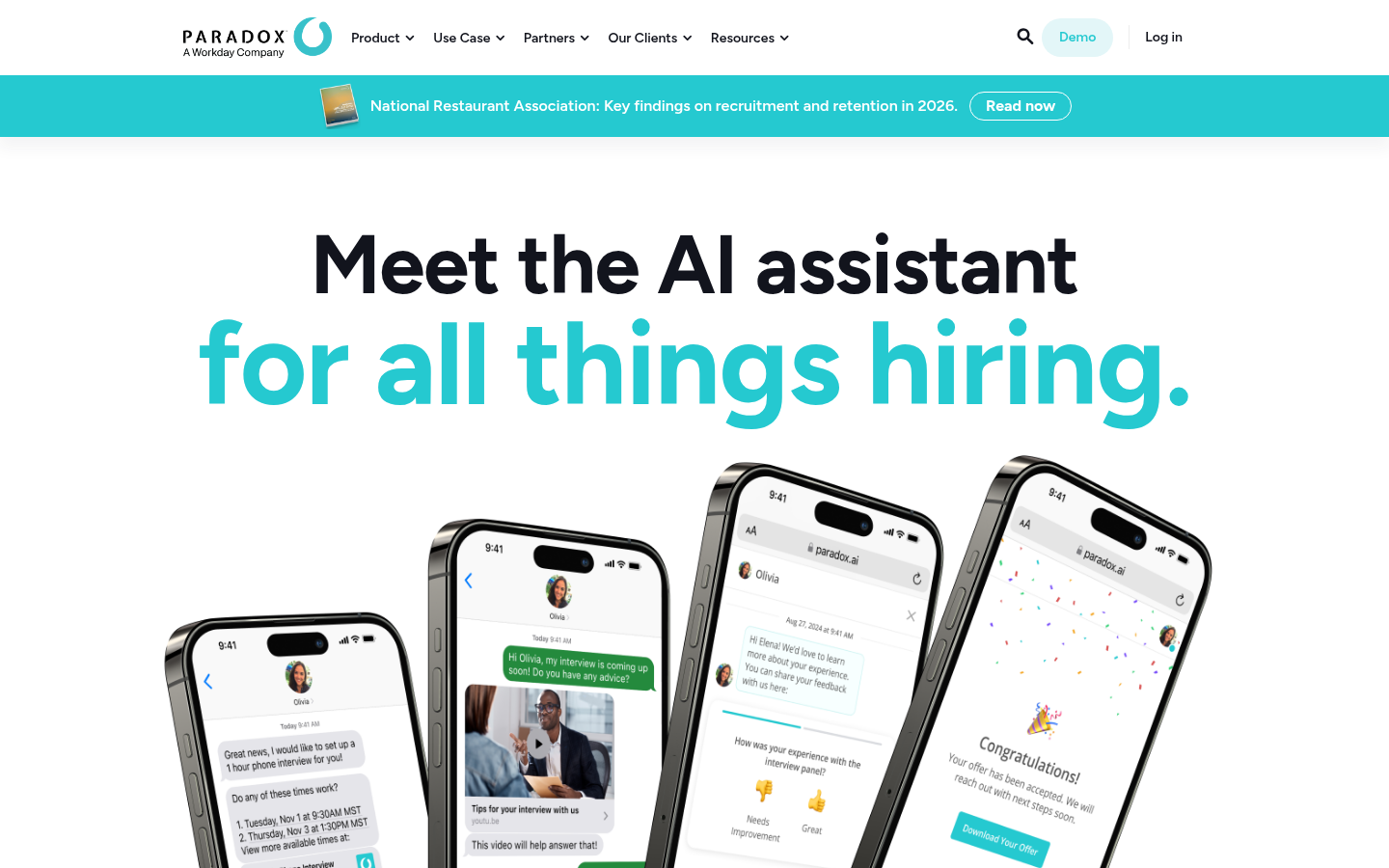
Rather than recreating a spoken screening interview, Paradox’s assistant Olivia screens candidates through simple text conversations.
That’s well suited to frontline and hourly hiring, where candidates may be applying from their phones and employers need to process large numbers of applications quickly. Candidates can use text-to-apply or QR codes, answer qualification questions, and move directly into interview scheduling when they meet the requirements.
It's less about conducting a deep interview and more about removing friction from the earliest stages of high-volume hiring.
Paradox is closer to conversational qualification than an in-depth AI screening interview. If you want candidates to explain their experience, respond to behavioral questions, and provide richer spoken evidence, a voice-first platform will be a better fit.
Key features
- Text-based screening: Qualify candidates through simple mobile conversations.
- Text-to-apply: Let candidates begin the application process quickly from their phones.
- Automated qualification: Screen applicants against predefined role requirements.
- Automatic scheduling: Move qualified candidates directly into interview booking.
- Alternative job matching: Suggest other openings when someone isn't right for the original role.
- Always-on candidate experience: Let applicants engage from any device and at any time.
Best for: Retail, hospitality, restaurants, and other frontline employers that need a fast, mobile-first way to screen large applicant volumes.
Pricing: Details available via demo request.
How to choose an AI interview screening tool.
The best tool isn't necessarily the one that automates the most tasks. Think carefully about the screening experience you want to create and the evidence you need at the end. If you want to score each shortlisted tool the same way, use our 30-question rubric for evaluating an AI screening tool.
Start with the candidate experience.
Take the AI interview yourself before putting candidates through it. Does it feel natural? Can candidates clarify an answer or take the conversation somewhere relevant? And is the system transparent about being AI?
A fast automated process isn't much of an improvement if candidates hate using it.
Look at what data recruiters receive.
The candidate-facing experience is only half the product. Ask to see exactly what recruiters get after an interview.
A score alone isn't enough. Look for transcripts, summaries, individual responses, evidence tied to your criteria, and an easy way to dig deeper when something looks interesting or questionable.
Test how adaptive the conversation really is.
"AI interview" can describe everything from a static questionnaire to a genuinely responsive conversation.
Try giving an incomplete answer and see what happens. Then give an unexpected but relevant one. A good conversational tool should know when to probe rather than simply moving to question five.
Understand who makes the decision.
Some platforms score candidates, some recommend who should progress, and others can automatically advance or reject applicants.
Decide how much automation you're comfortable with. If AI influences hiring decisions, recruiters should be able to understand the evidence behind its evaluation rather than treating a score as unquestionable.
Check how it fits your recruiting workflow.
Screening shouldn't create another silo of candidate data. Look at ATS integrations, recruiter review workflows, scorecards, reporting, and what happens to interview evidence once a candidate progresses.
The best setup lets information gathered during screening make the rest of the hiring process better, rather than disappearing after the initial decision.
AI interview screening tool comparison: Which should you choose?
There's no single best platform for every hiring team. These six tools take notably different approaches to the same underlying problem.
- Choose Metaview if you want adaptive, voice-first screening built around candidate experience, consistent evaluation, and human decision-making.
- Consider HireVue if you're a large enterprise looking for AI interviewing within a broader assessment and interviewing suite.
- Consider Sapia.ai if you want structured, asynchronous screening through text rather than voice.
- Consider Humanly if high-volume hiring and automating the wider screening-to-scheduling workflow are your priorities.
- Consider FloCareer if technical assessment, candidate verification, and proctoring are important parts of your screening process.
- Consider Paradox if you're hiring large numbers of frontline or hourly workers and want fast, mobile-first qualification and scheduling.
The biggest questions are what kind of conversation those candidates get, what you learn from it, and whether your recruiters have enough evidence to make a better decision.
Better AI screening starts with great conversations.
AI interview screening tools solve an obvious capacity problem. But screening more people isn't useful if the experience is poor or the resulting signal isn't trustworthy. The best tools should give candidates a genuine opportunity to explain what they can do, while giving recruiters clear evidence to make better decisions.
AI lets us gather better information from more candidates, then give recruiters the evidence and time to make good decisions.
That's the philosophy behind Metaview Screening: adaptive conversations, consistent evaluation, and more opportunities for candidates to show who they really are.
Find the hiring signals only a conversation can reveal.
Screening is the voice agent that speaks with every candidate and scores each call against your rubric. For every completed call, a recruiter decides who moves forward.
AI interview screening tool FAQs.
What is the best AI interview screening tool?
Metaview is our top overall AI interview screening tool for 2026, particularly for teams that want conversational voice screening with a strong candidate experience. Its screening agent adapts questions to each candidate while evaluating conversations consistently against the hiring team's criteria.
The right tool depends on your hiring model. Paradox is well suited to frontline and hourly hiring, for example, while Sapia.ai offers a text-first experience and FloCareer adds technical assessment and proctoring.
How do AI interview screening tools work?
Hiring teams typically start by defining the skills, experience, and other criteria they want to assess. The AI then conducts an interview based on those requirements and captures the candidate's responses.
Depending on the tool, it may also ask follow-up questions, summarize the conversation, score evidence against a rubric, and recommend next steps. Recruiters can then review the results and decide who should progress.
What's the difference between AI screening and AI interviewing?
AI screening is a broad category. It can include resume analysis, application review, knockout questions, assessments, candidate ranking, and interviews.
AI interviewing specifically involves AI interacting with the candidate as part of an interview. An AI interview screening tool uses that interaction at the early screening stage.
Are AI screening interviews the same as one-way video interviews?
Not necessarily. One-way video interviews typically present candidates with predetermined questions and record their responses, with no interviewer responding in real time.
Conversational AI interviewers can react to what a candidate says. They can ask for examples, clarify an answer, or explore something relevant in more depth. That's much closer to the back-and-forth of a recruiter screen than a recorded questionnaire.
Can AI interview screening tools ask follow-up questions?
Some can. Modern conversational candidate screening tools can interpret a candidate's response and generate relevant follow-up questions rather than following an entirely predetermined script.
This is worth testing when comparing vendors. "AI interview" doesn't automatically mean "AI conversation." Some products still rely much more heavily on fixed question sequences.
Are AI interview screening tools fair?
AI can make candidate screening more consistent, but consistency doesn't automatically guarantee fairness. Poor questions, irrelevant hiring criteria, or biased evaluation methods can still create poor outcomes.
Look for tools that use clear, job-relevant criteria and let recruiters understand the evidence behind candidate evaluations. Hiring teams should also monitor outcomes and maintain appropriate human oversight.
Can AI interview screening tools detect fake candidates?
AI interviews can provide useful additional evidence when an application looks suspicious. Asking someone to explain their experience, discuss specific projects, and respond to follow-up questions makes it possible to investigate claims that are difficult to verify from a resume alone.
Some platforms also offer dedicated identity verification, fraud detection, or proctoring features. But no AI interview should be treated as a foolproof fake-candidate detector.


