Eightfold AI helped push talent acquisition beyond simple keyword matching. Instead of asking whether someone's resume contains the right job title or exact skills, its talent intelligence approach aims to understand people's capabilities, experience, potential, and possible fit for different opportunities. Both for external hires and internal mobility.
But not every recruiting team needs that version of talent intelligence. Some want better ways to discover and match external candidates. Others want AI that can take action once a promising candidate has been identified: sourcing them, reaching out, screening them, or supporting the human interviews that follow.
That's why the best Eightfold AI alternatives aren't all direct replacements. Some compete closely on talent intelligence. Others focus on distinct aspects of Eightfold’s broader platform.
We've compared eight options below, highlighting your best choices to make finding and signing talent a more efficient, intelligent pursuit.
Eightfold AI alternatives at a glance
| Eightfold alternative | Best for | Talent intelligence | AI sourcing | AI screening | Interview intelligence |
|---|---|---|---|---|---|
| 1. Metaview | Complete AI recruiting | ✓ | ✓ | ✓ | ✓ |
| 2. fillmore | Autonomous sourcing and outbound | ✓ | ✓ | — | — |
| 3. SeekOut | Talent search and sourcing | ✓ | ✓ | Some | — |
| 4. Phenom | Enterprise talent experiences | ✓ | ✓ | ✓ | — |
| 5. Beamery | Talent lifecycle management | ✓ | ✓ | Some | — |
| 6. Findem | Talent data and sourcing | ✓ | ✓ | — | — |
| 7. hireEZ | Recruiter-focused AI sourcing | ✓ | ✓ | — | — |
| 8. Gem | Recruiting CRM and operations | Some | ✓ | Some | — |
What is Eightfold AI?
Eightfold AI is a talent intelligence platform to understand, acquire, develop, and deploy talent. Resumes and job titles provide an incomplete picture of what someone can do. Eightfold uses AI to build a richer understanding of people's skills, experience, capabilities, and potential, then uses that intelligence to connect people with relevant opportunities.
And that applies to both external recruiting and your existing workforce.
For talent acquisition teams, Eightfold can help discover and match candidates, manage talent pipelines, and support recruiting workflows. For HR and talent management teams, the same underlying intelligence can help identify internal candidates, support mobility, understand skills gaps, and connect employees with development opportunities.
Key Eightfold capabilities include:
- Talent acquisition: Discover, match, engage, and manage candidates.
- Candidate matching: Use skills and talent intelligence to identify people who may fit particular opportunities.
- Talent intelligence: Build a richer picture of candidates and employees beyond their current job titles.
- Skills intelligence: Understand existing capabilities, related skills, and potential gaps.
- Internal mobility: Connect existing employees with relevant roles and career opportunities.
- Talent marketplaces: Match employees with jobs, projects, and development opportunities.
- Workforce intelligence: Get greater visibility into the skills and talent available across your workforce.
- AI agents: Extend Eightfold's intelligence into recruiting and candidate-facing workflows.
That breadth is one of Eightfold's biggest strengths. It's not simply an AI sourcing tool or candidate-matching engine.
But a recruiting team primarily trying to improve sourcing, screening, or interviewing may not need the same platform as an enterprise trying to understand and mobilize talent across its entire workforce.
How does Eightfold's talent intelligence work?
Eightfold's core proposition involves creating a richer intelligence layer around candidates and employees, and using it to connect people with opportunities.
Look beyond resume keywords
Traditional candidate search often relies heavily on titles, keywords, companies, and explicit experience. That can miss candidates whose experience is described differently, or people whose existing skills could transfer naturally into a new role.
Eightfold's talent intelligence approach aims to understand the relationships between skills, roles, experience, and career paths rather than relying entirely on exact matches.
Understand skills and potential
Skills intelligence can help identify candidates with adjacent experience or transferable capabilities, giving organizations a broader potential talent pool than a rigid set of requirements might produce.
Match people with opportunities
Eightfold can then use this understanding to identify people who may fit particular jobs or other opportunities.
For recruiters, that can mean surfacing external candidates who might otherwise be overlooked. For existing employees, it can mean identifying internal roles that align with their skills and possible career progression.
Apply the same intelligence internally
Talent intelligence can also support internal mobility, talent marketplaces, skills development, and workforce planning.
The 8 best Eightfold AI alternatives and competitors
There isn't one direct replacement for everything Eightfold does. Some Eightfold competitors offer similarly broad talent intelligence capabilities. Others focus more tightly on external candidate discovery, sourcing, recruiting CRM, or actually executing the work that follows a candidate match.
Let's look at each Eightfold AI alternative in more detail.
1. Metaview: Eightfold alternative for complete AI recruiting
Best for: Recruiting teams that want AI to improve external hiring from candidate discovery through interviews, rather than primarily building a company-wide layer for skills intelligence, internal mobility, and workforce planning.
Eightfold builds intelligence around talent. Metaview puts intelligence to work throughout the recruiting process.
Instead of focusing primarily on understanding skills, potential, and talent across the workforce, Metaview's AI agents help recruiters find candidates, evaluate inbound applicants, conduct screening conversations, and capture evidence from human interviews.
They also learn from recruiter and hiring manager context, so the system develops a clearer understanding of what a strong candidate looks like for each particular role. The result is connected recruiting intelligence that follows the process from initial brief through to final interviews and debriefs.
Key features
- AI Sourcing: Finds candidates using the role brief, company context, example profiles, and recruiter feedback, rather than relying only on static matching criteria.
- Application Review: Reviews every inbound application against your specific requirements and hiring-manager preferences, helping teams look beyond simple keyword filters.
- AI Screening: Conducts personalized, unscripted candidate conversations and asks relevant follow-up questions to gather richer evidence before human interviews.
- Interview intelligence: Captures recruiter and hiring manager interviews, creates structured notes and scorecards, and preserves the evidence behind candidate evaluations.
- Hiring manager context: Uses intake meetings, candidate feedback, interviews, approvals, and rejections to develop a more nuanced understanding of the team's actual hiring bar.
- Connected recruiting intelligence: Carries context across intake → sourcing → application review → screening → human interviews → debriefs, rather than treating each recruiting stage as a separate workflow.
Metaview is a game changer for me. I can't always write notes fast enough and realize I miss some of what they are saying. I love that I can go back into the assistant and ask specific questions about topics discussed with the candidate.”
2. fillmore: autonomous sourcing and outbound recruiting
Best for: Recruiting teams that want to automate the work between defining a role and meeting high-fit outbound candidates, rather than simply generate another list of potential matches.
fillmore is an AI outbound recruiting agent that can take ownership of sourcing, candidate research, personalized outreach, follow-ups, replies, and scheduling. Instead of giving recruiters another pool of candidates to work through, fillmore does much of that work itself.
You brief it much like another member of the recruiting team. Share a job description, example profiles, or simply explain what you're looking for, and fillmore can start building the pipeline.
Key capabilities
- Autonomous sourcing: Searches for candidates who fit the role and your team's hiring criteria.
- Candidate research: Investigates individual profiles to understand whether someone genuinely looks relevant.
- Personalized outreach: Writes to candidates in your team's voice based on their specific background.
- Replies and follow-ups: Continues conversations and handles follow-up rather than handing every interaction back to a recruiter.
- Interview scheduling: Takes interested candidates through to a booked first call.
- Slack-native collaboration: Recruiters can brief fillmore, review its work, and provide feedback from Slack.
- Flexible autonomy: Teams can choose how independently fillmore operates for each role and put appropriate guardrails around its work.
fillmore is specifically focused on outbound recruiting. It isn't an alternative to Eightfold's internal mobility, talent marketplace, skills development, or broader workforce intelligence capabilities.
Teams looking for an enterprise-wide understanding of both employees and external talent will therefore be comparing two very different products.
3. SeekOut: talent search and sourcing
Best for: Talent acquisition teams whose main Eightfold use case is finding, understanding, and sourcing external candidates rather than managing talent across the entire workforce.
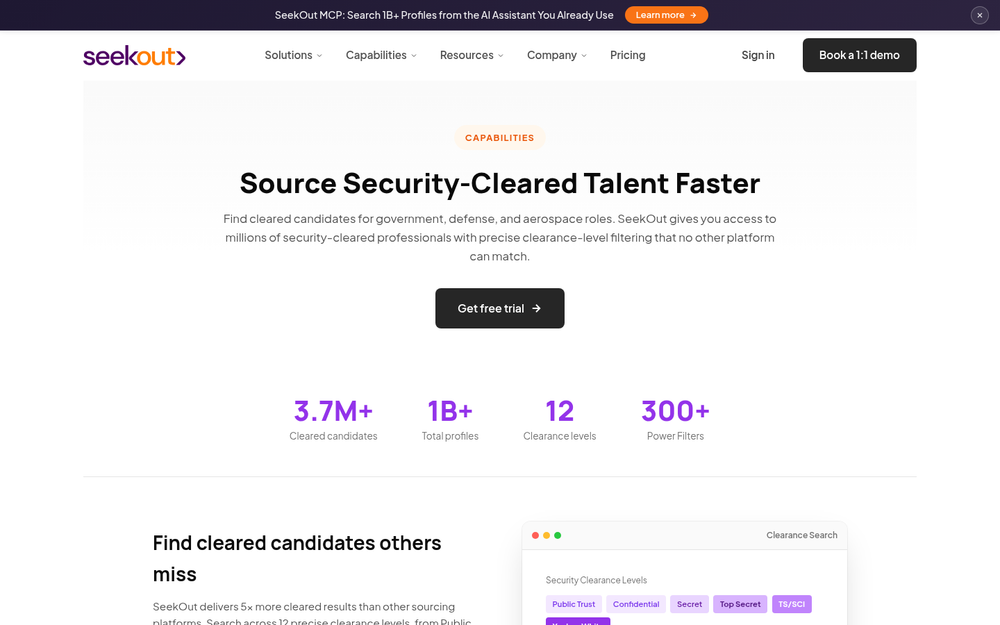
SeekOut is one of the more natural Eightfold competitors for teams primarily interested in external talent discovery.
It helps recruiters search across large talent pools, uncover candidates who match detailed criteria, and use AI to support sourcing. Like Eightfold, it helps recruiters look beyond basic keyword searches and build a richer picture of potential candidates.
The biggest difference is focus. Eightfold extends deeply into internal mobility, skills intelligence, and workforce planning, while SeekOut helps talent acquisition teams find and engage external candidates.
Key capabilities
- AI candidate sourcing: Helps recruiters identify relevant candidates based on role requirements.
- Talent search: Provides detailed search capabilities across large pools of professional profiles.
- Candidate insights: Gives recruiters additional context for evaluating potential matches.
- Talent intelligence: Helps teams understand talent availability and relevant candidate populations.
- Candidate engagement: Supports workflows for reaching out to potential candidates.
- Recruiting analytics: Provides data to help teams understand talent pools and sourcing activity.
Finding the right candidates is only part of the process. Teams that also want AI to review inbound applicants, conduct conversational screens, capture human interviews, and turn hiring-manager conversations into usable recruiting context may need additional tools.
4. Phenom: enterprise talent experiences
Best for: Large enterprises that want a broad talent platform spanning candidate acquisition, talent experiences, CRM, and internal mobility, rather than a recruiting-only AI solution.
Phenom is another broad enterprise platform, making it one of the closer Eightfold alternatives for organizations looking beyond standalone recruiting tools.
It spans candidate experiences, recruiting, talent CRM, career sites, employee experiences, internal mobility, and talent management. That makes it relevant to organizations that share Eightfold's goal of using AI and talent data across more than just external hiring.
Where Eightfold's positioning is heavily centered on talent intelligence and skills, Phenom puts particular emphasis on the experiences and workflows through which candidates, recruiters, employees, and managers interact with talent technology.
Key capabilities
- AI talent discovery: Helps recruiters find and match candidates to relevant opportunities.
- Talent CRM: Gives recruiting teams tools to build, segment, and engage candidate pipelines.
- Career sites: Creates personalized job discovery and application experiences.
- Candidate engagement: Supports communications and automated recruiting journeys.
- Internal mobility: Helps employees discover opportunities within the organization.
- Talent management: Extends the platform into employee development and broader talent experiences.
Like Eightfold, Phenom is a large platform with a wide remit. That breadth may be valuable for global enterprises, but it can be more than a recruiting team needs if the primary objective is simply to make sourcing, screening, and interviewing more effective.
5. Beamery: talent lifecycle management
Best for: Enterprises looking for a broad talent intelligence and lifecycle platform, particularly where workforce planning, skills, CRM, and internal mobility need to work together.
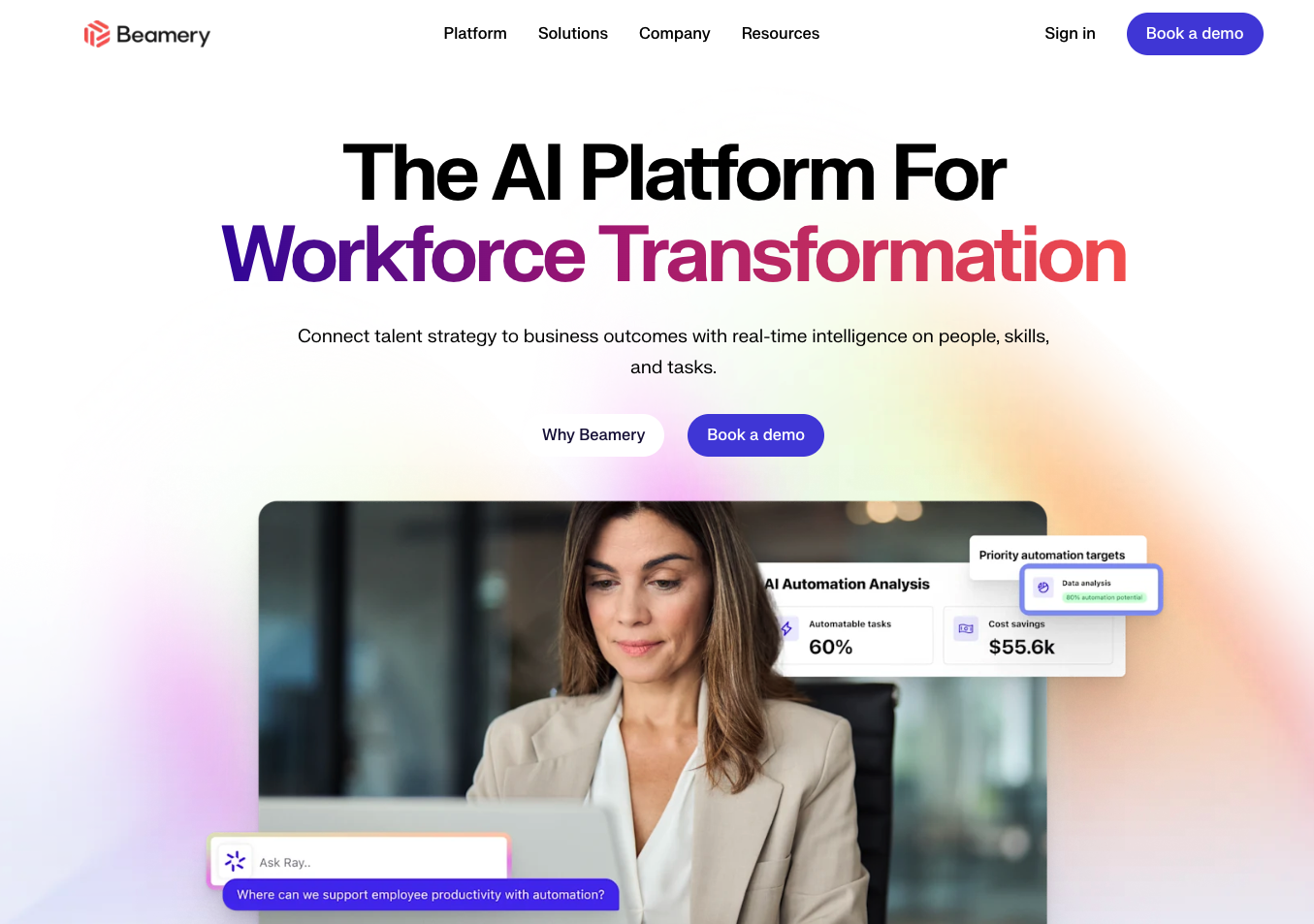
Beamery is one of the closer Eightfold AI competitors for enterprises that want to understand talent across both recruiting and the existing workforce.
Its platform combines talent intelligence, skills data, CRM, workforce planning, and internal mobility capabilities. Rather than focusing on a single recruiting stage, Beamery aims to give organizations a clearer picture of the people and skills they have, the talent they may need, and how to connect the two.
That puts it in similar territory to Eightfold, particularly for companies where talent acquisition is part of a broader workforce strategy.
Key capabilities
- Talent intelligence: Helps organizations understand skills, roles, and talent across their workforce and candidate pools.
- Talent CRM: Builds and manages relationships with prospective candidates.
- Skills intelligence: Creates a more structured view of workforce capabilities and potential gaps.
- Workforce planning: Helps teams connect future talent requirements with recruiting and development plans.
- Internal mobility: Supports opportunities for existing employees to move and develop within the organization.
- Talent pools: Helps recruiters organize, segment, and engage potential candidates over time.
Beamery's broad talent lifecycle approach means it may be more platform than you need if your immediate problems sit specifically within recruiting.
6. Findem: talent data and sourcing
Best for: Recruiting teams that want rich candidate data and powerful external talent discovery, without necessarily needing Eightfold's broader internal mobility and workforce intelligence capabilities.
Findem takes a data-heavy approach to talent acquisition, helping recruiters discover candidates based on a richer set of attributes than a conventional keyword search.
Its platform brings together candidate information from multiple sources and lets recruiters search for people based on combinations of experience, skills, companies, career history, and other characteristics.
That makes Findem particularly relevant for teams exploring Eightfold alternatives because they want stronger external candidate discovery rather than a company-wide talent management platform.
Key capabilities
- AI talent search: Helps recruiters find candidates using detailed and contextual search criteria.
- Candidate data: Combines information from multiple sources to create richer talent profiles.
- Talent intelligence: Helps teams understand and segment potential candidate populations.
- Talent pools: Lets recruiters create and manage groups of relevant prospects.
- Outbound recruiting: Supports workflows for engaging candidates after they've been identified.
- Recruiting analytics: Provides visibility into sourcing activity, talent pools, and pipelines.
Findem is primarily strongest before the interview process. Teams looking for AI screening, interview notes, scorecards, and deeper intelligence from recruiter and hiring-manager conversations may need additional tools.
7. hireEZ: recruiter-focused AI sourcing
Best for: Recruiting and sourcing teams that want AI-powered candidate discovery and engagement without the breadth of an enterprise talent intelligence platform.
hireEZ is a more tactical Eightfold competitor built primarily around helping recruiters find and engage candidates.
Its focus is less on creating an enterprise-wide picture of skills and workforce potential, and more on making sourcing teams faster and more effective. Recruiters can use the platform to discover candidates, enrich profiles, find contact information, rediscover talent already in their systems, and support outbound engagement.
That narrower scope can be an advantage when sourcing is the actual problem you're trying to solve.
Key capabilities
- AI sourcing: Helps recruiters identify candidates that match specific hiring requirements.
- Candidate search: Searches across talent pools to surface relevant prospects.
- Profile enrichment: Adds useful candidate information to support evaluation and outreach.
- Contact information: Helps recruiters find ways to reach promising candidates.
- ATS rediscovery: Surfaces relevant people already sitting within existing recruiting databases.
- Candidate engagement: Supports outbound communication with sourced candidates.
hireEZ doesn't aim to provide the same broad internal talent intelligence layer as Eightfold. Teams that need internal mobility, workforce skills intelligence, or an enterprise talent marketplace will therefore be looking at a substantially different product.
8. Gem: recruiting CRM and operations
Best for: Talent acquisition teams that want a recruiting CRM and operations platform for building, managing, and analyzing external candidate pipelines.
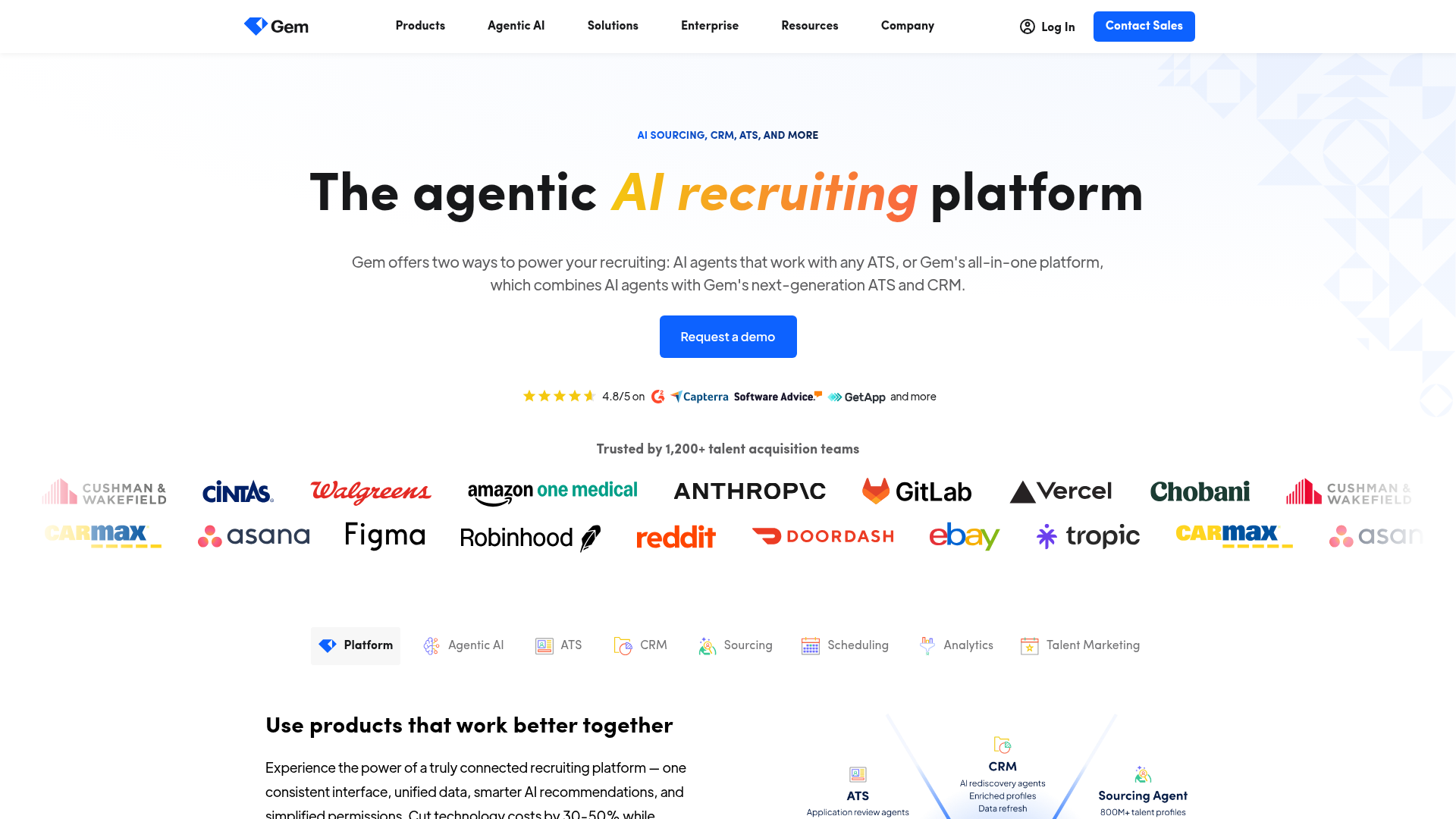
Gem is a recruiting platform focused on helping talent acquisition teams find candidates, manage relationships, run outreach, and understand recruiting performance.
It's a useful Eightfold alternative for teams that care primarily about external recruiting rather than building an intelligence layer across their entire workforce. Where Eightfold connects recruiting with skills, internal mobility, and talent management, Gem is more tightly centered on the workflows recruiters use to build and manage candidate pipelines.
Its CRM and analytics capabilities are particularly useful for teams that want more structure around how potential candidates move from initial discovery through the recruiting funnel.
Key capabilities
- Talent CRM: Helps teams organize prospects, build talent pools, and manage candidate relationships.
- Candidate sourcing: Supports recruiters in finding potential candidates for open roles.
- Outbound engagement: Helps teams run and manage candidate outreach.
- Pipeline management: Gives recruiters visibility into how candidates progress through the funnel.
- Recruiting analytics: Tracks sourcing, pipeline, conversion, and broader recruiting performance.
- Recruiting operations: Brings candidate activity and recruiting data together to help teams manage hiring more systematically.
Gem is primarily built around external talent acquisition, so it isn't a direct replacement for Eightfold's internal mobility, talent marketplace, and broader workforce intelligence capabilities.
Why look for an Eightfold AI alternative?
Eightfold's breadth is a major advantage for organizations that want to connect talent acquisition with internal mobility, skills intelligence, and workforce planning. But that's not necessarily what every recruiting team needs.
If your priority is improving the actual work of finding, engaging, screening, and interviewing external candidates, a more recruiting-focused platform may make more sense.
Teams may consider Eightfold alternatives because they:
- Want deeper recruiting workflow automation: AI should do more than identify potential matches; it should help move candidates through the process.
- Need stronger interview intelligence: Once humans take over, interview conversations create some of the most valuable evidence in hiring.
- Want autonomous outbound recruiting: Finding someone is only the first step. Recruiters still need to research, contact, follow up with, and schedule promising candidates.
- Want hiring-manager context to shape the AI: The real hiring bar often emerges through intake conversations, feedback, approvals, rejections, and interviews.
- Don't need internal mobility or a talent marketplace: A recruiting team may not need an enterprise platform designed to understand and mobilize the entire workforce.
- Want a specialist tool: Sourcing, talent CRM, candidate data, or recruiting automation may be the actual problem to solve.
Eightfold remains a compelling option when external recruiting is part of a much broader talent intelligence strategy. The alternatives above make more sense when you want a different approach to talent intelligence or need to go deeper into a particular part of recruiting.
Eightfold vs Metaview: how do they compare?
| Capability | Eightfold AI | Metaview |
|---|---|---|
| Talent intelligence | Core strength | Recruiting-focused |
| Skills-based candidate matching | ✓ | ✓ |
| AI sourcing | ✓ | ✓ |
| Internal mobility | ✓ | — |
| Talent marketplace | ✓ | — |
| Skills development | ✓ | — |
| Application review | ✓ | ✓ |
| Conversational AI screening | ✓ | ✓ |
| Autonomous outbound recruiting | Some capabilities | ✓ |
| Interview intelligence | More limited | Core strength |
| Interview notes and scorecards | More limited | ✓ |
| Hiring-manager context | ✓ | Core strength |
| Connected recruiting evidence | ✓ | Core platform approach |
Talent intelligence demands real action
Eightfold gets an important principle right: a resume and job title are incomplete representations of what someone can actually do.
Skills, adjacent experience, potential, and career trajectories can reveal candidates that conventional searches might miss. And for large organizations, applying the same intelligence to existing employees can unlock internal mobility and make better use of the talent already on the payroll.
But understanding talent is only part of recruiting.
You still need to find the right people, get them interested, evaluate applications, run effective screens, conduct great interviews, align with hiring managers, and gather enough evidence to make a confident decision.
Metaview takes a different route: applying AI throughout the work recruiters and hiring managers actually do.
Its agents can source candidates, review applications, and conduct screening conversations. fillmore can take outbound recruiting from the initial brief through to a booked call. And once humans take over, interview intelligence captures the evidence and context created in every conversation.
Try Metaview free and see what recruiting looks like when AI works first brief to final interview.
Bring Metaview into your hiring stack.
Live notes, structured scorecards, and ATS sync - set up in under 10 minutes.
FAQs: Eightfold AI and alternatives
What does Eightfold AI do
?
Eightfold helps companies match people with relevant opportunities based on more than simple resume keywords or job titles.
For recruiting teams, that includes discovering and matching external candidates. Across the wider organization, Eightfold can also help identify internal candidates, understand workforce skills, support employee mobility, and connect people with development opportunities.
What is Eightfold talent intelligence?
Eightfold's talent intelligence approach uses AI to build a richer understanding of people, skills, roles, and career paths.
The aim is to identify connections that a traditional keyword search might miss. For example, someone may have adjacent skills or transferable experience that makes them relevant for a role even if they haven't previously held the exact target job title.
How does Eightfold match candidates to jobs?
Eightfold uses information about candidates' skills, experience, career history, and potential to identify people who may fit particular opportunities.
This allows organizations to look beyond exact keyword matches and consider candidates whose existing capabilities may transfer naturally into a new role.
Who are Eightfold AI's main competitors?
Eightfold competitors include Metaview, SeekOut, Phenom, Beamery, Findem, hireEZ, and Gem, although these platforms solve different parts of the talent problem.
Beamery and Phenom offer broad enterprise talent platforms, while SeekOut, Findem, and hireEZ focus more heavily on external candidate discovery and sourcing. Metaview focuses on AI across the recruiting workflow, while fillmore specializes in autonomous sourcing and outbound recruiting.
Is Eightfold AI a sourcing tool?
Sourcing is one of Eightfold's capabilities, but describing it purely as a sourcing tool is too simplistic.
Eightfold also applies talent intelligence to candidate matching, skills, internal mobility, employee development, talent marketplaces, and broader workforce decisions.
Organizations primarily looking for sourcing may therefore want to compare more specialized platforms.
Does Eightfold AI support internal mobility?
Yes. Internal mobility is an important part of Eightfold's broader talent intelligence approach.
Organizations can use talent and skills data to identify existing employees who may fit open roles or other opportunities. This is one of the major differences between Eightfold and recruiting-specific platforms that concentrate primarily on external candidates.